64 Junior Mathematical Challenge questions from every year we have, newest year first. Use Difficulty › Position in the paper to practise the early (easier) or late (harder) questions, or the Year filter for one year.
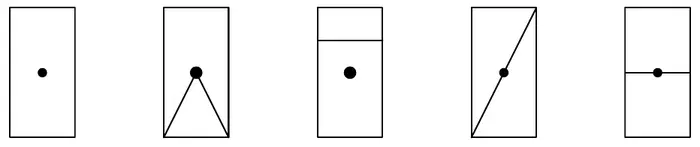
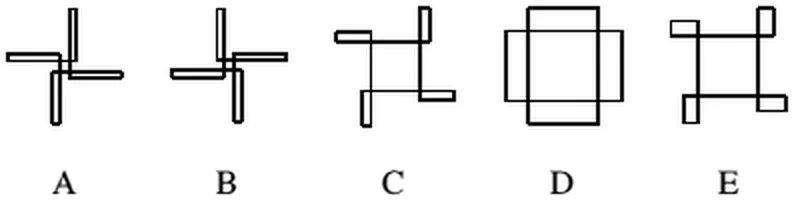
The only rotational symmetry of the rectangle is rotation through 180° and so has order two. The diagrams below show the effect of this rotation on each of the five figures.
Only the first, fourth and fifth of these figures remain unchanged and so just three figures have rotational symmetry of order two.
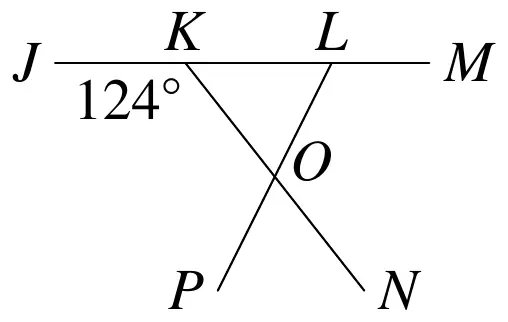
Let the size, in degrees, of \(\angle OLM\) be \(2x\). Then, in degrees, the size of \(\angle PON\) is \(x\). Therefore, since vertically opposite angles are equal, \(\angle KOL=x^\circ\). The sum of the angles on a straight line is 180°, so \(\angle LKO=180^\circ-124^\circ=56^\circ\). An exterior angle of a triangle is equal to the sum of the two opposite, interior angles. Therefore, in triangle \(KOL\),\(2x=x+56\). So \(x=56\). Hence \(\angle OLM\) is \(2\times 56^\circ=112^\circ\).
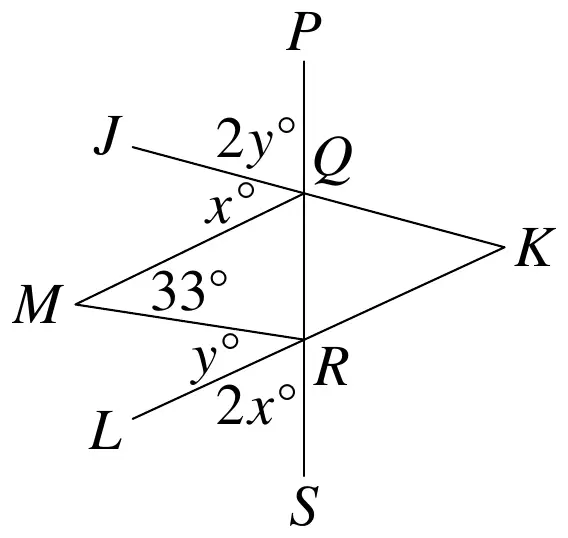
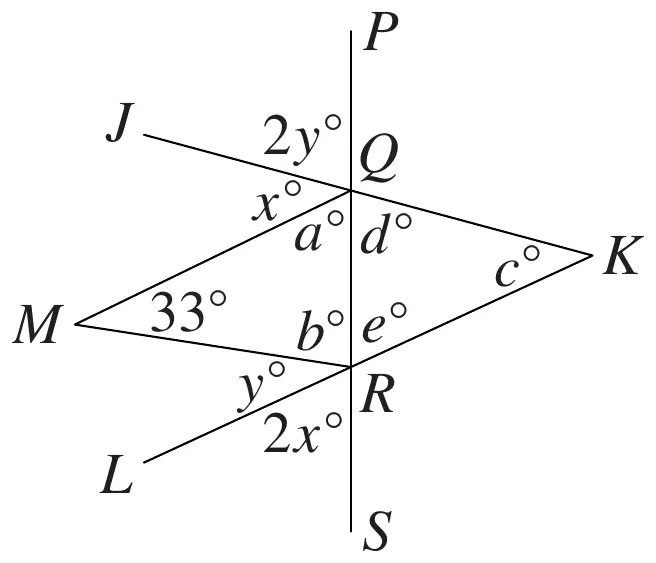
Let \(a^\circ, b^\circ, c^\circ, d^\circ\) and \(e^\circ\) be the sizes of the angles shown in the diagram. Since angles on a straight line add to 180°, the points \(Q\) and \(R\) on line \(PS\) give the equations \(x+2y+a=180\) and \(y+2x+b=180\). Adding these two equations gives \(3x+3y+a+b=360\). The sum of the interior angles of a triangle is 180°. Hence, in triangle \(QMR\),\(a+b+33=180\). Subtracting this equation from the previous one gives \(3x+3y-33=180\) and hence \(x+y=71\). Since vertically opposite angles are equal, we have \(d=2y\) and \(e=2x\). Also, from triangle \(QRK\) we see that \(d+e+c=180\). Therefore \(2x+2y+c=180\) and hence \(142+c=180\). So the size of angle \(JKL\) is 38°.
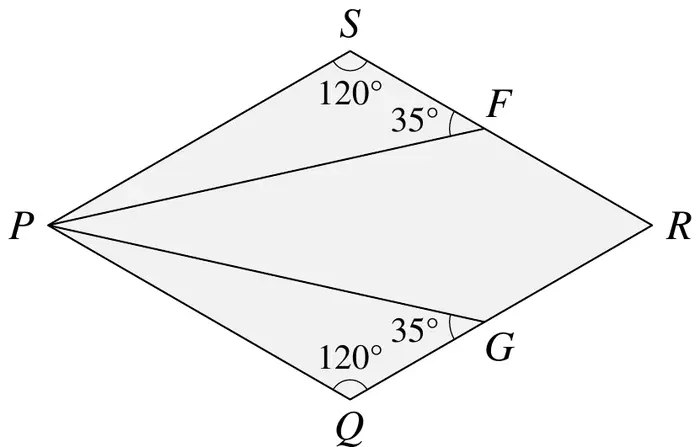
As \(PQRS\) is a rhombus, \(PQ\) is parallel to \(SR\), so \(\angle QPS + \angle RSP = 180°\). Therefore \(\angle QPS = 180° - 120° = 60°\). The sum of the interior angles of a triangle is equal to 180°, so \(\angle SPF = 180° - 120° - 35° = 25°\). Similarly, \(\angle QPG = 25°\), so \(\angle FPG = 60° - 2 \times 25° = 10°\).
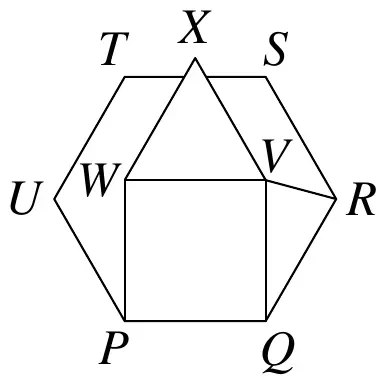
The exterior angle of a regular hexagon is 360° ÷ 6 = 60° and hence its interior angle is 180° − 60° = 120°. Therefore, \(\angle VQR = 120° - 90° = 30°\). The side \(PQ\) is common to both the square and the regular hexagon, so the side-lengths of these regular polygons are equal. So triangle \(QVR\) is an isosceles triangle with \(QV = QR\) and therefore \(\angle RVQ = \angle VRQ = \tfrac{1}{2} \times (180° - 30°) = 75°\). The angles at a point sum to 360°. So, considering the angles around point \(V\),\(\angle XVR + \angle RVQ + \angle QVW + \angle WVX = 360°\). Therefore \(\angle XVR = 360° - 75° - 90° - 60° = 135°\).
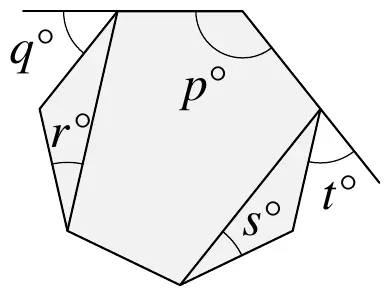
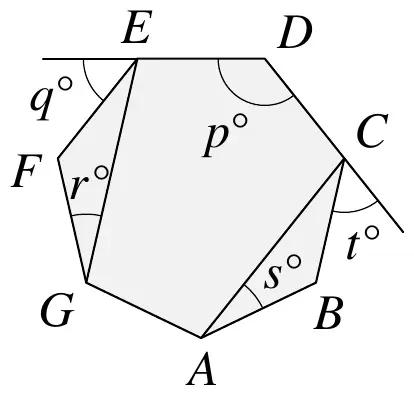
Consider triangles \(GFE\) and \(ABC\). Both triangles have two sides which are sides of the regular heptagon, so \(GF = FE = AB = BC\). Also, angles \(GFE\) and \(ABC\) are equal as both are interior angles of the regular heptagon. So the two triangles are isosceles and congruent (SAS). Therefore \(\angle FEG = \angle BCA\) as the two triangles are congruent and \(\angle BCA = \angle BAC\) as triangle \(ABC\) is isosceles. So \(\angle FEG = s°\). Also, \(\angle GFE = \angle EDC = p°\) as both angles are interior angles of the regular heptagon. Hence in triangle \(GFE\), as the sum of the interior angles of a triangle is 180°, \(p + r + s = 180\). Finally, exterior angles of a regular heptagon are equal and therefore \(q = t\). So \(p + q + r + s + t = 180 + q + t = 180 + 2q\). Since \(q°\) is the size of the exterior angle of the regular heptagon, \(q = \tfrac{360}{7}\). So it is clear that none of the other options equals \(180 + 2q\). (Note that this result does not apply only to a regular heptagon. The above calculation would be the same for every regular polygon with at least five sides.)
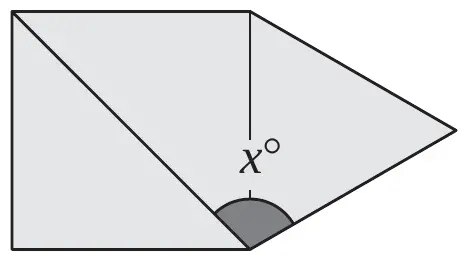
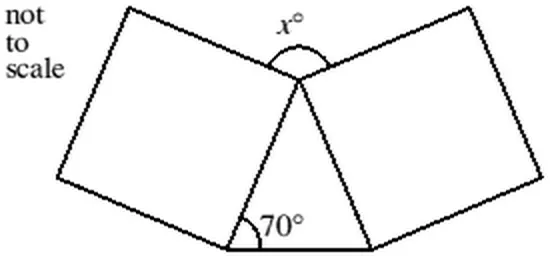
The diagonal of the square is the bisector of a right angle and the interior angle of an equilateral triangle is 60°. Therefore \(x = 90 \div 2 + 60 = 45 + 60 = 105\).
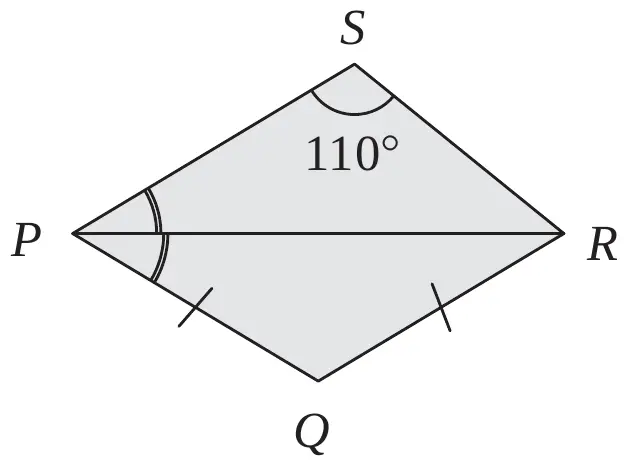
12. The diagram shows a quadrilateral \(PQRS\) in which \(PQ\) and \(QR\) have the same length. Also \(PR\) bisects \(\angle SPQ\), the ratio of \(\angle SPR\) to \(\angle PRS\) is 2 : 3 and \(\angle PSR = 110°\). How large is angle \(PQR\)?
The sum of the interior angles of a triangle equals 180°. So, as \(\angle PSR = 110°\),\(\angle SPR + \angle PRS = 70°\). Therefore \(\angle SPR = \tfrac{2}{5} \times 70° = 28°\). Now \(PR\) bisects \(\angle SPQ\), so \(\angle QPR = \angle SPR = 28°\). In triangle \(PQR\), we know that \(PQ = QR\) so \(\angle QRP = \angle QPR = 28°\). Therefore \(\angle PQR = 180° - 2 \times 28° = 124°\).
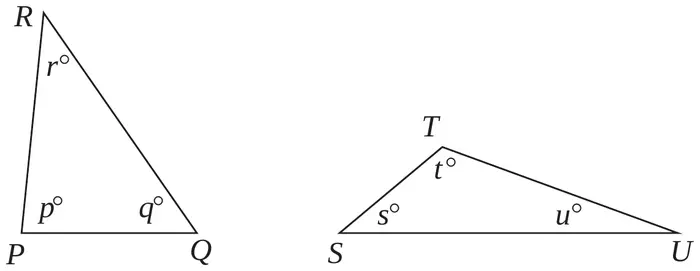
22. In the triangles \(PQR\) and \(STU\),\(\angle RPQ = 2 \times \angle UST\), \(\angle PRQ = 2 \times \angle SUT\) and \(\angle RQP = \dfrac{1}{5} \times \angle UTS\). How large is \(\angle UTS\)?
In the diagram, the sizes in degrees of the angles in triangles \(PQR\) and \(SUT\) are denoted by \(p°, q°, r°, s°, t°, u°\). Therefore \(p = 2s\);\(r = 2u\);\(q = \tfrac{1}{5}t\). Also, as the sum of the interior angles in a triangle is 180°, \(p + q + r = 180\)… (1) and \(s + u + t = 180\)… (2). Substituting for \(p\),\(q\), \(r\) in (1) gives \(2s + \tfrac{1}{5}t + 2u = 180\)… (3). Equation (2) × 2 gives \(2s + 2t + 2u = 360\)… (4). Subtracting (3) from (4) gives, \(2t - \tfrac{1}{5}t = 180\). So \(\dfrac{9t}{5} = 180\), that is \(t = 100\).
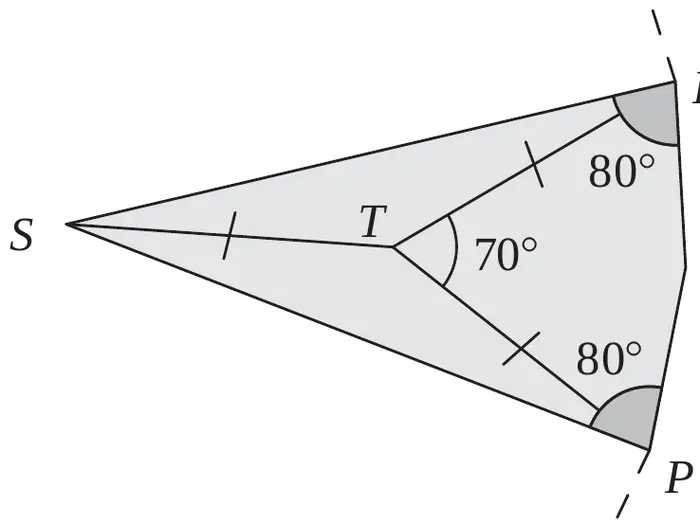
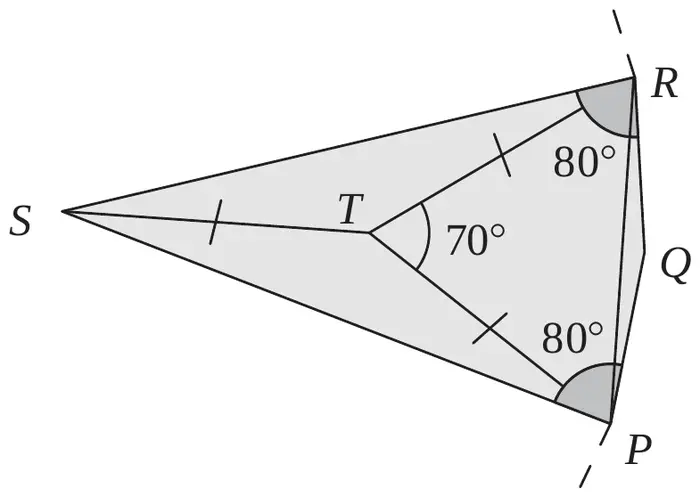
25. In the diagram \(PQ\) and \(QR\) are sides of a regular \(n\)-sided polygon, \(\angle SPQ = \angle SRQ = 80°\), \(\angle PTR = 70°\) and \(PT = ST = RT\). What is the value of \(n\)?
As \(PQ\) and \(QR\) are both sides of a regular polygon, they are equal in length. So \(\angle PRQ = \angle RPQ\) and hence in triangle \(PRS\),\(\angle PRS = \angle RPS\). Therefore triangle \(PRS\) is isosceles with \(RS = PS\). Hence triangles \(RST\) and \(PST\) are congruent (SSS). So \(\angle PTS = \angle RTS = \tfrac{1}{2} \times (360° - 70°) = 145°\). Therefore \(\angle TRS = \angle RST = \tfrac{1}{2} \times (180° - 145°) = 17\tfrac{1}{2}°\). So \(\angle RSP = 35°\). The sum of the angles in the quadrilateral \(SPQR\) is 360° and so \(\angle PQR = 360° - 80° - 80° - 35° = 165°\). Therefore the exterior angle of the regular polygon is \(180° - 165° = 15°\). So \(n = \dfrac{360}{15} = 24\).
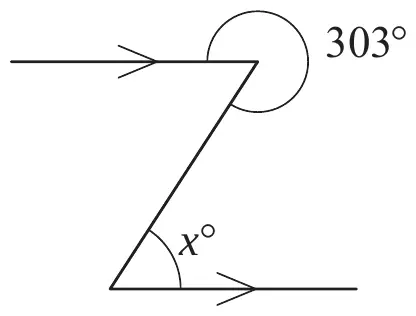
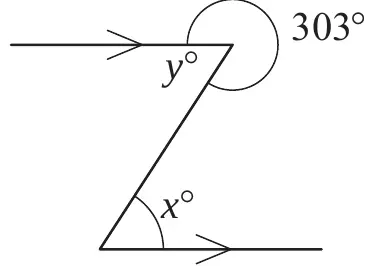
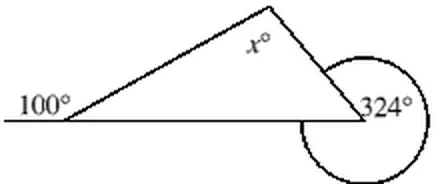
The angles which meet at a point sum to 360°, so \(y = 360 - 303 = 57\). As the marked lines are parallel, the angles marked \(x°\) and \(y°\) are equal (alternate angles). So \(x = y = 57\).
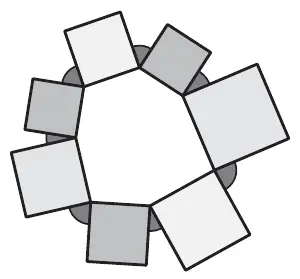
11. Seven squares are drawn on the sides of a heptagon so that they are outside the heptagon, as shown in the diagram. What is the sum of the seven marked angles?
In the diagram, each of the seven vertices of the heptagon has four angles meeting at it. This makes 28 angles in total. These comprise the seven marked angles, fourteen right angles and the seven interior angles of the heptagon. The sum of the angles meeting at a point is 360° and the sum of the interior angles of the heptagon is (7 − 2) × 180° = 5 × 180°. Therefore, (the sum of the seven marked angles) + 14 × 90° + 5 × 180° = 7 × 360°. So the sum of the seven marked angles is (28 − 14 − 10) × 90° = 4 × 90° = 360°.
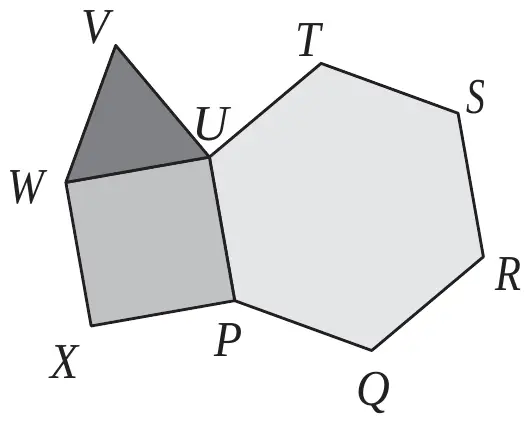
Note that the interior angles of an equilateral triangle, a square and and a regular hexagon are 60°, 90° and 120° respectively. The angles at a point sum to 360°, so \(\angle TUV = 360° - (60° + 90° + 120°) = 90°\) As \(WU\) is common to both equilateral triangle \(UVW\) and square \(PUWX\), the lengths of the sides of \(UVW\) and \(PUWX\) are equal. Similarly, \(UP\) is common to both square \(PUWX\) and regular hexagon \(PQRSTU\), so the lengths of the sides of \(PUWX\) and \(PQRSTU\) are also equal. So \(UV = UP = UT\) and hence triangle \(UTV\) is a right-angled isosceles triangle with \(\angle TVU = \angle VTU\). Therefore \(\angle TVU = (180° - 90°) \div 2 = 45°\).
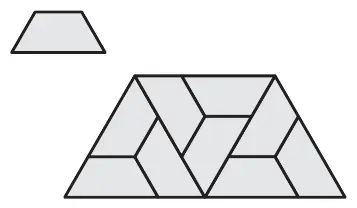
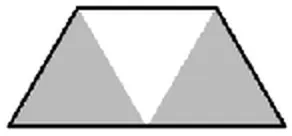
21. The small trapezium on the right has three equal sides and angles of 60° and 120°. Nine copies of this trapezium can be placed together to make a larger version of it, as shown. The larger trapezium has perimeter 18 cm. What is the perimeter of the smaller trapezium?
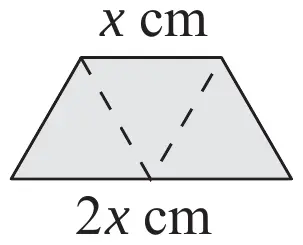
The diagram shows that the small trapezium may be divided into three congruent equilateral triangles. Let the length of each side of the triangles be \(x\) cm. Then the base of the small trapezium is \(2x\) cm. The perimeter of the larger trapezium is made up of five equal line segments each of length \((2x + x)\) cm. So \(15x = 18\). The perimeter of the smaller trapezium is \((x + x + x + 2x)\) cm = \(5x\) cm = \(5 \times \tfrac{18}{15}\) cm = 6 cm. {It is left as an exercise for the reader to prove that the small trapezium may be divided into three congruent equilateral triangles.}
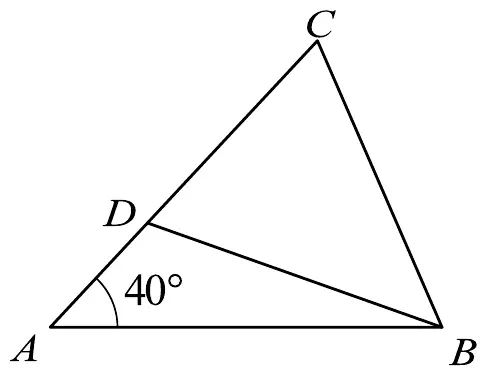
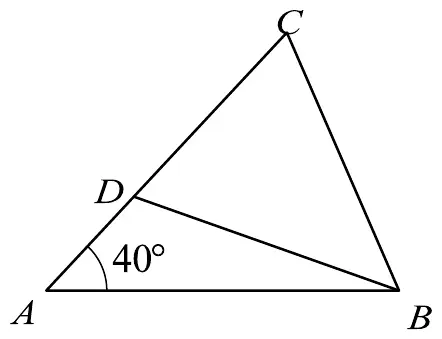
As \(AB = AC\), triangle \(ABC\) is isosceles. So \(\angle ABC = \angle ACB = \tfrac{1}{2}(180° - 40°) = 70°\) as \(\angle BAC = 40°\) and the angle sum of a triangle is 180°. Triangle \(BCD\) is also isosceles as \(BD = BC\), so \(\angle BDC = \angle BCD = 70°\). Considering triangle \(ABD\): \(\angle BDC = \angle DAB + \angle ABD\) as an exterior angle of a triangle is equal to the sum of the two interior opposite angles. So \(\angle ABD = \angle BDC - \angle DAB = 70° - 40° = 30°\).
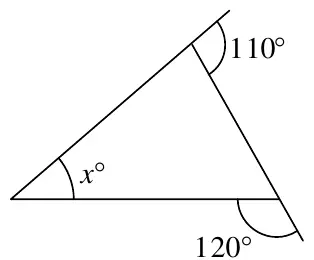
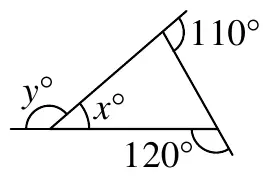
The sum of the exterior angles of any polygon is 360°. So \(y = 360 - (110 + 120) = 360 - 230 = 130\). The sum of the angles on a straight line is 180°, so \(x = 180 - y = 180 - 130 = 50\).
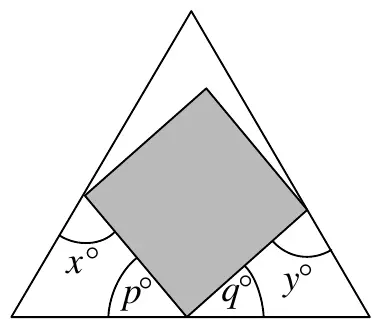
The size of each interior angle of an equilateral triangle is 60°. As the sum of the interior angles of a triangle is 180°, \(x + p + 60 = 180\), so \(p = 120 - x\). Similarly, \(q = 120 - y\). Each interior angle of a square is a right angle and the sum of the angles on a straight line is 180°, so \(p + q + 90 = 180\). Therefore \(120 - x + 120 - y + 90 = 180\), that is \(330 - (x + y) = 180\). So \(x + y = 330 - 180 = 150\).
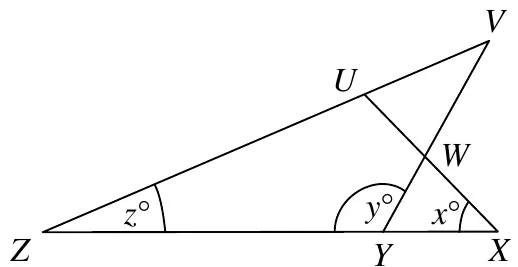
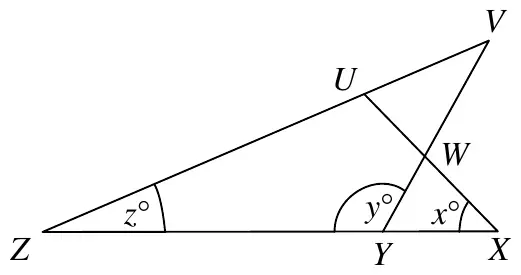
25. The four straight lines in the diagram are such that \(VU = VW\). The sizes of \(\angle UXZ\), \(\angle VYZ\) and \(\angle VZX\) are \(x°\), \(y°\) and \(z°\). Which of the following equations gives \(x\) in terms of \(y\) and \(z\)?
The exterior angle of a triangle is equal to the sum of its two interior and opposite angles. Applying this theorem to triangle \(UZX\): \(\angle VUW = z° + x°\). Similarly, in triangle \(WYX\):\(y° = \angle XWY + x°\), so \(\angle XWY = y° - x°\). As \(VU = VW\), \(\angle VUW = \angle VWU\) and also \(\angle VWU = \angle XWY\) because they are vertically opposite angles. Therefore \(\angle VUW = \angle XWY\). So \(z° + x° = y° - x°\) and hence \(x = \tfrac{1}{2}(y - z)\).
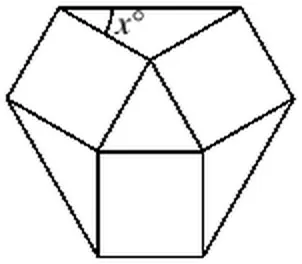
The angles at a point sum to 360°, so the largest angle in the triangle which includes the angle marked \(x\)° is equal to (360 − 90 − 90 − 60)° = 120°. This triangle is isosceles as the sides of the three squares in the figure are equal to the sides of the equilateral triangle. So the triangle has angles 120°, \(x\)° and \(x\)°. Therefore \(x = \tfrac{1}{2}(180 - 120) = 30\).
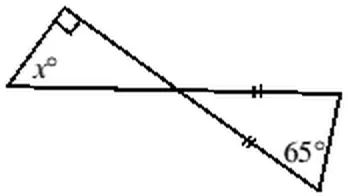
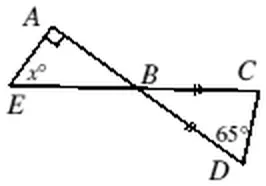
Triangle BCD is isosceles, so \(\angle BCD = \angle BDC = 65^\circ\). The sum of the interior angles of a triangle is 180° so \(\angle CBD = (180 - 2 \times 65)^\circ = 50^\circ\). Therefore \(\angle ABE = 50^\circ\) (vertically opposite angles). So \(\angle AEB = (180 - 90 - 50)^\circ = 40^\circ\).
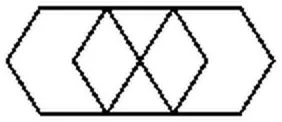
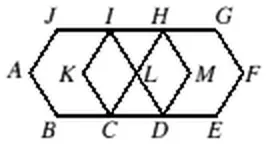
Figure ABEFGJ itself is a hexagon. There are three hexagons congruent to ABCLIJ; two hexagons congruent to ABDMHJ; four hexagons congruent to ABCKIJ; two hexagons congruent to ABDLHJ. So in total there are twelve hexagons.
14. Each side of an isosceles triangle is a whole number of centimetres. Its perimeter has length 20 cm. How many possibilities are there for the lengths of its sides?
Let the two equal sides of the isosceles triangle have length \(a\) and the other side have length \(b\). Then \(2a + b = 20\). Since the sum of the lengths of any two sides of a triangle is greater than the length of the third, \(2a > b\). Hence \(4a > 2a + b\). So \(4a > 20\), i.e. \(a > 5\). Also \(a < 10\) since \(2a + b = 20\). So the possibilities are \(a = 6, b = 8\);\(a = 7, b = 6\);\(a = 8, b = 4\); and \(a = 9, b = 2\).
4. Beatrix looks at the word JUNIOR in a mirror. How many of the reflected letters never look the same as the original, no matter how Beatrix holds the mirror?
None of the letters J, N, R has an axis of symmetry, so these letters cannot look the same when reflected in a mirror, no matter how the mirror is held. However, the letters U, I, O all have at least one axis of symmetry, so each may look the same when reflected in a mirror.
The first two views of the cube show that I, M, U, O are not opposite K. So P is opposite K. Similarly, the second and third views show that I is opposite O. So the remaining two faces, M and U, must be opposite each other.
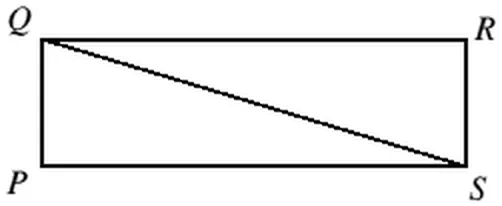
As \(\angle QPS = 90^\circ\),\(\angle PSQ + \angle PQS = 90^\circ\). So, since the ratio of these angles is 1:5, \(\angle PSQ = 15^\circ\) and \(\angle PQS = 75^\circ\). Now \(\angle QSR = \angle PQS\) (alternate angles). So \(\angle QSR = 75^\circ\).
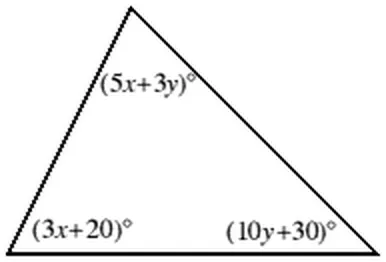
25. The interior angles of a triangle are \((5x + 3y)^\circ\), \((3x + 20)^\circ\) and \((10y + 30)^\circ\) where \(x\), \(y\) are positive integers. What is the value of \(x + y\)?
The sum of the interior angles of a triangle is 180°. Therefore \(5x + 3y + 3x + 20 + 10y + 30 = 180\), i.e. \(8x + 13y = 130\). As \(x\) and \(y\) are both positive integers, it may be deduced that \(x\) is a multiple of 13. Also, since \(y \geqslant 1, x \leqslant \dfrac{117}{8}\) so the only possible value of \(x\) is 13. If \(x = 13\) then \(y = 2\), so \(x + y = 15\).
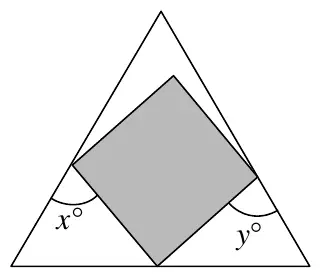
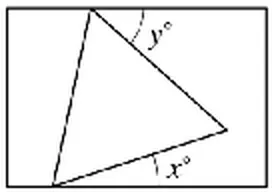
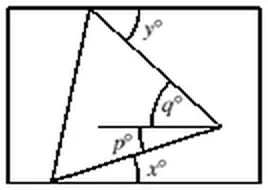
A line segment which is parallel to two sides of the rectangle has been added to the diagram, as shown. The angle marked \(p\)° is equal to the angle marked \(x\)° as these are alternate angles between parallel lines. So \(x = p\). Similarly \(y = q\). The angles marked \(p\)° and \(q\)° together form one interior angle of an equilateral triangle. Therefore \(x + y = p + q = 60\).
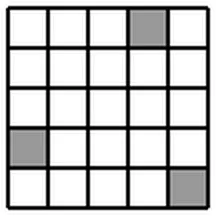
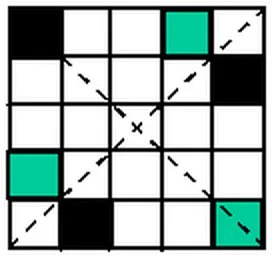
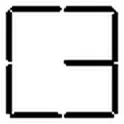
15. What is the smallest number of additional squares which must be shaded so that this figure has at least one line of symmetry and rotational symmetry of order 2 ?
In order that the figure has rotational symmetry of order 2, the three squares which appear in black must be shaded. When this has been done, we note that the broken lines shown are both lines of symmetry. So the minimum number of squares which must be shaded is 3.
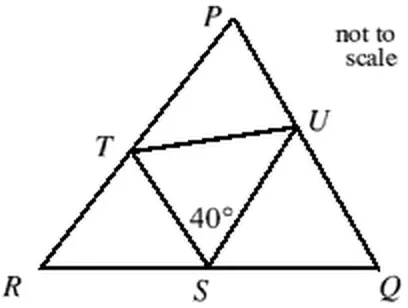
23. The points \(S\),\(T\), \(U\) lie on the sides of the triangle PQR, as shown, so that \(QS = QU\) and \(RS = RT\). \(\angle TSU = 40^\circ\). What is the size of \(\angle TPU\)?
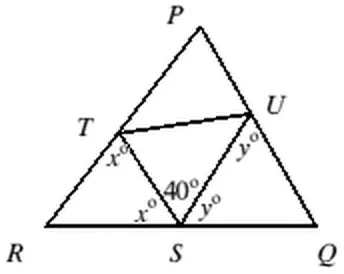
Let \(\angle RTS = x^\circ\). Then \(\angle RST = x^\circ\) as \(RS = RT\). Let \(\angle QUS = y^\circ\). Then \(\angle QSU = y^\circ\) as \(QS = QU\). As RSQ is a straight line, \(x + y + 40 = 180\); so \(x + y = 140\).
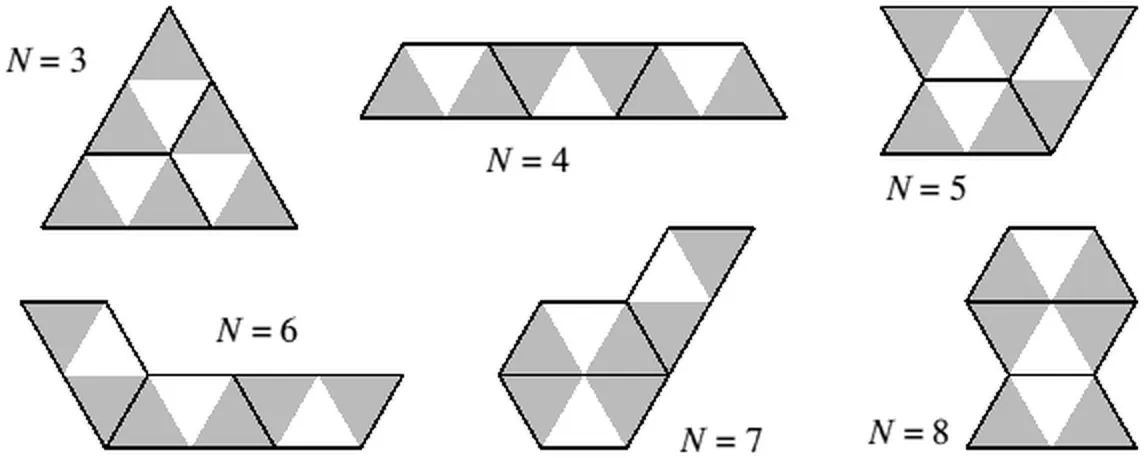
25. The diagram shows a trapezium made from three equilateral triangles. Three copies of the trapezium are placed together, without gaps or overlaps and so that only complete edges coincide, to form a polygon with \(N\) sides. How many different values of \(N\) are possible?
The three trapezia have 12 edges in total. Whenever two trapezia are joined together the total number of edges is reduced by at least 2. Therefore the maximum possible value of \(N\) is 12 − 2 × 2 = 8. As the shapes form a polygon, \(N\) cannot be less than 3. The diagrams below show that all values of \(N\) from 3 to 8 are indeed possible, so there are 6 different values of \(N\).
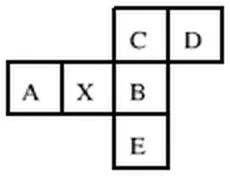
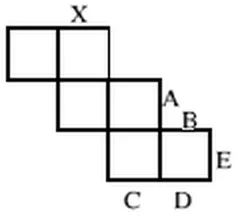
Let X be on the top face of the cube. If the base is placed on a horizontal surface, then A, B, C, E will all be on vertical faces of the cube and D will be on the base, opposite X.
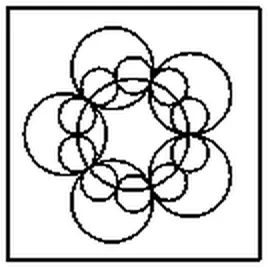
5. The diagram shows a pattern of 16 circles inside a square. The central circle passes through the points where the other circles touch. The circles divide the square into regions. How many regions are there?
Each of the five outer circles is divided into six regions, giving 30 regions in total. In addition, there is one region in the centre of the diagram and one region between the circles and the sides of the square. So, in all, there are 32 regions.
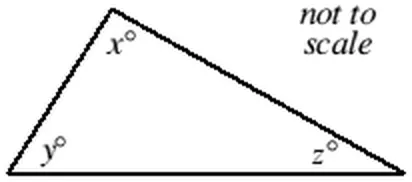
If the mean of \(y\) and \(z\) is \(x\), then \(y + z = 2x\). So the sum of the interior angles of the triangle is \((x + y + z)^\circ = 3x^\circ\). So \(3x = 180\), that is \(x = 60\).
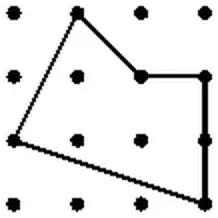
23. A single polygon is made by joining dots in the 4 × 4 grid with straight lines, which meet only at dots at their end points. No dot is at more than one corner. The diagram shows a five-sided polygon formed in this way. What is the greatest possible number of sides of a polygon formed by joining the dots using these same rules?
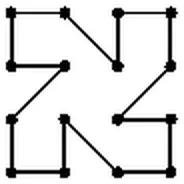
The number of sides of the polygon is equal to the number of corners it has. As no dot is at more than one corner, the maximum number of corners is 16. So the maximum possible number of sides is 16, provided that a 16-sided figure may be drawn. The figure on the right shows one of several ways in which this can be achieved.
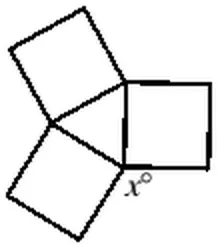
The triangle in the centre of the diagram is equilateral since each of its sides is equal in length to the side of one of the squares. The sum of the angles at a point is 360°, so \(x = 360 - (90 + 90 + 60) = 120\).
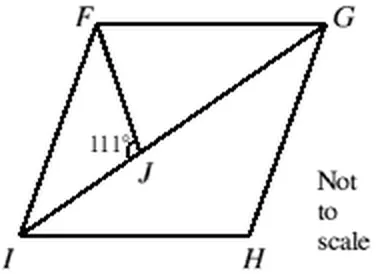
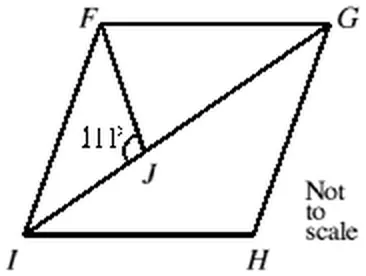
19. The diagram on the right shows a rhombus FGHI and an isosceles triangle FGJ in which \(GF = GJ\). Angle FJI = 111°. What is the size of angle JFI ?
21. A rectangular sheet of paper is divided into two pieces by a single straight cut. One of the pieces is then further divided into two, also by a single straight cut. Which of the following could not be the total number of edges of the resulting three pieces?
The diagrams below show how the total number of edges of the resulting three pieces may be 9, 10, 11 or 12. However, 12 is the maximum value of the total number of edges since the original number of edges is four and any subsequent cut adds a maximum of four edges (by dividing two existing edges and adding the new ‘cuts’).
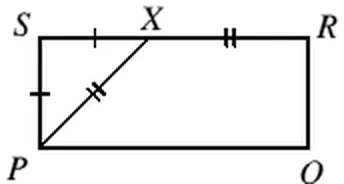
13. A rectangle \(PQRS\) is cut into two pieces along \(PX\), where \(PX = XR\) and \(PS = SX\) as shown. The two pieces are reassembled without turning either piece over, by matching two edges of equal length. Not counting the original rectangle, how many different shapes are possible?
New shapes may be formed by joining \(PX\) to \(XR\) (quadrilateral) or \(SP\) to \(RQ\) (parallelogram) or \(XS\) to \(RQ\) (trapezium). Triangle \(SPX\) shows that \(PX\) and \(SX\) have different lengths; and \(PX\) and \(PQ\) have different lengths because \(XR\) is shorter than \(SR\). So there are no other places to position the triangle.
Of the five alternatives, only A and B have straight lines in the ratio 2:15:20. However, B would be formed by repeatedly moving forward 2 units, turning right, moving forward 20 units, turning right, moving forward 15 units, turning right.
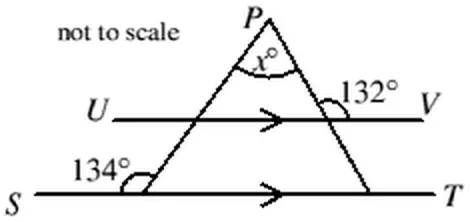
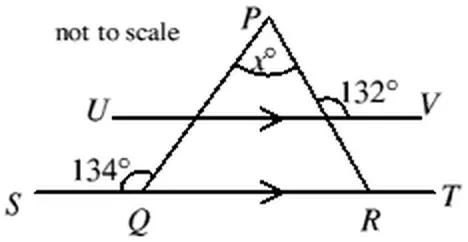
As \(ST\) is parallel to \(UV\), \(\angle PRT = 132^\circ\) (corresponding angles). So \(\angle PRQ = 48^\circ\) (angles on a straight line). From the exterior angle of a triangle theorem, \(\angle SQP = \angle QPR + \angle PRQ\), so \(x = 134 - 48 = 86\).
13. Points \(P\) and \(Q\) have coordinates (1, 4) and (1, −2) respectively. For which of the following possible coordinates of point \(R\) would triangle \(PQR\) not be isosceles?
If \(R\) is (−5, 4) then \(PQ = PR = 6\). If \(R\) is (7, 1) or if \(R\) is (−6, 1) then \(R\) lies on the perpendicular bisector of \(PQ\) (the line \(y = 1\)), so in both cases \(PR = QR\). If \(R\) is (7, −2), then \(QP = QR = 6\). However if \(R\) is (−6, −2), then \(PQ = 6\), \(QR = 7\) and \(PR > 7\), so triangle \(PQR\) is scalene.
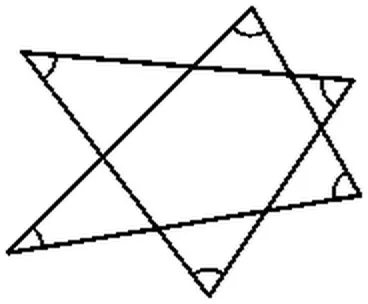
The six marked angles, together with the six interior angles of the two triangles, comprise all of the angles around five separate points. So the required sum is (5 × 360 − 2 × 180)° = 1440°.
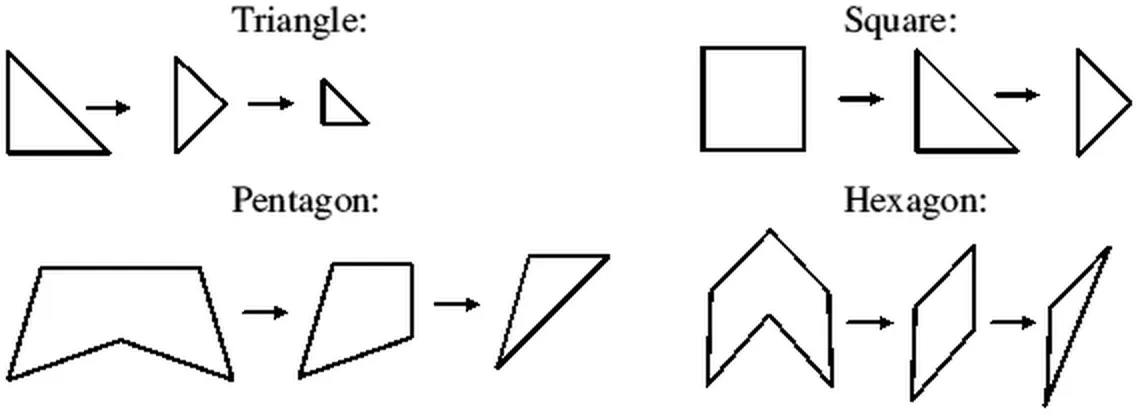
25. A piece of paper in the shape of a polygon is folded in half along a line of symmetry. The resulting shape is also folded in half, again along a line of symmetry. The final shape is a triangle. How many possibilities are there for the number of sides of the original polygon?
Imagine unfolding the final triangle once. Then one edge of the final triangle is inside the new shape obtained; and the other two triangle edges have ‘mirror image’ copies. So the new shape has at most 4 edges. After unfolding once more, one of these edges is now on the inside; and the remaining edges get mirror images again. So the shape obtained (the original shape) has no more than 6 edges. The diagrams below show that 3, 4, 5 and 6 sides are all possible.
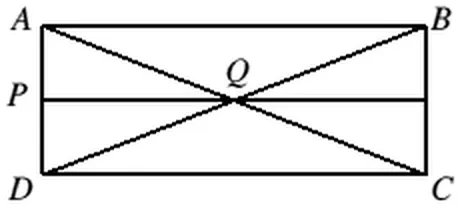
There are 4 triangles congruent to \(\Delta AQP\) (including \(\Delta AQP\) itself), 2 triangles congruent to \(\Delta AQB\), 2 triangles congruent to \(\Delta AQD\), 4 triangles congruent to \(\Delta ACD\).
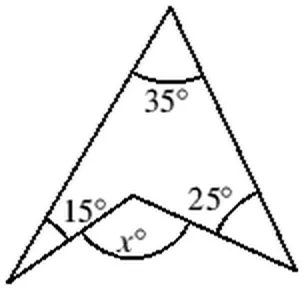
Let the size of the reflex angle in the quadrilateral be \(y\)°. Then \(x + y = 360\) (angles at a point). Furthermore, \(35 + 15 + 25 + y = 360\) (sum of interior angles of a quadrilateral). So \(x = 35 + 15 + 25\).
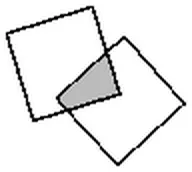
If the overlapping region is a triangle, two of its sides must be adjacent sides of one of the squares. So one of its angles will be a right angle and therefore an equilateral triangle could not appear as the overlapping region. The diagrams show how the other options could appear as the overlapping region.
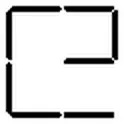
2. The diagram shows a pattern made from matchsticks stuck to a piece of card. What is the smallest number of matchsticks that need to be added so that the resulting pattern has a line of symmetry?
The original figure does not have a line of symmetry, so at least one match must be added. The figure shown, which is created by adding one extra match, does have a line of symmetry, so the smallest number of matches that need to be added is one.
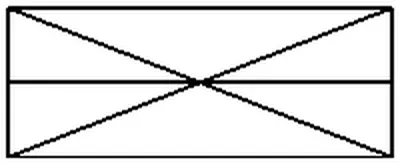
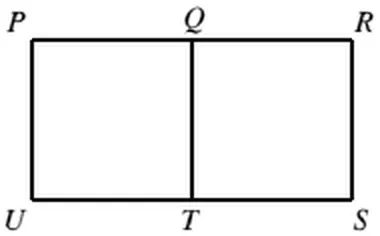
17. The figure shows rectangle \(PRSU\) and line \(QT\), which divides the rectangle into two squares. How many right-angled triangles can be drawn using any three of the points \(P\),\(Q\),\(R\),\(S\),\(T\), \(U\) as corners?
There are two right-angled triangles which have their right angle at \(P\): triangles \(UPQ\) and \(UPR\). Similarly, there are two right-angled triangles in each case which have their right angle at \(R\), \(S\) and \(U\). There are three right-angled triangles which have their right angle at \(Q\): triangles \(PQT\), \(RQT\) and \(UQS\). Similarly, there are three right-angled triangles which have their right angle at \(T\), making 14 in all.
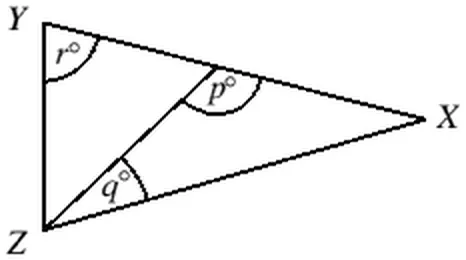
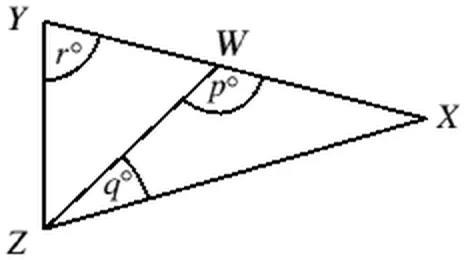
As \(XY = XZ\),\(\angle XZY = \angle XYZ\), so \(\angle YZW = r^\circ - q^\circ\). In a triangle, an exterior angle is equal to the sum of the two interior opposite angles. Applying this theorem to triangle \(ZYW\): \(\angle ZWX = \angle YZW + \angle ZYW\), that is \(p = (r - q) + r\). So \(2r = p + q\).
11. The diagram shows a rod with five equally spaced points \(A\),\(B\),\(C\), \(D\) and \(E\) marked on it.
The rod is rotated three times through 180 degrees, first about \(A\), then about \(B\) and finally about \(E\). Which point finishes in the same position as it was at the start?
The diagram shows the positions of the points after the rotations. Note that \(A_1\), which is not marked, is the same point as \(A\). Similarly, \(E_3\), which is not marked, is the same point as \(E_2\).
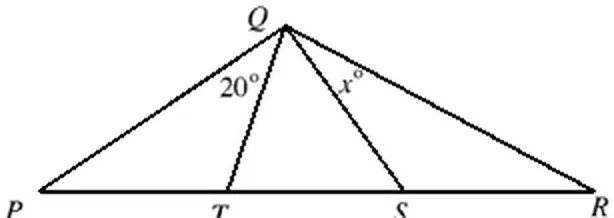
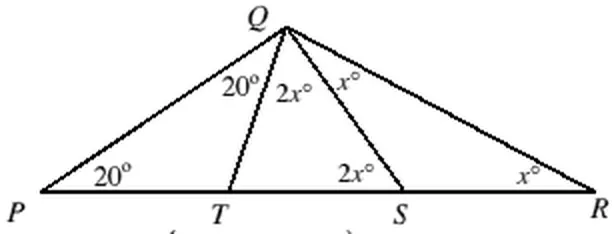
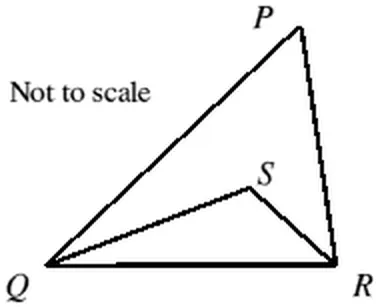
13. In the triangle \(PQR\), the angle \(QPR\) = 40° and the internal bisectors of the angles at \(Q\) and \(R\) meet at \(S\), as shown. What is the size of angle \(QSR\)?
16. A robot, which is initially facing North, is programmed to travel 5 m then turn through 10°, travel 5 m then turn through 20°, travel 5 m then turn through 30°, and so on. Each move consists of moving 5 m in a straight line and then turning clockwise through an angle which increases by 10° at each move. How far has it travelled by the time it is first facing due East at the end of a move?
The total angle turned through after each of the first 4 moves is 10°, 30°, 60° and 100°. So the robot does not face due East at the end of a move in its first complete revolution. The total angle it has turned through after each of the next 5 moves is 150°, 210°, 280°, 360° and 450°, so at the end of the 9th move the robot does face due East. As the robot moves 5 m in each move, the distance it travels is 45 m. Note that this solution assumes that the robot is not starting the process close to the North Pole!
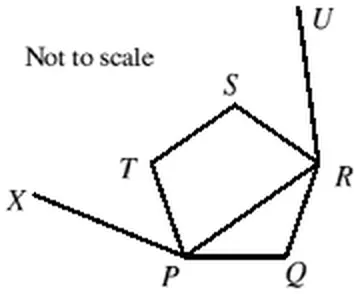
20. The figure shows a regular pentagon \(PQRST\) together with three sides \(XP\),\(PR\), \(RU\) of a regular hexagon with vertices \(PRUVWX\). What is the size of angle \(SRU\)?
As \(PQRST\) is a regular pentagon, each of its internal angles is 108°. The internal angles of the quadrilateral \(PRST\) add up to 360° and so by symmetry \(\angle PRS = \angle RPT = \tfrac{1}{2}(360^\circ - 2 \times 108^\circ) = 72^\circ\). Each interior angle of a regular hexagon is 120°, so \(\angle PRU = 120^\circ\). Therefore \(\angle SRU = \angle PRU - \angle PRS = 120^\circ - 72^\circ = 48^\circ\).
We'd like to use Google Analytics cookies to count visits and see which pages help most. They're optional, and the site works exactly the same either way. Privacy policy