
JMC 2019 Q21
21. The diagram shows a regular hexagon \(PQRSTU\), a square \(PQVW\) and an equilateral triangle \(VXW\).
What is the size of angle \(XVR\)?
- A 120°
- B 125°
- C 130°
- D 135°
- E 140°
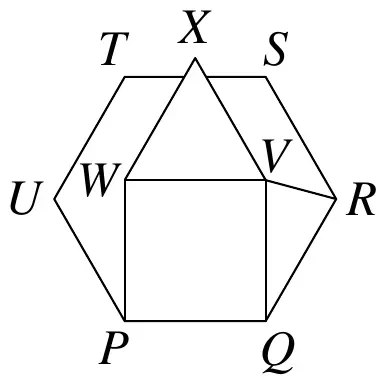
Junior Mathematical Challenge 2019, Question 21. © UK Mathematics Trust. Original paper on ukmt.org.uk
Answer: D 135°
The exterior angle of a regular hexagon is 360° ÷ 6 = 60° and hence its interior angle is 180° − 60° = 120°.
Therefore, \(\angle VQR = 120° - 90° = 30°\). The side \(PQ\) is common to both the square and the regular hexagon, so the side-lengths of these regular polygons are equal. So triangle \(QVR\) is an isosceles triangle with \(QV = QR\) and therefore \(\angle RVQ = \angle VRQ = \tfrac{1}{2} \times (180° - 30°) = 75°\).
The angles at a point sum to 360°. So, considering the angles around point \(V\), \(\angle XVR + \angle RVQ + \angle QVW + \angle WVX = 360°\).
Therefore \(\angle XVR = 360° - 75° - 90° - 60° = 135°\).
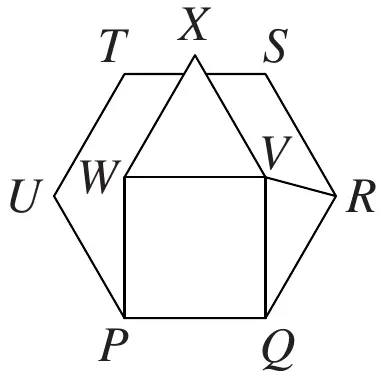
Solution © UK Mathematics Trust, from the JMC 2019 solutions. Longer versions with investigations: Solutions and investigations (PDF).