The whole Junior Mathematical Challenge 2020 paper, one question at a time in order (25 questions). Press Mark as done after each one: your marks add up below.
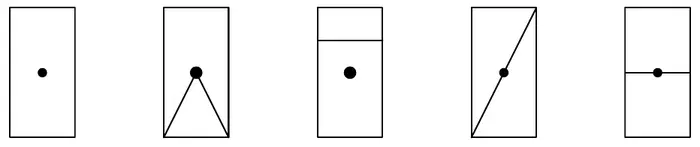
The only rotational symmetry of the rectangle is rotation through 180° and so has order two. The diagrams below show the effect of this rotation on each of the five figures.
Only the first, fourth and fifth of these figures remain unchanged and so just three figures have rotational symmetry of order two.
5. Amrita thinks of a number. She doubles it, adds 9, divides her answer by 3 and finally subtracts 1. She obtains the same number she originally thought of. What was Amrita’s number?
The value of \(\dfrac{6}{12}-\dfrac{5}{12}+\dfrac{4}{12}-\dfrac{3}{12}+\dfrac{2}{12}-\dfrac{1}{12}=\dfrac{1}{12}+\dfrac{1}{12}+\dfrac{1}{12}=\dfrac{3}{12}=\dfrac{1}{4}\).
Note that 110 = 10 × 11 = 2 × 5 × 11, which is the prime factorisation of 110. Therefore the four different positive integers whose product is 110 are 1, 2, 5 and 11. Their sum is 19.
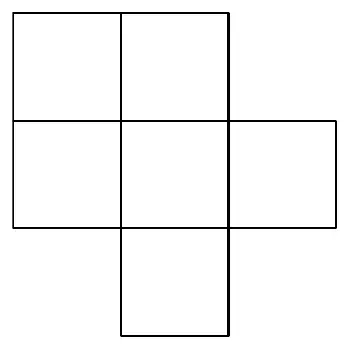
8. Wesley has a grid of six cells. He wants to colour two of the cells black so that the two black cells share a vertex but not a side. In how many ways can he achieve this?
The diagram shows the original diagram with the cells labelled 1, 2, 3, 4, 5, 6. The pairs of cells which Wesley can colour are 1 and 4; 2 and 3; 2 and 5; 3 and 6; 5 and 6. Therefore the diagram can be coloured in five ways.
Let the required number be \(n\). Then, \(\tfrac{1}{2}\times\tfrac{1}{3}\times\tfrac{1}{4}\times\tfrac{1}{5}\times n=2\). Therefore \(\tfrac{1}{120}\times n=2\). Hence \(n=120\times 2=240\).
The solutions of the four equations are, from left to right, \(x=12\);\(x=48\);\(x=8\);\(x=13\). Therefore exactly one of the equations has solution \(x=12\).
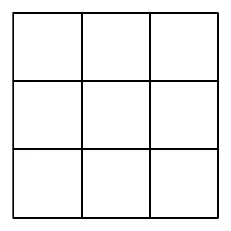
In a 20 by 20 grid there are 21 horizontal wires each of length 20 cm and 21 vertical wires each of length 20 cm. Therefore the total length of wire required for a 20 by 20 grid is 42 × 20 cm = 840 cm.
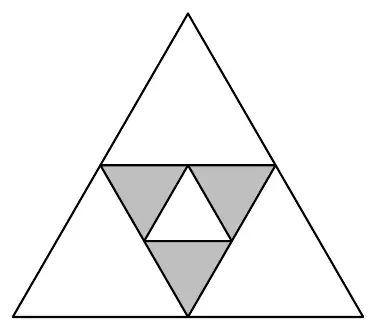
12. The diagram shows an equilateral triangle divided into four smaller equilateral triangles. One of these triangles has itself been divided into four smaller equilateral triangles. What fraction of the area of the large triangle has been shaded?
The large equilateral triangle has been divided into four congruent equilateral triangles. Therefore each of these triangles has an area equal to one quarter of the area of the large triangle. Similarly, the equilateral triangle which is partly shaded has been divided into four congruent equilateral triangles, three of which are shaded. Therefore the fraction of the area of the large triangle which has been shaded is \(\tfrac{3}{4}\times\tfrac{1}{4}=\tfrac{3}{16}\).
The mean of four positive integers is 5. Therefore the sum of the four integers is 4 × 5 = 20. The median of the integers is the mean of the two middle integers. Since this median is 6, the sum of the two middle integers is 2 × 6 = 12. Hence the sum of the smallest and largest of the four integers is 20 − 12 = 8. Therefore the mean of the largest and smallest of the integers is 8 ÷ 2 = 4.
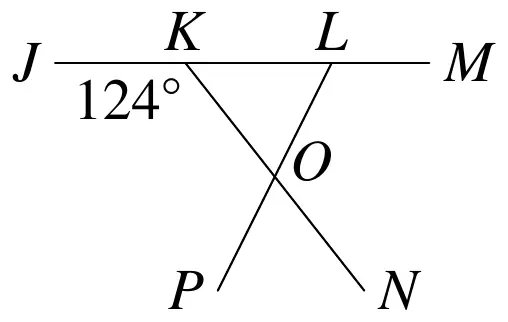
Let the size, in degrees, of \(\angle OLM\) be \(2x\). Then, in degrees, the size of \(\angle PON\) is \(x\). Therefore, since vertically opposite angles are equal, \(\angle KOL=x^\circ\). The sum of the angles on a straight line is 180°, so \(\angle LKO=180^\circ-124^\circ=56^\circ\). An exterior angle of a triangle is equal to the sum of the two opposite, interior angles. Therefore, in triangle \(KOL\),\(2x=x+56\). So \(x=56\). Hence \(\angle OLM\) is \(2\times 56^\circ=112^\circ\).
15. A group of 42 children all play tennis or football, or both sports. The same number play tennis as play just football. Twice as many play both tennis and football as play just tennis. How many of the children play football?
Let the number of children who play only football be \(f\), the number of children who play only tennis be \(t\) and the number of children who play both sports be \(b\). Since there are 42 children, \(f+t+b=42\). Also, since the number of children who play tennis is equal to the number of children who play only football, \(t+b=f\). Therefore \(f+f=42\). So \(f=21\) and \(t+b=21\). Finally, twice as many play both tennis and football as play just tennis. Therefore \(b=2t\). Substituting for \(b\), gives \(t+2t=21\). Hence \(t=7\). Therefore the number of children who play football is \(42-t=42-7=35\).
16. You are given the sequence of digits "0625", and can insert a decimal point at the beginning, at the end, or at any of the other three positions. Which of these numbers can you not make?
Note that \(\tfrac{6}{25}=\tfrac{24}{100}=0.24\). Therefore \(\tfrac{6}{25}\) cannot be made from the sequence "0625". Of the other four options, \(\tfrac{5}{8}=0.625\);\(\tfrac{1}{16}=.0625\);\(\tfrac{25}{4}=06.25\);\(25^2=0625\). Hence \(\tfrac{6}{25}\) is the only option which cannot be made from the given sequence.
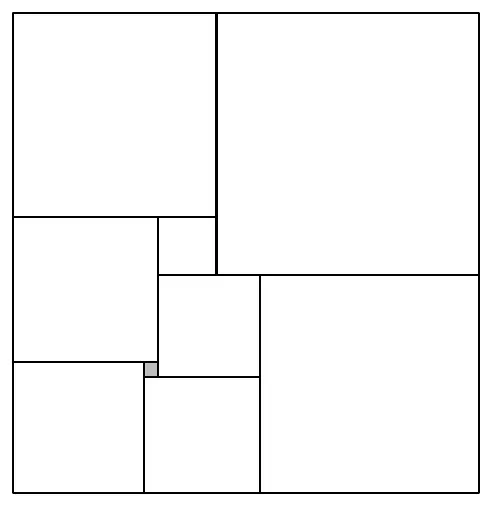
17. In 1925, Zbigniew Morón published a rectangle that could be dissected into nine different sized squares as shown in the diagram. The lengths of the sides of these squares are 1, 4, 7, 8, 9, 10, 14, 15 and 18. What is the area of Morón’s rectangle?
Label the individual squares, except for the smallest, \(P, Q, R, S, T, U, V\) and \(W\) as shown. The side-length of the smallest square is 1. Since the next smallest squares are \(W\) and \(V\), they have side-lengths 4 and 7 respectively. Therefore \(Q\) has side-length 7 + 1 = 8, \(P\) has side-length 8 + 1 = 9 and \(U\) has side-length 9 + 1 = 10. Hence \(T\) has side-length 10 + 4 = 14 and \(R\) has side-length 7 + 8 = 15. Therefore the rectangle has side-lengths 9 + 8 + 15 = 32 and 9 + 10 + 14 = 33. Therefore the area of the rectangle is 32 × 33 = 1056.
(Alternatively: the three largest squares R, S and T have side-length 15, 18 and 14 respectively. So the rectangle has sides of length 18 + 15 and 18 + 14 and so measures 33 by 32.)
The digits which are non-prime are 0, 1, 4, 6, 8, 9. However, the units digit of a prime cannot be 0, 4, 6 or 8. Therefore any two-digit primes which have both their digits non-prime have a units digit of 1 or 9. The only such primes are 11, 19, 41, 61 and 89. Hence there five such primes.
19. In the table shown, the sum of each row is shown to the right of the row and the sum of each column is shown below the column. What is the value of \(L\)?
Adding the top row and the middle column gives, \(2J+K+2K+J=5+7=12\). Hence \(3J+3K=12\). So \(J+K=4\). The first column shows that \(J+K+L=11\). Hence, \(J+K+L-(J+K)=11-4=7\). Therefore \(L=7\). (It is then possible to deduce that \(J=1\) and \(K=3\) and check that each total is correct.)
20. Edmund makes a cube using eight small cubes. Samuel uses cubes of the same size as the small cubes to make a cuboid twice as long, three times as wide and four times as high as Edmund’s cube. How many more cubes does Samuel use than Edmund?
Edmund makes a cube using eight small cubes. Therefore his cube measures 2 × 2 × 2. Since Samuel makes a cuboid twice as long, three times as wide and four times as high as Edmund’s cube, Samuel’s cube measures 4 × 6 × 8. Therefore Samuel uses 192 small cubes in making his cube. Hence Samuel uses 192 − 8 = 184 more small cubes than Edmund.
21. The digits of both the two-digit numbers in the first calculation below have been reversed to give the two-digit numbers in the second calculation. The answers to the two calculations are the same.
62 × 13 = 806 26 × 31 = 806
For which one of the calculations below is the same thing true?
It is possible to eliminate certain options by comparing the units digit of the original product with the units digit of the new product. The units digit of 25 × 36 is 0, but the units digit of 52 × 63 is 6. So A is not the correct option. The corresponding units digits for the other options are B: 8 and 2; C: 4 and 5; D: 6 and 6; E: 6 and 2. These calculations suggest that the correct option is D. In confirmation, note that 42 × 48 = 2 × 21 × 2 × 24 = 24 × 2 × 2 × 21 = 24 × 84.
22. Harriet has a square piece of paper. She folds it in half to form a rectangle and then in half again to form a second rectangle (which is not a square). The perimeter of the second rectangle is 30 cm. What is the area of the original square?
Let the side-length of Harriet’s square be \(4x\) cm. Then, the rectangle obtained when the square is folded in half measures \(4x\) cm by \(2x\) cm. When that rectangle is folded in half, it gives a rectangle which is not a square so this rectangle measures \(4x\) cm by \(x\) cm. The perimeter of the smaller rectangle is \(2(4x+x)\) cm = \(10x\) cm. Therefore, since the perimeter of the smaller rectangle is given as 30 cm, we have \(x=3\). Hence the side-length of Harriet’s square is 12 cm and its area is 144 cm2.
23. There is more than one integer, greater than 1, which leaves a remainder of 1 when divided by each of the four smallest primes. What is the difference between the two smallest such integers?
The four smallest primes are 2, 3, 5, 7. Since these are all prime, their lowest common multiple is 2 × 3 × 5 × 7 = 210. Therefore the smallest positive integer which leaves remainder 1 when divided by each of the four smallest primes is 210 + 1 = 211. The next positive such integer is 2 × 210 + 1 = 421. Therefore the required difference is 421 − 211 = 210.
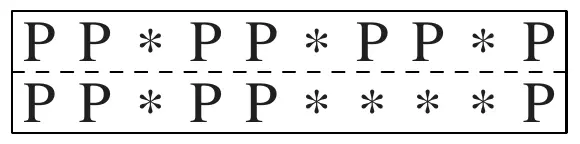
24. Susan is attending a talk at her son’s school. There are 8 rows of 10 chairs where 54 parents are sitting. Susan notices that every parent is either sitting on their own or next to just one other person. What is the largest possible number of adjacent empty chairs in a single row at that talk?
For the number of adjacent empty chairs in a single row to be a maximum, all rows apart from that one must hold as many parents as possible.
In view of Susan’s observation, the maximum number of parents sitting in any row is seven, as the upper diagram shows. Therefore, the maximum number of parents in seven of the eight rows is 7 × 7 = 49. The number in the remaining row is then 54 − 49 = 5. In that case, and again in view of Susan’s observation, the maximum number of adjacent empty chairs would be four as shown in the lower diagram.
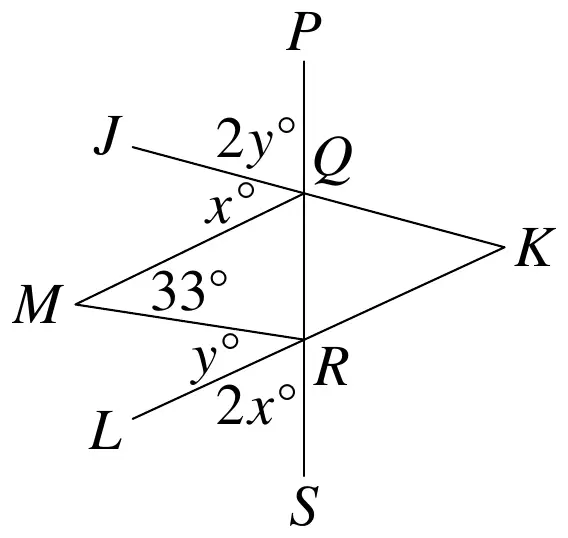
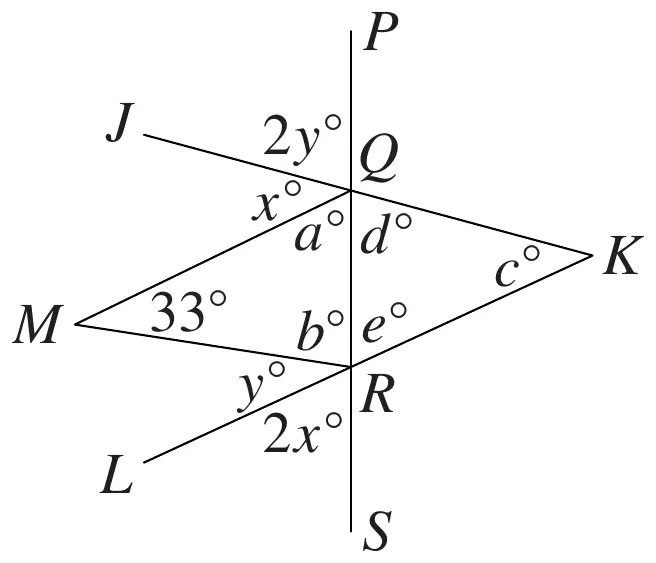
Let \(a^\circ, b^\circ, c^\circ, d^\circ\) and \(e^\circ\) be the sizes of the angles shown in the diagram. Since angles on a straight line add to 180°, the points \(Q\) and \(R\) on line \(PS\) give the equations \(x+2y+a=180\) and \(y+2x+b=180\). Adding these two equations gives \(3x+3y+a+b=360\). The sum of the interior angles of a triangle is 180°. Hence, in triangle \(QMR\),\(a+b+33=180\). Subtracting this equation from the previous one gives \(3x+3y-33=180\) and hence \(x+y=71\). Since vertically opposite angles are equal, we have \(d=2y\) and \(e=2x\). Also, from triangle \(QRK\) we see that \(d+e+c=180\). Therefore \(2x+2y+c=180\) and hence \(142+c=180\). So the size of angle \(JKL\) is 38°.
We'd like to use Google Analytics cookies to count visits and see which pages help most. They're optional, and the site works exactly the same either way. Privacy policy