The whole Junior Mathematical Challenge 2019 paper, one question at a time in order (25 questions). Press Mark as done after each one: your marks add up below.
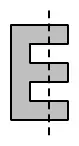
The greatest number of pieces into which figures A to D inclusive can be cut by a single straight cut are 3, 2, 3 and 2 respectively. The diagram shows how figure E may be cut into four different pieces by a single cut.
On Aoife’s 16th birthday, Buster was three times her age, that is 48. It is then five years until Aoife’s 21st birthday, so Buster’s age at that time was 48 + 5 = 53.
7. The shortest street in the UK, Ebenezer Place in Wick, is 2.06 m long. The Trans-Canada Highway, one of the world’s longest roads, is approximately 7821 km in length.
Approximately, how many times longer than the street is the highway?
The length of the Trans-Canada Highway is 7821 km = 7 821 000 m, which is approximately 8 000 000 m. So its length is roughly 4 000 000 times greater than 2.06 m-long Ebenezer Place.
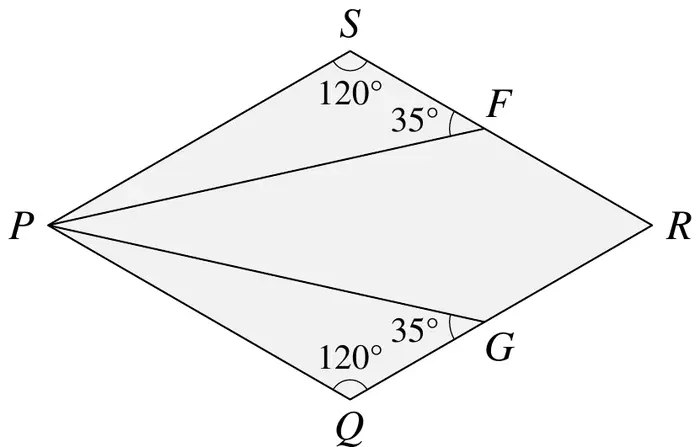
As \(PQRS\) is a rhombus, \(PQ\) is parallel to \(SR\), so \(\angle QPS + \angle RSP = 180°\). Therefore \(\angle QPS = 180° - 120° = 60°\). The sum of the interior angles of a triangle is equal to 180°, so \(\angle SPF = 180° - 120° - 35° = 25°\). Similarly, \(\angle QPG = 25°\), so \(\angle FPG = 60° - 2 \times 25° = 10°\).
It is a general rule that \(x\)% of \(y\) equals \(y\)% of \(x\). This is because \(x\)% of \(y = \dfrac{x}{100} \times y = \dfrac{xy}{100}\) and \(y\)% of \(x = \dfrac{y}{100} \times x = \dfrac{yx}{100}\).
So 50% of 18.3 plus 18.3% of 50 = 50% of 18.3 plus 50% of 18.3 = 100% of 18.3 = 18.3.
For the number to be as small as possible, we need the number of digits to be as small as possible. For instance, 111…1 (2019 1s) has a digit sum of 2019, but it is a much larger number than 333…3 (673 3s), which also has a digit sum of 2019. Clearly, to reduce the number of digits in the number, we need to make as many as possible of the digits in the number equal to 9. Now 2019 ÷ 9 = 224 remainder 3, so the smallest positive integer with digit sum of 2019 is 399…9 (224 9s). Its last digit is 9.
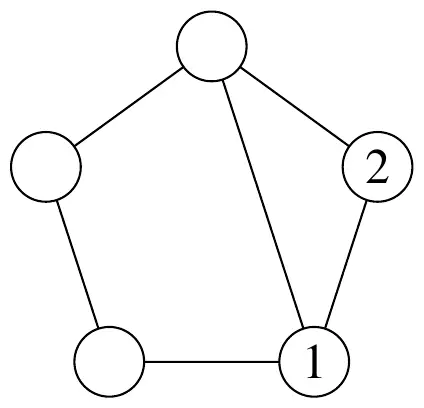
11. Two players \(X\) and \(Y\) take alternate turns in a game, starting with the diagram alongside.
At each turn, one player writes one of 1, 2 or 3 in an empty circle, so that no two circles connected by an edge contain the same number. A player loses when they cannot go. In each of the five diagrams below it is \(Y\)’s turn.
In which of the diagrams can \(Y\)’s move ensure that \(X\) loses the game?
Note that in each of the figures, there will be exactly one empty circle available after \(Y\) takes the next turn. So for \(Y\) to ensure that there is a definite loss for \(X\), then the latter must be left in a situation where the only available circle is already connected to each of 1, 2 and 3. It is left to the reader to show that \(Y\) cannot ensure a loss for \(X\) in figures A, B, C and E. However, if \(Y\) places 3 in the available circle on the left of figure D, then \(X\) is left with the top circle which is now connected to 1, 2 and 3. Hence \(X\) loses.
12. Jamal writes down a sequence of six integers. The rule he uses is, “after the first three terms, each term is the sum of the three previous terms.” His sequence is —, —, —, 8, 13, 25.
Let the first six terms of Jamal’s sequence be \(p\),\(q\),\(r\), 8, 13 and 25 respectively. Then \(r + 8 + 13 = 25\), so \(r = 4\). Hence \(q + 4 + 8 = 13\), so \(q = 1\). Therefore, \(p + 1 + 4 = 8\), so \(p = 3\). (Note that the problem may be solved without being given that the sixth term of the sequence is 25. In this case,\(q + r + 8 = 13\),so\(q + r = 5\).Also, \(p + q + r = 8\) and therefore\(p = 8 - 5 = 3\).)
13. In how many different ways can you spell out JMC, starting at the centre, and moving to the next letter in a neighbouring square – horizontally, vertically, or diagonally – each time?
Note first that from the central J, one may move to any one of eight squares containing the letter M. Also, from each of the four corner M squares, it is possible to move to exactly five squares containing the letter C and from each of the four M squares not at a corner, it is possible to move to exactly three squares containing the letter C.
So the number of different ways that JMC can be spelled out is 4 × 5 + 4 × 3 = 20 + 12 = 32.
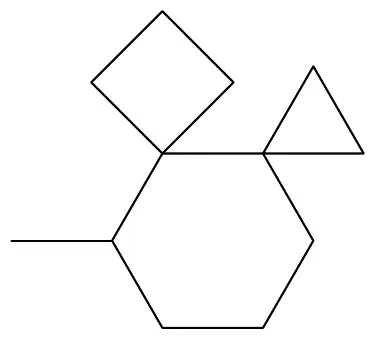
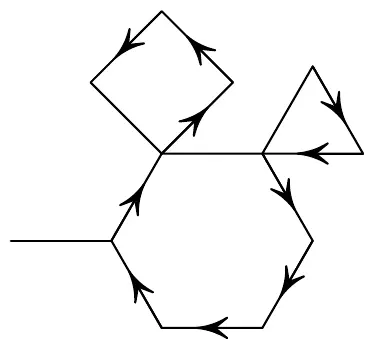
Any path can use at most 5 sides of the hexagon, 3 sides of the square, 2 sides of the triangle and just the 1 side of the protruding line. In order to use 3 sides of the square, the path would need to start or end in the square. Likewise, to use 2 sides of the triangle, it would need to start or end in the triangle. And to use the 1 protruding line, it would need to start or end at the outer point. Since the path can only start once and finish once, no path can be longer than (5 + 3 + 2) cm = 10 cm; and the diagram shows that there is a path of that length.
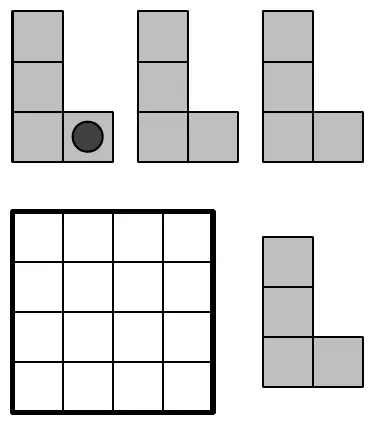
15. All four L-shapes shown in the diagram are to be placed in the 4 by 4 grid so that all sixteen cells are covered and there is no overlap. Each piece can be rotated or reflected before being placed and the black dot is visible from both sides.
How many of the 16 cells of the grid could contain the black dot?
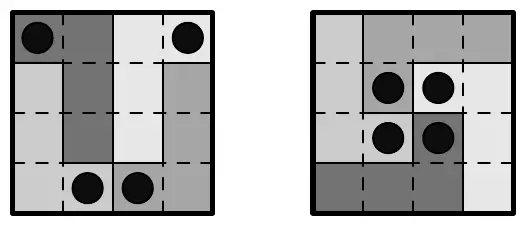
The first figure shows a possible configuration of the four L shapes fitting into the square and illustrates four cells which could contain the black dot. When this figure is rotated in one direction through 90°, 180° and 270°, it is clear that all twelve cells on the outside of the square could contain the black dot. Finally, the second figure shows that each of the four cells in the centre of the square could also contain the black dot. So each of the 16 cells in the diagram could contain the black dot.
16. Tamsin writes down three two-digit integers. One is square, one is prime and one is triangular. She uses the digits 3, 4, 5, 6, 7 and 8 exactly once each.
First note that Tamsin can write down two squares, namely 36 and 64. Also, she can write down three triangular numbers, namely 36, 45 and 78. If she chooses 36 and 45 for the square and triangular number respectively, then the remaining digits are 7 and 8, but neither 78 nor 87 is prime. Similarly, if she chooses 36 and 78 then the remaining digits are 4 and 5, but neither 45 nor 54 is prime. So the square chosen cannot be 36 and is therefore 64. Evidently, 64 cannot be paired with 36 nor with 45, but if it is paired with 78 then the remaining digits are 3 and 5. Although 35 is not prime, 53 is prime and hence is the prime which Tamsin writes.
17. A rectangle is three times as long as it is high. The area of a square is twelve times the area of the rectangle. What is the ratio of the perimeter of the square to the perimeter of the rectangle?
Let the height of the rectangle be \(x\). Then its length is \(3x\) and its area is \(3x^2\). So the area of the square is \(12 \times 3x^2 = 36x^2\) and hence its side-length is \(\sqrt{36x^2} = 6x\). So the perimeter of the rectangle is \(2(x + 3x) = 8x\) and the perimeter of the square is \(4 \times 6x = 24x\). Therefore the required ratio is \(24x : 8x = 3 : 1\).
As \(1 = 1^3\) and \(8000 = 20^3\), there are 20 cubes from 1 to 8000. So the fraction of the integers from 1 to 8000 inclusive which are cubes is \(\dfrac{20}{8000} = \dfrac{1}{400}\).
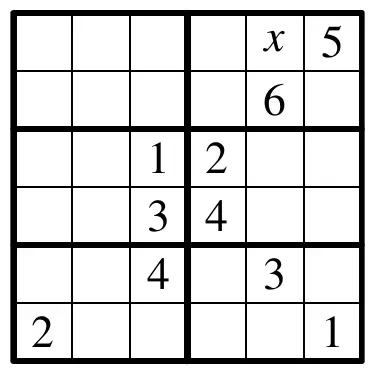
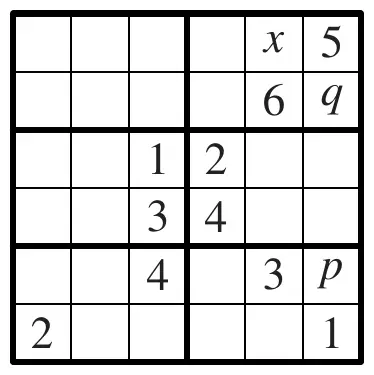
19. Each row, each column and each of the bold 2 by 3 rectangles in the grid has to contain each of the numbers 1, 2, 3, 4, 5 and 6 (one number in each cell).
From the rules in the question, there must be a 2 somewhere in the fifth column. The 2 cannot be placed in the middle right-hand rectangle, since this rectangle already contains a 2; it cannot be placed in the bottom row, since this row already contains a 2. Hence the 2 in the fifth column must go in the cell marked \(x\).
It is left to the reader to check that this “mini-sudoku” can be completed as required (although not in a unique fashion).
20. Emily writes down the largest two-digit prime such that each of its digits is prime. Krish writes down the smallest two-digit prime such that each of its digits is prime. Kirsten subtracts Krish’s number from Emily’s number. What answer does Kirsten obtain?
The prime digits are 2, 3, 5 and 7. So the largest two-digit integer whose digits are both prime is 77. However, 77 is not prime, nor is 75, but 73 is prime. So Emily writes down 73. The smallest two-digit integer whose digits are both prime is 22. However, 22 is not prime, but 23 is prime. So Krish writes down 23. Therefore the answer which Kirsten obtains is 73 − 23 = 50.
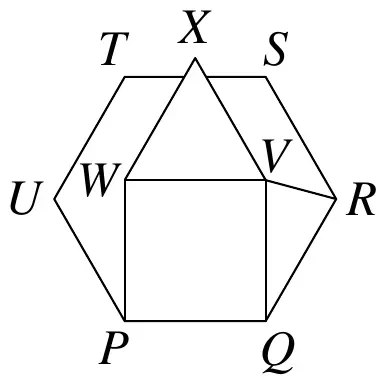
The exterior angle of a regular hexagon is 360° ÷ 6 = 60° and hence its interior angle is 180° − 60° = 120°. Therefore, \(\angle VQR = 120° - 90° = 30°\). The side \(PQ\) is common to both the square and the regular hexagon, so the side-lengths of these regular polygons are equal. So triangle \(QVR\) is an isosceles triangle with \(QV = QR\) and therefore \(\angle RVQ = \angle VRQ = \tfrac{1}{2} \times (180° - 30°) = 75°\). The angles at a point sum to 360°. So, considering the angles around point \(V\),\(\angle XVR + \angle RVQ + \angle QVW + \angle WVX = 360°\). Therefore \(\angle XVR = 360° - 75° - 90° - 60° = 135°\).
Because the product has exactly four digits, it is clear that \(T = 1\) and \(P = 9\). So we have \((1000 + 100R + 10A + 9) \times 9 = 1000 \times 9 + 100A + 10R + 1\). Therefore \(9000 + 900R + 90A + 81 = 9000 + 100A + 10R + 1\). Hence \(890R + 80 = 10A\), which simplifies to \(89R + 8 = A\). Because \(A < 10\), the only solutions to this equation are \(R = 0\) and \(A = 8\). As a check, we see that 1089 × 9 is indeed 9801.
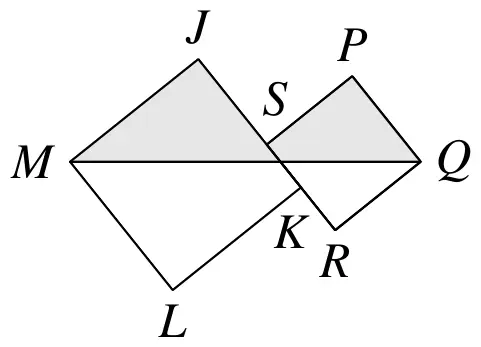
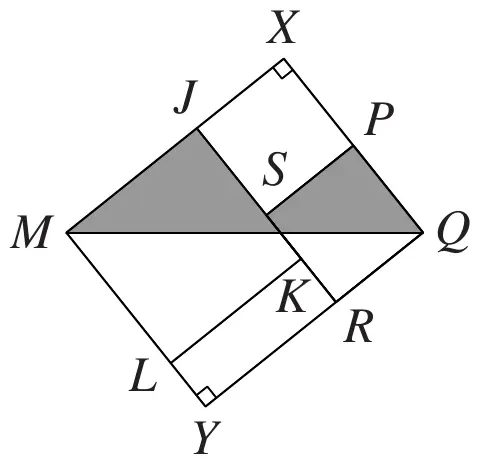
23. The diagram shows two squares \(JKLM\) and \(PQRS\). The length of \(JK\) is 6 cm and that of \(PQ\) is 4 cm. The vertex \(K\) is the midpoint of side \(RS\). What is the area of the shaded region?
The diagram shows \(MJ\) produced and \(QP\) produced meeting at \(X\). Since \(MJ\) and \(QP\) are perpendicular to each other, \(\angle MXQ\) is a right angle. Similarly, \(ML\) produced and \(QR\) produced meet at \(Y\) and \(\angle QYM\) is a right angle. So \(MYQX\) is a rectangle. The length of the rectangle is \(MJ + JX = MJ + SP = (6 + 4)\) cm = 10 cm. As the vertex \(K\) is the midpoint of side \(RS\), then \(KR = (4 \div 2)\) cm = 2 cm. So the width of the rectangle is \(ML + LY = ML + KR = (6 + 2)\) cm = 8 cm. Also, \(JS = JK - SK = (6 - 2)\) cm = 4 cm. So \(SPXJ\) is a square of side 4 cm.
Hence the area of the shaded region is the area of triangle \(MXQ\) minus the area of square \(SPXJ\); that is, \((\tfrac{1}{2} \times 8 \times 10 - 4 \times 4)\) cm2 = 24 cm2.
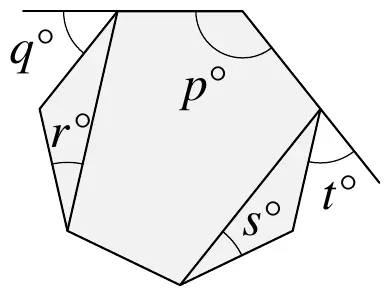
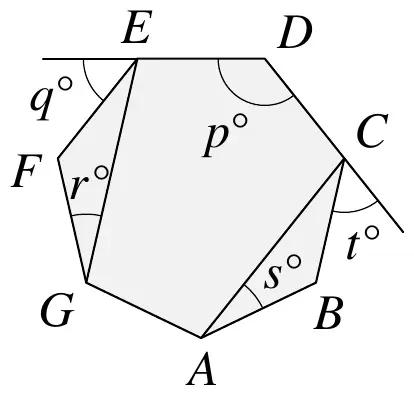
Consider triangles \(GFE\) and \(ABC\). Both triangles have two sides which are sides of the regular heptagon, so \(GF = FE = AB = BC\). Also, angles \(GFE\) and \(ABC\) are equal as both are interior angles of the regular heptagon. So the two triangles are isosceles and congruent (SAS). Therefore \(\angle FEG = \angle BCA\) as the two triangles are congruent and \(\angle BCA = \angle BAC\) as triangle \(ABC\) is isosceles. So \(\angle FEG = s°\). Also, \(\angle GFE = \angle EDC = p°\) as both angles are interior angles of the regular heptagon. Hence in triangle \(GFE\), as the sum of the interior angles of a triangle is 180°, \(p + r + s = 180\). Finally, exterior angles of a regular heptagon are equal and therefore \(q = t\). So \(p + q + r + s + t = 180 + q + t = 180 + 2q\). Since \(q°\) is the size of the exterior angle of the regular heptagon, \(q = \tfrac{360}{7}\). So it is clear that none of the other options equals \(180 + 2q\). (Note that this result does not apply only to a regular heptagon. The above calculation would be the same for every regular polygon with at least five sides.)
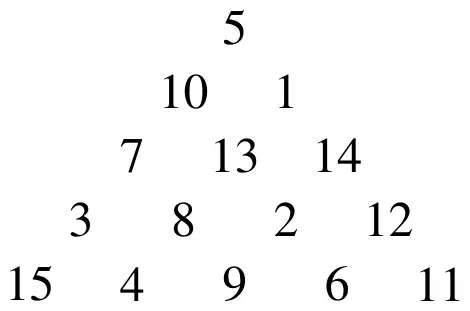
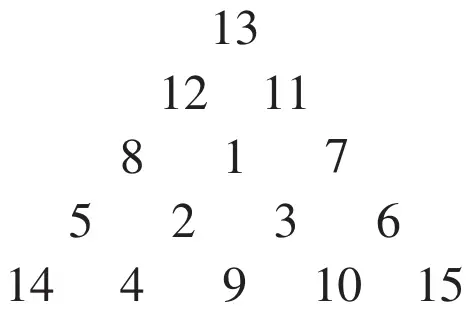
25. The diagram shows the first fifteen positive integers arranged in a ‘triangle’. These numbers are to be rearranged so that the five integers along each ‘edge’ of the triangle have the same sum, unlike the example shown. When this is done, what is the greatest possible such sum?
Note that there are three integers in the centre of the ‘triangle’. For the sum of the integers on each edge to be equal and a maximum, it is preferable for these integers to be 1, 2 and 3. When this is the case, the sum of the remaining integers is \(4 + 5 + 6 + \cdots + 13 + 14 + 15 = 114\). Note that the three integers at the vertices of the triangle contribute to the totals of the integers on two edges of the triangles. So for these three totals to be a maximum, it would be preferable for these integers at the vertices to be 13, 14 and 15. When this is the case, the sum of the integers on the three edges of the triangle is 114 + 13 + 14 + 15 = 156. So, the greatest possible total of the five integers on each edge of the triangle when these totals are equal, is at most \(\dfrac{156}{3} = 52\). The diagram shows that it is possible for the three totals to all equal 52.
We'd like to use Google Analytics cookies to count visits and see which pages help most. They're optional, and the site works exactly the same either way. Privacy policy