The whole Junior Mathematical Challenge 2014 paper, one question at a time in order (25 questions). Press Mark as done after each one: your marks add up below.
There are 24 hours in one day, so \(\tfrac{1}{12}\) of a day is 2 hours. Therefore the number of minutes in \(\tfrac{1}{12}\) of a day is 2 × 60 = 120.
3. In my row in the theatre the seats are numbered consecutively from T1 to T50. I am sitting in seat T17 and you are sitting in seat T39. How many seats are there between us?
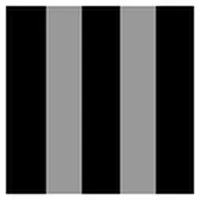
6. The diagram shows a square divided into strips of equal width. Three strips are black and two are grey. What fraction of the perimeter of the square is grey?
Let the width of each strip be 1. Then the square has side 5 and perimeter 20. The grey strips contribute 4 to the perimeter, so the fraction of the perimeter which is grey is \(\tfrac{4}{20} = \tfrac{1}{5}\).
Prime numbers have exactly two distinct factors, so 1 is not a prime number as it has exactly one factor. Of the others, 12, 1234 and 123 456 are all even numbers, so are not prime as the only even prime is 2. Also, 123 = 3 × 41 and 12 345 is clearly a multiple of 5, so neither of these is prime. Therefore none of the numbers in the list is prime.
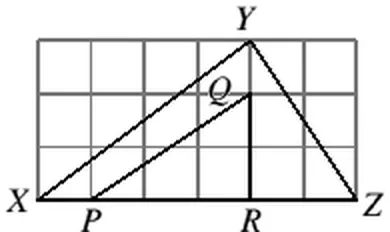
The area of a triangle = \(\tfrac{1}{2}\) × base × height. If we let the length of the sides of each square in the grid be 1, then the area of triangle \(PQR\) is \(\tfrac{1}{2}\) × 3 × 2 = 3. The area of triangle \(XYZ\) is \(\tfrac{1}{2}\) × 6 × 3 = 9. So the required fraction is \(\tfrac{3}{9} = \tfrac{1}{3}\).
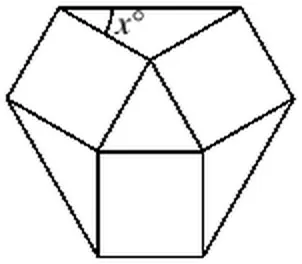
The angles at a point sum to 360°, so the largest angle in the triangle which includes the angle marked \(x\)° is equal to (360 − 90 − 90 − 60)° = 120°. This triangle is isosceles as the sides of the three squares in the figure are equal to the sides of the equilateral triangle. So the triangle has angles 120°, \(x\)° and \(x\)°. Therefore \(x = \tfrac{1}{2}(180 - 120) = 30\).
11. The first two terms of a sequence are 1 and 2. Each of the following terms in the sequence is the sum of all the terms which come before it in the sequence. Which of these is not a term in the sequence?
The third term of the sequence equals 1 + 2 = 3. Now consider the fourth term: it is the sum of the first three terms. However, as the first two terms sum to the third term, the sum of the first three terms is twice the third term, i.e. 2 × 3 = 6. So the fourth term is twice the third term. Similar reasoning applies to each subsequent term, i.e. each term after the third term is equal to twice the term which precedes it. Therefore the sequence is 1, 2, 3, 6, 12, 24, 48, 96, ….
As \(7Q2ST - P3R96 = 22222\), it follows that \(7Q2ST = P3R96 + 22222\). Looking at the units column: 2 + 6 = \(T\), so \(T = 8\). Looking at the tens column, as 2 + 9 = 11, we deduce that \(S = 1\) and that 1 is carried to the hundreds column. Looking at the hundreds column: the carry of 1 + 2 + \(R\) must equal 12 since the sum has 2 in the hundreds column. So \(R = 9\) and there is a carry of 1 to the thousands column. Looking at this column: the carry of 1 + 2 + 3 = \(Q\), so \(Q = 6\). Finally, since there is no carry to the next column, 2 + \(P\) = 7, so \(P = 5\). Therefore the calculation is 76218 − 53996 = 22222 and \(P + Q + R + S + T = 5 + 6 + 9 + 1 + 8 = 29\).
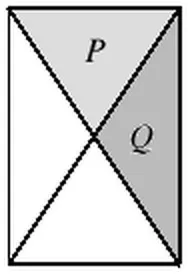
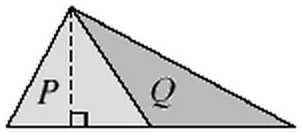
The diagram shows part of the given diagram after a rotation so that the diagonal shown is horizontal. The perpendicular height of triangle \(P\) is shown and it can be seen that this is also the perpendicular height of triangle \(Q\). The diagonals of a rectangle bisect each other, so triangles \(P\) and \(Q\) have bases of equal length and the same perpendicular height. Therefore their areas are equal.
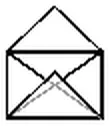
15. The diagram shows a rectangular envelope made by folding (and gluing) a single piece of paper. What could the original unfolded piece of paper look like? (The dashed lines are the fold lines.)
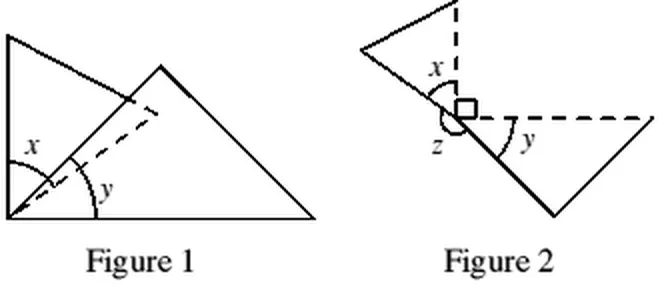
Consider, for example, the bottom left-hand corner of the envelope (see Figure 1). The two flaps overlap, so that the sum of the angles marked \(x\) and \(y\) is greater than 90°. So when the flaps are unfolded, as in Figure 2, the angle marked \(z\) is less than 180°. Therefore the correct answer is E.
If A is true then B is true which cannot be so since we are told only one statement is true. Hence A is false which is what E says. So E is the one true statement. [For completeness, we note that C and D must be false because we are told that exactly one statement is true; and B is false because A is false.]
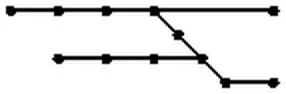
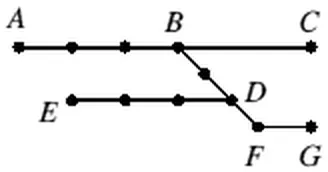
17. The diagram is a ‘map’ of Jo's local rail network, where the dots represent stations and the lines are routes. Jo wants to visit all the stations, travelling only by train, starting at any station and ending at any station, with no restrictions on which routes are taken.
What is the smallest number of stations that Jo must go to more than once?
Whichever route is chosen, it must include section \(BD\). We will divide the route into two sections. The first will include stations \(A\),\(B\), C and will finish at \(D\). The second will start at \(D\) and include stations \(E\),\(F\), and \(G\). Clearly the first section cannot be traversed without visiting at least one station more than once and the route \(A - B - C - B - D\) visits only B more than once so it is an optimal solution. Also, traversing the second section involves visiting D more than once as two branches lead from it. If \(D - E - D\) is part of the route then two stations are visited more than once. However, if \(D - G - D\) is part of the route then only \(F\) is visited more than once. So to traverse the second section, it is necessary to visit at least two stations (one of which is \(D\)) more than once. Therefore, the complete route must involve visiting at least 3 stations more than once. An example of an optimum route is \(A - B - C - B - D - F - G - F - D - E\). The stations visited twice are \(B\),\(D\), and \(F\).
The units digit of any power of 5 is 5 so the units digit of 1 + 56 is 6. Therefore the units digits of the calculations in the 5 options are 2, 1, 0, 9, 8 in that order. So the only calculation which could be correct is E. Checking this gives 1 + 56 − 8 = 1 + 15 625 − 8 = 15 626 − 8 = 15 618.
19. Jack and Jill played a game for two people. In each game, the winner was awarded 2 points and the loser 1 point. No games were drawn. Jack won exactly 4 games and Jill had a final score of 10 points. How many games did they play?
Since Jack won 4 games, Jill lost 4 games for which she was awarded 4 points. So the number of games she won is (10 − 4) ÷ 2 = 3. Therefore, they played 7 games in total.
20. Box P has \(p\) chocolates and box Q has \(q\) chocolates, where \(p\) and \(q\) are both odd and \(p > q\). What is the smallest number of chocolates which would have to be moved from box P to box Q so that box Q has more chocolates than box P?
Let the smallest number of chocolates required be \(n\). Then \(q + n > p - n\), that is \(2n > p - q\). Therefore \(n > \tfrac{1}{2}(p - q)\). Since \(p > q\) and \(p\) and \(q\) are both odd, \(\tfrac{1}{2}(p - q)\) is a positive integer. So the smallest possible value of \(n\) is \(\tfrac{1}{2}(p - q) + 1 = \tfrac{1}{2}(p - q + 2)\).
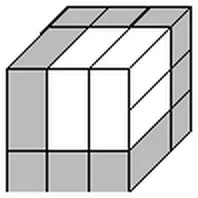
21. Pablo's teacher has given him 27 identical white cubes. She asks him to paint some of the faces of these cubes grey and then stack the cubes so that they appear as shown. What is the largest possible number of the individual white cubes which Pablo can leave with no faces painted grey?
Both the top and bottom layers of 9 cubes can be seen to contain 5 cubes with at least one face printed grey. The bottom layer could contain more than 5. In the middle layer, two cubes with grey faces are visible and there could be more. Therefore at least 12 cubes must have at least one face painted grey, which means that the largest number of cubes which Pablo can leave with no faces painted grey is 27 − 12 = 15.
In order to increase the result of the calculation (the quotient) by 100, the number to be divided (the dividend) must be increased by 100 × 18, that is 1800. So the new dividend needs to be 952 473 + 1800, that is 954 273. So the two digits which need to be swapped are 2 and 4.
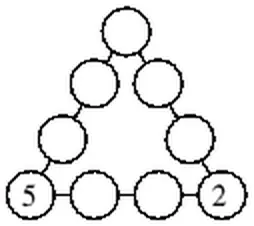
23. Sam wants to complete the diagram so that each of the nine circles contains one of the digits from 1 to 9 inclusive and each contains a different digit. Also, the digits in each of the three lines of four circles must have the same total. What is this total?
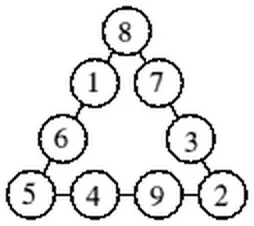
Note first that the sum of the first 9 positive integers is 45. Therefore, when the four numbers in each of the three lines are added together the total is 45 plus the sum of the numbers in the three corner circles, each of which contributes to the sum of two lines of circles. So if the number in the top circle is \(x\), the total of all 3 lines is 45 + 2 + 5 + \(x\) = 52 + \(x\). As all three lines of circles must have the same total, 52 + \(x\) must be a multiple of 3. The possible values of \(x\) are 2, 5 and 8 but 2 and 5 have already been assigned. So \(x = 8\) and the sum of each line is 60 ÷ 3 = 20. The diagram shows one way of completing the task.
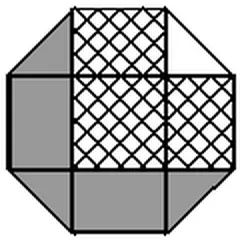
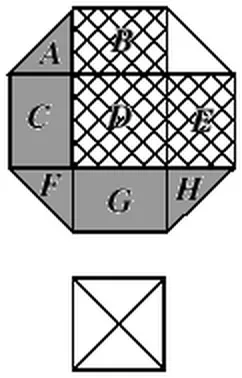
24. The diagram shows a regular octagon with sides of length 1. The octagon is divided into regions by four diagonals. What is the difference between the area of the hatched region and the area of the region shaded grey?
Note that rectangles \(B\),\(C\), \(E\) and \(G\) are all congruent. Two of these are shaded grey and two are hatched, so the difference between the area of the hatched region and the area shaded grey is the difference between the area of square \(D\) of side 1 and the sum of the areas of triangles \(A\), \(F\) and \(H\). These are all isosceles right-angled triangles with hypotenuse 1 and the lower diagram shows how a square of side 1 may be divided into 4 such triangles. So the required difference in area is \(1 - \tfrac{3}{4} = \tfrac{1}{4}\).
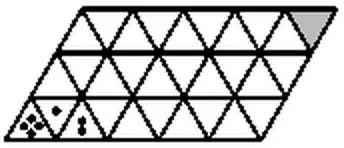
25. A die has the shape of a regular tetrahedron, with the four faces having 1, 2, 3 and 4 pips. The die is placed with 4 pips ‘face down’ in one corner of the triangular grid shown, so that the face with 4 pips precisely covers the triangle marked with 4 pips. The die is now ‘rolled’, by rotating about an edge without slipping, so that 1 pip is face down. It is rolled again, so that 2 pips are face down, as indicated. The rolling continues until the die rests on the shaded triangle in the opposite corner of the grid. How many pips are now face down?
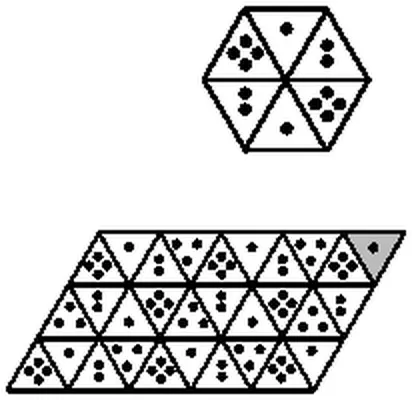
If the die is rolled around a single vertex it covers, in turn, 6 small triangles making up a regular hexagon. It uses three different faces, repeated twice. An example is shown on the right. However, if it is rolled out from that hexagon in any direction, that will use the fourth face. The face that ends up covering each small triangle in the grid is always the same, regardless of the path taken to reach that triangle. Using these facts, it is easy to complete the diagram as shown. So, whichever route through the grid is taken, the ‘1’ is face down when it reaches the shaded triangle.
We'd like to use Google Analytics cookies to count visits and see which pages help most. They're optional, and the site works exactly the same either way. Privacy policy