
JMC 2014 Q24
24. The diagram shows a regular octagon with sides of length 1. The octagon is divided into regions by four diagonals.
What is the difference between the area of the hatched region and the area of the region shaded grey?
- A 0
- B \(\dfrac{1}{8}\)
- C \(\dfrac{1}{4}\)
- D \(\dfrac{1}{2}\)
- E 1
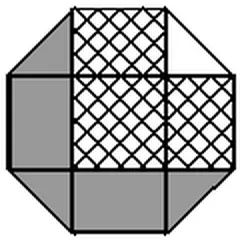
Junior Mathematical Challenge 2014, Question 24. © UK Mathematics Trust. Original paper on ukmt.org.uk
Answer: C \(\dfrac{1}{4}\)
Note that rectangles \(B\), \(C\), \(E\) and \(G\) are all congruent. Two of these are shaded grey and two are hatched, so the difference between the area of the hatched region and the area shaded grey is the difference between the area of square \(D\) of side 1 and the sum of the areas of triangles \(A\), \(F\) and \(H\). These are all isosceles right-angled triangles with hypotenuse 1 and the lower diagram shows how a square of side 1 may be divided into 4 such triangles. So the required difference in area is \(1 - \tfrac{3}{4} = \tfrac{1}{4}\).
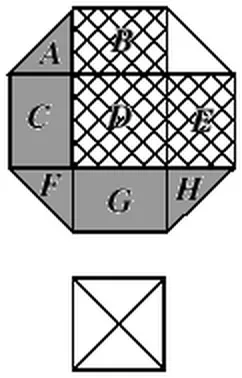
Solution © UK Mathematics Trust, from the JMC 2014 solutions. Longer versions with investigations: Solutions and investigations (PDF).