The whole Junior Mathematical Challenge 2009 paper, one question at a time in order (25 questions). Press Mark as done after each one: your marks add up below.
The problem may be solved by dividing each of the alternatives in turn by 7, but the prime factorisation of 1001, i.e. 1001 = 7 × 11 × 13, leads to the conclusion that 111 111, which is 111 × 1001, is a multiple of 7.
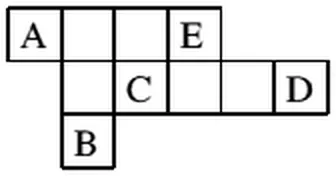
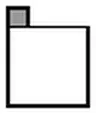
8. The figure on the right shows an arrangement of ten square tiles. Which labelled tile could be removed, but still leave the length of the perimeter unchanged?
Removing tile A or tile B or tile D has the effect of reducing the perimeter by a distance equal to twice the side of one tile, whilst removing tile C increases the perimeter by that same distance. Removing tile E, however, leaves the length of the perimeter unchanged.
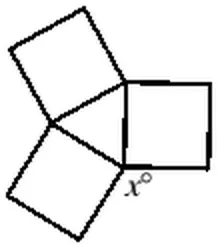
The triangle in the centre of the diagram is equilateral since each of its sides is equal in length to the side of one of the squares. The sum of the angles at a point is 360°, so \(x = 360 - (90 + 90 + 60) = 120\).
11. In a sequence of numbers, each term after the first three terms is the sum of the previous three terms. The first three terms are −3, 0, 2. Which is the first term to exceed 100?
12. Gill is 21 this year. At the famous visit to the clinic in 1988, her weight was calculated to be 5kg, but she now weighs 50kg. What has been the percentage increase in Gill's weight from 1988 to 2009?
The increase in Gill's weight is 45 kg, which is 9 times her weight in 1988. So the percentage increase in weight is 900%. (The problem refers to Q14 in the very first Schools Mathematical Challenge – the forerunner of the current Junior and Intermediate Mathematical Challenges – in 1988. This was ‘Weighing the baby at the clinic was a problem. The baby would not keep still and caused the scales to wobble. So I held the baby and stood on the scales while the nurse read off 78 kg. Then the nurse held the baby while I read off 69 kg. Finally I held the nurse while the baby read off 137 kg. What is the combined weight of all three (in kg)? A 142 B 147 C 206 D 215 E 284.’)
Let the ten consecutive integers be \(x - 4, x - 3, x - 2, x - 1, x, x + 1, x + 2, x + 3, x + 4\) and \(x + 5\) respectively. The sum of these is \(10x + 5\) so \(10x + 5 = 5\), that is \(x = 0\). Hence the largest of the integers is 5.
15. In Matt’s pocket there are 8 watermelon jellybeans, 4 vanilla jellybeans and 4 butter popcorn jellybeans. What is the smallest number of jellybeans he must take out of his pocket to be certain that he takes at least one of each flavour?
If Matt takes 12 jellybeans then he will have taken at least one of each flavour unless he takes all 8 watermelon jellybeans and either all 4 vanilla jellybeans or all 4 butter popcorn jellybeans. In this case the 4 remaining jellybeans will all be of the flavour he has yet to take, so taking one more jellybean ensures that he will have taken at least one of each flavour.
16. The kettle in Keith’s kitchen is 80% full. After 20% of the water in it has been poured out, there are 1152 ml of water left. What volume of water does Keith’s kitchen kettle hold when it is full?
20% of the 80% is 16% of the kettle's capacity. Therefore the volume of water left in the kettle after Keith has poured out 20% of the original amount is 64% of the kettle's capacity. So when full, the kettle holds \(\dfrac{1152}{64}\) × 100 ml, that is 1800 ml.
17. The tiling pattern shown uses two sizes of square, with sides of length 1 and 4. A very large number of these squares is used to tile an enormous floor in this pattern. Which of the following is closest to the ratio of the number of grey tiles on the floor to the number of white tiles?
18. Six friends are having dinner together in their local restaurant. The first eats there every day, the second eats there every other day, the third eats there every third day, the fourth eats there every fourth day, the fifth eats there every fifth day and the sixth eats there every sixth day. They agree to have a party the next time they all eat together there. In how many days' time is the party?
The lowest common multiple of 2, 3, 4, 5 and 6 is required. Of these numbers, 2, 3 and 5 are prime whilst 4 = 22 and 6 = 2 × 3. So their lowest common multiple is 22 × 3 × 5, that is 60.
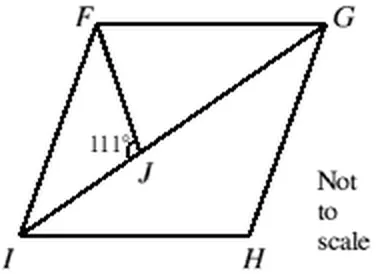
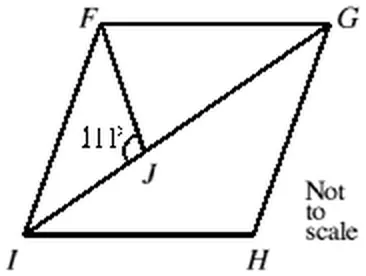
19. The diagram on the right shows a rhombus FGHI and an isosceles triangle FGJ in which \(GF = GJ\). Angle FJI = 111°. What is the size of angle JFI ?
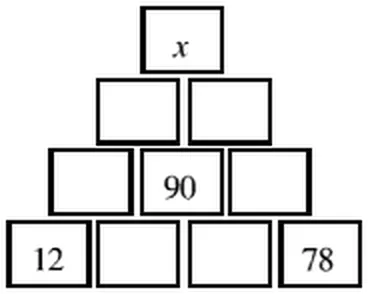
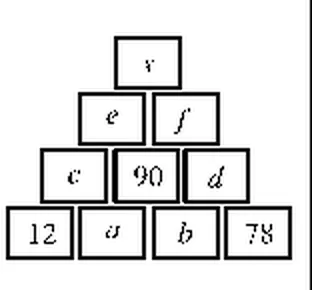
20. In the diagram on the right, the number in each box is obtained by adding the numbers in the two boxes immediately underneath. What is the value of \(x\)?
Let the numbers in the boxes be as shown in the diagram. Then \(b = 90 - a\);\(c = 12 + a\);\(d = b + 78 = 168 - a\). Also, \(e = 90 + c = 102 + a\);\(f = 90 + d = 258 - a\). So \(x = e + f = 102 + a + 258 - a = 360\).
21. A rectangular sheet of paper is divided into two pieces by a single straight cut. One of the pieces is then further divided into two, also by a single straight cut. Which of the following could not be the total number of edges of the resulting three pieces?
The diagrams below show how the total number of edges of the resulting three pieces may be 9, 10, 11 or 12. However, 12 is the maximum value of the total number of edges since the original number of edges is four and any subsequent cut adds a maximum of four edges (by dividing two existing edges and adding the new ‘cuts’).
22. Starting at the square containing the 2, you are allowed to move from one square to the next either across a common edge, or diagonally through a common corner. How many different routes are there passing through exactly two squares containing a 0 and ending in one of the squares containing a 9?
In order to reach a 9 in three steps, the first zero must be one of the three adjacent to the 2 and the second zero must be one of the five adjacent to a 9. The table shows the number of such routes to that point. So the total number of different routes is 25.
23. The currency used on the planet Zog consists of bank notes of a fixed size differing only in colour. Three green notes and eight blue notes are worth 46 zogs; eight green notes and three blue notes are worth 31 zogs. How many zogs are two green notes and three blue notes worth?
Let the value of a green note and the value of a blue note be \(g\) zogs and \(b\) zogs respectively. Then \(3g + 8b = 46\) and \(8g + 3b = 31\). Adding these two equations gives \(11g + 11b = 77\), so \(b + g = 7\). Therefore \(3g + 3b = 21\). Subtracting this equation from the original equations in turn gives \(5b = 25\) and \(5g = 10\) respectively. So \(b = 5\), \(g = 2\) and \(2g + 3b = 19\).
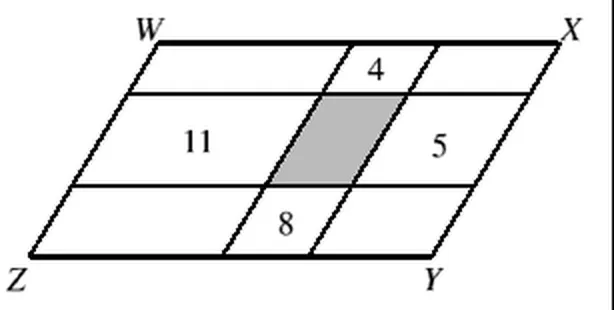
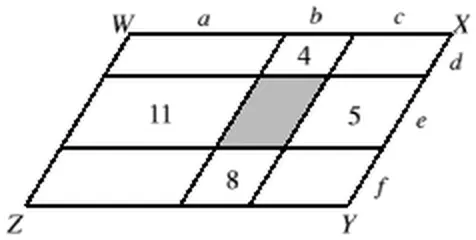
24. The parallelogram WXYZ shown in the diagram on the right has been divided into nine smaller parallelograms. The perimeters, in centimetres, of four of the smaller parallelograms are shown. The perimeter of WXYZ is 21 cm. What is the perimeter of the shaded parallelogram?
Let the lengths \(a, b, c, d, e, f\) be as shown in the diagram. Then the sum of the perimeters of the four labelled parallelograms is \(2(a + e) + 2(b + d) + 2(b + f) + 2(c + e)\) \(= 2(a + b + c + d + e + f) + 2(b + e)\) = perimeter of WXYZ + perimeter of shaded parallelogram. So the perimeter of the shaded parallelogram is \(((11 + 8 + 4 + 5) - 21)\) cm=7 cm.
25. In Miss Quaffley’s class, one third of the pupils bring a teddy bear to school. Last term, each boy took 12 books out of the library, each girl took 17 books and each teddy bear took 9 books. In total, 305 books were taken out. How many girls are there in Miss Quaffley’s class?
Let the number of boys in Miss Quaffley's class be \(b\) and the number of girls be \(g\). Then the number of teddy bears is \(\tfrac{1}{3}(b + g)\). Also, in total, the boys took out \(12b\) library books last term and the girls took out \(17g\) books. The total number of books taken out by the bears was \(9 \times \tfrac{1}{3}(b + g)\) that is \(3(b + g)\). So \(12b + 17g + 3(b + g) = 305\), that is \(15b + 20g = 305\), that is \(3b + 4g = 61\). Clearly, \(b\) and \(g\) are positive integers. The positive integer solutions of the equation \(3b + 4g = 61\) are \(b = 3, g = 13\);\(b = 7, g = 10\);\(b = 11, g = 7\);\(b = 15, g = 4\);\(b = 19, g = 1\). However, there is one further condition: the number of teddy bears, that is \(\tfrac{1}{3}(b + g)\), is also a positive integer and of the five pairs of solutions above, this condition is satisfied only by \(b = 11, g = 7\). Check: the 11 boys take out 132 books, the 7 girls take out 119 books and the 6 teddy bears take out 54 books, giving a total of 305 books. (The equation \(3b + 4g = 61\) in which \(b\) and \(g\) both represent positive integers is an example of a Diophantine equation.)
We'd like to use Google Analytics cookies to count visits and see which pages help most. They're optional, and the site works exactly the same either way. Privacy policy