
JMC 2009 Q19
19. The diagram on the right shows a rhombus FGHI and an isosceles triangle FGJ in which \(GF = GJ\). Angle FJI = 111°.
What is the size of angle JFI ?
- A 27°
- B 29°
- C 31°
- D 33°
- E \(34\frac{1}{2}\)°
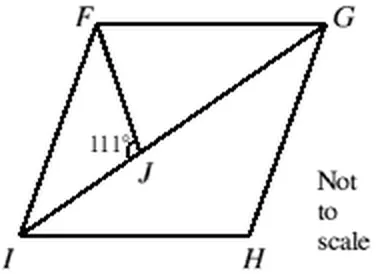
Junior Mathematical Challenge 2009, Question 19. © UK Mathematics Trust. Original paper on ukmt.org.uk
Answer: A 27°
Adjacent angles on a straight line add up to 180°, so \(\angle GJF = 180^\circ - 111^\circ = 69^\circ\). In triangle FGJ, \(GJ = GF\) so \(\angle GFJ = \angle GJF\). Therefore \(\angle FGJ = (180 - 2 \times 69)^\circ = 42^\circ\). As FGHI is a rhombus, \(FG = FI\) and therefore \(\angle GIF = \angle FGI = 42^\circ\). Finally, from triangle FJI, \(\angle JFI = (180 - 111 - 42)^\circ = 27^\circ\).
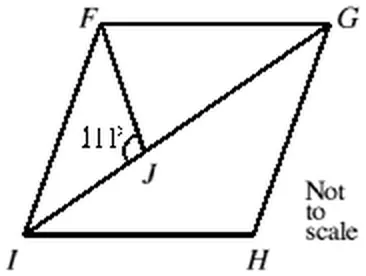
Solution © UK Mathematics Trust, from the JMC 2009 solutions.