
JMC 2020 Q17
17. In 1925, Zbigniew Morón published a rectangle that could be dissected into nine different sized squares as shown in the diagram. The lengths of the sides of these squares are 1, 4, 7, 8, 9, 10, 14, 15 and 18.
What is the area of Morón’s rectangle?
- A 144
- B 225
- C 900
- D 1024
- E 1056
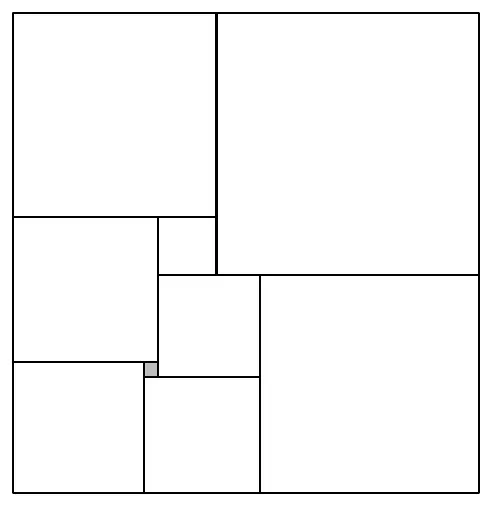
Junior Mathematical Challenge 2020, Question 17. © UK Mathematics Trust. Original paper on ukmt.org.uk
Answer: E 1056
Label the individual squares, except for the smallest, \(P, Q, R, S, T, U, V\) and \(W\) as shown. The side-length of the smallest square is 1. Since the next smallest squares are \(W\) and \(V\), they have side-lengths 4 and 7 respectively. Therefore \(Q\) has side-length 7 + 1 = 8, \(P\) has side-length 8 + 1 = 9 and \(U\) has side-length 9 + 1 = 10. Hence \(T\) has side-length 10 + 4 = 14 and \(R\) has side-length 7 + 8 = 15. Therefore the rectangle has side-lengths 9 + 8 + 15 = 32 and 9 + 10 + 14 = 33. Therefore the area of the rectangle is 32 × 33 = 1056.

(Alternatively: the three largest squares R, S and T have side-length 15, 18 and 14 respectively. So the rectangle has sides of length 18 + 15 and 18 + 14 and so measures 33 by 32.)
Solution © UK Mathematics Trust, from the JMC 2020 solutions. Longer versions with investigations: Solutions and investigations (PDF).