
JMC 2016 Q22
22. Four copies of the triangle shown are joined together, without gaps or overlaps, to make a parallelogram.
What is the largest possible perimeter of the parallelogram?
- A 46 cm
- B 52 cm
- C 58 cm
- D 62 cm
- E 76 cm
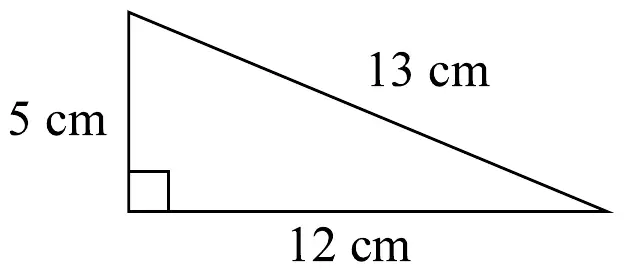
Junior Mathematical Challenge 2016, Question 22. © UK Mathematics Trust. Original paper on ukmt.org.uk
Answer: E 76 cm
In order to join the four triangles together it is required to join together at least three pairs of edges, which consequently are not part of the perimeter of the resulting parallelogram. The four triangles have a total of 12 edges, so the maximum number of edges which can be part of the perimeter of the parallelogram is 12 − 3 × 2 = 6. For the perimeter to be as large as possible, all four 13 cm edges should be included together with two of the 12 cm edges, if this is possible. The diagram shows how it may be accomplished. So the largest possible perimeter is (4 × 13 + 2 × 12) cm = 76 cm.
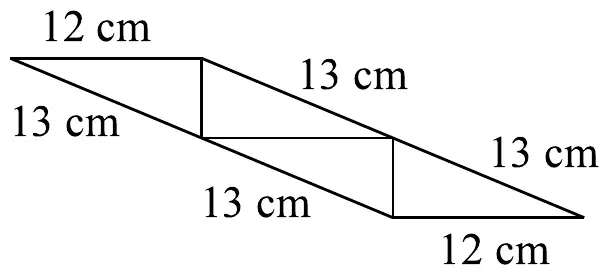
Solution © UK Mathematics Trust, from the JMC 2016 solutions. Longer versions with investigations: Solutions and investigations (PDF).