
JMC 2007 Q19
19. The points \(P\), \(Q\), \(R\), \(S\) lie in order along a straight line, with \(PQ = QR = RS = 2\) cm. Semicircles with diameters \(PQ\), \(QR\), \(RS\) and \(SP\) join to make the shape shown on the right. What, in cm2, is the area of the shape?
- A \(5\pi\)
- B \(9\pi/2\)
- C \(4\pi\)
- D \(7\pi/2\)
- E \(3\pi\)
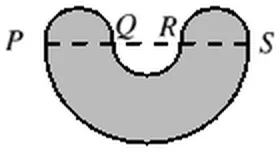
Junior Mathematical Challenge 2007, Question 19. © UK Mathematics Trust. Original paper on ukmt.org.uk
Answer: A \(5\pi\)
If the semicircle with diameter \(PQ\) is rotated through 180° about \(Q\), the new shape formed has the same area as the original shape. It consists of a semicircle of diameter 6 cm and a semicircle of diameter 2 cm. So its area is \((\tfrac{1}{2} \times \pi \times 3^2 + \tfrac{1}{2} \times \pi \times 1^2)\) cm2, that is \(5\pi\) cm2.
Solution © UK Mathematics Trust, from the JMC 2007 solutions.