Senior Mathematical Challenge (SMC): Area, Perimeter & Shape

81 Senior Mathematical Challenge questions from every year we have, newest year first. Use Difficulty › Position in the paper to practise the early (easier) or late (harder) questions, or the Year filter for one year.

Questions and solutions © UK Mathematics Trust, shown with permission. Papers and more at ukmt.org.uk.

SMC 2020

SMC 2019

SMC 2018

SMC 2017

SMC 2016

SMC 2015

SMC 2014

SMC 2013

SMC 2012

SMC 2011

SMC 2010

SMC 2009

SMC 2008

SMC 2007

SMC 2006

SMC 2005

SMC 2020 Q3

SMCCurrent spec4 marksArea, Perimeter & Shape

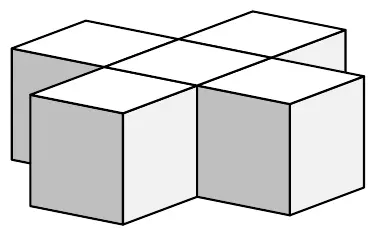
3. A shape is made from five unit cubes, as shown.

What is the surface area of the shape?

  1. A 22
  2. B 24
  3. C 26
  4. D 28
  5. E 30
Five unit cubes joined face to face in a plus-sign arrangement, drawn in perspective

Senior Mathematical Challenge 2020, Question 3. © UK Mathematics Trust. Original paper on ukmt.org.uk

SMC 2020 Q11

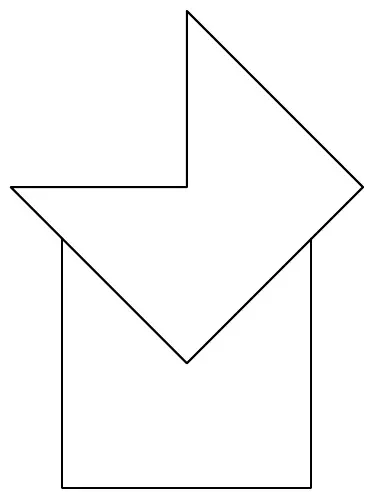
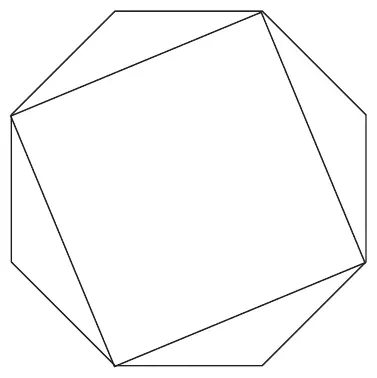
11. Two congruent pentagons are each formed by removing a right-angled isosceles triangle from a square of side-length 1. The two pentagons are then fitted together as shown.

What is the length of the perimeter of the octagon formed?

  1. A 4
  2. B \(4 + 2\sqrt{2}\)
  3. C 5
  4. D \(6 - 2\sqrt{2}\)
  5. E 6
Two congruent pentagons, each a unit square with a right-angled isosceles triangle cut off one corner, fitted together to form an octagon

Senior Mathematical Challenge 2020, Question 11. © UK Mathematics Trust. Original paper on ukmt.org.uk

SMC 2020 Q15

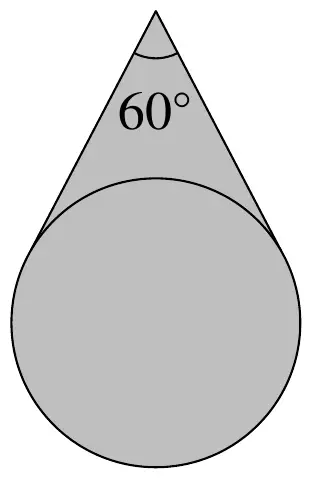
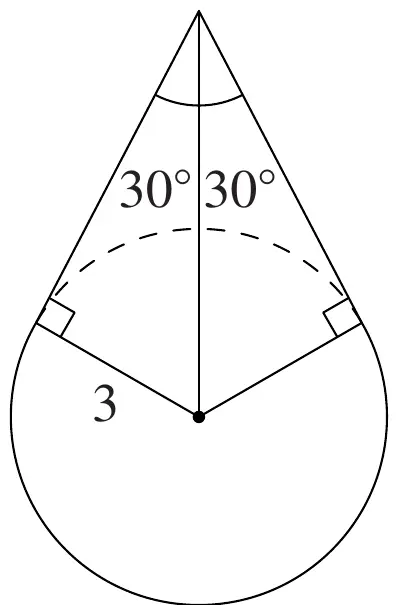
15. The shaded area shown in the diagram consists of the interior of a circle of radius 3 together with the area between the circle and two tangents to the circle. The angle between the tangents at the point where they meet is 60°.

What is the shaded area?

  1. A \(6\pi + 9\sqrt{3}\)
  2. B \(15\sqrt{3}\)
  3. C \(9\pi\)
  4. D \(9\pi + 4\sqrt{3}\)
  5. E \(6\pi + \frac{9\sqrt{3}}{4}\)
A shaded circle with two tangents meeting above it at an angle of 60 degrees; the region between the tangents and the circle is also shaded

Senior Mathematical Challenge 2020, Question 15. © UK Mathematics Trust. Original paper on ukmt.org.uk

SMC 2020 Q22

SMCCurrent spec5 marksAlgebraArea, Perimeter & Shape

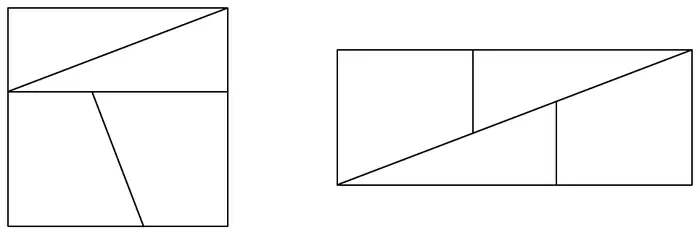
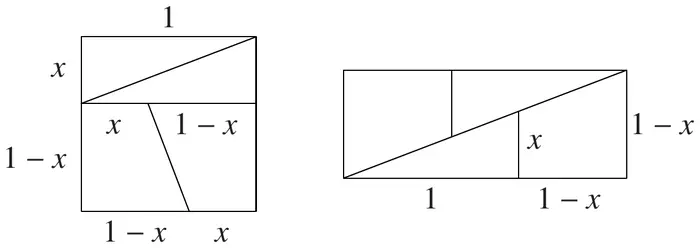
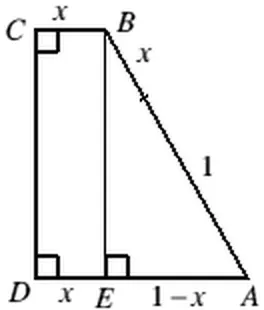
22. A square with perimeter 4 cm can be cut into two congruent right-angled triangles and two congruent trapezia as shown in the first diagram in such a way that the four pieces can be rearranged to form the rectangle shown in the second diagram.

What is the perimeter, in centimetres, of this rectangle?

  1. A \(2\sqrt{5}\)
  2. B \(4\sqrt{2}\)
  3. C 5
  4. D \(4\sqrt{3}\)
  5. E \(3\sqrt{7}\)
A square cut into two congruent right-angled triangles and two congruent trapezia, and the four pieces rearranged into a rectangle

Senior Mathematical Challenge 2020, Question 22. © UK Mathematics Trust. Original paper on ukmt.org.uk

SMC 2019 Q12

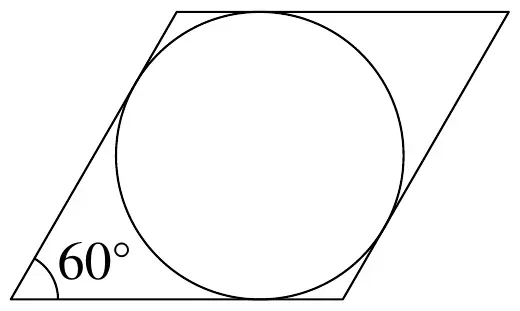
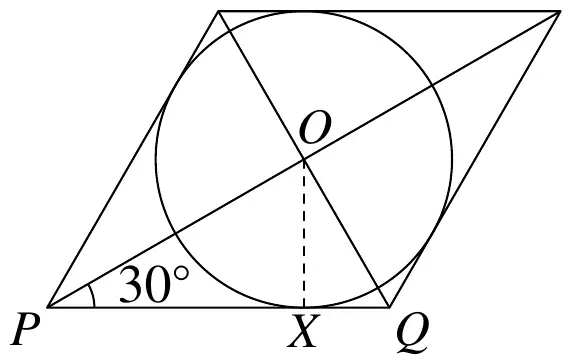
12. A circle with radius 1 touches the sides of a rhombus, as shown. Each of the smaller angles between the sides of the rhombus is 60°.

What is the area of the rhombus?

  1. A 6
  2. B 4
  3. C \(2\sqrt{3}\)
  4. D \(3\sqrt{3}\)
  5. E \(\dfrac{8\sqrt{3}}{3}\)
A rhombus with a circle touching all four sides; one of the smaller angles is marked 60 degrees

Senior Mathematical Challenge 2019, Question 12. © UK Mathematics Trust. Original paper on ukmt.org.uk

SMC 2019 Q23

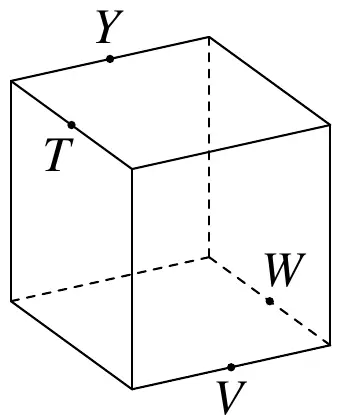
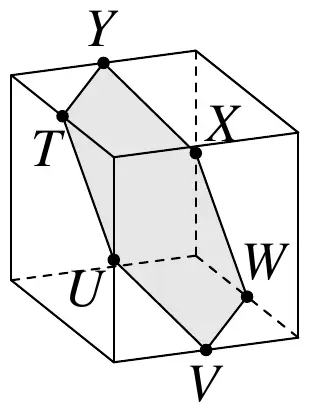
23. The edge-length of the solid cube shown is 2. A single plane cut goes through the points \(Y\), \(T\), \(V\) and \(W\) which are midpoints of the edges of the cube, as shown.

What is the area of the cross-section?

  1. A \(\sqrt{3}\)
  2. B \(3\sqrt{3}\)
  3. C 6
  4. D \(6\sqrt{2}\)
  5. E 8
A cube with points Y, T, V and W marked at midpoints of four edges

Senior Mathematical Challenge 2019, Question 23. © UK Mathematics Trust. Original paper on ukmt.org.uk

SMC 2019 Q25

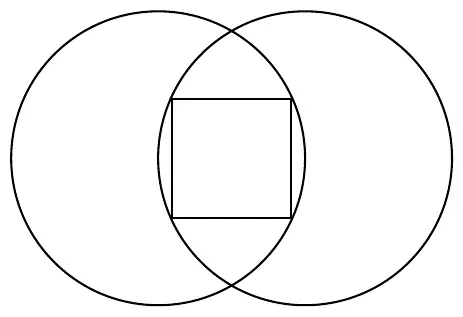
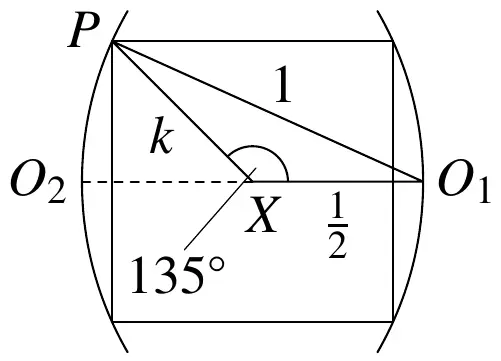
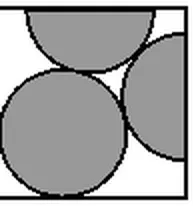
25. Two circles of radius 1 are such that the centre of each circle lies on the other circle. A square is inscribed in the space between the circles.

What is the area of the square?

  1. A \(2 - \dfrac{\sqrt{7}}{2}\)
  2. B \(2 + \dfrac{\sqrt{7}}{2}\)
  3. C \(4 - \sqrt{5}\)
  4. D 1
  5. E \(\dfrac{\sqrt{5}}{5}\)
Two overlapping circles, each passing through the centre of the other, with a square drawn in the space between them

Senior Mathematical Challenge 2019, Question 25. © UK Mathematics Trust. Original paper on ukmt.org.uk

SMC 2018 Q9

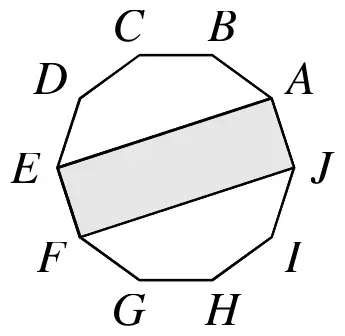
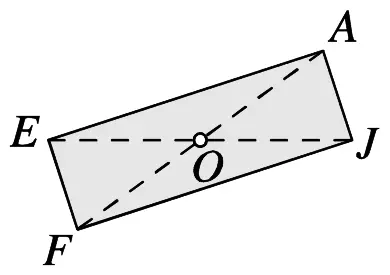
9. The diagram shows a rectangle \(AEFJ\) inside a regular decagon \(ABCDEFGHIJ\).
What is the ratio of the area of the rectangle to the area of the decagon?

  1. A 2 : 5
  2. B 1 : 4
  3. C 3 : 5
  4. D 3 : 10
  5. E 3 : 20
A regular decagon ABCDEFGHIJ with the rectangle AEFJ shaded inside it

Senior Mathematical Challenge 2018, Question 9. © UK Mathematics Trust. Original paper on ukmt.org.uk

SMC 2018 Q15

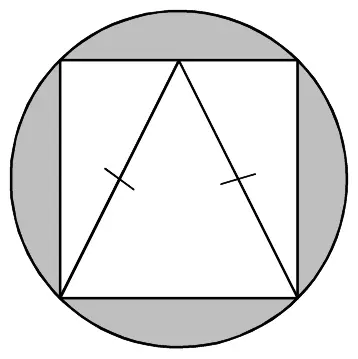
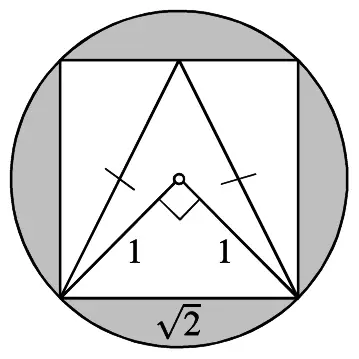
15. A square is inscribed in a circle of radius 1. An isosceles triangle is inscribed in the square as shown.

What is the ratio of the area of this triangle to the area of the shaded region?

  1. A \(\pi : \sqrt{2}\)
  2. B \(\pi : 1\)
  3. C \(1 : 4\)
  4. D \(1 : \pi - 2\)
  5. E \(2 : \pi\)
A square inscribed in a circle with the four regions between them shaded; an isosceles triangle inscribed in the square has its base along the bottom side and its apex at the midpoint of the top side

Senior Mathematical Challenge 2018, Question 15. © UK Mathematics Trust. Original paper on ukmt.org.uk

SMC 2018 Q20

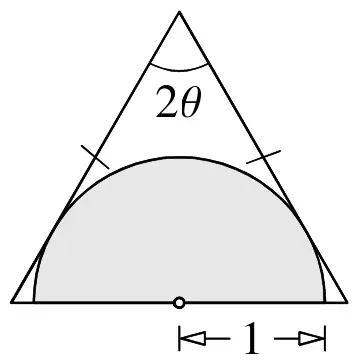
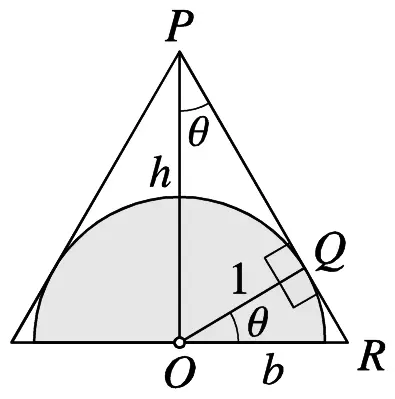
20. The diagram shows a semicircle of radius 1 inside an isosceles triangle. The diameter of the semicircle lies along the ‘base’ of the triangle, and the angle of the triangle opposite the ‘base’ is equal to \(2\theta\). Each of the two equal sides of the triangle is tangent to the semicircle.
What is the area of the triangle?

  1. A \(\frac{1}{2}\tan 2\theta\)
  2. B \(\sin\theta\cos\theta\)
  3. C \(\sin\theta + \cos\theta\)
  4. D \(\frac{1}{2}\cos 2\theta\)
  5. E \(\dfrac{1}{\sin\theta\cos\theta}\)
A shaded semicircle with its diameter on the base of an isosceles triangle, touching both equal sides; the top angle is 2 theta and the radius is 1

Senior Mathematical Challenge 2018, Question 20. © UK Mathematics Trust. Original paper on ukmt.org.uk

SMC 2018 Q22

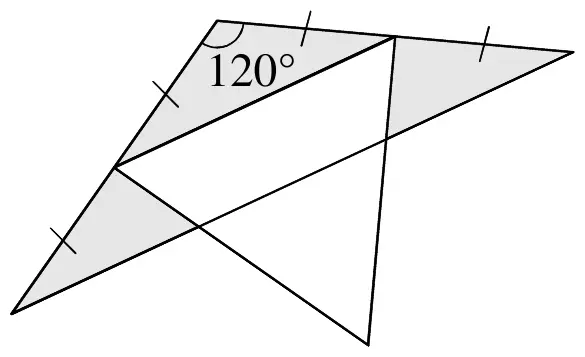
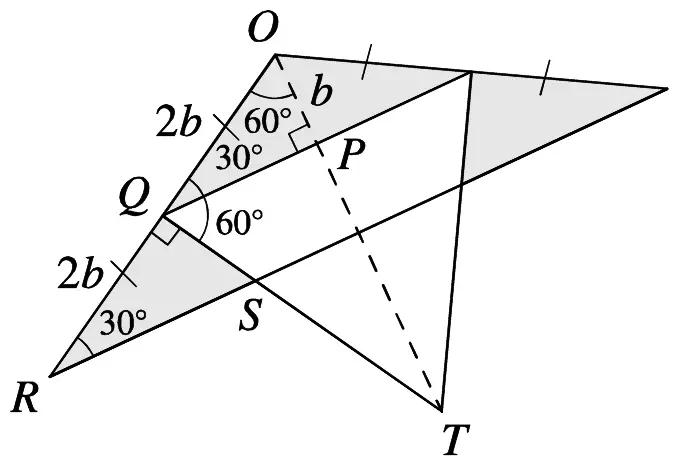
22. The diagram shows two overlapping triangles; an isosceles triangle with an angle of 120° and an equilateral triangle with area 36. Two of the vertices of the equilateral triangle are midpoints of the equal sides of the isosceles triangle.

What is the total area of the shaded regions (inside the isosceles triangle but outside the equilateral triangle)?

  1. A 24
  2. B 26
  3. C 28
  4. D 30
  5. E 32
An isosceles triangle with a 120 degree angle overlapping an equilateral triangle; two vertices of the equilateral triangle are the midpoints of the equal sides, and the parts of the isosceles triangle outside the equilateral triangle are shaded

Senior Mathematical Challenge 2018, Question 22. © UK Mathematics Trust. Original paper on ukmt.org.uk

SMC 2018 Q25

SMCCurrent spec5 marksArea, Perimeter & Shape

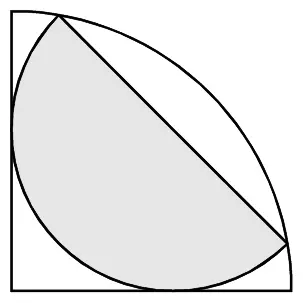
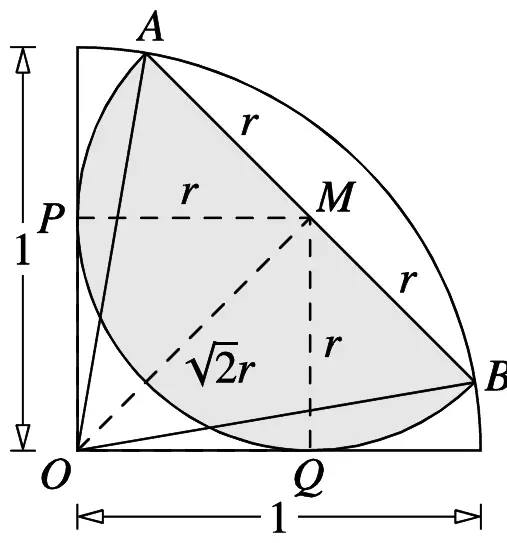
25. A semicircle is inscribed in a quarter circle as shown.

What fraction of the quarter circle is shaded?

  1. A \(\frac{1}{3}\)
  2. B \(\frac{1}{\sqrt{3}}\)
  3. C \(\frac{2}{3}\)
  4. D \(\frac{\sqrt{3}}{2}\)
  5. E \(\frac{1}{\sqrt{2}}\)
A quarter circle with a shaded semicircle inscribed in it, the diameter of the semicircle joining two points on the arc

Senior Mathematical Challenge 2018, Question 25. © UK Mathematics Trust. Original paper on ukmt.org.uk

SMC 2017 Q9

SMCCurrent spec4 marksAlgebraArea, Perimeter & Shape

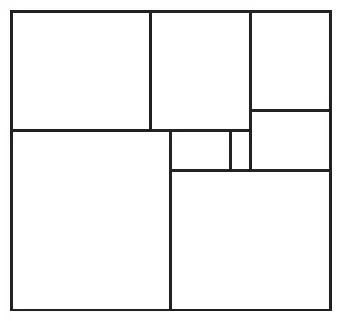
9. The diagram shows an \(n \times (n + 1)\) rectangle tiled with \(k \times (k + 1)\) rectangles, where \(n\) and \(k\) are integers and \(k\) takes each value from 1 to 8 inclusive.
What is the value of \(n\)?

  1. A 16
  2. B 15
  3. C 14
  4. D 13
  5. E 12
A rectangle tiled with eight rectangles of sizes 1 by 2 up to 8 by 9

Senior Mathematical Challenge 2017, Question 9. © UK Mathematics Trust. Original paper on ukmt.org.uk

SMC 2017 Q10

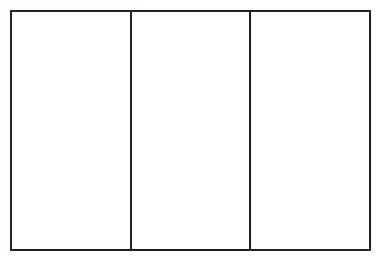
10. A rectangle is divided into three smaller congruent rectangles as shown.
Each smaller rectangle is similar to the large rectangle.
In each of these four rectangles, what is the ratio of the length of a longer side to that of a shorter side?

  1. A \(2\sqrt{3} : 1\)
  2. B \(3 : 1\)
  3. C \(2 : 1\)
  4. D \(\sqrt{3} : 1\)
  5. E \(\sqrt{2} : 1\)
A rectangle divided into three congruent smaller rectangles side by side

Senior Mathematical Challenge 2017, Question 10. © UK Mathematics Trust. Original paper on ukmt.org.uk

SMC 2017 Q15

SMCCurrent spec4 marksAlgebraArea, Perimeter & Shape

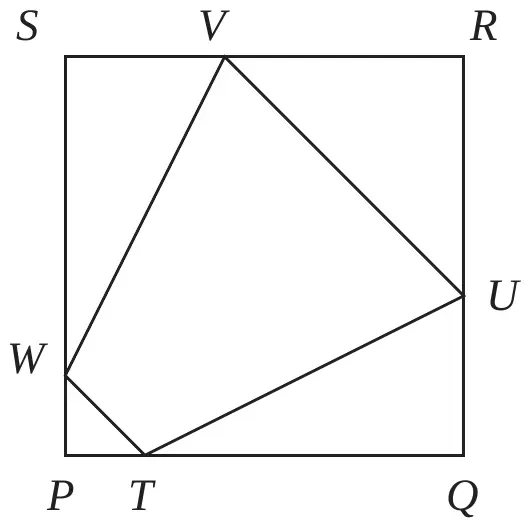
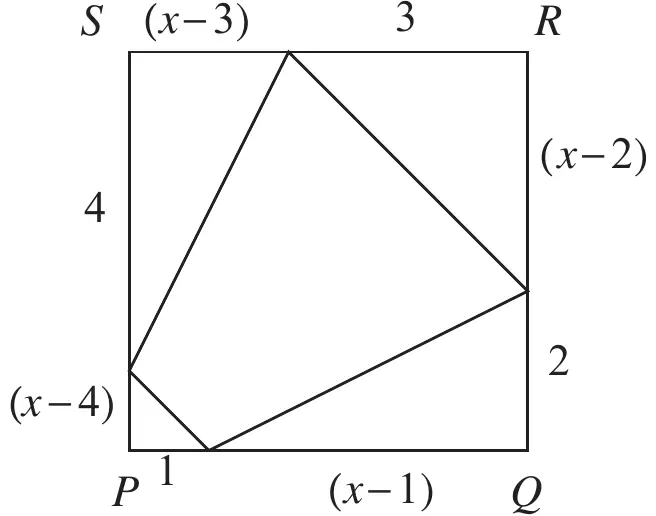
15. The diagram shows a square \(PQRS\). Points \(T\), \(U\), \(V\) and \(W\) lie on the edges of the square as shown, such that \(PT = 1\), \(QU = 2\), \(RV = 3\) and \(SW = 4\).
The area of \(TUVW\) is half that of \(PQRS\). What is the length of \(PQ\)?

  1. A 5
  2. B 6
  3. C 7
  4. D 8
  5. E 9
Square PQRS with points T on PQ, U on QR, V on RS and W on SP joined to form quadrilateral TUVW

Senior Mathematical Challenge 2017, Question 15. © UK Mathematics Trust. Original paper on ukmt.org.uk

SMC 2017 Q16

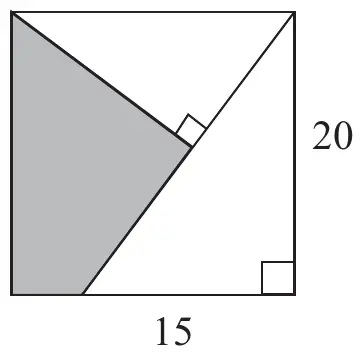
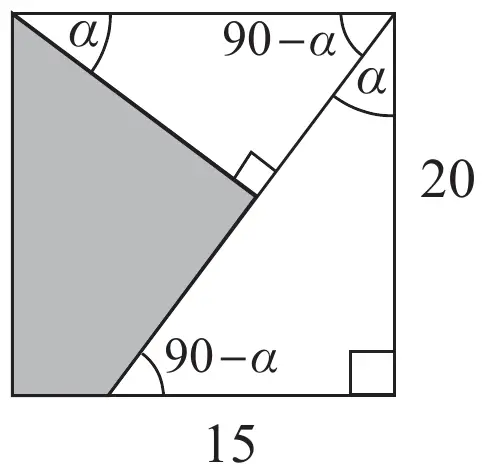
16. The diagram shows two right-angled triangles inside a square. The perpendicular edges of the larger triangle have lengths 15 and 20.
What is the area of the shaded quadrilateral?

  1. A 142
  2. B 146
  3. C 150
  4. D 154
  5. E 158
A square containing two right-angled triangles, the larger with perpendicular edges 15 and 20; a quadrilateral is shaded

Senior Mathematical Challenge 2017, Question 16. © UK Mathematics Trust. Original paper on ukmt.org.uk

SMC 2017 Q20

20. The diagram shows a square \(PQRS\) with edges of length 1, and four arcs, each of which is a quarter of a circle. Arc \(TRU\) has centre \(P\); arc \(VPW\) has centre \(R\); arc \(UV\) has centre \(S\); and arc \(WT\) has centre \(Q\).
What is the length of the perimeter of the shaded region?

  1. A 6
  2. B \(\left(2\sqrt{2} - 1\right)\pi\)
  3. C \(\left(\sqrt{2} - \tfrac{1}{2}\right)\pi\)
  4. D \(2\pi\)
  5. E \(\left(3\sqrt{2} - 2\right)\pi\)
Square PQRS with four quarter-circle arcs TRU, UV, VPW and WT enclosing a shaded oval region

Senior Mathematical Challenge 2017, Question 20. © UK Mathematics Trust. Original paper on ukmt.org.uk

SMC 2017 Q22

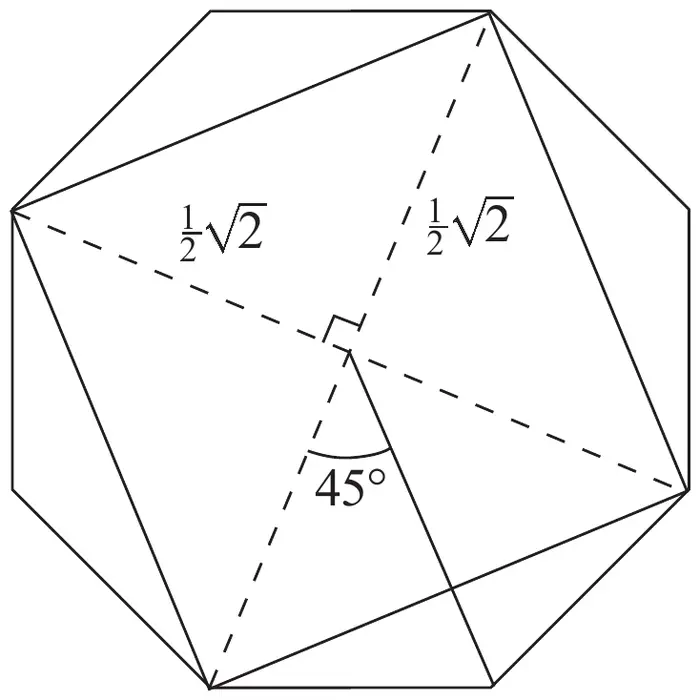
22. The diagram shows a regular octagon and a square formed by drawing four diagonals of the octagon. The edges of the square have length 1.
What is the area of the octagon?

  1. A \(\dfrac{\sqrt{6}}{2}\)
  2. B \(\dfrac{4}{3}\)
  3. C \(\dfrac{7}{5}\)
  4. D \(\sqrt{2}\)
  5. E \(\dfrac{3}{2}\)
A regular octagon with a square formed by four of its diagonals

Senior Mathematical Challenge 2017, Question 22. © UK Mathematics Trust. Original paper on ukmt.org.uk

SMC 2017 Q25

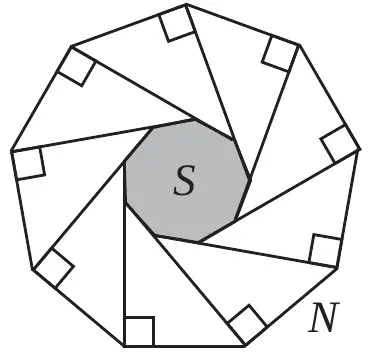
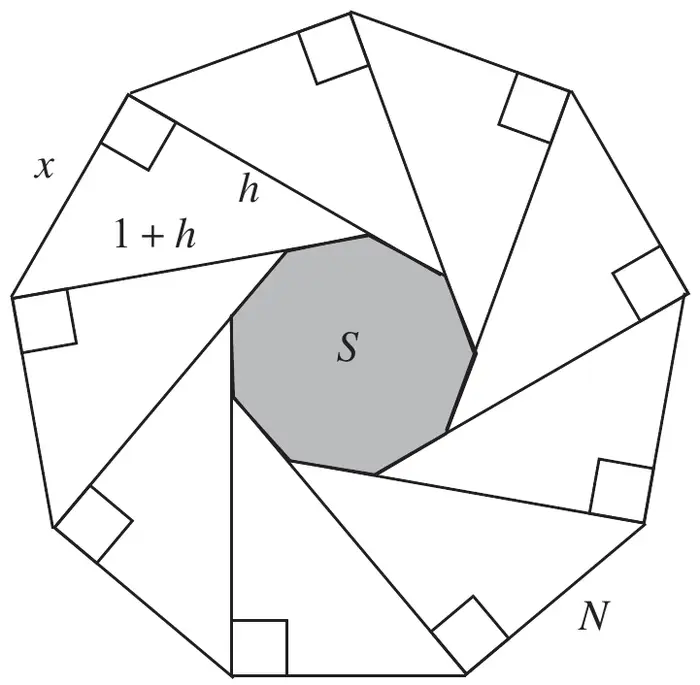
25. The diagram shows a regular nonagon \(N\). Moving clockwise around \(N\), at each vertex a line segment is drawn perpendicular to the preceding edge. This produces a smaller nonagon \(S\), shown shaded.
What fraction of the area of \(N\) is the area of \(S\)?

  1. A \(\dfrac{1 - \cos 40°}{1 + \cos 40°}\)
  2. B \(\dfrac{\cos 40°}{1 + \cos 40°}\)
  3. C \(\dfrac{\sin 40°}{1 + \sin 40°}\)
  4. D \(\dfrac{1 - \sin 40°}{1 + \sin 40°}\)
  5. E \(\dfrac{1}{9}\)
A regular nonagon N with a line segment at each vertex perpendicular to the preceding edge, producing a smaller shaded nonagon S

Senior Mathematical Challenge 2017, Question 25. © UK Mathematics Trust. Original paper on ukmt.org.uk

SMC 2016 Q3

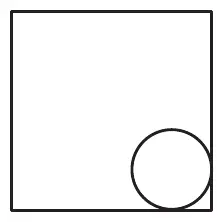
3. The diagram shows a circle with radius 1 that rolls without slipping around the inside of a square with sides of length 5.
The circle rolls once around the square, returning to its starting point.
What distance does the centre of the circle travel?

  1. A \(16 - 2\pi\)
  2. B 12
  3. C \(6 + \pi\)
  4. D \(20 - 2\pi\)
  5. E 20
A circle of radius 1 inside a square, touching two of its sides

Senior Mathematical Challenge 2016, Question 3. © UK Mathematics Trust. Original paper on ukmt.org.uk

SMC 2016 Q6

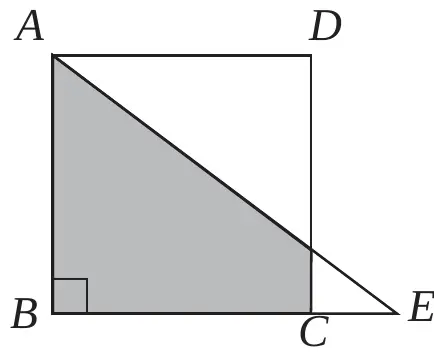
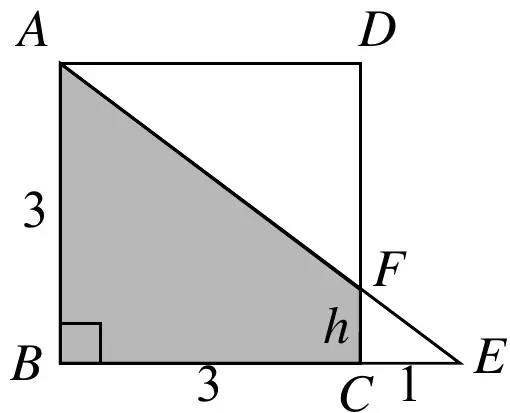
6. The diagram shows a square \(ABCD\) and a right-angled triangle \(ABE\). The length of \(BC\) is 3. The length of \(BE\) is 4.
What is the area of the shaded region?

  1. A \(5\frac{1}{4}\)
  2. B \(5\frac{3}{8}\)
  3. C \(5\frac{1}{2}\)
  4. D \(5\frac{5}{8}\)
  5. E \(5\frac{3}{4}\)
Square ABCD with right-angled triangle ABE, E on BC extended; the part of the triangle inside the square is shaded

Senior Mathematical Challenge 2016, Question 6. © UK Mathematics Trust. Original paper on ukmt.org.uk

SMC 2016 Q13

SMCCurrent spec4 marksArea, Perimeter & Shape

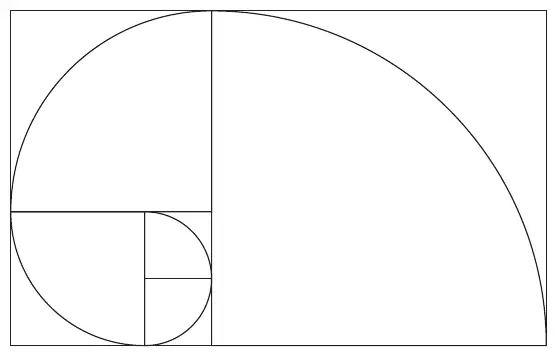
13. Five square tiles are put together side by side. A quarter circle is drawn on each tile to make a continuous curve as shown. Each of the smallest squares has side-length 1.
What is the total length of the curve?

  1. A \(6\pi\)
  2. B \(6.5\pi\)
  3. C \(7\pi\)
  4. D \(7.5\pi\)
  5. E \(8\pi\)
Five squares of sides 1, 1, 2, 3 and 5 put together, with a quarter circle in each forming a continuous spiral curve

Senior Mathematical Challenge 2016, Question 13. © UK Mathematics Trust. Original paper on ukmt.org.uk

SMC 2016 Q18

SMCCurrent spec5 marksArea, Perimeter & Shape

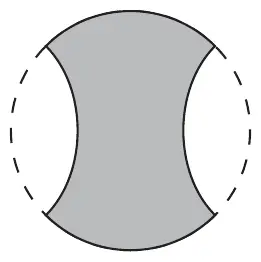
18. The circumference of a circle with radius 1 is divided into four equal arcs. Two of the arcs are ‘turned over’ as shown.
What is the area of the shaded region?

  1. A 1
  2. B \(\sqrt{2}\)
  3. C \(\tfrac{1}{2}\pi\)
  4. D \(\sqrt{3}\)
  5. E 2
A circle with two opposite arcs turned over inwards; the remaining region is shaded

Senior Mathematical Challenge 2016, Question 18. © UK Mathematics Trust. Original paper on ukmt.org.uk

SMC 2016 Q20

SMCCurrent spec5 marksArea, Perimeter & Shape

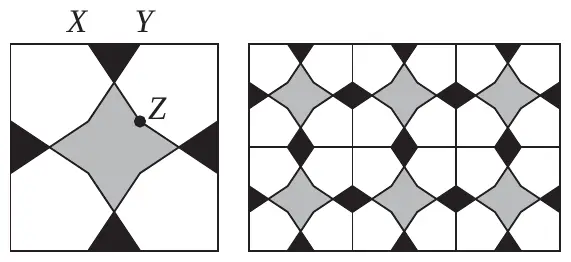
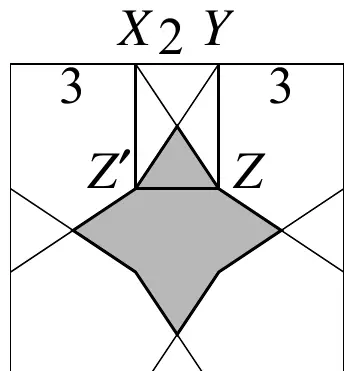
20. Michael was walking in Marrakesh when he saw a tiling formed by tessellating the square tile as shown.
The tile has four lines of symmetry and the length of each side is 8 cm. The length of \(XY\) is 2 cm. The point \(Z\) is such that \(XZ\) is a straight line and \(YZ\) is parallel to sides of the square.
What is the area of the central grey octagon?

  1. A 6 cm2
  2. B 7 cm2
  3. C 8 cm2
  4. D 9 cm2
  5. E 10 cm2
A square tile with a grey central octagon and black triangles, with points X, Y and Z marked, and a tiling made from copies of the tile

Senior Mathematical Challenge 2016, Question 20. © UK Mathematics Trust. Original paper on ukmt.org.uk

SMC 2016 Q23

23. A cuboid has sides of lengths 22, 2 and 10. It is contained within a sphere of the smallest possible radius. What is the side-length of the largest cube that will fit inside the same sphere?

  1. A 10
  2. B 11
  3. C 12
  4. D 13
  5. E 14

Senior Mathematical Challenge 2016, Question 23. © UK Mathematics Trust. Original paper on ukmt.org.uk

SMC 2015 Q4

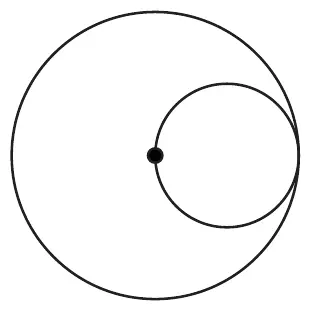
4. In the diagram, the smaller circle touches the larger circle and also passes through its centre. What fraction of the area of the larger circle is outside the smaller circle?

  1. A \(\dfrac{2}{3}\)
  2. B \(\dfrac{3}{4}\)
  3. C \(\dfrac{4}{5}\)
  4. D \(\dfrac{5}{6}\)
  5. E \(\dfrac{6}{7}\)
A large circle with a smaller circle inside it that touches it and passes through its centre

Senior Mathematical Challenge 2015, Question 4. © UK Mathematics Trust. Original paper on ukmt.org.uk

SMC 2015 Q8

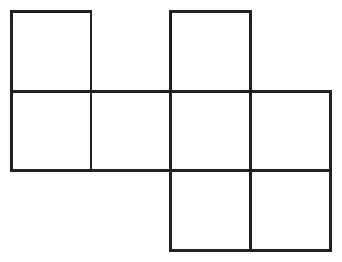
8. The diagram shows eight small squares. Six of these squares are to be shaded so that the shaded squares form the net of a cube.
In how many different ways can this be done?

  1. A 10
  2. B 8
  3. C 7
  4. D 6
  5. E 4
Eight small squares: one square on its own above the left end of a row of four, and a column of three crossing the row

Senior Mathematical Challenge 2015, Question 8. © UK Mathematics Trust. Original paper on ukmt.org.uk

SMC 2015 Q14

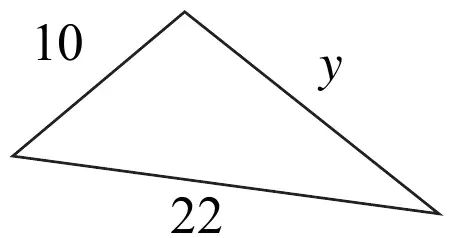
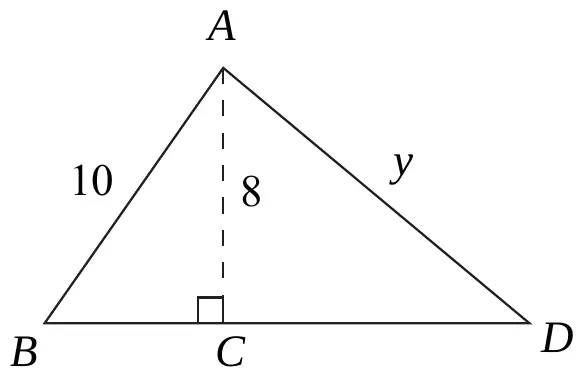
14. The triangle shown has an area of 88 square units. What is the value of \(y\)?

  1. A 17.6
  2. B \(2\sqrt{46}\)
  3. C \(6\sqrt{10}\)
  4. D \(13\sqrt{2}\)
  5. E \(8\sqrt{5}\)
A triangle with sides 10, 22 and y

Senior Mathematical Challenge 2015, Question 14. © UK Mathematics Trust. Original paper on ukmt.org.uk

SMC 2015 Q15

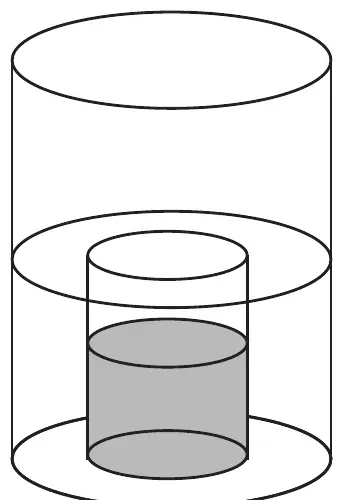
15. Two vases are cylindrical in shape. The larger vase has diameter 20 cm. The smaller vase has diameter 10 cm and height 16 cm. The larger vase is partially filled with water. Then the empty smaller vase, with the open end at the top, is slowly pushed down into the water, which flows over its rim. When the smaller vase is pushed right down, it is half full of water.
What was the original depth of the water in the larger vase?

  1. A 10 cm
  2. B 12 cm
  3. C 14 cm
  4. D 16 cm
  5. E 18 cm
A small cylindrical vase, half full of water, standing inside a larger cylindrical vase of water

Senior Mathematical Challenge 2015, Question 15. © UK Mathematics Trust. Original paper on ukmt.org.uk

SMC 2015 Q17

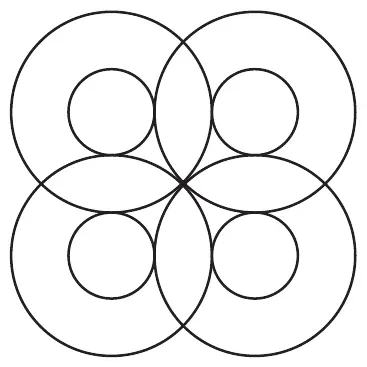
17. The diagram shows eight circles of two different sizes. The circles are arranged in concentric pairs so that the centres form a square. Each larger circle touches one other larger circle and two smaller circles. The larger circles have radius 1. What is the radius of each smaller circle?

  1. A \(\tfrac{1}{3}\)
  2. B \(\tfrac{2}{5}\)
  3. C \(\sqrt{2} - 1\)
  4. D \(\tfrac{1}{2}\)
  5. E \(\tfrac{1}{2}\sqrt{2}\)
Four pairs of concentric circles whose centres form a square; each larger circle touches one other larger circle and two smaller circles

Senior Mathematical Challenge 2015, Question 17. © UK Mathematics Trust. Original paper on ukmt.org.uk

SMC 2015 Q20

SMCCurrent spec5 marksArea, Perimeter & Shape

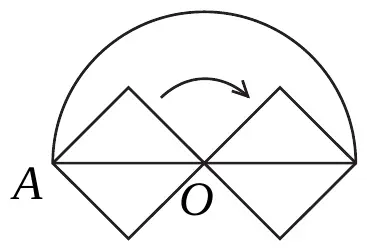
20. A square ink pad has sides of length 1 cm. It is covered in black ink and carefully placed in the middle of a piece of white paper. The square pad is then rotated 180° about one of its corners so that all of the pad remains in contact with the paper throughout the turn. The pad is then removed from the paper. What area of paper, in cm2, is coloured black?

  1. A \(\pi + 2\)
  2. B \(2\pi - 1\)
  3. C 4
  4. D \(2\pi - 2\)
  5. E \(\pi + 1\)

Senior Mathematical Challenge 2015, Question 20. © UK Mathematics Trust. Original paper on ukmt.org.uk

SMC 2014 Q10

SMCCurrent spec4 marksAlgebraArea, Perimeter & Shape

10. A rectangle has area 120 cm2 and perimeter 46 cm. Which of the following is the length of each of the diagonals?

  1. A 15 cm
  2. B 16 cm
  3. C 17 cm
  4. D 18 cm
  5. E 19 cm

Senior Mathematical Challenge 2014, Question 10. © UK Mathematics Trust. Original paper on ukmt.org.uk

SMC 2014 Q16

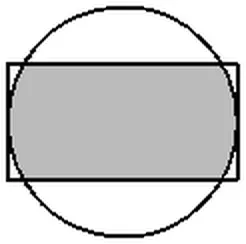
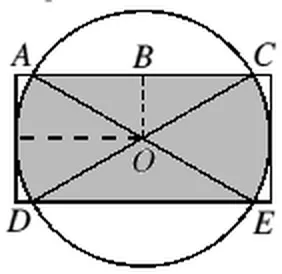
16. The diagram shows a rectangle measuring \(6 \times 12\) and a circle.
The two shorter sides of the rectangle are tangents to the circle. The circle and rectangle have the same centre.
The region that lies inside both the rectangle and the circle is shaded. What is its area?

  1. A \(12\pi + 18\sqrt{3}\)
  2. B \(24\pi - 3\sqrt{3}\)
  3. C \(18\pi - 8\sqrt{3}\)
  4. D \(18\pi + 12\sqrt{3}\)
  5. E \(24\pi + 18\sqrt{3}\)
A circle with a horizontal rectangle whose shorter sides touch the circle; the region inside both is shaded

Senior Mathematical Challenge 2014, Question 16. © UK Mathematics Trust. Original paper on ukmt.org.uk

SMC 2013 Q8

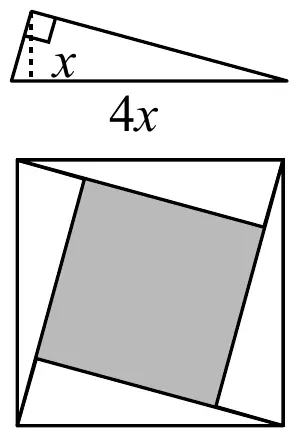
8. The right-angled triangle shown has a base which is 4 times its height. Four such triangles are placed so that their hypotenuses form the boundary of a large square as shown.
What is the side-length of the shaded square in the diagram?

  1. A \(2x\)
  2. B \(2\sqrt{2}x\)
  3. C \(3x\)
  4. D \(2\sqrt{3}x\)
  5. E \(\sqrt{15}x\)
Above, a right-angled triangle with height x and base 4x. Below, four such triangles inside a large square, their hypotenuses forming its boundary, around a shaded square

Senior Mathematical Challenge 2013, Question 8. © UK Mathematics Trust. Original paper on ukmt.org.uk

SMC 2013 Q9

9. According to a headline, ‘Glaciers in the French Alps have lost a quarter of their area in the past 40 years’. What is the approximate percentage reduction in the length of the side of a square when it loses one quarter of its area, thereby becoming a smaller square?

  1. A 13%
  2. B 25%
  3. C 38%
  4. D 50%
  5. E 65%

Senior Mathematical Challenge 2013, Question 9. © UK Mathematics Trust. Original paper on ukmt.org.uk

SMC 2013 Q11

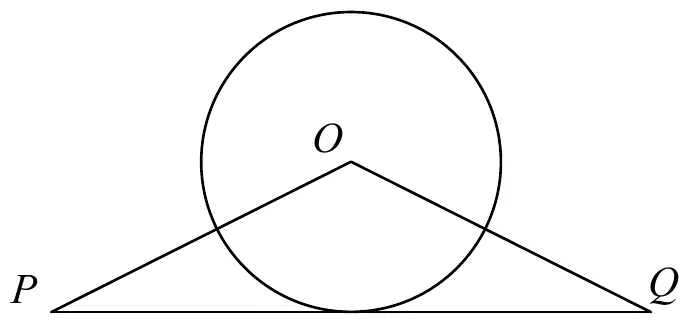
11. The diagram shows a circle with centre \(O\) and a triangle \(OPQ\). Side \(PQ\) is a tangent to the circle. The area of the circle is equal to the area of the triangle. What is the ratio of the length of \(PQ\) to the circumference of the circle?

  1. A \(1 : 1\)
  2. B \(2 : 3\)
  3. C \(2 : \pi\)
  4. D \(3 : 2\)
  5. E \(\pi : 2\)
A circle with centre O and a triangle OPQ whose side PQ is a tangent to the circle

Senior Mathematical Challenge 2013, Question 11. © UK Mathematics Trust. Original paper on ukmt.org.uk

SMC 2013 Q14

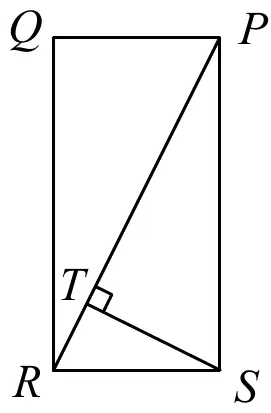
14. The diagram shows a rectangle \(PQRS\) in which \(PQ : QR = 1 : 2\). The point \(T\) on \(PR\) is such that \(ST\) is perpendicular to \(PR\). What is the ratio of the area of the triangle \(RST\) to the area of the rectangle \(PQRS\)?

  1. A \(1 : 4\sqrt{2}\)
  2. B \(1 : 6\)
  3. C \(1 : 8\)
  4. D \(1 : 10\)
  5. E \(1 : 12\)
Rectangle PQRS with Q top left, P top right, R bottom left and S bottom right; the diagonal PR is drawn and ST is perpendicular to PR at T

Senior Mathematical Challenge 2013, Question 14. © UK Mathematics Trust. Original paper on ukmt.org.uk

SMC 2013 Q21

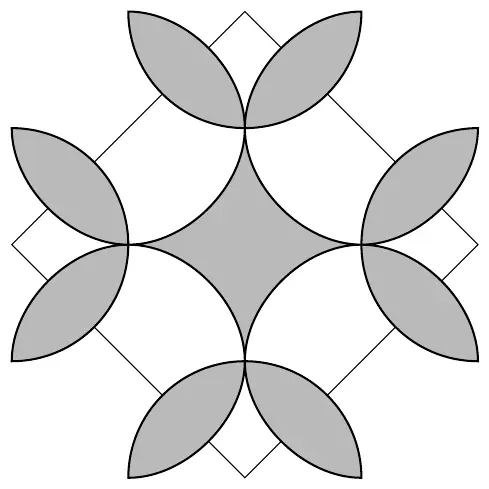
21.
A square standing on one corner with a shaded design of eight circular arcs: four arcs centred on the vertices of the square and four touching arcs centred on the midpoints of its sides

The shaded design shown in the diagram is made by drawing eight circular arcs, all with the same radius. The centres of four arcs are the vertices of the square; the centres of the four touching arcs are the midpoints of the sides of the square. The diagonals of the square have length 1.
What is the total length of the border of the shaded design?

  1. A \(2\pi\)
  2. B \(\dfrac{5\pi}{2}\)
  3. C \(3\pi\)
  4. D \(\dfrac{7\pi}{2}\)
  5. E \(4\pi\)

Senior Mathematical Challenge 2013, Question 21. © UK Mathematics Trust. Original paper on ukmt.org.uk

SMC 2013 Q23

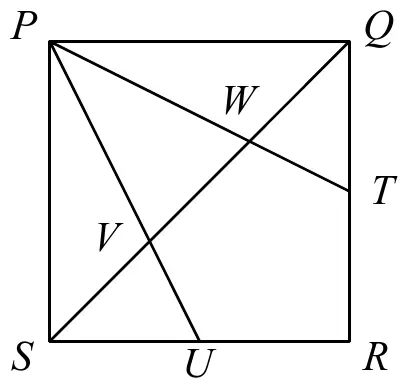
23. PQRS is a square. The points T and U are the midpoints of QR and RS respectively. The line QS cuts PT and PU at W and V respectively. What fraction of the area of the square PQRS is the area of the pentagon RTWVU?

  1. A \(\dfrac{1}{3}\)
  2. B \(\dfrac{2}{5}\)
  3. C \(\dfrac{3}{7}\)
  4. D \(\dfrac{5}{12}\)
  5. E \(\dfrac{4}{15}\)
Square PQRS with T the midpoint of QR and U the midpoint of RS; the diagonal QS crosses PT at W and PU at V

Senior Mathematical Challenge 2013, Question 23. © UK Mathematics Trust. Original paper on ukmt.org.uk

SMC 2012 Q11

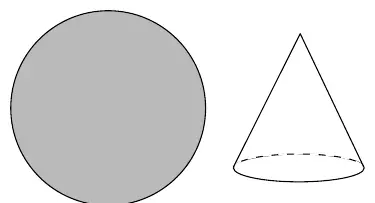
11. Coco is making clown hats from a circular piece of cardboard. The circumference of the base of each hat equals its slant height, which in turn is equal to the radius of the piece of cardboard. What is the maximum number of hats that Coco can make from the piece of cardboard?

  1. A 3
  2. B 4
  3. C 5
  4. D 6
  5. E 7
A grey circular piece of cardboard and a cone-shaped hat

Senior Mathematical Challenge 2012, Question 11. © UK Mathematics Trust. Original paper on ukmt.org.uk

SMC 2012 Q16

SMCCurrent spec5 marksAlgebraArea, Perimeter & Shape

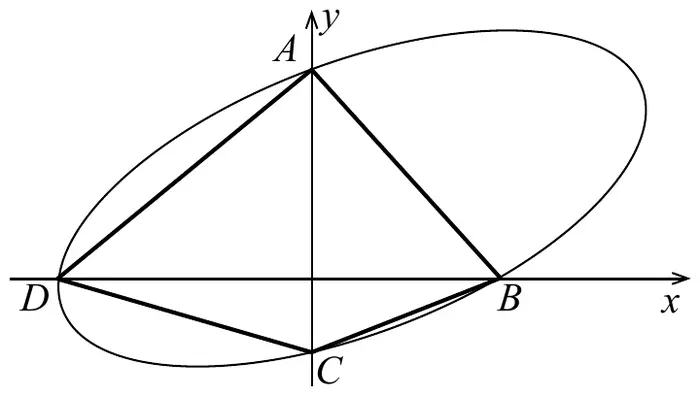
16. The diagram shows the ellipse whose equation is \(x^2 + y^2 - xy + x - 4y = 12\). The curve cuts the \(y\)-axis at points \(A\) and \(C\) and cuts the \(x\)-axis at points \(B\) and \(D\). What is the area of the inscribed quadrilateral \(ABCD\)?

  1. A 28
  2. B 36
  3. C 42
  4. D 48
  5. E 56
An ellipse crossing the axes, with quadrilateral ABCD drawn: A and C on the y-axis, D and B on the x-axis

Senior Mathematical Challenge 2012, Question 16. © UK Mathematics Trust. Original paper on ukmt.org.uk

SMC 2012 Q17

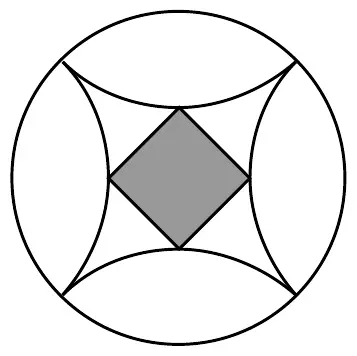
17. The diagram shows a pattern found on a floor tile in the cathedral in Spoleto, Umbria. A circle of radius 1 surrounds four quarter circles, also of radius 1, which enclose a square. The pattern has four axes of symmetry. What is the side length of the square?

  1. A \(\dfrac{1}{\sqrt{2}}\)
  2. B \(2 - \sqrt{2}\)
  3. C \(\dfrac{1}{\sqrt{3}}\)
  4. D \(\dfrac{1}{2}\)
  5. E \(\sqrt{2} - 1\)
A circle containing four quarter circle arcs which enclose a grey square standing on one corner

Senior Mathematical Challenge 2012, Question 17. © UK Mathematics Trust. Original paper on ukmt.org.uk

SMC 2012 Q20

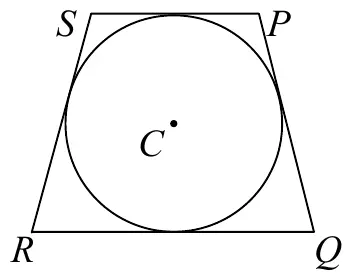
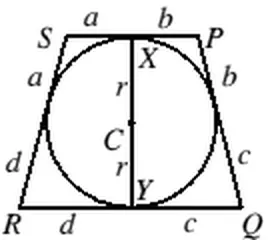
20. In trapezium PQRS, SR = PQ = 25cm and SP is parallel to RQ. All four sides of PQRS are tangent to a circle with centre C. The area of the trapezium is 600cm2. What is the radius of the circle?

  1. A 7.5cm
  2. B 8cm
  3. C 9cm
  4. D 10cm
  5. E 12cm
Trapezium PQRS with SP at the top and RQ at the bottom, and a circle with centre C touching all four sides

Senior Mathematical Challenge 2012, Question 20. © UK Mathematics Trust. Original paper on ukmt.org.uk

SMC 2012 Q22

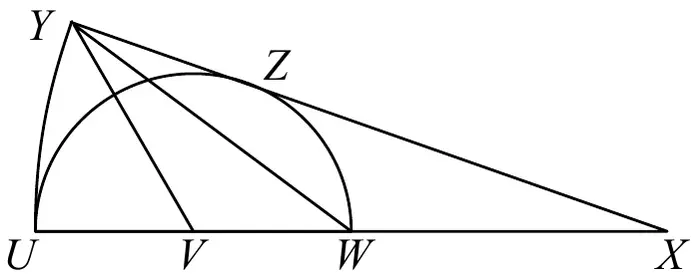
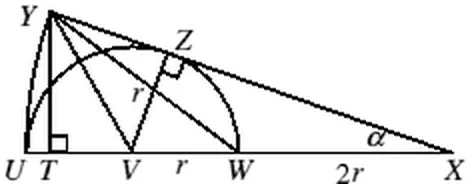
22. A semicircle of radius \(r\) is drawn with centre \(V\) and diameter \(UW\). The line \(UW\) is then extended to the point \(X\), such that \(UW\) and \(WX\) are of equal length. An arc of the circle with centre \(X\) and radius \(4r\) is then drawn so that the line \(XY\) is a tangent to the semicircle at \(Z\), as shown. What, in terms of \(r\), is the area of triangle \(YVW\)?

  1. A \(\dfrac{4r^2}{9}\)
  2. B \(\dfrac{2r^2}{3}\)
  3. C \(r^2\)
  4. D \(\dfrac{4r^2}{3}\)
  5. E \(2r^2\)
A semicircle on diameter UW with centre V; UW is extended to X; an arc centred at X passes through Y above U, and the line XY touches the semicircle at Z

Senior Mathematical Challenge 2012, Question 22. © UK Mathematics Trust. Original paper on ukmt.org.uk

SMC 2012 Q24

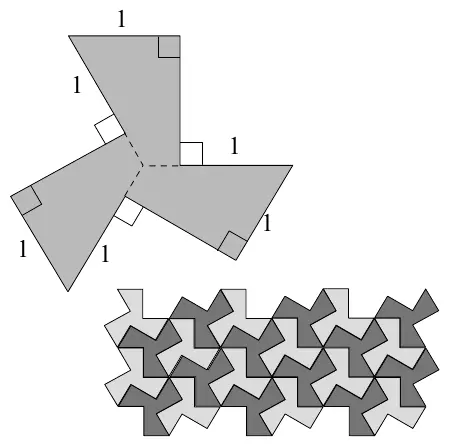
24. The top diagram on the right shows a shape that tiles the plane, as shown in the lower diagram. The tile has nine sides, six of which have length 1. It may be divided into three congruent quadrilaterals as shown. What is the area of the tile?

  1. A \(\dfrac{1 + 2\sqrt{3}}{2}\)
  2. B \(\dfrac{4\sqrt{3}}{3}\)
  3. C \(\sqrt{6}\)
  4. D \(\dfrac{3 + 4\sqrt{3}}{4}\)
  5. E \(\dfrac{3\sqrt{3}}{2}\)
Top: a grey nine-sided tile divided into three congruent quadrilaterals, with six sides of length 1 and right angles marked. Bottom: copies of the tile in light and dark grey tiling the plane

Senior Mathematical Challenge 2012, Question 24. © UK Mathematics Trust. Original paper on ukmt.org.uk

SMC 2011 Q10

10. A triangle has two edges of length 5. What length should be chosen for the third side of the triangle so as to maximise the area within the triangle?

  1. A 5
  2. B 6
  3. C \(5\sqrt{2}\)
  4. D 8
  5. E \(5\sqrt{3}\)

Senior Mathematical Challenge 2011, Question 10. © UK Mathematics Trust. Original paper on ukmt.org.uk

SMC 2011 Q11

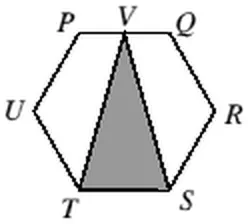
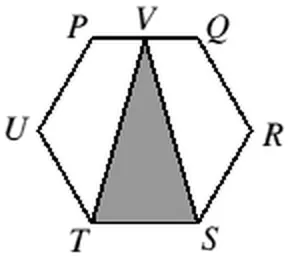
11. PQRSTU is a regular hexagon and V is the midpoint of PQ.
What fraction of the area of PQRSTU is the area of triangle STV?

  1. A \(\dfrac{1}{4}\)
  2. B \(\dfrac{2}{15}\)
  3. C \(\dfrac{1}{3}\)
  4. D \(\dfrac{2}{5}\)
  5. E \(\dfrac{5}{12}\)
A regular hexagon PQRSTU with V the midpoint of PQ; triangle STV is shaded grey

Senior Mathematical Challenge 2011, Question 11. © UK Mathematics Trust. Original paper on ukmt.org.uk

SMC 2011 Q16

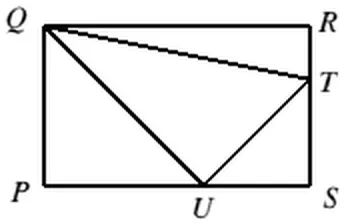
16. PQRS is a rectangle. The area of triangle QRT is \(\tfrac{1}{5}\) of the area of PQRS, and the area of triangle TSU is \(\tfrac{1}{8}\) of the area of PQRS. What fraction of the area of rectangle PQRS is the area of triangle QTU?

  1. A \(\dfrac{27}{40}\)
  2. B \(\dfrac{21}{40}\)
  3. C \(\dfrac{1}{2}\)
  4. D \(\dfrac{19}{40}\)
  5. E \(\dfrac{23}{60}\)
Rectangle PQRS with Q top left, R top right, S bottom right and P bottom left; T is on RS and U is on PS, and triangle QTU is drawn

Senior Mathematical Challenge 2011, Question 16. © UK Mathematics Trust. Original paper on ukmt.org.uk

SMC 2011 Q19

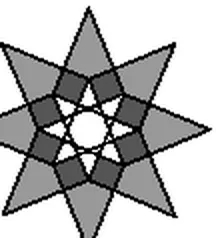
19. The diagram shows a small regular octagram (an eight-sided star) surrounded by eight squares (dark grey) and eight kites (light grey) to make a large regular octagram. Each square has area 1.
What is the area of one of the light grey kites?

  1. A 2
  2. B \(\sqrt{2} + 1\)
  3. C \(\dfrac{21}{8}\)
  4. D \(4\sqrt{2} - 3\)
  5. E \(\dfrac{11}{4}\)
A large eight-pointed star made of a small white octagram surrounded by eight dark grey squares and eight light grey kites

Senior Mathematical Challenge 2011, Question 19. © UK Mathematics Trust. Original paper on ukmt.org.uk

SMC 2011 Q25

SMCCurrent spec5 marksArea, Perimeter & Shape

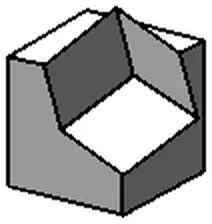
25. A solid sculpture consists of a \(4 \times 4 \times 4\) cube with a \(3 \times 3 \times 3\) cube sticking out, as shown. Three vertices of the smaller cube lie on edges of the larger cube, the same distance along each.
What is the total volume of the sculpture?

  1. A 79
  2. B 81
  3. C 82
  4. D 84
  5. E 85
A 4 by 4 by 4 cube with a 3 by 3 by 3 cube sticking out of one corner

Senior Mathematical Challenge 2011, Question 25. © UK Mathematics Trust. Original paper on ukmt.org.uk

SMC 2010 Q10

SMCCurrent spec4 marksAlgebraArea, Perimeter & Shape

10. A square is cut into 37 squares of which 36 have area 1 cm2. What is the length of the side of the original square?

  1. A 6 cm
  2. B 7 cm
  3. C 8 cm
  4. D 9 cm
  5. E 10 cm

Senior Mathematical Challenge 2010, Question 10. © UK Mathematics Trust. Original paper on ukmt.org.uk

SMC 2010 Q12

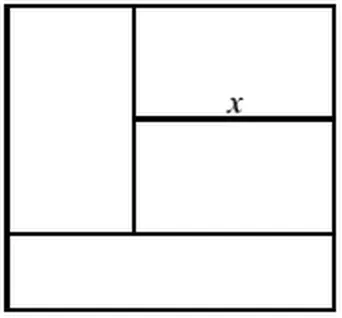
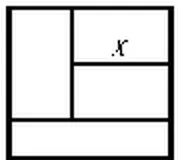
12. The diagram, which is not to scale, shows a square with side length 1, divided into four rectangles whose areas are equal. What is the length labelled \(x\)?

  1. A \(\dfrac{2}{3}\)
  2. B \(\dfrac{17}{24}\)
  3. C \(\dfrac{4}{5}\)
  4. D \(\dfrac{49}{60}\)
  5. E \(\dfrac{5}{6}\)
A square divided into four rectangles: a tall rectangle on the left, two rectangles stacked on the right with the length x marked on their common side, and a wide rectangle along the bottom

Senior Mathematical Challenge 2010, Question 12. © UK Mathematics Trust. Original paper on ukmt.org.uk

SMC 2010 Q18

SMCCurrent spec5 marksArea, Perimeter & Shape

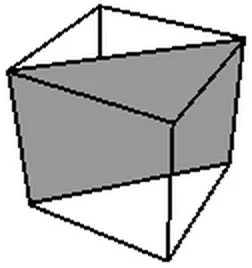
18. A solid cube of side 2 cm is cut into two triangular prisms by a plane passing through four vertices, as shown. What is the total surface area of these two prisms?

  1. A \(8(3 + \sqrt{2})\)
  2. B \(2(8 + \sqrt{2})\)
  3. C \(8(3 + 2\sqrt{2})\)
  4. D \(16(3 + \sqrt{2})\)
  5. E \(8\sqrt{2}\)
A cube cut by a shaded plane passing through four of its vertices

Senior Mathematical Challenge 2010, Question 18. © UK Mathematics Trust. Original paper on ukmt.org.uk

SMC 2010 Q19

SMCCurrent spec5 marksArea, Perimeter & Shape

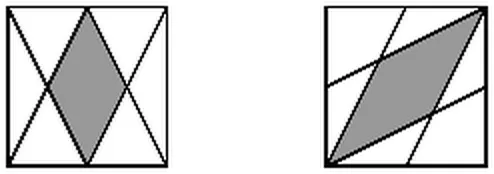
19. The diagrams show two different shaded rhombuses, each inside a square with sides of length 6.
Each rhombus is formed by joining vertices of the square to midpoints of the sides of the square. What is the difference between the shaded areas?

  1. A 4
  2. B 3
  3. C 2
  4. D 1
  5. E 0
Two squares side by side, each with lines from vertices to midpoints of sides; the left square has a vertical grey rhombus and the right square has a slanted grey rhombus

Senior Mathematical Challenge 2010, Question 19. © UK Mathematics Trust. Original paper on ukmt.org.uk

SMC 2010 Q21

21. The diagram shows a regular hexagon, with sides of length 1, inside a square. Two vertices of the hexagon lie on a diagonal of the square and the other four lie on the edges.

What is the area of the square?

  1. A \(2 + \sqrt{3}\)
  2. B 4
  3. C \(3 + \sqrt{2}\)
  4. D \(1 + \dfrac{3\sqrt{3}}{2}\)
  5. E \(\dfrac{7}{2}\)
A grey regular hexagon inside a square, with two vertices on a diagonal of the square and the other four on its edges

Senior Mathematical Challenge 2010, Question 21. © UK Mathematics Trust. Original paper on ukmt.org.uk

SMC 2010 Q23

23. The diagram shows two different semicircles inside a square with sides of length 2. The common centre of the semicircles lies on a diagonal of the square.
What is the total shaded area?

  1. A \(\pi\)
  2. B \(6\pi(3 - 2\sqrt{2})\)
  3. C \(\pi\sqrt{2}\)
  4. D \(3\pi(2 - \sqrt{2})\)
  5. E \(8\pi(2\sqrt{2} - 3)\)
A square containing two grey semicircles of different sizes whose diameters lie along a diagonal of the square, with their common centre marked

Senior Mathematical Challenge 2010, Question 23. © UK Mathematics Trust. Original paper on ukmt.org.uk

SMC 2010 Q24

24. Three spheres of radius 1 are placed on a horizontal table and inside a vertical hollow cylinder of height 2 units which is just large enough to surround them. What fraction of the internal volume of the cylinder is occupied by the spheres?

  1. A \(\dfrac{2}{7 + 4\sqrt{3}}\)
  2. B \(\dfrac{2}{2 + \sqrt{3}}\)
  3. C \(\dfrac{1}{3}\)
  4. D \(\dfrac{3}{2 + \sqrt{3}}\)
  5. E \(\dfrac{6}{7 + 4\sqrt{3}}\)

Senior Mathematical Challenge 2010, Question 24. © UK Mathematics Trust. Original paper on ukmt.org.uk

SMC 2009 Q17

17. A solid cube is divided into two pieces by a single rectangular cut. As a result, the total surface area increases by a fraction \(f\) of the surface area of the original cube. What is the greatest possible value of \(f\)?

  1. A \(\dfrac{1}{3}\)
  2. B \(\dfrac{\sqrt{3}}{4}\)
  3. C \(\dfrac{\sqrt{2}}{3}\)
  4. D \(\dfrac{1}{2}\)
  5. E \(\dfrac{1}{\sqrt{3}}\)

Senior Mathematical Challenge 2009, Question 17. © UK Mathematics Trust. Original paper on ukmt.org.uk

SMC 2009 Q20

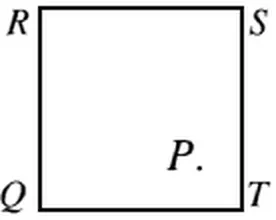
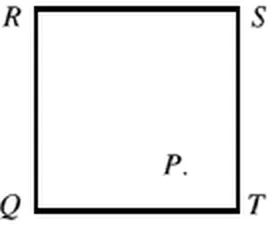
20. A point \(P\) is chosen at random inside a square \(QRST\). What is the probability that \(\angle RPQ\) is acute?

  1. A \(\dfrac{3}{4}\)
  2. B \(\sqrt{2} - 1\)
  3. C \(\dfrac{1}{2}\)
  4. D \(\dfrac{\pi}{4}\)
  5. E \(1 - \dfrac{\pi}{8}\)
Square QRST with R top left, S top right, Q bottom left and T bottom right, and a point P inside it

Senior Mathematical Challenge 2009, Question 20. © UK Mathematics Trust. Original paper on ukmt.org.uk

SMC 2009 Q21

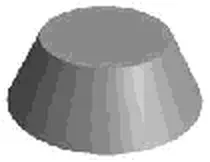
21. A frustum is the solid obtained by slicing a right-circular cone perpendicular to its axis and removing the small cone above the slice. This leaves a shape with two circular faces and a curved surface. The original cone has base radius 6 cm and height 8 cm, and the curved surface area of the frustum is equal to the area of the two circles. What is the height of the frustum?

  1. A 3 cm
  2. B 4 cm
  3. C 5 cm
  4. D 6 cm
  5. E 7 cm
A grey frustum of a cone, wider at the bottom than at the top

Senior Mathematical Challenge 2009, Question 21. © UK Mathematics Trust. Original paper on ukmt.org.uk

SMC 2009 Q22

SMCCurrent spec5 marksArea, Perimeter & Shape

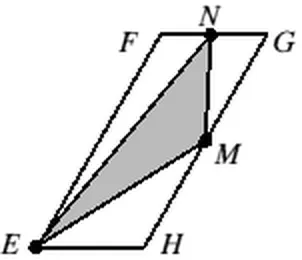
22. \(M\) and \(N\) are the midpoints of sides \(GH\) and \(FG\), respectively, of parallelogram \(EFGH\). The area of triangle \(ENM\) is 12 cm2. What is the area of the parallelogram \(EFGH\)?

  1. A 20 cm2
  2. B 24 cm2
  3. C 32 cm2
  4. D 48 cm2
  5. E more information is required

Senior Mathematical Challenge 2009, Question 22. © UK Mathematics Trust. Original paper on ukmt.org.uk

SMC 2009 Q24

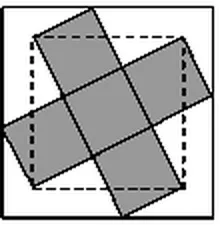
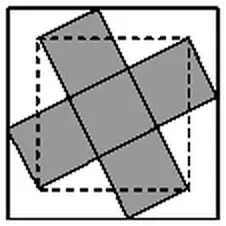
24. A figure in the shape of a cross is made from five 1 × 1 squares, as shown. The cross is inscribed in a large square whose sides are parallel to the dashed square, formed by four of the vertices of the cross. What is the area of the large outer square?

  1. A 9
  2. B \(\dfrac{49}{5}\)
  3. C 10
  4. D \(\dfrac{81}{8}\)
  5. E \(\dfrac{32}{3}\)
A grey cross of five unit squares, tilted, inside a large square; four vertices of the cross form a dashed square with sides parallel to the large square

Senior Mathematical Challenge 2009, Question 24. © UK Mathematics Trust. Original paper on ukmt.org.uk

SMC 2008 Q11

SMCCurrent spec4 marksArea, Perimeter & Shape

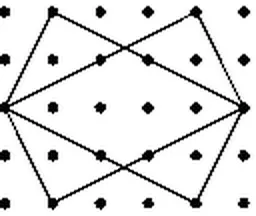
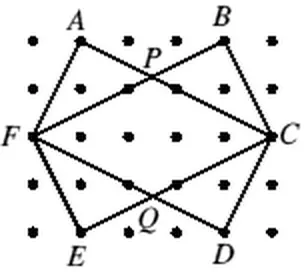
11. The distance between two neighbouring dots in the dot lattice is 1 unit. What, in square units, is the area of the region where the two rectangles overlap?

  1. A 6
  2. B \(6\tfrac{1}{4}\)
  3. C \(6\tfrac{1}{2}\)
  4. D 7
  5. E \(7\tfrac{1}{2}\)
A dot lattice with two congruent rectangles drawn on it, tilted in opposite directions, crossing to form an X shape

Senior Mathematical Challenge 2008, Question 11. © UK Mathematics Trust. Original paper on ukmt.org.uk

SMC 2008 Q18

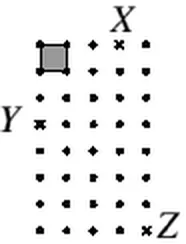
18. The shaded square of the lattice shown has area 1. What is the area of the circle through the points \(X\), \(Y\) and \(Z\)?

  1. A \(\dfrac{9\pi}{2}\)
  2. B \(8\pi\)
  3. C \(\dfrac{25\pi}{2}\)
  4. D \(25\pi\)
  5. E \(50\pi\)
A rectangular lattice of dots with a small shaded unit square at the top left; X is a point on the top row, Y a point on the left-hand side and Z the bottom right corner

Senior Mathematical Challenge 2008, Question 18. © UK Mathematics Trust. Original paper on ukmt.org.uk

SMC 2008 Q20

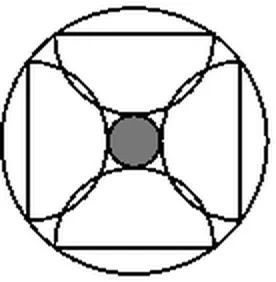
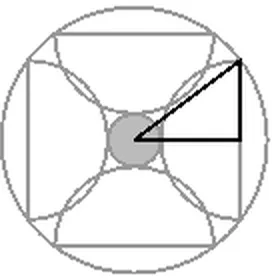
20. The diagram shows four semicircles symmetrically placed between two circles. The shaded circle has area 4 and each semicircle has area 18. What is the area of the outer circle?

  1. A \(72\sqrt{2}\)
  2. B 100
  3. C 98
  4. D 96
  5. E \(32\sqrt{3}\)
A large circle containing a square-like shape whose four sides are bowed in by four semicircles, with a small shaded circle at the centre touching all four semicircles

Senior Mathematical Challenge 2008, Question 20. © UK Mathematics Trust. Original paper on ukmt.org.uk

SMC 2008 Q25

SMCCurrent spec5 marksAlgebraArea, Perimeter & Shape

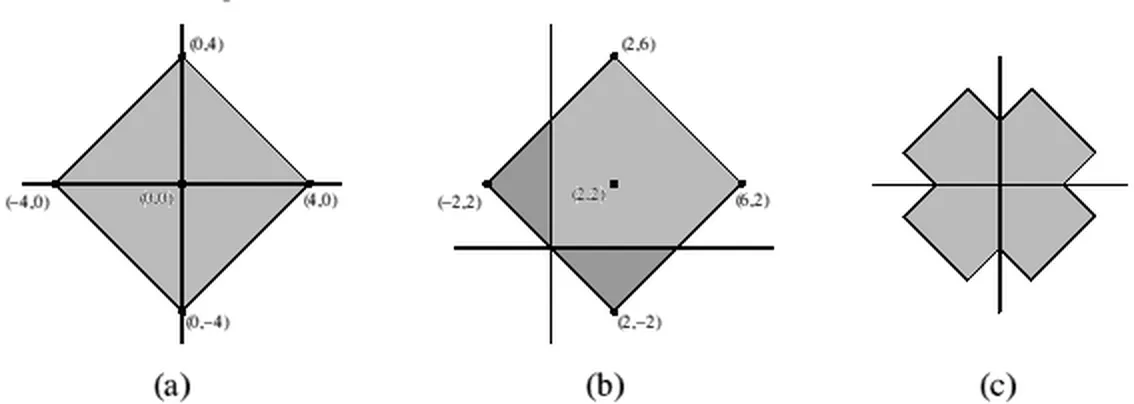
25. What is the area of the polygon formed by all points \((x,\ y)\) in the plane satisfying the inequality \(\big|\,|x| - 2\big| + \big|\,|y| - 2\big| \leqslant 4\) ?

  1. A 24
  2. B 32
  3. C 64
  4. D 96
  5. E 112

Senior Mathematical Challenge 2008, Question 25. © UK Mathematics Trust. Original paper on ukmt.org.uk

SMC 2007 Q11

SMCCurrent spec4 marksArea, Perimeter & Shape

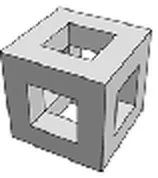
11. A 4 × 4 × 4 cube has three 2 × 2 × 4 holes drilled symmetrically all the way through, as shown.
What is the surface area of the resulting solid?

  1. A 192
  2. B 144
  3. C 136
  4. D 120
  5. E 96
A grey cube with a square hole through the middle of each pair of opposite faces

Senior Mathematical Challenge 2007, Question 11. © UK Mathematics Trust. Original paper on ukmt.org.uk

SMC 2007 Q14

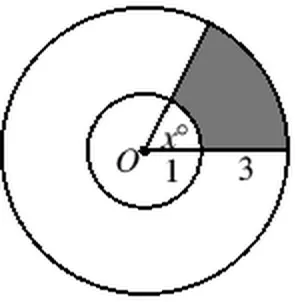
14. The point \(O\) is the centre of both circles and the shaded area is one-sixth of the area of the outer circle.
What is the value of \(x\)?

  1. A 60
  2. B 64
  3. C 72
  4. D 80
  5. E 84
Two concentric circles with centre O and radii 1 and 3; a sector of angle x degrees is shaded in the ring between the circles

Senior Mathematical Challenge 2007, Question 14. © UK Mathematics Trust. Original paper on ukmt.org.uk

SMC 2007 Q17

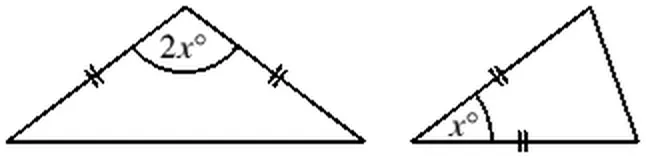
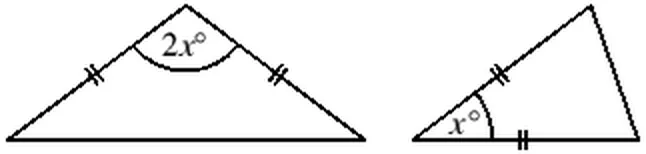
17. The two triangles have equal areas and the four marked lengths are equal.
What is the value of \(x\)?

  1. A 30
  2. B 45
  3. C 60
  4. D 75
  5. E more information needed
Two triangles. The first is isosceles with its two equal sides marked and the angle between them 2x degrees. The second has two marked sides, equal to those of the first, with the angle between them x degrees

Senior Mathematical Challenge 2007, Question 17. © UK Mathematics Trust. Original paper on ukmt.org.uk

SMC 2007 Q20

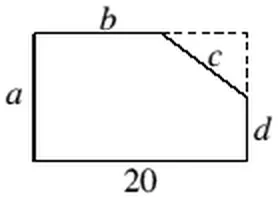
20. A triangle is cut from the corner of a rectangle. The resulting pentagon has sides of length 8, 10, 13, 15 and 20 units, though not necessarily in that order. What is the area of the pentagon?

  1. A 252.5
  2. B 260
  3. C 270
  4. D 275.5
  5. E 282.5

Senior Mathematical Challenge 2007, Question 20. © UK Mathematics Trust. Original paper on ukmt.org.uk

SMC 2007 Q22

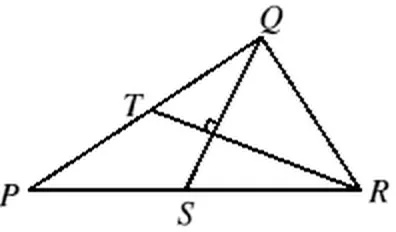
22. In triangle \(PQR\), \(S\) and \(T\) are the midpoints of \(PR\) and \(PQ\) respectively; \(QS\) is perpendicular to \(RT\); \(QS = 8\); \(RT = 12\).
What is the area of triangle \(PQR\)?

  1. A 24
  2. B 32
  3. C 48
  4. D 64
  5. E 96
Triangle PQR with S the midpoint of PR and T the midpoint of PQ; QS and RT cross at right angles

Senior Mathematical Challenge 2007, Question 22. © UK Mathematics Trust. Original paper on ukmt.org.uk

SMC 2007 Q23

SMCCurrent spec5 marksAlgebraArea, Perimeter & Shape

23. The sum of the lengths of the 12 edges of a cuboid is \(x\) cm. The distance from one corner of the cuboid to the furthest corner is \(y\) cm. What, in cm2, is the total surface area of the cuboid?

  1. A \(\dfrac{x^2 - 2y^2}{2}\)
  2. B \(x^2 + y^2\)
  3. C \(\dfrac{x^2 - 4y^2}{4}\)
  4. D \(\dfrac{xy}{6}\)
  5. E \(\dfrac{x^2 - 16y^2}{16}\)

Senior Mathematical Challenge 2007, Question 23. © UK Mathematics Trust. Original paper on ukmt.org.uk

SMC 2006 Q15

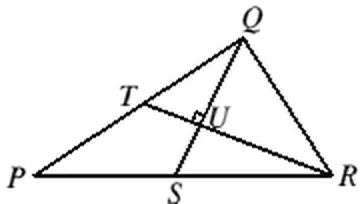
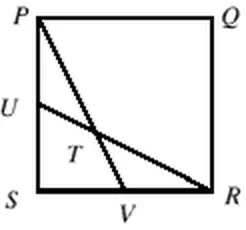
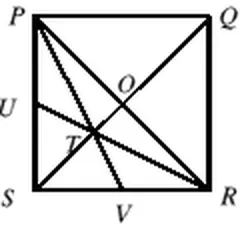
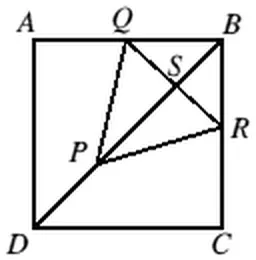
15. \(PQRS\) is a square with \(U\) and \(V\) the mid-points of the sides \(PS\) and \(SR\) respectively. Line segments \(PV\) and \(UR\) meet at \(T\).
What fraction of the area of the square \(PQRS\) is the area of the quadrilateral \(PQRT\)?

  1. A \(\tfrac{1}{2}\)
  2. B \(\tfrac{5}{8}\)
  3. C \(\tfrac{2}{3}\)
  4. D \(\tfrac{3}{4}\)
  5. E \(\tfrac{5}{9}\)
Square PQRS with U the midpoint of PS and V the midpoint of SR; segments PV and UR cross at T

Senior Mathematical Challenge 2006, Question 15. © UK Mathematics Trust. Original paper on ukmt.org.uk

SMC 2006 Q17

SMCCurrent spec5 marksAlgebraArea, Perimeter & Shape

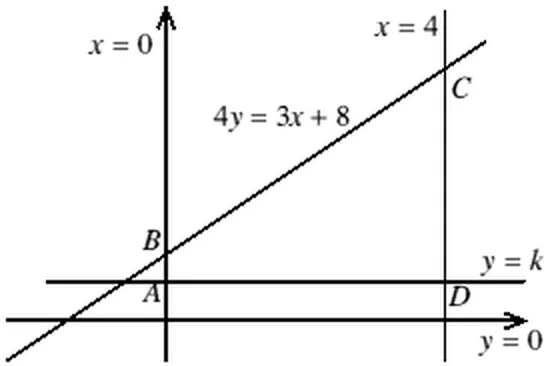
17. A trapezium is bounded by four lines, the equations of which are \(x = 0\), \(x = 4\), \(4y = 3x + 8\) and \(y = k\), where \(k < 2\).
For which value of \(k\) is the numerical value of the perimeter of the trapezium equal to the numerical value of the area of the trapezium?

  1. A \(\tfrac{3}{2}\)
  2. B 1
  3. C \(\tfrac{1}{2}\)
  4. D \(-\tfrac{1}{2}\)
  5. E −1

Senior Mathematical Challenge 2006, Question 17. © UK Mathematics Trust. Original paper on ukmt.org.uk

SMC 2006 Q23

23. In the diagram, the circle and the two semicircles have radius 1.
What is the perimeter of the square?

  1. A \(6 + 4\sqrt{2}\)
  2. B \(2 + 4\sqrt{2} + 2\sqrt{3}\)
  3. C \(3\sqrt{2} + 4\sqrt{3}\)
  4. D \(4 + 2\sqrt{2} + 2\sqrt{6}\)
  5. E 12
A square containing a shaded circle in its bottom left corner and two shaded semicircles, one on the top side and one on the right-hand side, all touching each other

Senior Mathematical Challenge 2006, Question 23. © UK Mathematics Trust. Original paper on ukmt.org.uk

SMC 2006 Q24

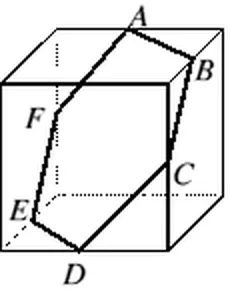
24. A solid red plastic cube, volume 1 cm3, is painted white on its outside. The cube is cut by a plane passing through the mid-points of various edges, as shown.
What, in cm2, is the total red area exposed by the cut?

  1. A \(\dfrac{3\sqrt{3}}{2}\)
  2. B 2
  3. C \(\dfrac{9\sqrt{2}}{5}\)
  4. D 3
  5. E \(\dfrac{3(\sqrt{3} + \sqrt{2})}{4}\)
A cube cut by a plane through the midpoints A, B, C, D, E, F of six of its edges, forming a hexagonal cross-section

Senior Mathematical Challenge 2006, Question 24. © UK Mathematics Trust. Original paper on ukmt.org.uk

SMC 2005 Q4

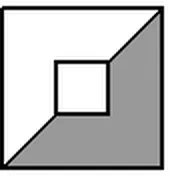
4. The diagram shows two squares, with sides of length 1 and 3, which have the same centre and corresponding sides parallel. What fraction of the larger square is shaded?

  1. A \(\dfrac{4}{9}\)
  2. B \(\dfrac{4}{11}\)
  3. C \(\dfrac{2}{5}\)
  4. D \(\dfrac{2}{7}\)
  5. E \(\dfrac{6}{11}\)
A small square inside a larger square with the same centre; the region below the diagonal from the bottom left to the top right corner of the large square, outside the small square, is shaded

Senior Mathematical Challenge 2005, Question 4. © UK Mathematics Trust. Original paper on ukmt.org.uk

SMC 2005 Q11

SMCCurrent spec4 marksArea, Perimeter & Shape

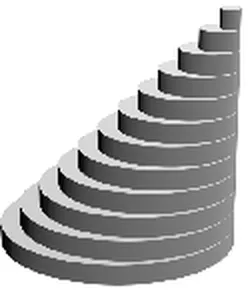
11. A sculpture is made up of 12 wooden cylinders, each of height 2 cm. They are glued together as shown. The diameter of the top cylinder is 2 cm and each of the other cylinders has a diameter 2 cm more than the one immediately above it. The exhibit stands with its base on a marble table. What, in cm2, is the total surface area of the sculpture, excluding the base?

  1. A \(456\pi\)
  2. B \(356\pi\)
  3. C \(256\pi\)
  4. D \(156\pi\)
  5. E \(144\pi\)
A stack of twelve grey cylinders, each smaller than the one below, with their backs lined up so that they form a stepped tower

Senior Mathematical Challenge 2005, Question 11. © UK Mathematics Trust. Original paper on ukmt.org.uk

SMC 2005 Q17

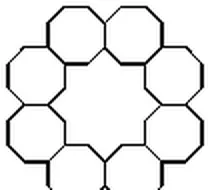
17. Eight identical regular octagons are placed edge to edge in a ring in such a way that a symmetrical star shape is formed by the interior edges.
If each octagon has sides of length 1, what is the area of the star?

  1. A \(5 + 10\sqrt{2}\)
  2. B \(8\sqrt{2}\)
  3. C \(9 + 4\sqrt{2}\)
  4. D \(16 - 4\sqrt{2}\)
  5. E \(8 + 4\sqrt{2}\)
Eight regular octagons joined edge to edge in a ring, enclosing a star-shaped region in the middle

Senior Mathematical Challenge 2005, Question 17. © UK Mathematics Trust. Original paper on ukmt.org.uk

SMC 2005 Q20

20. It takes two weeks to clean the 3312 panes of glass in the 6000 m2 glass roof of the British Museum, a task performed once every two years. Assuming that all the panes are equilateral triangles of the same size, roughly how long is the side of each pane?

  1. A 50 cm
  2. B 1 m
  3. C 2 m
  4. D 3 m
  5. E 4 m

Senior Mathematical Challenge 2005, Question 20. © UK Mathematics Trust. Original paper on ukmt.org.uk

SMC 2005 Q23

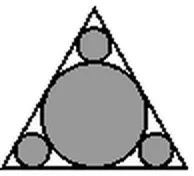
23. The diagram shows four touching circles, each of which also touches the sides of an equilateral triangle with sides of length 3.
What is the area of the shaded region?

  1. A \(\dfrac{11\pi}{12}\)
  2. B \(\pi\)
  3. C \(\dfrac{(4 + \sqrt{3})\pi}{6}\)
  4. D \(\dfrac{(3 + \sqrt{3})\pi}{4}\)
  5. E \(\dfrac{37\pi}{36}\)
An equilateral triangle containing a large shaded circle touching all three sides and three small shaded circles, one in each corner, each touching the large circle and two sides

Senior Mathematical Challenge 2005, Question 23. © UK Mathematics Trust. Original paper on ukmt.org.uk