
SMC 2013 Q8
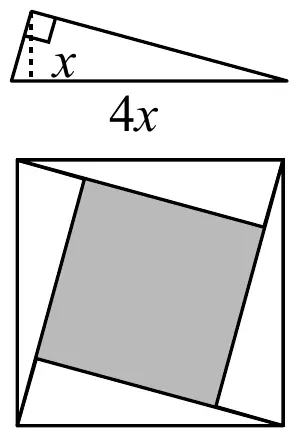
8. The right-angled triangle shown has a base which is 4 times its height. Four such triangles are placed so that their hypotenuses form the boundary of a large square as shown.
What is the side-length of the shaded square in the diagram?
- A \(2x\)
- B \(2\sqrt{2}x\)
- C \(3x\)
- D \(2\sqrt{3}x\)
- E \(\sqrt{15}x\)
Senior Mathematical Challenge 2013, Question 8. © UK Mathematics Trust. Original paper on ukmt.org.uk
Answer: B \(2\sqrt{2}x\)
The area of the shaded square is equal to the area of the large square minus the area of the four triangles. Thus the area of the shaded square is \((4x)^2 - 4 \times \tfrac{1}{2} \times 4x \times x = 16x^2 - 8x^2 = 8x^2\). So the side-length is \(\sqrt{8x^2} = 2\sqrt{2}x\).
Solution © UK Mathematics Trust, from the SMC 2013 solutions. Longer versions with investigations: Solutions and investigations (PDF).