Geometry & Angles

Your progress
0 of 149 done
Ticks are kept only in this browser: clearing your browsing data or changing device loses them. · ·

Senior Mathematical Challenge (SMC)

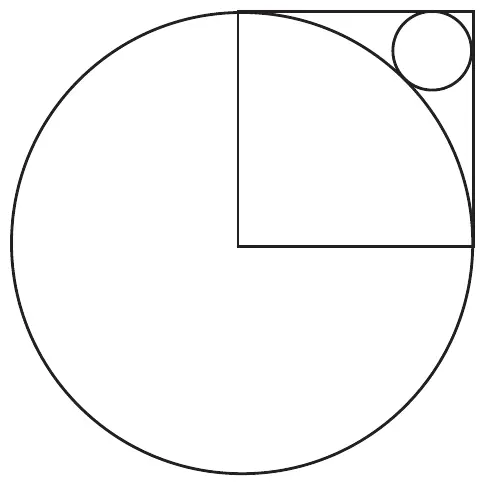
Senior Kangaroo (SK)

Mathematical Olympiad for Girls (MOG)

British Mathematical Olympiad Round 1 (BMO1)

British Mathematical Olympiad Round 2 (BMO2)

SMC 2020 Q25

SMCCurrent spec5 marksGeometry & Angles

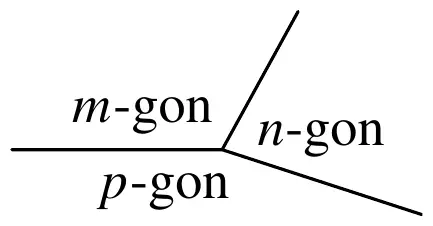
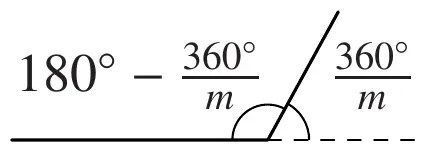
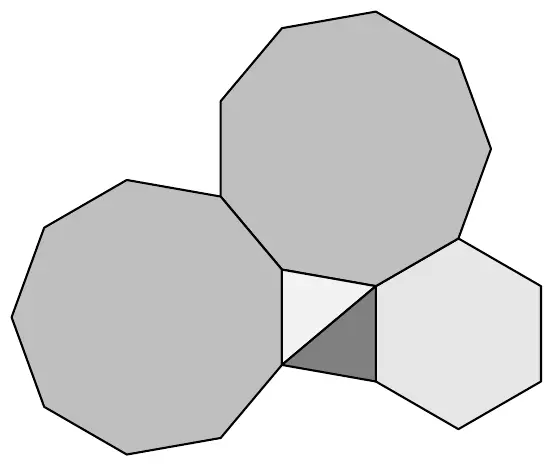
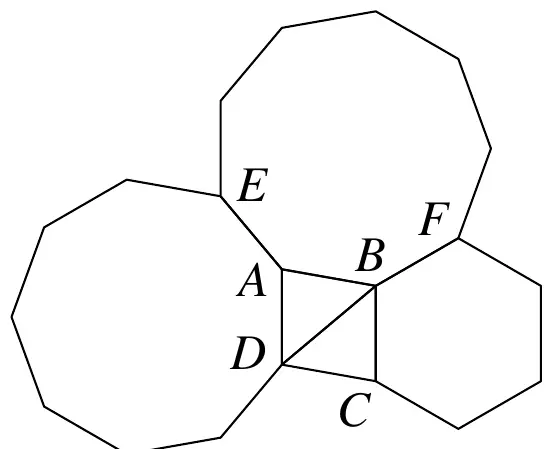
25. A regular \(m\)-gon, a regular \(n\)-gon and a regular \(p\)-gon share a vertex and pairwise share edges, as shown in the diagram.

What is the largest possible value of \(p\)?

  1. A 6
  2. B 20
  3. C 42
  4. D 50
  5. E 100
Three regular polygons, an m-gon, an n-gon and a p-gon, meeting at a vertex and pairwise sharing edges

Senior Mathematical Challenge 2020, Question 25. © UK Mathematics Trust. Original paper on ukmt.org.uk

SMC 2020 Q24

SMCCurrent spec5 marksGeometry & Angles

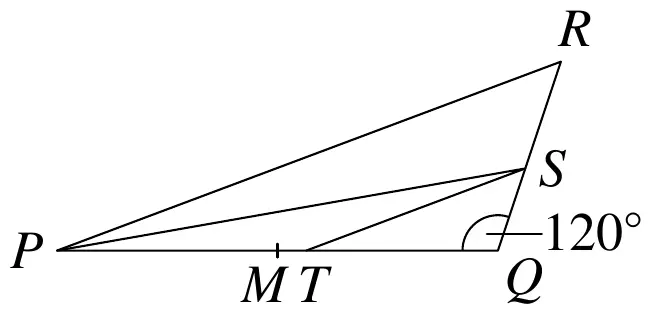
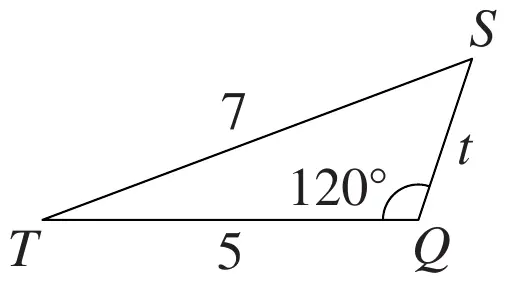
24. In the diagram shown, \(M\) is the mid-point of \(PQ\). The line \(PS\) bisects \(\angle RPQ\) and intersects \(RQ\) at \(S\). The line \(ST\) is parallel to \(PR\) and intersects \(PQ\) at T. The length of \(PQ\) is 12 and the length of \(MT\) is 1. The angle \(SQT\) is 120°.

What is the length of \(SQ\)?

  1. A 2
  2. B 3
  3. C 3.5
  4. D 4
  5. E 5
Triangle PQR with S on RQ, M and T on PQ, PS and ST drawn, and angle SQT of 120 degrees

Senior Mathematical Challenge 2020, Question 24. © UK Mathematics Trust. Original paper on ukmt.org.uk

SMC 2020 Q18

SMCCurrent spec5 marksGeometry & Angles

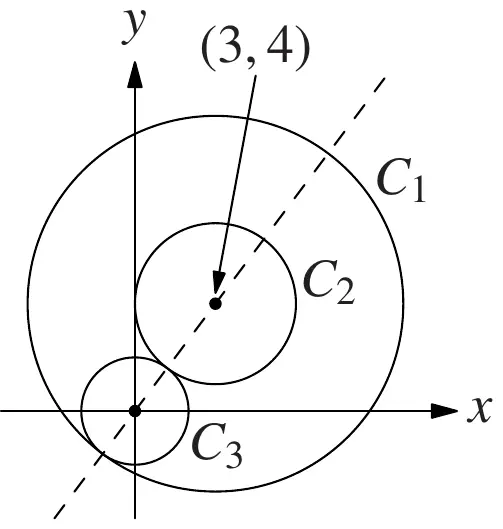
18. Two circles \(C_1\) and \(C_2\) have their centres at the point (3,4) and touch a third circle, \(C_3\). The centre of \(C_3\) is at the point (0,0) and its radius is 2.

What is the sum of the radii of the two circles \(C_1\) and \(C_2\)?

  1. A 6
  2. B 7
  3. C 8
  4. D 9
  5. E 10

Senior Mathematical Challenge 2020, Question 18. © UK Mathematics Trust. Original paper on ukmt.org.uk

SMC 2020 Q15

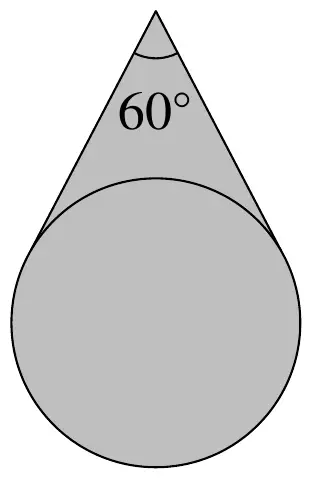
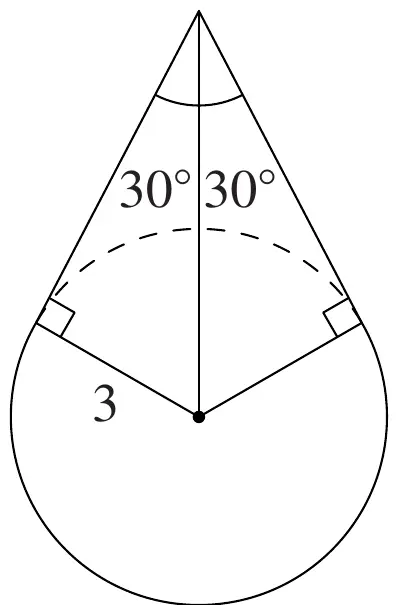
15. The shaded area shown in the diagram consists of the interior of a circle of radius 3 together with the area between the circle and two tangents to the circle. The angle between the tangents at the point where they meet is 60°.

What is the shaded area?

  1. A \(6\pi + 9\sqrt{3}\)
  2. B \(15\sqrt{3}\)
  3. C \(9\pi\)
  4. D \(9\pi + 4\sqrt{3}\)
  5. E \(6\pi + \frac{9\sqrt{3}}{4}\)
A shaded circle with two tangents meeting above it at an angle of 60 degrees; the region between the tangents and the circle is also shaded

Senior Mathematical Challenge 2020, Question 15. © UK Mathematics Trust. Original paper on ukmt.org.uk

SMC 2020 Q11

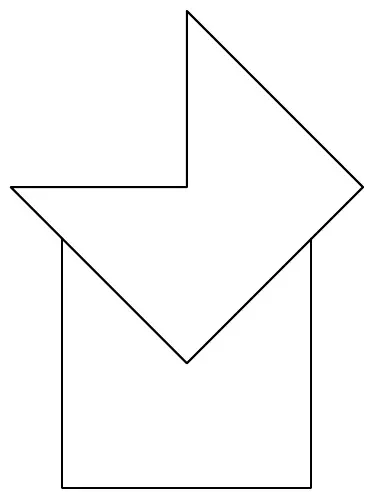
11. Two congruent pentagons are each formed by removing a right-angled isosceles triangle from a square of side-length 1. The two pentagons are then fitted together as shown.

What is the length of the perimeter of the octagon formed?

  1. A 4
  2. B \(4 + 2\sqrt{2}\)
  3. C 5
  4. D \(6 - 2\sqrt{2}\)
  5. E 6
Two congruent pentagons, each a unit square with a right-angled isosceles triangle cut off one corner, fitted together to form an octagon

Senior Mathematical Challenge 2020, Question 11. © UK Mathematics Trust. Original paper on ukmt.org.uk

SMC 2019 Q25

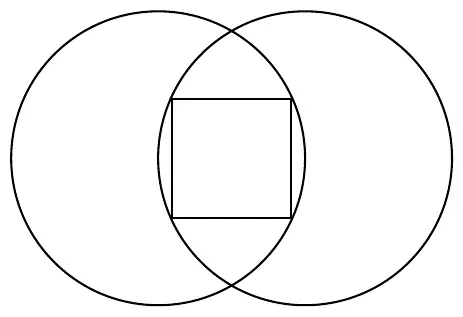
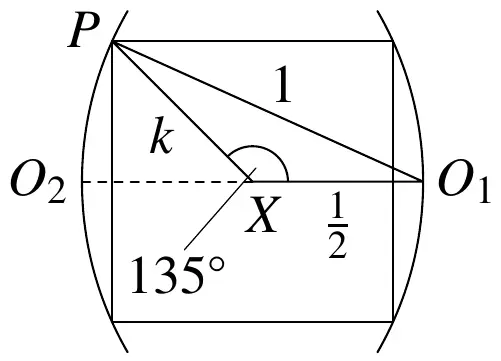
25. Two circles of radius 1 are such that the centre of each circle lies on the other circle. A square is inscribed in the space between the circles.

What is the area of the square?

  1. A \(2 - \dfrac{\sqrt{7}}{2}\)
  2. B \(2 + \dfrac{\sqrt{7}}{2}\)
  3. C \(4 - \sqrt{5}\)
  4. D 1
  5. E \(\dfrac{\sqrt{5}}{5}\)
Two overlapping circles, each passing through the centre of the other, with a square drawn in the space between them

Senior Mathematical Challenge 2019, Question 25. © UK Mathematics Trust. Original paper on ukmt.org.uk

SMC 2019 Q23

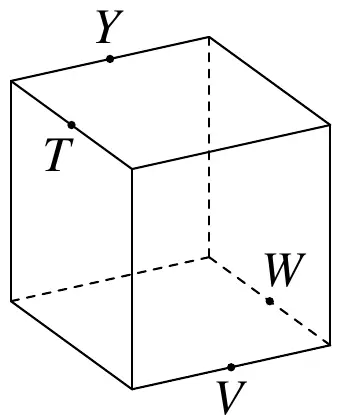
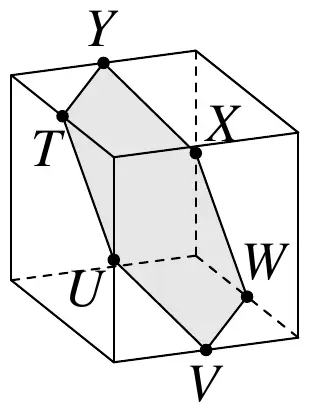
23. The edge-length of the solid cube shown is 2. A single plane cut goes through the points \(Y\), \(T\), \(V\) and \(W\) which are midpoints of the edges of the cube, as shown.

What is the area of the cross-section?

  1. A \(\sqrt{3}\)
  2. B \(3\sqrt{3}\)
  3. C 6
  4. D \(6\sqrt{2}\)
  5. E 8
A cube with points Y, T, V and W marked at midpoints of four edges

Senior Mathematical Challenge 2019, Question 23. © UK Mathematics Trust. Original paper on ukmt.org.uk

SMC 2019 Q20

SMCCurrent spec5 marksGeometry & Angles

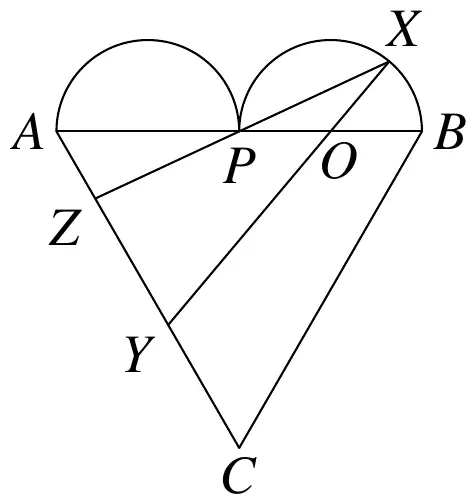
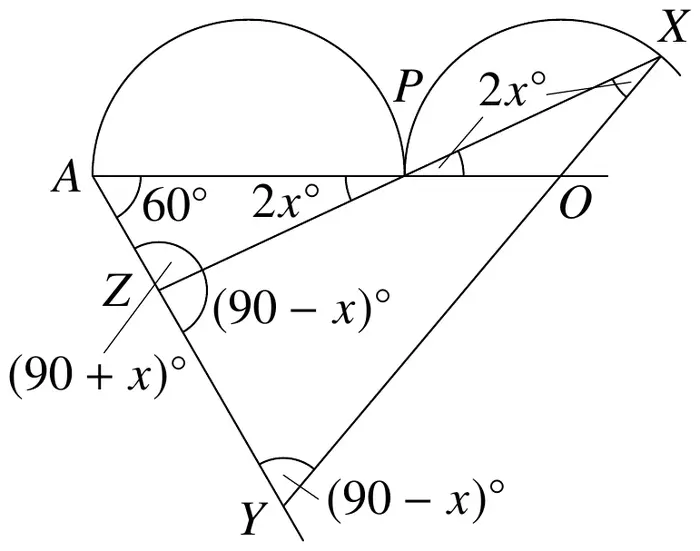
20. The "heart" shown in the diagram is formed from an equilateral triangle \(ABC\) and two congruent semicircles on \(AB\). The two semicircles meet at the point \(P\). The point \(O\) is the centre of one of the semicircles. On the semicircle with centre \(O\), lies a point \(X\). The lines \(XO\) and \(XP\) are extended to meet \(AC\) at \(Y\) and \(Z\) respectively. The lines \(XY\) and \(XZ\) are of equal length.

What is \(\angle ZXY\)?

  1. A 20°
  2. B 25°
  3. C 30°
  4. D 40°
  5. E 45°
A heart made from equilateral triangle ABC and two semicircles on AB meeting at P; O is the centre of the right semicircle, X is on it, and XO and XP extended meet AC at Y and Z

Senior Mathematical Challenge 2019, Question 20. © UK Mathematics Trust. Original paper on ukmt.org.uk

SMC 2019 Q18

SMCCurrent spec5 marksGeometry & Angles

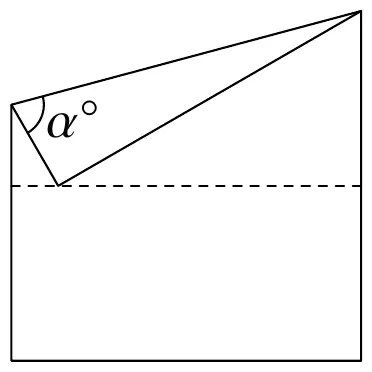
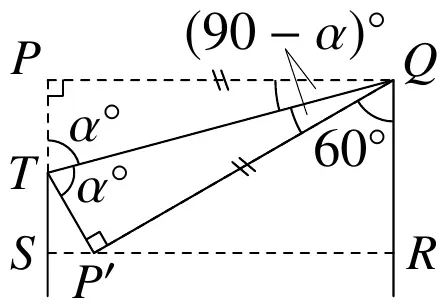
18. Alison folds a square piece of paper in half along the dashed line shown in the diagram. After opening the paper out again, she then folds one of the corners onto the dashed line.

What is the value of \(\alpha\)?

  1. A 45
  2. B 60
  3. C 65
  4. D 70
  5. E 75
A square with a dashed horizontal line across its middle; the top-left corner has been folded down onto the dashed line, making an angle alpha degrees at the top-left

Senior Mathematical Challenge 2019, Question 18. © UK Mathematics Trust. Original paper on ukmt.org.uk

SMC 2019 Q12

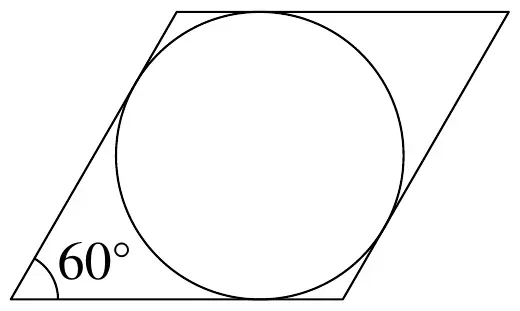
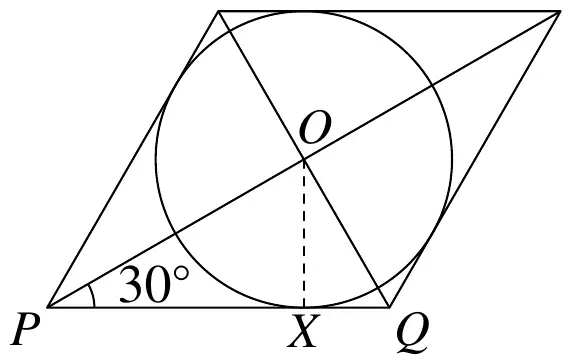
12. A circle with radius 1 touches the sides of a rhombus, as shown. Each of the smaller angles between the sides of the rhombus is 60°.

What is the area of the rhombus?

  1. A 6
  2. B 4
  3. C \(2\sqrt{3}\)
  4. D \(3\sqrt{3}\)
  5. E \(\dfrac{8\sqrt{3}}{3}\)
A rhombus with a circle touching all four sides; one of the smaller angles is marked 60 degrees

Senior Mathematical Challenge 2019, Question 12. © UK Mathematics Trust. Original paper on ukmt.org.uk

SMC 2019 Q9

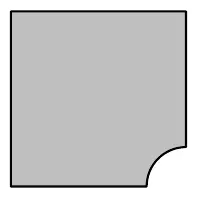
9. A square of paper is folded in half four times to obtain a smaller square. Then a corner is removed as shown.

Which of the following could be the paper after it is unfolded?

Five grey squares labelled A to E with circular holes: A one hole, B two, C three in a diagonal line, D four, E five
A grey square with one corner cut away by a quarter-circle

Senior Mathematical Challenge 2019, Question 9. © UK Mathematics Trust. Original paper on ukmt.org.uk

SMC 2018 Q24

SMCCurrent spec5 marksGeometry & Angles

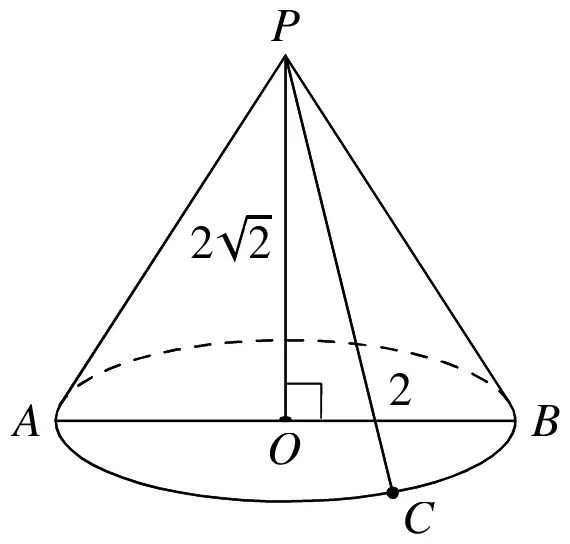
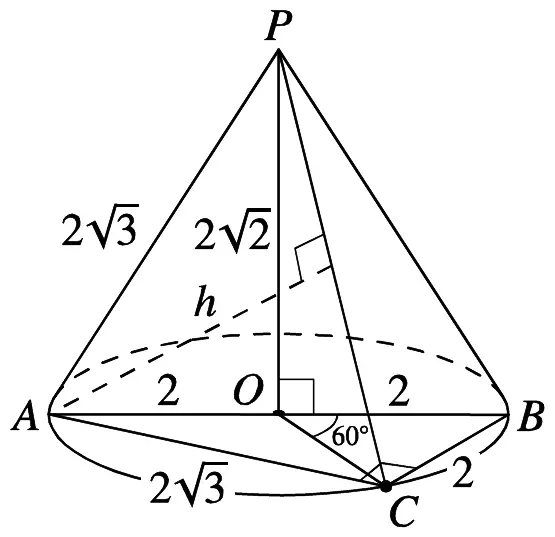
24. The diagram shows a circle with centre \(O\) which lies in a horizontal plane. The diameter \(AB\) has length 4. Point \(P\) lies vertically above \(O\) and \(PO = 2\sqrt{2}\). Point \(C\) lies on the semicircular arc \(AB\) such that the ratio of the lengths of the arcs \(AC\) and \(CB\) is 2 : 1.

What is the shortest distance from \(A\) to \(PC\)?

  1. A \(\sqrt{2}\)
  2. B \(\sqrt{3}\)
  3. C 2
  4. D \(2\sqrt{2}\)
  5. E 3
A cone-like figure: a horizontal circle with centre O and diameter AB of length 4, a point P vertically above O with PO = 2 root 2, and a point C on the circle joined to P

Senior Mathematical Challenge 2018, Question 24. © UK Mathematics Trust. Original paper on ukmt.org.uk

SMC 2018 Q22

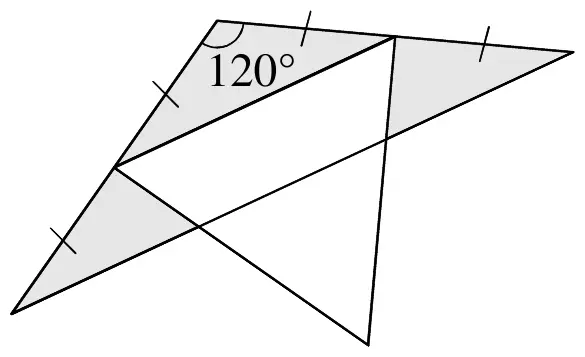
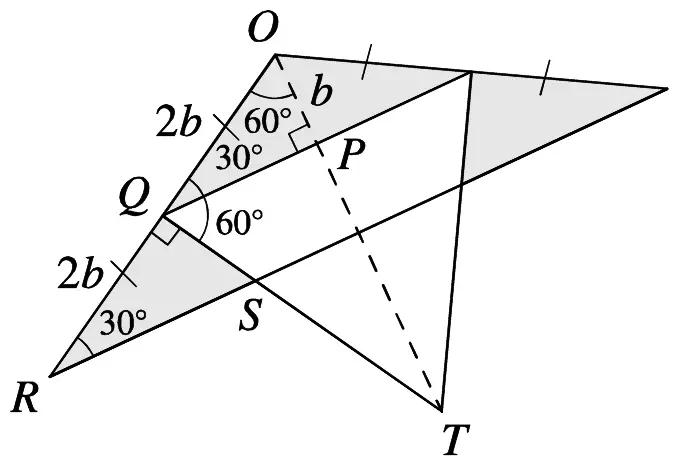
22. The diagram shows two overlapping triangles; an isosceles triangle with an angle of 120° and an equilateral triangle with area 36. Two of the vertices of the equilateral triangle are midpoints of the equal sides of the isosceles triangle.

What is the total area of the shaded regions (inside the isosceles triangle but outside the equilateral triangle)?

  1. A 24
  2. B 26
  3. C 28
  4. D 30
  5. E 32
An isosceles triangle with a 120 degree angle overlapping an equilateral triangle; two vertices of the equilateral triangle are the midpoints of the equal sides, and the parts of the isosceles triangle outside the equilateral triangle are shaded

Senior Mathematical Challenge 2018, Question 22. © UK Mathematics Trust. Original paper on ukmt.org.uk

SMC 2018 Q20

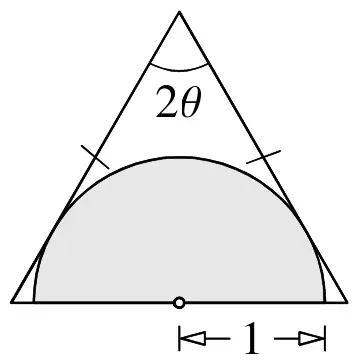
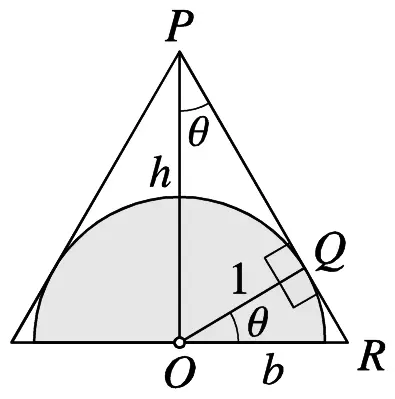
20. The diagram shows a semicircle of radius 1 inside an isosceles triangle. The diameter of the semicircle lies along the ‘base’ of the triangle, and the angle of the triangle opposite the ‘base’ is equal to \(2\theta\). Each of the two equal sides of the triangle is tangent to the semicircle.

What is the area of the triangle?

  1. A \(\frac{1}{2}\tan 2\theta\)
  2. B \(\sin\theta\cos\theta\)
  3. C \(\sin\theta + \cos\theta\)
  4. D \(\frac{1}{2}\cos 2\theta\)
  5. E \(\dfrac{1}{\sin\theta\cos\theta}\)
A shaded semicircle with its diameter on the base of an isosceles triangle, touching both equal sides; the top angle is 2 theta and the radius is 1

Senior Mathematical Challenge 2018, Question 20. © UK Mathematics Trust. Original paper on ukmt.org.uk

SMC 2018 Q19

19. How many pairs of numbers \((m, n)\) are there such that the following statement is true?

‘A regular \(m\)-sided polygon has an exterior angle of size \(n°\) and
a regular \(n\)-sided polygon has an exterior angle of size \(m°\).’
  1. A 24
  2. B 22
  3. C 20
  4. D 18
  5. E 16

Senior Mathematical Challenge 2018, Question 19. © UK Mathematics Trust. Original paper on ukmt.org.uk

SMC 2018 Q18

18. \(P\), \(Q\) and \(R\) are the three angles of a triangle, when each has been rounded to the nearest degree.

Which of the following is the complete list of possible values of \(P + Q + R\)?

  1. A 179°, 180° or 181°
  2. B 180°, 181° or 182°
  3. C 178°, 179° or 180°
  4. D 180°
  5. E 178°, 179°, 180°, 181° or 182°

Senior Mathematical Challenge 2018, Question 18. © UK Mathematics Trust. Original paper on ukmt.org.uk

SMC 2018 Q12

SMCCurrent spec4 marksGeometry & Angles

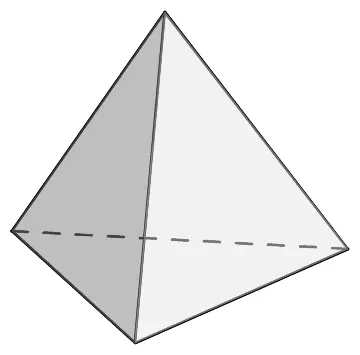
12. A regular tetrahedron is a polyhedron with four faces, each of which is an equilateral triangle, as shown. A solid regular tetrahedron is cut into two pieces by a single plane cut.

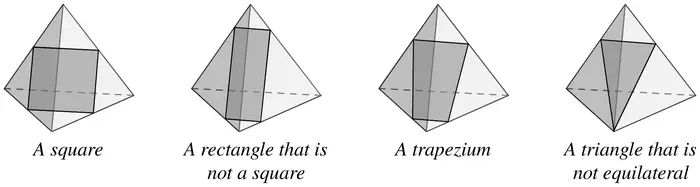
Which of the following could not be the shape of the section formed by the cut?

  1. A a pentagon
  2. B a square
  3. C a rectangle that is not a square
  4. D a trapezium
  5. E a triangle that is not equilateral
A regular tetrahedron drawn with one hidden edge dashed

Senior Mathematical Challenge 2018, Question 12. © UK Mathematics Trust. Original paper on ukmt.org.uk

SMC 2018 Q7

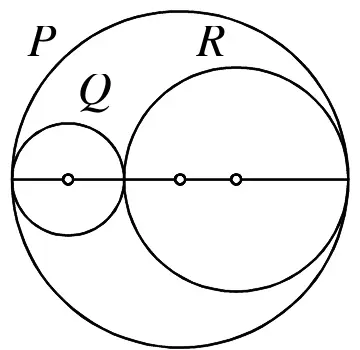
7. The circles \(P\), \(Q\) and \(R\) are all tangent to each other. Their centres all lie on a diameter of \(P\), as shown in the figure.

What is the value of \(\dfrac{\text{circumference of } Q + \text{circumference of } R}{\text{circumference of } P}\)?

  1. A 1
  2. B \(\frac{1}{2}\)
  3. C \(\frac{1}{3}\)
  4. D \(\frac{1}{4}\)
  5. E more information needed
Three circles P, Q and R with centres on a diameter of P; Q and R touch each other and both touch P on the inside

Senior Mathematical Challenge 2018, Question 7. © UK Mathematics Trust. Original paper on ukmt.org.uk

SMC 2018 Q3

SMCCurrent spec4 marksGeometry & Angles

3. Which of the following shows the digit 6 after it has been rotated clockwise through 135°?

Five pictures of the digit 6 in different orientations, labelled A to E

Senior Mathematical Challenge 2018, Question 3. © UK Mathematics Trust. Original paper on ukmt.org.uk

SMC 2017 Q25

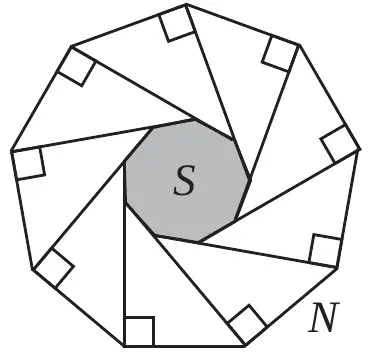
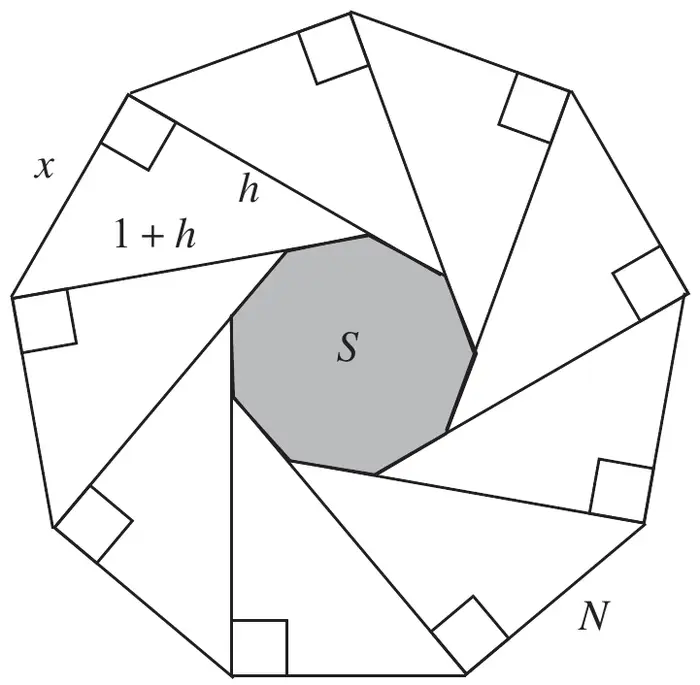
25. The diagram shows a regular nonagon \(N\). Moving clockwise around \(N\), at each vertex a line segment is drawn perpendicular to the preceding edge. This produces a smaller nonagon \(S\), shown shaded.
What fraction of the area of \(N\) is the area of \(S\)?
  1. A \(\dfrac{1 - \cos 40°}{1 + \cos 40°}\)
  2. B \(\dfrac{\cos 40°}{1 + \cos 40°}\)
  3. C \(\dfrac{\sin 40°}{1 + \sin 40°}\)
  4. D \(\dfrac{1 - \sin 40°}{1 + \sin 40°}\)
  5. E \(\dfrac{1}{9}\)
A regular nonagon N with a line segment at each vertex perpendicular to the preceding edge, producing a smaller shaded nonagon S

Senior Mathematical Challenge 2017, Question 25. © UK Mathematics Trust. Original paper on ukmt.org.uk

SMC 2017 Q22

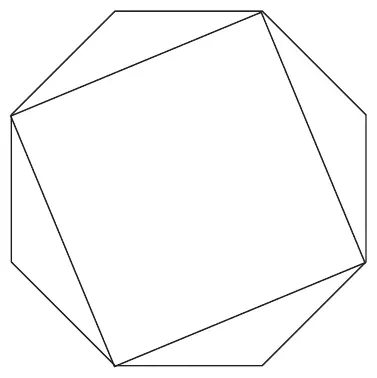
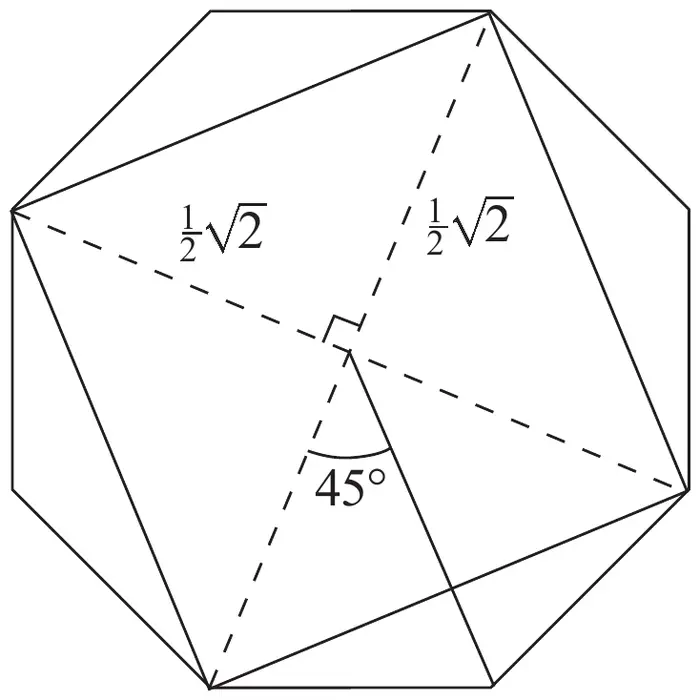
22. The diagram shows a regular octagon and a square formed by drawing four diagonals of the octagon. The edges of the square have length 1.
What is the area of the octagon?

  1. A \(\dfrac{\sqrt{6}}{2}\)
  2. B \(\dfrac{4}{3}\)
  3. C \(\dfrac{7}{5}\)
  4. D \(\sqrt{2}\)
  5. E \(\dfrac{3}{2}\)
A regular octagon with a square formed by four of its diagonals

Senior Mathematical Challenge 2017, Question 22. © UK Mathematics Trust. Original paper on ukmt.org.uk

SMC 2017 Q20

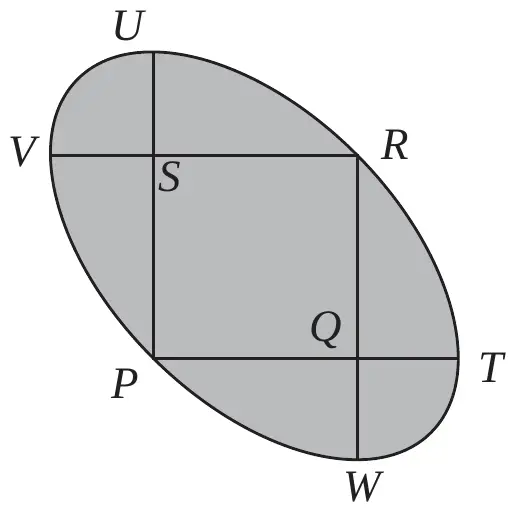
20. The diagram shows a square \(PQRS\) with edges of length 1, and four arcs, each of which is a quarter of a circle. Arc \(TRU\) has centre \(P\); arc \(VPW\) has centre \(R\); arc \(UV\) has centre \(S\); and arc \(WT\) has centre \(Q\).
What is the length of the perimeter of the shaded region?

  1. A 6
  2. B \(\left(2\sqrt{2} - 1\right)\pi\)
  3. C \(\left(\sqrt{2} - \tfrac{1}{2}\right)\pi\)
  4. D \(2\pi\)
  5. E \(\left(3\sqrt{2} - 2\right)\pi\)
Square PQRS with four quarter-circle arcs TRU, UV, VPW and WT enclosing a shaded oval region

Senior Mathematical Challenge 2017, Question 20. © UK Mathematics Trust. Original paper on ukmt.org.uk

SMC 2017 Q19

SMCCurrent spec5 marksGeometry & Angles

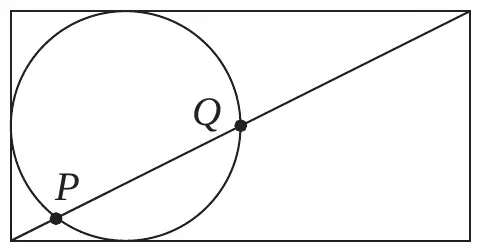
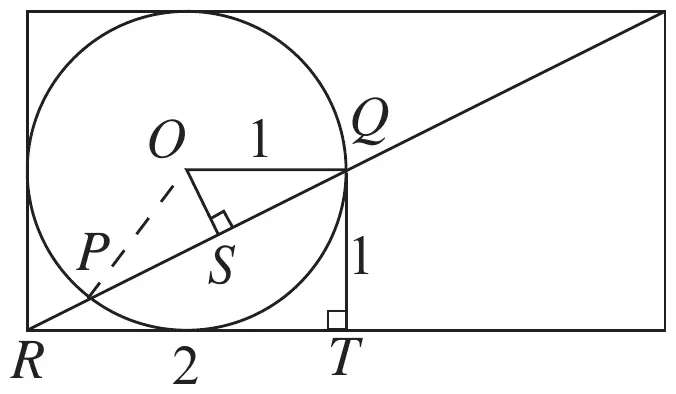
19. The diagram shows a circle of radius 1 touching three sides of a \(2 \times 4\) rectangle. A diagonal of the rectangle intersects the circle at \(P\) and \(Q\), as shown. What is the length of the chord \(PQ\)?

  1. A \(\sqrt{5}\)
  2. B \(\dfrac{4}{\sqrt{5}}\)
  3. C \(\sqrt{5} - \dfrac{2}{\sqrt{5}}\)
  4. D \(\dfrac{5\sqrt{5}}{6}\)
  5. E 2
A 2 by 4 rectangle with a circle of radius 1 touching three sides; a diagonal cuts the circle at P and Q

Senior Mathematical Challenge 2017, Question 19. © UK Mathematics Trust. Original paper on ukmt.org.uk

SMC 2017 Q16

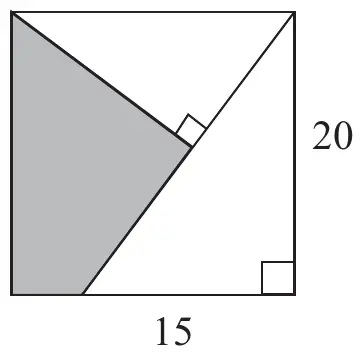
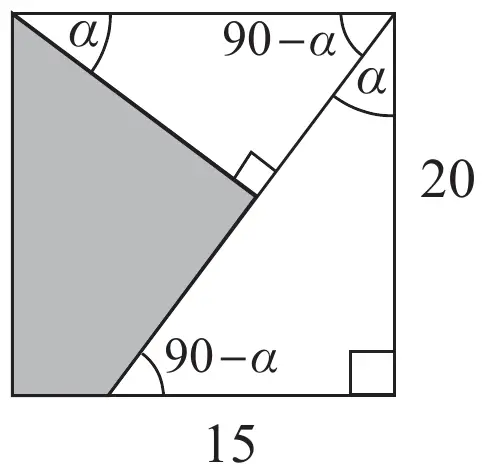
16. The diagram shows two right-angled triangles inside a square. The perpendicular edges of the larger triangle have lengths 15 and 20.
What is the area of the shaded quadrilateral?

  1. A 142
  2. B 146
  3. C 150
  4. D 154
  5. E 158
A square containing two right-angled triangles, the larger with perpendicular edges 15 and 20; a quadrilateral is shaded

Senior Mathematical Challenge 2017, Question 16. © UK Mathematics Trust. Original paper on ukmt.org.uk

SMC 2017 Q14

SMCCurrent spec4 marksAlgebraGeometry & Angles

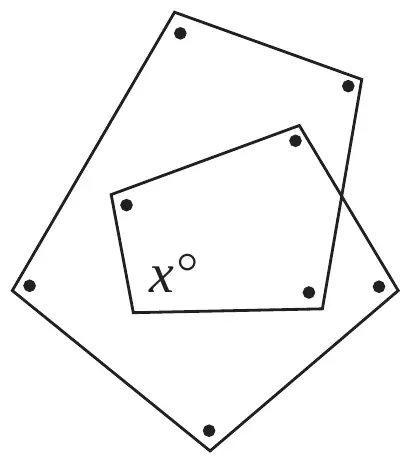
14. In the diagram, all the angles marked • are equal in size to the angle marked \(x°\).
What is the value of \(x\)?

  1. A 100
  2. B 105
  3. C 110
  4. D 115
  5. E 120
A pentagon inside a hexagon; angles marked with dots and one angle marked x degrees

Senior Mathematical Challenge 2017, Question 14. © UK Mathematics Trust. Original paper on ukmt.org.uk

SMC 2017 Q12

SMCCurrent spec4 marksGeometry & Angles

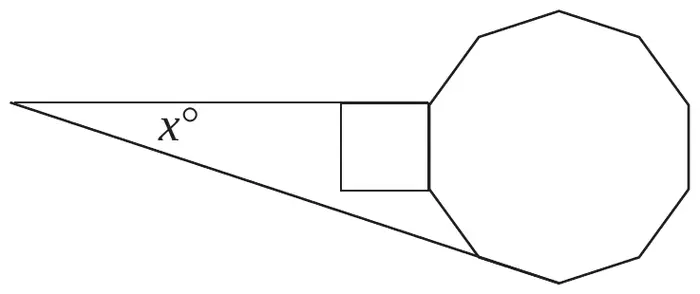
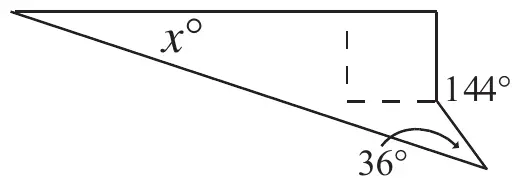
12. The diagram shows a square and a regular decagon that share an edge. One side of the square is extended to meet an extended side of the decagon.
What is the value of \(x\)?

  1. A 15
  2. B 18
  3. C 21
  4. D 24
  5. E 27
A square and a regular decagon sharing an edge; one side of the square and one side of the decagon are extended to meet at an angle x degrees

Senior Mathematical Challenge 2017, Question 12. © UK Mathematics Trust. Original paper on ukmt.org.uk

SMC 2016 Q24

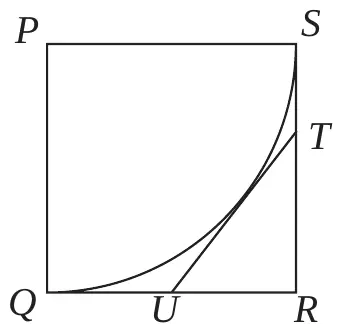
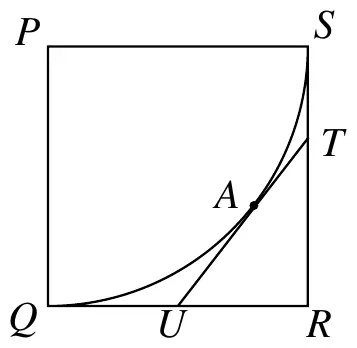
24. The diagram shows a square \(PQRS\). The arc \(QS\) is a quarter circle. The point \(U\) is the midpoint of \(QR\) and the point \(T\) lies on \(SR\). The line \(TU\) is a tangent to the arc \(QS\). What is the ratio of the length of \(TR\) to the length of \(UR\)?

  1. A \(3:2\)
  2. B \(4:3\)
  3. C \(5:4\)
  4. D \(7:6\)
  5. E \(9:8\)
Square PQRS with quarter-circle arc QS centred at P; U is the midpoint of QR and the line TU touches the arc, with T on SR

Senior Mathematical Challenge 2016, Question 24. © UK Mathematics Trust. Original paper on ukmt.org.uk

SMC 2016 Q23

23. A cuboid has sides of lengths 22, 2 and 10. It is contained within a sphere of the smallest possible radius. What is the side-length of the largest cube that will fit inside the same sphere?

  1. A 10
  2. B 11
  3. C 12
  4. D 13
  5. E 14

Senior Mathematical Challenge 2016, Question 23. © UK Mathematics Trust. Original paper on ukmt.org.uk

SMC 2016 Q21

SMCCurrent spec5 marksGeometry & Angles

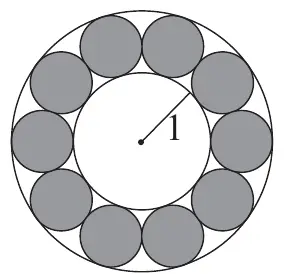
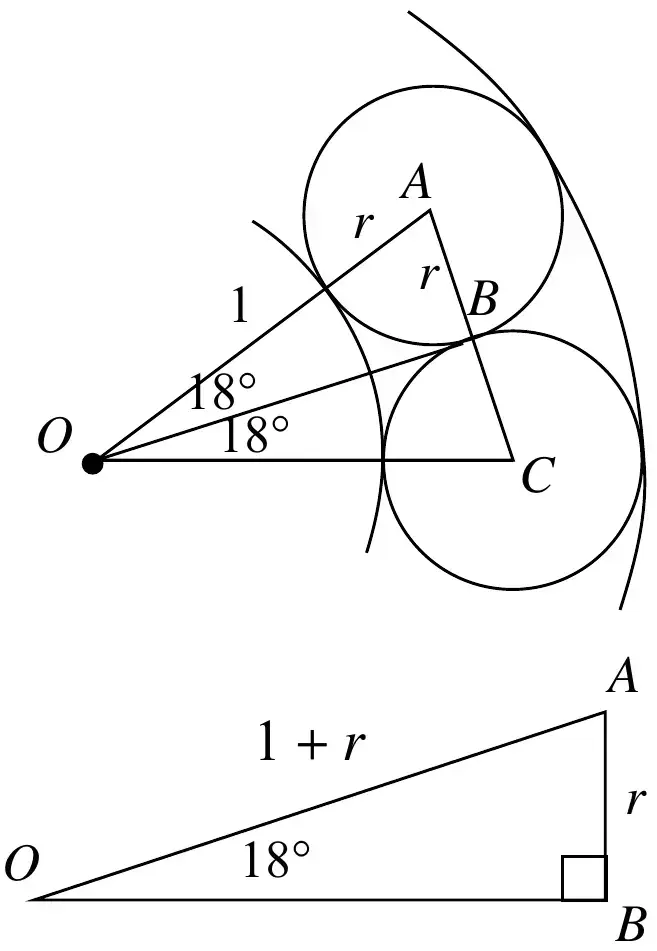
21. The diagram shows ten equal discs that lie between two concentric circles − an inner circle and an outer circle. Each disc touches two neighbouring discs and both circles. The inner circle has radius 1.
What is the radius of the outer circle?

  1. A \(2\tan 36°\)
  2. B \(\dfrac{\sin 36°}{1 - \sin 36°}\)
  3. C \(\dfrac{1 + \sin 18°}{1 - \sin 18°}\)
  4. D \(\dfrac{2}{\cos 18°}\)
  5. E \(\dfrac{9}{5}\)
Ten equal grey discs in a ring between two concentric circles; the inner circle has radius 1

Senior Mathematical Challenge 2016, Question 21. © UK Mathematics Trust. Original paper on ukmt.org.uk

SMC 2016 Q19

19. Let \(S\) be a set of five different positive integers, the largest of which is \(m\). It is impossible to construct a quadrilateral with non-zero area, whose side-lengths are all distinct elements of \(S\). What is the smallest possible value of \(m\)?

  1. A 2
  2. B 4
  3. C 9
  4. D 11
  5. E 12

Senior Mathematical Challenge 2016, Question 19. © UK Mathematics Trust. Original paper on ukmt.org.uk

SMC 2016 Q15

SMCCurrent spec4 marksGeometry & Angles

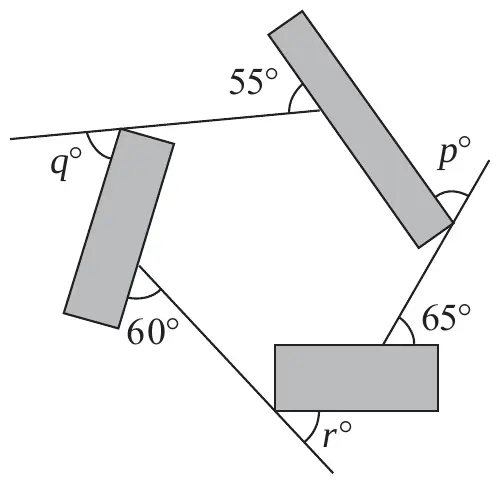
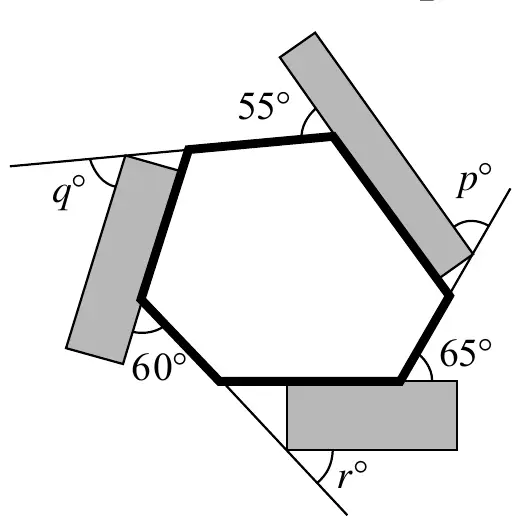
15. The diagram shows three rectangles and three straight lines.
What is the value of \(p + q + r\)?

  1. A 135
  2. B 180
  3. C 210
  4. D 225
  5. E 270
Three grey rectangles and three straight lines, with angles 55, 60 and 65 degrees and angles p, q and r degrees marked

Senior Mathematical Challenge 2016, Question 15. © UK Mathematics Trust. Original paper on ukmt.org.uk

SMC 2016 Q6

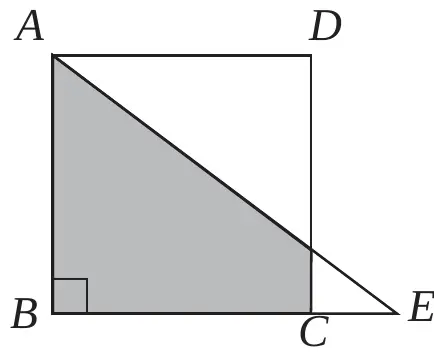
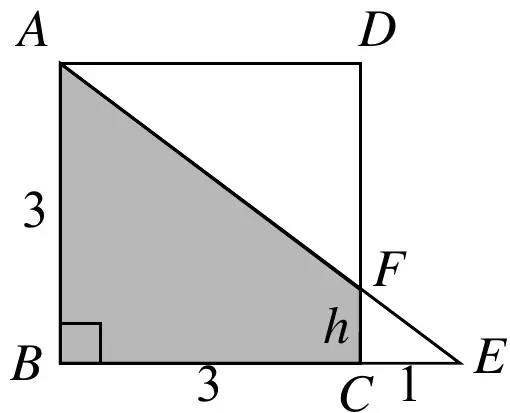
6. The diagram shows a square \(ABCD\) and a right-angled triangle \(ABE\). The length of \(BC\) is 3. The length of \(BE\) is 4.
What is the area of the shaded region?

  1. A \(5\frac{1}{4}\)
  2. B \(5\frac{3}{8}\)
  3. C \(5\frac{1}{2}\)
  4. D \(5\frac{5}{8}\)
  5. E \(5\frac{3}{4}\)
Square ABCD with right-angled triangle ABE, E on BC extended; the part of the triangle inside the square is shaded

Senior Mathematical Challenge 2016, Question 6. © UK Mathematics Trust. Original paper on ukmt.org.uk

SMC 2016 Q4

SMCCurrent spec4 marksGeometry & Angles

4. Alex draws a scalene triangle. One of the angles is 80°.
Which of the following could be the difference between the other two angles in Alex's triangle?

  1. A 0°
  2. B 60°
  3. C 80°
  4. D 100°
  5. E 120°

Senior Mathematical Challenge 2016, Question 4. © UK Mathematics Trust. Original paper on ukmt.org.uk

SMC 2016 Q3

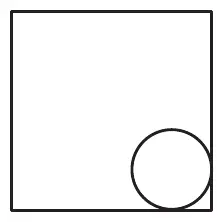
3. The diagram shows a circle with radius 1 that rolls without slipping around the inside of a square with sides of length 5.
The circle rolls once around the square, returning to its starting point.
What distance does the centre of the circle travel?

  1. A \(16 - 2\pi\)
  2. B 12
  3. C \(6 + \pi\)
  4. D \(20 - 2\pi\)
  5. E 20
A circle of radius 1 inside a square, touching two of its sides

Senior Mathematical Challenge 2016, Question 3. © UK Mathematics Trust. Original paper on ukmt.org.uk

SMC 2015 Q21

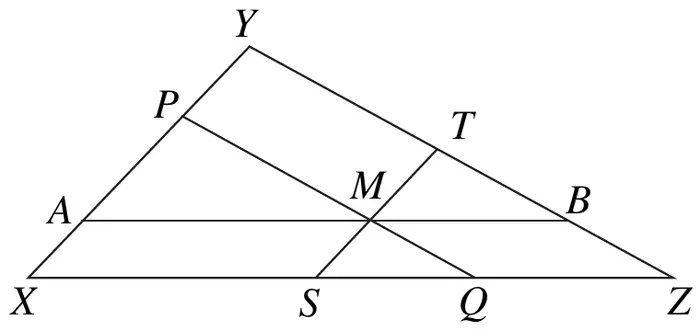
21. The diagram shows a triangle \(XYZ\). The sides \(XY\), \(YZ\) and \(XZ\) have lengths 2, 3 and 4 respectively. The lines \(AMB\), \(PMQ\) and \(SMT\) are drawn parallel to the sides of triangle \(XYZ\) so that \(AP\), \(QS\) and \(BT\) are of equal length.
What is the length of \(AP\)?

  1. A \(\dfrac{10}{11}\)
  2. B \(\dfrac{11}{12}\)
  3. C \(\dfrac{12}{13}\)
  4. D \(\dfrac{13}{14}\)
  5. E \(\dfrac{14}{15}\)
Triangle XYZ with lines AMB, PMQ and SMT through a point M, each parallel to a side of the triangle

Senior Mathematical Challenge 2015, Question 21. © UK Mathematics Trust. Original paper on ukmt.org.uk

SMC 2015 Q19

SMCCurrent spec5 marksAlgebraGeometry & Angles

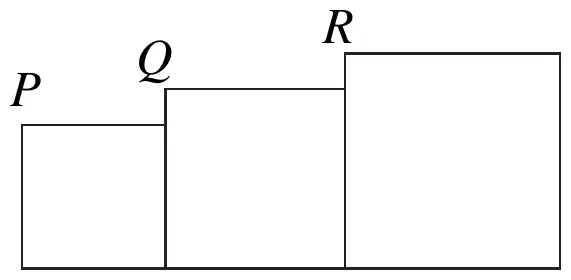
19. Three squares are arranged as shown so that their bases lie on a straight line. Also, the corners \(P\), \(Q\) and \(R\) lie on a straight line. The middle square has sides that are 8 cm longer than the sides of the smallest square. The largest square has sides of length 50 cm.
There are two possible values for the length (in cm) of the sides of the smallest square. Which of the following are they?

  1. A 2, 32
  2. B 4, 42
  3. C 4, 34
  4. D 32, 40
  5. E 34, 42
Three squares of increasing size side by side on a line, with top corners P, Q and R

Senior Mathematical Challenge 2015, Question 19. © UK Mathematics Trust. Original paper on ukmt.org.uk

SMC 2015 Q17

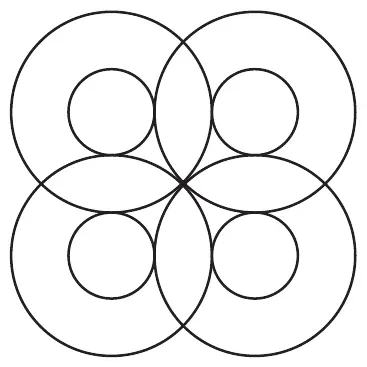
17. The diagram shows eight circles of two different sizes. The circles are arranged in concentric pairs so that the centres form a square. Each larger circle touches one other larger circle and two smaller circles. The larger circles have radius 1. What is the radius of each smaller circle?

  1. A \(\tfrac{1}{3}\)
  2. B \(\tfrac{2}{5}\)
  3. C \(\sqrt{2} - 1\)
  4. D \(\tfrac{1}{2}\)
  5. E \(\tfrac{1}{2}\sqrt{2}\)
Four pairs of concentric circles whose centres form a square; each larger circle touches one other larger circle and two smaller circles

Senior Mathematical Challenge 2015, Question 17. © UK Mathematics Trust. Original paper on ukmt.org.uk

SMC 2015 Q14

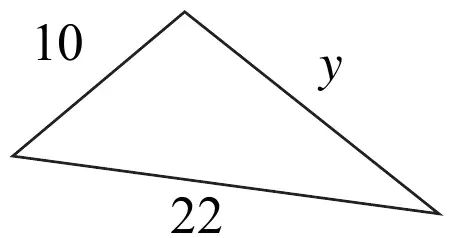
14. The triangle shown has an area of 88 square units. What is the value of \(y\)?

  1. A 17.6
  2. B \(2\sqrt{46}\)
  3. C \(6\sqrt{10}\)
  4. D \(13\sqrt{2}\)
  5. E \(8\sqrt{5}\)
A triangle with sides 10, 22 and y

Senior Mathematical Challenge 2015, Question 14. © UK Mathematics Trust. Original paper on ukmt.org.uk

SMC 2015 Q12

SMCCurrent spec4 marksGeometry & Angles

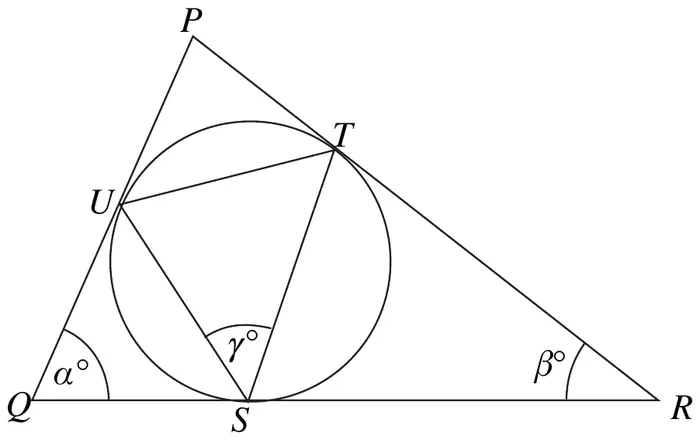
12. A circle touches the sides of triangle \(PQR\) at the points \(S\), \(T\) and \(U\) as shown. Also \(\angle PQR = \alpha°\), \(\angle PRQ = \beta°\) and \(\angle TSU = \gamma°\).
Which of the following gives \(\gamma\) in terms of \(\alpha\) and \(\beta\)?

  1. A \(\tfrac{1}{2}(\alpha + \beta)\)
  2. B \(180 - \tfrac{1}{2}(\alpha + \beta)\)
  3. C \(180 - (\alpha + \beta)\)
  4. D \(\alpha + \beta\)
  5. E \(\tfrac{1}{3}(\alpha + \beta)\)
Triangle PQR with its inscribed circle touching QR at S, RP at T and PQ at U; angles alpha at Q, beta at R and gamma at S between SU and ST

Senior Mathematical Challenge 2015, Question 12. © UK Mathematics Trust. Original paper on ukmt.org.uk

SMC 2015 Q9

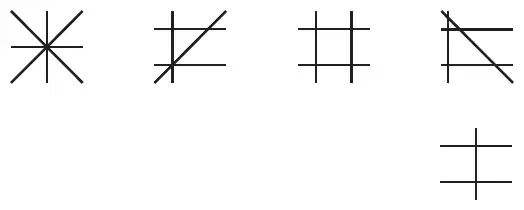
9. Four different straight lines are drawn on a flat piece of paper. The number of points where two or more lines intersect is counted.
Which of the following could not be the number of such points?

  1. A 1
  2. B 2
  3. C 3
  4. D 4
  5. E 5

Senior Mathematical Challenge 2015, Question 9. © UK Mathematics Trust. Original paper on ukmt.org.uk

SMC 2014 Q25

SMCCurrent spec5 marksGeometry & Angles

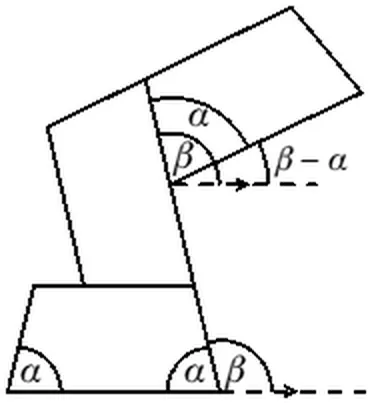
25. Figure 1 shows a tile in the form of a trapezium, where \(\alpha = 83\tfrac{1}{3}°\). Several copies of the tile are placed together to form a symmetrical pattern, part of which is shown in Figure 2. The outer border of the complete pattern is a regular ‘star polygon’. Figure 3 shows an example of a regular ‘star polygon’.

Figure 1: a trapezium tile with two slanted sides of length 1, base 2 and base angles alpha. Figure 2: part of the pattern, a zigzag chain of grey tiles. Figure 3: a regular star polygon with many points

How many tiles are there in the complete pattern?

  1. A 48
  2. B 54
  3. C 60
  4. D 66
  5. E 72

Senior Mathematical Challenge 2014, Question 25. © UK Mathematics Trust. Original paper on ukmt.org.uk

SMC 2014 Q21

SMCCurrent spec5 marksGeometry & Angles

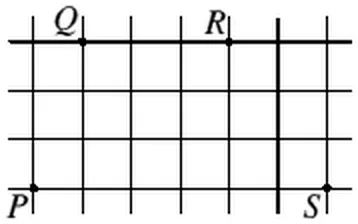
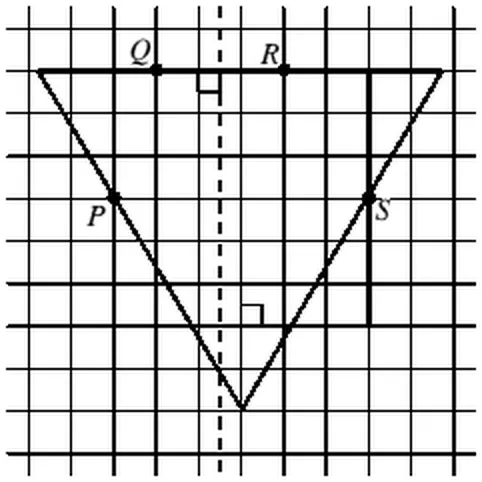
21. Fiona wants to draw a 2-dimensional shape whose perimeter passes through all of the points \(P\), \(Q\), \(R\) and \(S\) on the grid of squares shown. Which of the following can she draw?

(i) A circle(ii) An equilateral triangle
(iii) A square
  1. A only (i) and (ii)
  2. B only (ii) and (iii)
  3. C only (i) and (iii)
  4. D all of (i), (ii) and (iii)
  5. E none of (i), (ii) and (iii)
A grid of squares with points P and S on the bottom line and Q and R on the top line

Senior Mathematical Challenge 2014, Question 21. © UK Mathematics Trust. Original paper on ukmt.org.uk

SMC 2014 Q20

SMCCurrent spec5 marksGeometry & Angles

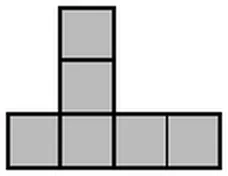
20. The diagram shows six squares with sides of length 2 placed edge-to-edge. What is the radius of the smallest circle containing all six squares?

  1. A \(2\sqrt{5}\)
  2. B \(2\sqrt{6}\)
  3. C 5
  4. D \(\sqrt{26}\)
  5. E \(2\sqrt{7}\)
Six grey squares: a row of four with a column of two more squares on top of the second square

Senior Mathematical Challenge 2014, Question 20. © UK Mathematics Trust. Original paper on ukmt.org.uk

SMC 2014 Q19

SMCCurrent spec5 marksGeometry & Angles

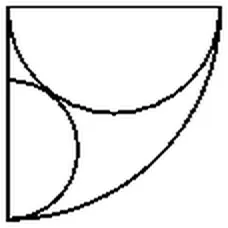
19. The diagram shows a quadrant of radius 2, and two touching semicircles. The larger semicircle has radius 1. What is the radius of the smaller semicircle?

  1. A \(\dfrac{\pi}{6}\)
  2. B \(\dfrac{\sqrt{3}}{2}\)
  3. C \(\dfrac{1}{2}\)
  4. D \(\dfrac{1}{\sqrt{3}}\)
  5. E \(\dfrac{2}{3}\)
A quadrant of radius 2 containing a larger semicircle along its top radius and a smaller semicircle along its left radius, the two semicircles touching

Senior Mathematical Challenge 2014, Question 19. © UK Mathematics Trust. Original paper on ukmt.org.uk

SMC 2014 Q18

SMCCurrent spec5 marksGeometry & Angles

18. Beatrix decorates the faces of a cube, whose edges have length 2. For each face, she either leaves it blank, or draws a single straight line on it. Every line drawn joins the midpoints of two edges, either opposite or adjacent, as shown.
What is the length of the longest unbroken line that Beatrix can draw on the cube?

  1. A 8
  2. B \(4 + 4\sqrt{2}\)
  3. C \(6 + 3\sqrt{2}\)
  4. D \(8 + 2\sqrt{2}\)
  5. E 12
Two faces of a cube: one with a line joining the midpoints of opposite edges, one with a line joining the midpoints of adjacent edges

Senior Mathematical Challenge 2014, Question 18. © UK Mathematics Trust. Original paper on ukmt.org.uk

SMC 2014 Q17

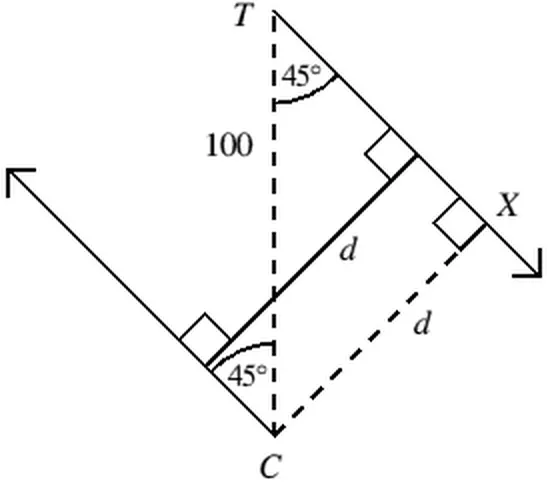
17. An oil tanker is 100 km due north of a cruise liner. The tanker sails SE at a speed of 20 kilometres per hour and the liner sails NW at a speed of 10 kilometres per hour. What is the shortest distance between the two boats during the subsequent motion?

  1. A 100km
  2. B 80km
  3. C \(50\sqrt{2}\)km
  4. D 60km
  5. E \(33\tfrac{1}{3}\)km

Senior Mathematical Challenge 2014, Question 17. © UK Mathematics Trust. Original paper on ukmt.org.uk

SMC 2014 Q16

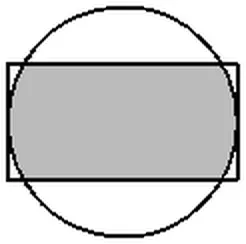
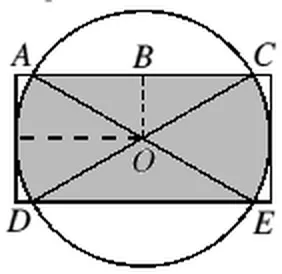
16. The diagram shows a rectangle measuring \(6 \times 12\) and a circle.
The two shorter sides of the rectangle are tangents to the circle. The circle and rectangle have the same centre.
The region that lies inside both the rectangle and the circle is shaded. What is its area?

  1. A \(12\pi + 18\sqrt{3}\)
  2. B \(24\pi - 3\sqrt{3}\)
  3. C \(18\pi - 8\sqrt{3}\)
  4. D \(18\pi + 12\sqrt{3}\)
  5. E \(24\pi + 18\sqrt{3}\)
A circle with a horizontal rectangle whose shorter sides touch the circle; the region inside both is shaded

Senior Mathematical Challenge 2014, Question 16. © UK Mathematics Trust. Original paper on ukmt.org.uk

SMC 2014 Q13

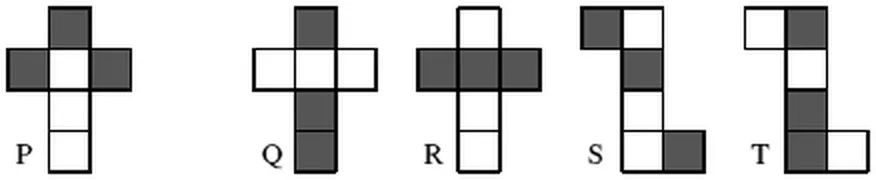
13. Each of the five nets P, Q, R, S and T is made from six squares. Both sides of each square have the same colour. Net P is folded to form a cube.

Five nets of a cube labelled P, Q, R, S and T, each made of six squares, three black and three white

How many of the nets Q, R, S and T can be folded to produce a cube that looks the same as that produced by P?

  1. A 0
  2. B 1
  3. C 2
  4. D 3
  5. E 4

Senior Mathematical Challenge 2014, Question 13. © UK Mathematics Trust. Original paper on ukmt.org.uk

SMC 2013 Q24

SMCCurrent spec5 marksGeometry & Angles

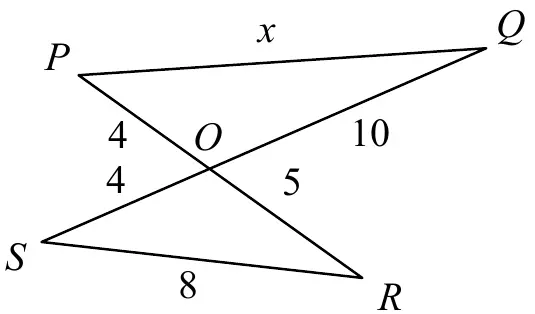
24. The diagram shows two straight lines \(PR\) and \(QS\) crossing at \(O\).
What is the value of \(x\)?

  1. A \(7\sqrt{2}\)
  2. B \(2\sqrt{29}\)
  3. C \(14\sqrt{2}\)
  4. D \(7(1 + \sqrt{13})\)
  5. E \(9\sqrt{2}\)
Two straight lines PR and QS crossing at O, with PQ and SR joined; PO = 4, SO = 4, OR = 5, OQ = 10, SR = 8 and PQ = x

Senior Mathematical Challenge 2013, Question 24. © UK Mathematics Trust. Original paper on ukmt.org.uk

SMC 2013 Q21

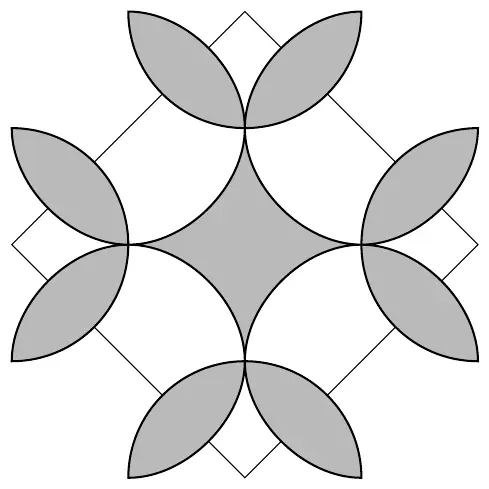
21.
A square standing on one corner with a shaded design of eight circular arcs: four arcs centred on the vertices of the square and four touching arcs centred on the midpoints of its sides

The shaded design shown in the diagram is made by drawing eight circular arcs, all with the same radius. The centres of four arcs are the vertices of the square; the centres of the four touching arcs are the midpoints of the sides of the square. The diagonals of the square have length 1.
What is the total length of the border of the shaded design?

  1. A \(2\pi\)
  2. B \(\dfrac{5\pi}{2}\)
  3. C \(3\pi\)
  4. D \(\dfrac{7\pi}{2}\)
  5. E \(4\pi\)

Senior Mathematical Challenge 2013, Question 21. © UK Mathematics Trust. Original paper on ukmt.org.uk

SMC 2013 Q19

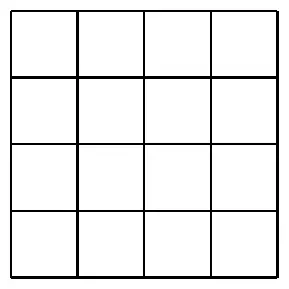
19. The 16 small squares shown in the diagram each have a side length of 1 unit. How many pairs of vertices are there in the diagram whose distance apart is an integer number of units?

  1. A 40
  2. B 64
  3. C 108
  4. D 132
  5. E 16
A 4 by 4 grid of unit squares

Senior Mathematical Challenge 2013, Question 19. © UK Mathematics Trust. Original paper on ukmt.org.uk

SMC 2013 Q17

SMCCurrent spec5 marksGeometry & Angles

17. The equilateral triangle \(PQR\) has side-length 1. The lines \(PT\) and \(PU\) trisect the angle \(RPQ\), the lines \(RS\) and \(RT\) trisect the angle \(QRP\) and the lines \(QS\) and \(QU\) trisect the angle \(PQR\).
What is the side-length of the equilateral triangle \(STU\)?

  1. A \(\dfrac{\cos 80°}{\cos 20°}\)
  2. B \(\tfrac{1}{3}\cos 20°\)
  3. C \(\cos^2 20°\)
  4. D \(\tfrac{1}{6}\)
  5. E \(\cos 20° \cos 80°\)
Equilateral triangle PQR with the angle trisectors from each vertex meeting at S, T and U, which form a smaller equilateral triangle

Senior Mathematical Challenge 2013, Question 17. © UK Mathematics Trust. Original paper on ukmt.org.uk

SMC 2013 Q8

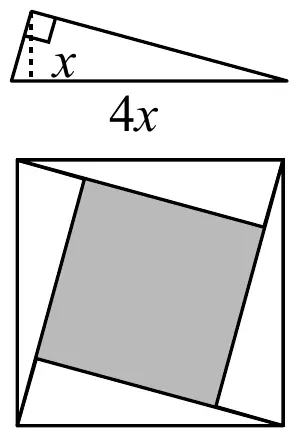
8. The right-angled triangle shown has a base which is 4 times its height. Four such triangles are placed so that their hypotenuses form the boundary of a large square as shown.
What is the side-length of the shaded square in the diagram?

  1. A \(2x\)
  2. B \(2\sqrt{2}x\)
  3. C \(3x\)
  4. D \(2\sqrt{3}x\)
  5. E \(\sqrt{15}x\)
Above, a right-angled triangle with height x and base 4x. Below, four such triangles inside a large square, their hypotenuses forming its boundary, around a shaded square

Senior Mathematical Challenge 2013, Question 8. © UK Mathematics Trust. Original paper on ukmt.org.uk

SMC 2012 Q24

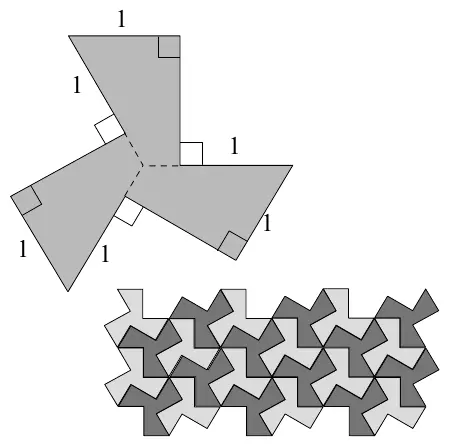
24. The top diagram on the right shows a shape that tiles the plane, as shown in the lower diagram. The tile has nine sides, six of which have length 1. It may be divided into three congruent quadrilaterals as shown. What is the area of the tile?

  1. A \(\dfrac{1 + 2\sqrt{3}}{2}\)
  2. B \(\dfrac{4\sqrt{3}}{3}\)
  3. C \(\sqrt{6}\)
  4. D \(\dfrac{3 + 4\sqrt{3}}{4}\)
  5. E \(\dfrac{3\sqrt{3}}{2}\)
Top: a grey nine-sided tile divided into three congruent quadrilaterals, with six sides of length 1 and right angles marked. Bottom: copies of the tile in light and dark grey tiling the plane

Senior Mathematical Challenge 2012, Question 24. © UK Mathematics Trust. Original paper on ukmt.org.uk

SMC 2012 Q22

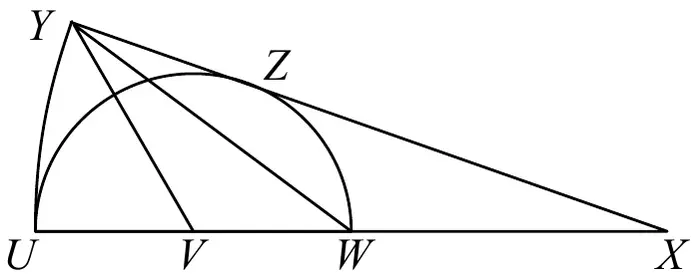
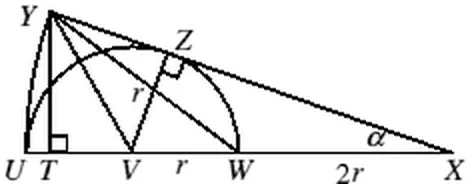
22. A semicircle of radius \(r\) is drawn with centre \(V\) and diameter \(UW\). The line \(UW\) is then extended to the point \(X\), such that \(UW\) and \(WX\) are of equal length. An arc of the circle with centre \(X\) and radius \(4r\) is then drawn so that the line \(XY\) is a tangent to the semicircle at \(Z\), as shown. What, in terms of \(r\), is the area of triangle \(YVW\)?

  1. A \(\dfrac{4r^2}{9}\)
  2. B \(\dfrac{2r^2}{3}\)
  3. C \(r^2\)
  4. D \(\dfrac{4r^2}{3}\)
  5. E \(2r^2\)
A semicircle on diameter UW with centre V; UW is extended to X; an arc centred at X passes through Y above U, and the line XY touches the semicircle at Z

Senior Mathematical Challenge 2012, Question 22. © UK Mathematics Trust. Original paper on ukmt.org.uk

SMC 2012 Q20

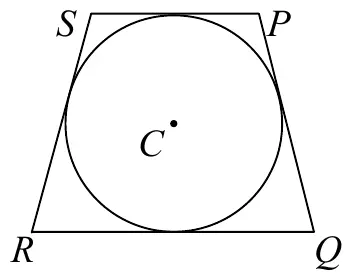
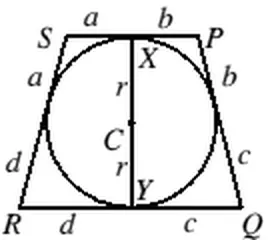
20. In trapezium PQRS, SR = PQ = 25cm and SP is parallel to RQ. All four sides of PQRS are tangent to a circle with centre C. The area of the trapezium is 600cm2. What is the radius of the circle?

  1. A 7.5cm
  2. B 8cm
  3. C 9cm
  4. D 10cm
  5. E 12cm
Trapezium PQRS with SP at the top and RQ at the bottom, and a circle with centre C touching all four sides

Senior Mathematical Challenge 2012, Question 20. © UK Mathematics Trust. Original paper on ukmt.org.uk

SMC 2012 Q18

SMCCurrent spec5 marksGeometry & Angles

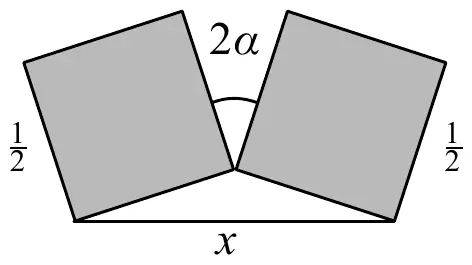
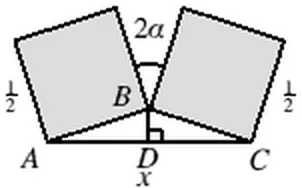
18. The diagram shows two squares, with sides of length \(\tfrac{1}{2}\), inclined at an angle \(2\alpha\) to one another. What is the value of \(x\)?

  1. A \(\cos\alpha\)
  2. B \(\dfrac{1}{\cos\alpha}\)
  3. C \(\sin\alpha\)
  4. D \(\dfrac{1}{\sin\alpha}\)
  5. E \(\tan\alpha\)
Two grey squares of side one half meeting at a vertex, inclined at an angle 2 alpha to one another; x is the distance between their lower outer corners

Senior Mathematical Challenge 2012, Question 18. © UK Mathematics Trust. Original paper on ukmt.org.uk

SMC 2012 Q17

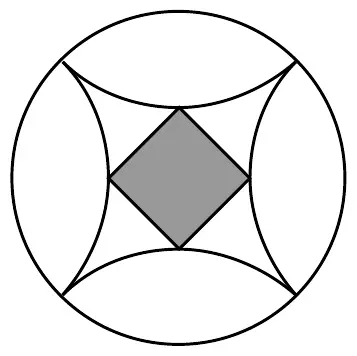
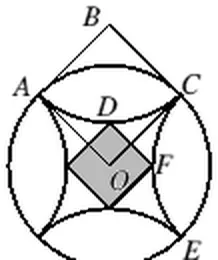
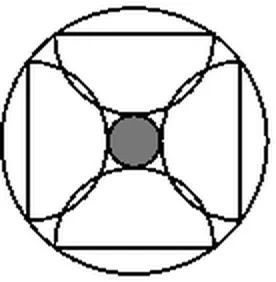
17. The diagram shows a pattern found on a floor tile in the cathedral in Spoleto, Umbria. A circle of radius 1 surrounds four quarter circles, also of radius 1, which enclose a square. The pattern has four axes of symmetry. What is the side length of the square?

  1. A \(\dfrac{1}{\sqrt{2}}\)
  2. B \(2 - \sqrt{2}\)
  3. C \(\dfrac{1}{\sqrt{3}}\)
  4. D \(\dfrac{1}{2}\)
  5. E \(\sqrt{2} - 1\)
A circle containing four quarter circle arcs which enclose a grey square standing on one corner

Senior Mathematical Challenge 2012, Question 17. © UK Mathematics Trust. Original paper on ukmt.org.uk

SMC 2012 Q11

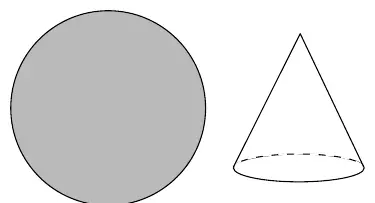
11. Coco is making clown hats from a circular piece of cardboard. The circumference of the base of each hat equals its slant height, which in turn is equal to the radius of the piece of cardboard. What is the maximum number of hats that Coco can make from the piece of cardboard?

  1. A 3
  2. B 4
  3. C 5
  4. D 6
  5. E 7
A grey circular piece of cardboard and a cone-shaped hat

Senior Mathematical Challenge 2012, Question 11. © UK Mathematics Trust. Original paper on ukmt.org.uk

SMC 2012 Q8

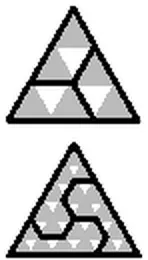
8. The diagrams below show four types of tile, each of which is made up of one or more equilateral triangles. For how many of these types of tile can we place three identical copies of the tile together, without gaps or overlaps, to make an equilateral triangle?

Four grey tiles in a row: a single equilateral triangle, a rhombus of two triangles, a trapezium of three triangles, and a shape made of twelve small triangles
  1. A 0
  2. B 1
  3. C 2
  4. D 3
  5. E 4

Senior Mathematical Challenge 2012, Question 8. © UK Mathematics Trust. Original paper on ukmt.org.uk

SMC 2012 Q2

SMCCurrent spec4 marksGeometry & Angles

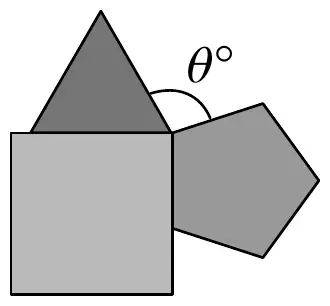
2. The diagram shows an equilateral triangle, a square and a regular pentagon which all share a common vertex. What is the value of \(\theta\)?

  1. A 98
  2. B 102
  3. C 106
  4. D 110
  5. E 112
A dark grey equilateral triangle on top of a light grey square, with a grey regular pentagon to the right; all three share a common vertex and the angle theta degrees is marked between the triangle and the pentagon

Senior Mathematical Challenge 2012, Question 2. © UK Mathematics Trust. Original paper on ukmt.org.uk

SMC 2011 Q24

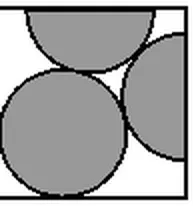
SMCCurrent spec5 marksGeometry & Angles

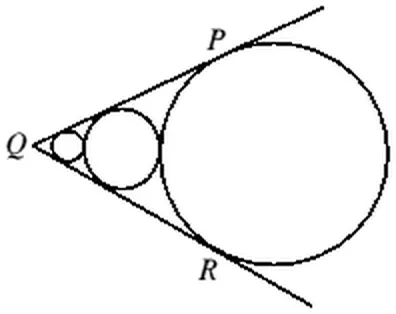
24. Three circles and the lines PQ and QR touch as shown. The distance between the centres of the smallest and the biggest circles is 16 times the radius of the smallest circle. What is the size of \(\angle PQR\)?

  1. A 45°
  2. B 60°
  3. C 75°
  4. D 90°
  5. E 135°
Two lines from Q touching three circles of increasing size, the largest touching the lines at P and R

Senior Mathematical Challenge 2011, Question 24. © UK Mathematics Trust. Original paper on ukmt.org.uk

SMC 2011 Q22

SMCCurrent spec5 marksGeometry & Angles

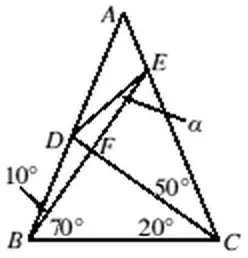
22. In the diagram, \(\angle ABE = 10°\); \(\angle EBC = 70°\); \(\angle ACD = 50°\); \(\angle DCB = 20°\); \(\angle DEF = \alpha\).
Which of the following is equal to \(\tan\alpha\)?

  1. A \(\dfrac{\tan 10° \tan 20°}{\tan 50°}\)
  2. B \(\dfrac{\tan 10° \tan 20°}{\tan 70°}\)
  3. C \(\dfrac{\tan 10° \tan 50°}{\tan 70°}\)
  4. D \(\dfrac{\tan 20° \tan 50°}{\tan 70°}\)
  5. E \(\dfrac{\tan 10° \tan 70°}{\tan 50°}\)
Triangle ABC with points D on AB, E on AC, lines BE and CD meeting at F, and a line from E through F; angles of 10 and 70 degrees are marked at B, 20 and 50 degrees at C, and alpha at E

Senior Mathematical Challenge 2011, Question 22. © UK Mathematics Trust. Original paper on ukmt.org.uk

SMC 2011 Q19

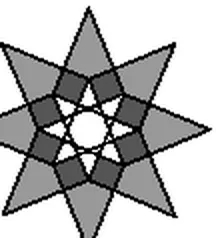
19. The diagram shows a small regular octagram (an eight-sided star) surrounded by eight squares (dark grey) and eight kites (light grey) to make a large regular octagram. Each square has area 1.
What is the area of one of the light grey kites?

  1. A 2
  2. B \(\sqrt{2} + 1\)
  3. C \(\dfrac{21}{8}\)
  4. D \(4\sqrt{2} - 3\)
  5. E \(\dfrac{11}{4}\)
A large eight-pointed star made of a small white octagram surrounded by eight dark grey squares and eight light grey kites

Senior Mathematical Challenge 2011, Question 19. © UK Mathematics Trust. Original paper on ukmt.org.uk

SMC 2011 Q14

14. An equilateral triangle of side length 4 cm is divided into smaller equilateral triangles, all of which have side length equal to a whole number of centimetres. Which of the following cannot be the number of smaller triangles obtained?

  1. A 4
  2. B 8
  3. C 12
  4. D 13
  5. E 16

Senior Mathematical Challenge 2011, Question 14. © UK Mathematics Trust. Original paper on ukmt.org.uk

SMC 2011 Q10

10. A triangle has two edges of length 5. What length should be chosen for the third side of the triangle so as to maximise the area within the triangle?

  1. A 5
  2. B 6
  3. C \(5\sqrt{2}\)
  4. D 8
  5. E \(5\sqrt{3}\)

Senior Mathematical Challenge 2011, Question 10. © UK Mathematics Trust. Original paper on ukmt.org.uk

SMC 2011 Q7

7. Two sides of a triangle have lengths 4 cm and 5 cm. The third side has length \(x\) cm, where \(x\) is a positive integer. How many different values can \(x\) have?

  1. A 4
  2. B 5
  3. C 6
  4. D 7
  5. E 8

Senior Mathematical Challenge 2011, Question 7. © UK Mathematics Trust. Original paper on ukmt.org.uk

SMC 2011 Q5

SMCCurrent spec4 marksGeometry & Angles

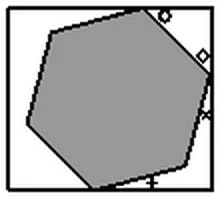
5. The diagram shows a regular hexagon inside a rectangle.
What is the sum of the four marked angles?

  1. A 90°
  2. B 120°
  3. C 150°
  4. D 180°
  5. E 210°
A grey regular hexagon inside a rectangle, with two vertices on the left and right sides; four angles between the hexagon and the rectangle are marked

Senior Mathematical Challenge 2011, Question 5. © UK Mathematics Trust. Original paper on ukmt.org.uk

SMC 2010 Q23

23. The diagram shows two different semicircles inside a square with sides of length 2. The common centre of the semicircles lies on a diagonal of the square.
What is the total shaded area?

  1. A \(\pi\)
  2. B \(6\pi(3 - 2\sqrt{2})\)
  3. C \(\pi\sqrt{2}\)
  4. D \(3\pi(2 - \sqrt{2})\)
  5. E \(8\pi(2\sqrt{2} - 3)\)
A square containing two grey semicircles of different sizes whose diameters lie along a diagonal of the square, with their common centre marked

Senior Mathematical Challenge 2010, Question 23. © UK Mathematics Trust. Original paper on ukmt.org.uk

SMC 2010 Q21

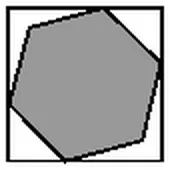
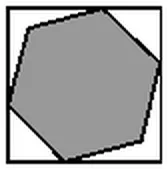
21. The diagram shows a regular hexagon, with sides of length 1, inside a square. Two vertices of the hexagon lie on a diagonal of the square and the other four lie on the edges.

What is the area of the square?

  1. A \(2 + \sqrt{3}\)
  2. B 4
  3. C \(3 + \sqrt{2}\)
  4. D \(1 + \dfrac{3\sqrt{3}}{2}\)
  5. E \(\dfrac{7}{2}\)
A grey regular hexagon inside a square, with two vertices on a diagonal of the square and the other four on its edges

Senior Mathematical Challenge 2010, Question 21. © UK Mathematics Trust. Original paper on ukmt.org.uk

SMC 2010 Q16

SMCCurrent spec5 marksGeometry & Angles

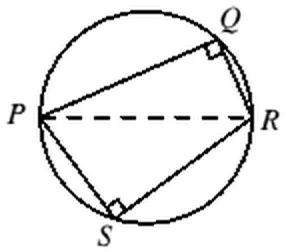
16. PQRS is a quadrilateral inscribed in a circle of which PR is a diameter. The lengths of PQ, QR and RS are 60, 25 and 52 respectively. What is the length of SP?

  1. A \(21\tfrac{2}{3}\)
  2. B \(28\tfrac{11}{13}\)
  3. C 33
  4. D 36
  5. E 39

Senior Mathematical Challenge 2010, Question 16. © UK Mathematics Trust. Original paper on ukmt.org.uk

SMC 2010 Q14

SMCCurrent spec4 marksAlgebraGeometry & Angles

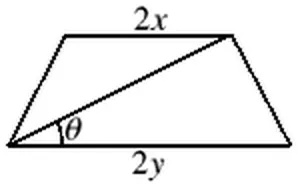
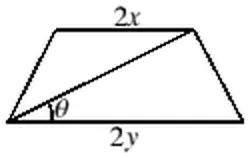
14. The parallel sides of a trapezium have lengths \(2x\) and \(2y\) respectively. The diagonals are equal in length, and a diagonal makes an angle \(\theta\) with the parallel sides, as shown. What is the length of each diagonal?

  1. A \(x + y\)
  2. B \(\dfrac{x + y}{\sin\theta}\)
  3. C \((x + y)\cos\theta\)
  4. D \((x + y)\tan\theta\)
  5. E \(\dfrac{x + y}{\cos\theta}\)
A trapezium with top side 2x and bottom side 2y, and a diagonal making an angle theta with the bottom side

Senior Mathematical Challenge 2010, Question 14. © UK Mathematics Trust. Original paper on ukmt.org.uk

SMC 2010 Q3

SMCCurrent spec4 marksGeometry & Angles

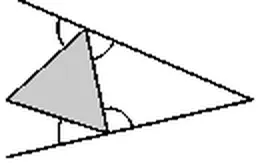
3. The diagram shows an equilateral triangle touching two straight lines.
What is the sum of the four marked angles?

  1. A 120°
  2. B 180°
  3. C 240°
  4. D 300°
  5. E 360°
Two straight lines meeting at a point on the right, with a grey equilateral triangle touching both lines; two angles are marked between each line and the triangle

Senior Mathematical Challenge 2010, Question 3. © UK Mathematics Trust. Original paper on ukmt.org.uk

SMC 2009 Q24

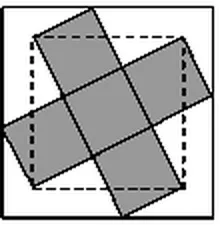
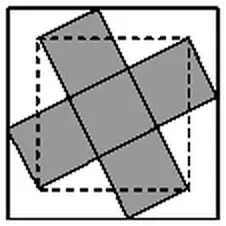
24. A figure in the shape of a cross is made from five 1 × 1 squares, as shown. The cross is inscribed in a large square whose sides are parallel to the dashed square, formed by four of the vertices of the cross. What is the area of the large outer square?

  1. A 9
  2. B \(\dfrac{49}{5}\)
  3. C 10
  4. D \(\dfrac{81}{8}\)
  5. E \(\dfrac{32}{3}\)
A grey cross of five unit squares, tilted, inside a large square; four vertices of the cross form a dashed square with sides parallel to the large square

Senior Mathematical Challenge 2009, Question 24. © UK Mathematics Trust. Original paper on ukmt.org.uk

SMC 2009 Q21

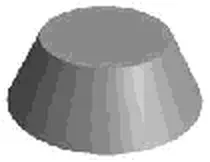
21. A frustum is the solid obtained by slicing a right-circular cone perpendicular to its axis and removing the small cone above the slice. This leaves a shape with two circular faces and a curved surface. The original cone has base radius 6 cm and height 8 cm, and the curved surface area of the frustum is equal to the area of the two circles. What is the height of the frustum?

  1. A 3 cm
  2. B 4 cm
  3. C 5 cm
  4. D 6 cm
  5. E 7 cm
A grey frustum of a cone, wider at the bottom than at the top

Senior Mathematical Challenge 2009, Question 21. © UK Mathematics Trust. Original paper on ukmt.org.uk

SMC 2009 Q17

17. A solid cube is divided into two pieces by a single rectangular cut. As a result, the total surface area increases by a fraction \(f\) of the surface area of the original cube. What is the greatest possible value of \(f\)?

  1. A \(\dfrac{1}{3}\)
  2. B \(\dfrac{\sqrt{3}}{4}\)
  3. C \(\dfrac{\sqrt{2}}{3}\)
  4. D \(\dfrac{1}{2}\)
  5. E \(\dfrac{1}{\sqrt{3}}\)

Senior Mathematical Challenge 2009, Question 17. © UK Mathematics Trust. Original paper on ukmt.org.uk

SMC 2009 Q14

SMCCurrent spec4 marksGeometry & Angles

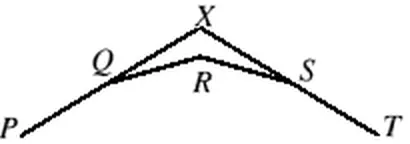
14. \(P\), \(Q\), \(R\), \(S\), \(T\) are vertices of a regular polygon. The sides \(PQ\) and \(TS\) are produced to meet at \(X\), as shown in the diagram, and \(\angle QXS = 140°\). How many sides does the polygon have?

  1. A 9
  2. B 18
  3. C 24
  4. D 27
  5. E 40
Five consecutive vertices P, Q, R, S, T of a regular polygon; the sides PQ and TS are extended to meet at X above R

Senior Mathematical Challenge 2009, Question 14. © UK Mathematics Trust. Original paper on ukmt.org.uk

SMC 2009 Q12

SMCCurrent spec4 marksGeometry & Angles

12. Which of the following has the greatest value?

  1. A cos 50°
  2. B sin 50°
  3. C tan 50°
  4. D \(\dfrac{1}{\sin 50°}\)
  5. E \(\dfrac{1}{\cos 50°}\)

Senior Mathematical Challenge 2009, Question 12. © UK Mathematics Trust. Original paper on ukmt.org.uk

SMC 2009 Q9

SMCCurrent spec4 marksGeometry & Angles

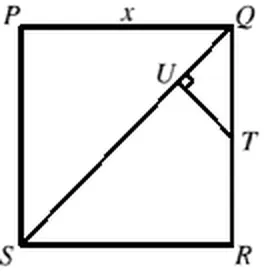
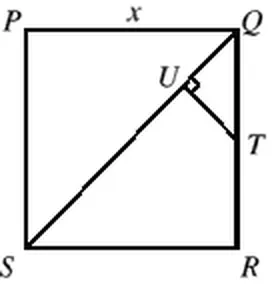
9. A square \(PQRS\) has sides of length \(x\). \(T\) is the midpoint of \(QR\) and \(U\) is the foot of the perpendicular from \(T\) to \(QS\). What is the length of \(TU\)?

  1. A \(\dfrac{x}{2}\)
  2. B \(\dfrac{x}{3}\)
  3. C \(\dfrac{x}{\sqrt{2}}\)
  4. D \(\dfrac{x}{2\sqrt{2}}\)
  5. E \(\dfrac{x}{4}\)
Square PQRS with side PQ of length x, diagonal QS, T the midpoint of QR and TU perpendicular to QS

Senior Mathematical Challenge 2009, Question 9. © UK Mathematics Trust. Original paper on ukmt.org.uk

SMC 2009 Q5

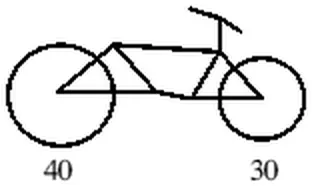
5. Boris Biker entered the Tour de Transylvania with an unusual bicycle whose back wheel is larger than the front. The radius of the back wheel is 40 cm, and the radius of the front wheel is 30 cm. On the first stage of the race the smaller wheel made 120000 revolutions. How many revolutions did the larger wheel make?

  1. A 90000
  2. B \(90000\pi\)
  3. C 160000
  4. D \(\dfrac{160000}{\pi}\)
  5. E 120000
A bicycle with a back wheel of radius 40 and a smaller front wheel of radius 30

Senior Mathematical Challenge 2009, Question 5. © UK Mathematics Trust. Original paper on ukmt.org.uk

SMC 2008 Q24

SMCCurrent spec5 marksAlgebraGeometry & Angles

24. The length of the hypotenuse of a particular right-angled triangle is given by \(\sqrt{1 + 3 + 5 + 7 + \;\ldots\; + 25}\). The lengths of the other two sides are given by \(\sqrt{1 + 3 + 5 + \;\ldots\; + x}\) and \(\sqrt{1 + 3 + 5 + \;\ldots\; + y}\) where \(x\) and \(y\) are positive integers.
What is the value of \(x + y\)?

  1. A 12
  2. B 17
  3. C 24
  4. D 28
  5. E 32

Senior Mathematical Challenge 2008, Question 24. © UK Mathematics Trust. Original paper on ukmt.org.uk

SMC 2008 Q22

22. A pentagon is made by attaching an equilateral triangle to a square with the same edge length. Four such pentagons are placed inside a rectangle, as shown.
What is the ratio of the length of the rectangle to its width?

  1. A \(\sqrt{3}\):1
  2. B 2:1
  3. C \(\sqrt{2}\):1
  4. D 3:2
  5. E 4:\(\sqrt{3}\)
A tall rectangle containing four pentagons, each a square with an equilateral triangle attached, fitted together

Senior Mathematical Challenge 2008, Question 22. © UK Mathematics Trust. Original paper on ukmt.org.uk

SMC 2008 Q20

20. The diagram shows four semicircles symmetrically placed between two circles. The shaded circle has area 4 and each semicircle has area 18. What is the area of the outer circle?

  1. A \(72\sqrt{2}\)
  2. B 100
  3. C 98
  4. D 96
  5. E \(32\sqrt{3}\)
A large circle containing a square-like shape whose four sides are bowed in by four semicircles, with a small shaded circle at the centre touching all four semicircles

Senior Mathematical Challenge 2008, Question 20. © UK Mathematics Trust. Original paper on ukmt.org.uk

SMC 2008 Q18

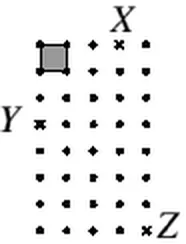
18. The shaded square of the lattice shown has area 1. What is the area of the circle through the points \(X\), \(Y\) and \(Z\)?

  1. A \(\dfrac{9\pi}{2}\)
  2. B \(8\pi\)
  3. C \(\dfrac{25\pi}{2}\)
  4. D \(25\pi\)
  5. E \(50\pi\)
A rectangular lattice of dots with a small shaded unit square at the top left; X is a point on the top row, Y a point on the left-hand side and Z the bottom right corner

Senior Mathematical Challenge 2008, Question 18. © UK Mathematics Trust. Original paper on ukmt.org.uk

SMC 2008 Q14

SMCCurrent spec4 marksGeometry & Angles

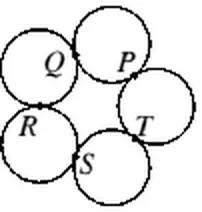
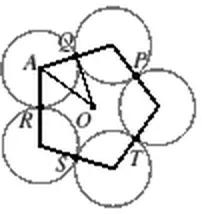
14. Five touching circles each have radius 1 and their centres are at the vertices of a regular pentagon. What is the radius of the circle through the points of contact \(P\), \(Q\), \(R\), \(S\) and \(T\)?

  1. A tan 18°
  2. B tan 36°
  3. C tan 45°
  4. D tan 54°
  5. E tan 72°
Five equal circles in a ring, each touching its two neighbours at the points P, Q, R, S and T

Senior Mathematical Challenge 2008, Question 14. © UK Mathematics Trust. Original paper on ukmt.org.uk

SMC 2008 Q8

SMCCurrent spec4 marksAlgebraGeometry & Angles

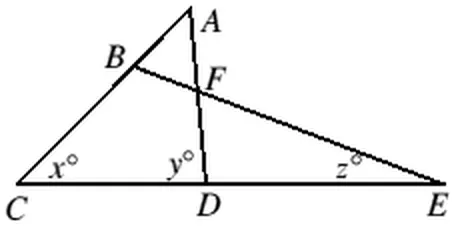
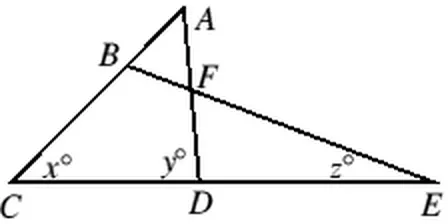
8. In the figure shown, \(AB = AF\) and \(ABC\), \(AFD\), \(BFE\) and \(CDE\) are all straight lines.
Which of the following expressions gives \(z\) in terms of \(x\) and \(y\)?

  1. A \(\dfrac{y - x}{2}\)
  2. B \(y - \dfrac{x}{2}\)
  3. C \(\dfrac{y - x}{3}\)
  4. D \(y - \dfrac{x}{3}\)
  5. E \(y - x\)
A figure in which line CBA rises from C to A, line AFD drops from A to D on the base CDE, and line BFE runs from B to E; the angle at C is x degrees, angle ADC is y degrees and the angle at E is z degrees

Senior Mathematical Challenge 2008, Question 8. © UK Mathematics Trust. Original paper on ukmt.org.uk

SMC 2008 Q6

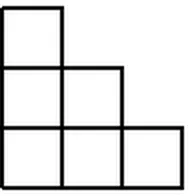
6. It is required to shade at least one of the six small squares in the diagram on the right so that the resulting figure has exactly one axis of symmetry. In how many different ways can this be done?

  1. A 6
  2. B 9
  3. C 10
  4. D 12
  5. E 15
A staircase of six unit squares: three squares in the bottom row, two in the middle row and one in the top row, all aligned on the left

Senior Mathematical Challenge 2008, Question 6. © UK Mathematics Trust. Original paper on ukmt.org.uk

SMC 2007 Q24

SMCCurrent spec5 marksGeometry & Angles

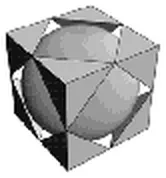
24. A paperweight is made from a glass cube of side 2 units by first shearing off the eight tetrahedral corners which touch at the midpoints of the edges of the cube. The remaining inner core of the cube is discarded and replaced by a sphere. The eight corner pieces are now stuck onto the sphere so that they have the same positions relative to each other as they did originally. What is the diameter of the sphere?
  1. A \(\sqrt{8} - 1\)
  2. B \(\sqrt{8} + 1\)
  3. C \(\tfrac{1}{3}(6 + \sqrt{3})\)
  4. D \(\tfrac{4}{3}\sqrt{3}\)
  5. E \(2\sqrt{3}\)
A grey glass cube whose eight corners are tetrahedra, with a sphere visible in the middle

Senior Mathematical Challenge 2007, Question 24. © UK Mathematics Trust. Original paper on ukmt.org.uk

SMC 2007 Q22

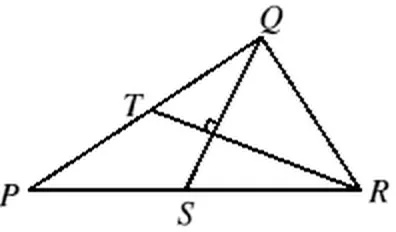
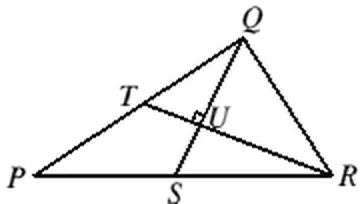
22. In triangle \(PQR\), \(S\) and \(T\) are the midpoints of \(PR\) and \(PQ\) respectively; \(QS\) is perpendicular to \(RT\); \(QS = 8\); \(RT = 12\).
What is the area of triangle \(PQR\)?

  1. A 24
  2. B 32
  3. C 48
  4. D 64
  5. E 96
Triangle PQR with S the midpoint of PR and T the midpoint of PQ; QS and RT cross at right angles

Senior Mathematical Challenge 2007, Question 22. © UK Mathematics Trust. Original paper on ukmt.org.uk

SMC 2007 Q20

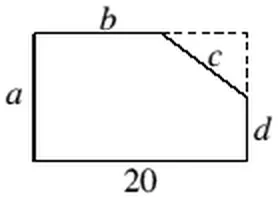
20. A triangle is cut from the corner of a rectangle. The resulting pentagon has sides of length 8, 10, 13, 15 and 20 units, though not necessarily in that order. What is the area of the pentagon?

  1. A 252.5
  2. B 260
  3. C 270
  4. D 275.5
  5. E 282.5

Senior Mathematical Challenge 2007, Question 20. © UK Mathematics Trust. Original paper on ukmt.org.uk

SMC 2007 Q19

SMCCurrent spec5 marksGeometry & Angles

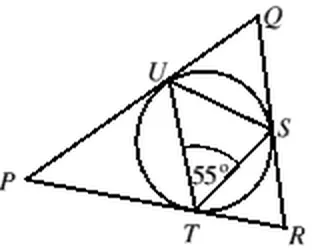
19. The largest circle which it is possible to draw inside triangle \(PQR\) touches the triangle at \(S\), \(T\) and \(U\), as shown in the diagram.
The size of \(\angle STU = 55°\). What is the size of \(\angle PQR\)?

  1. A 55°
  2. B 60°
  3. C 65°
  4. D 70°
  5. E 75°
Triangle PQR with its inscribed circle touching QR at S, RP at T and PQ at U; triangle STU is drawn and the angle at T is marked 55 degrees

Senior Mathematical Challenge 2007, Question 19. © UK Mathematics Trust. Original paper on ukmt.org.uk

SMC 2007 Q17

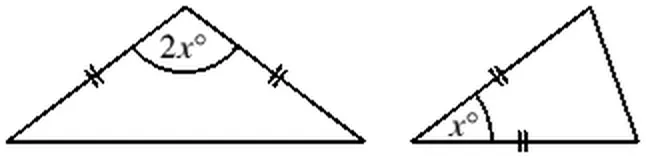
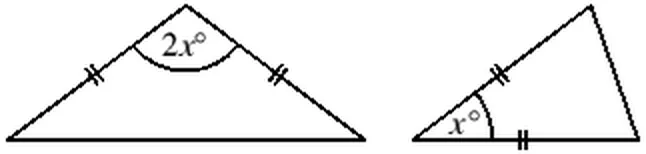
17. The two triangles have equal areas and the four marked lengths are equal.
What is the value of \(x\)?

  1. A 30
  2. B 45
  3. C 60
  4. D 75
  5. E more information needed
Two triangles. The first is isosceles with its two equal sides marked and the angle between them 2x degrees. The second has two marked sides, equal to those of the first, with the angle between them x degrees

Senior Mathematical Challenge 2007, Question 17. © UK Mathematics Trust. Original paper on ukmt.org.uk

SMC 2007 Q15

15. How many hexagons can be found in the diagram on the right if each side of a hexagon must consist of all or part of one of the straight lines in the diagram?

  1. A 4
  2. B 8
  3. C 12
  4. D 16
  5. E 20

Senior Mathematical Challenge 2007, Question 15. © UK Mathematics Trust. Original paper on ukmt.org.uk

SMC 2007 Q14

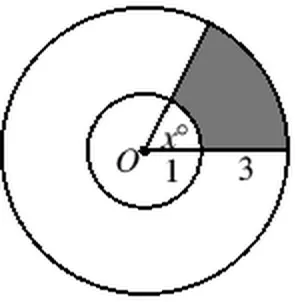
14. The point \(O\) is the centre of both circles and the shaded area is one-sixth of the area of the outer circle.
What is the value of \(x\)?

  1. A 60
  2. B 64
  3. C 72
  4. D 80
  5. E 84
Two concentric circles with centre O and radii 1 and 3; a sector of angle x degrees is shaded in the ring between the circles

Senior Mathematical Challenge 2007, Question 14. © UK Mathematics Trust. Original paper on ukmt.org.uk

SMC 2007 Q4

SMCCurrent spec4 marksGeometry & Angles

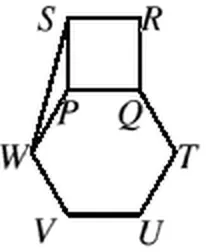
4. The diagram shows square \(PQRS\) and regular hexagon \(PQTUVW\).
What is the size of \(\angle PSW\)?

  1. A 10°
  2. B 12°
  3. C 15°
  4. D 24°
  5. E 30°
Square PQRS drawn on side PQ of regular hexagon PQTUVW, with the square outside the hexagon; S is joined to W

Senior Mathematical Challenge 2007, Question 4. © UK Mathematics Trust. Original paper on ukmt.org.uk

SMC 2006 Q24

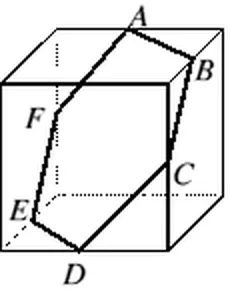
24. A solid red plastic cube, volume 1 cm3, is painted white on its outside. The cube is cut by a plane passing through the mid-points of various edges, as shown.
What, in cm2, is the total red area exposed by the cut?

  1. A \(\dfrac{3\sqrt{3}}{2}\)
  2. B 2
  3. C \(\dfrac{9\sqrt{2}}{5}\)
  4. D 3
  5. E \(\dfrac{3(\sqrt{3} + \sqrt{2})}{4}\)
A cube cut by a plane through the midpoints A, B, C, D, E, F of six of its edges, forming a hexagonal cross-section

Senior Mathematical Challenge 2006, Question 24. © UK Mathematics Trust. Original paper on ukmt.org.uk

SMC 2006 Q23

23. In the diagram, the circle and the two semicircles have radius 1.
What is the perimeter of the square?

  1. A \(6 + 4\sqrt{2}\)
  2. B \(2 + 4\sqrt{2} + 2\sqrt{3}\)
  3. C \(3\sqrt{2} + 4\sqrt{3}\)
  4. D \(4 + 2\sqrt{2} + 2\sqrt{6}\)
  5. E 12
A square containing a shaded circle in its bottom left corner and two shaded semicircles, one on the top side and one on the right-hand side, all touching each other

Senior Mathematical Challenge 2006, Question 23. © UK Mathematics Trust. Original paper on ukmt.org.uk

SMC 2006 Q21

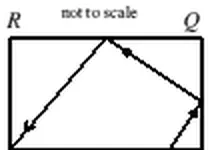
21. A toy pool table is 6 feet long and 3 feet wide. It has pockets at each of the four corners \(P\), \(Q\), \(R\) and \(S\). When a ball hits a side of the table, it bounces off the side at the same angle as it hit that side. A ball, initially 1 foot to the left of pocket \(P\), is hit from the side \(SP\) towards the side \(PQ\) as shown.

How many feet from \(P\) does the ball hit side \(PQ\) if it lands in pocket \(S\) after two bounces?

  1. A 1
  2. B \(\dfrac{6}{7}\)
  3. C \(\dfrac{3}{4}\)
  4. D \(\dfrac{2}{3}\)
  5. E \(\dfrac{3}{5}\)
A rectangle with corners R top left, Q top right, S bottom left and P bottom right, marked not to scale, showing the path of a ball from near P to side PQ, then to side QR, then to S

Senior Mathematical Challenge 2006, Question 21. © UK Mathematics Trust. Original paper on ukmt.org.uk

SMC 2006 Q16

SMCCurrent spec5 marksGeometry & Angles

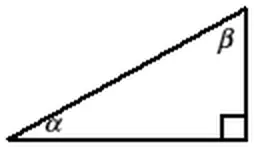
16. If \(\alpha < \beta\), how many different values are there among the following expressions?
\[\sin\alpha\,\sin\beta \qquad\quad \sin\alpha\,\cos\beta \qquad\quad \cos\alpha\,\sin\beta \qquad\quad \cos\alpha\,\cos\beta\]

  1. A 1
  2. B 2
  3. C 3
  4. D 4
  5. E It depends on the value of \(\alpha\)
A right-angled triangle with angle alpha at the left-hand vertex and angle beta at the top vertex

Senior Mathematical Challenge 2006, Question 16. © UK Mathematics Trust. Original paper on ukmt.org.uk

SMC 2006 Q9

9. The 80 spokes of the giant wheel The London Eye are made from 4 miles of cable. Roughly what is the circumference of the wheel in metres?

  1. A 50
  2. B 100
  3. C 500
  4. D 750
  5. E 900

Senior Mathematical Challenge 2006, Question 9. © UK Mathematics Trust. Original paper on ukmt.org.uk

SMC 2006 Q7

SMCCurrent spec4 marksAlgebraGeometry & Angles

7. The base of a pyramid has \(n\) edges. What is the difference between the number of edges the pyramid has and the number of faces the pyramid has?

  1. A \(n - 2\)
  2. B \(n - 1\)
  3. C \(n\)
  4. D \(n + 1\)
  5. E \(n + 2\)

Senior Mathematical Challenge 2006, Question 7. © UK Mathematics Trust. Original paper on ukmt.org.uk

SMC 2006 Q3

SMCCurrent spec4 marksGeometry & Angles

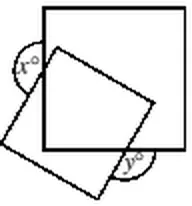
3. The diagram shows overlapping squares.
What is the value of \(x + y\)?

  1. A 270
  2. B 300
  3. C 330
  4. D 360
  5. E more information needed
Two overlapping squares, one tilted; an angle x degrees is marked outside the upper left where the sides cross and an angle y degrees outside the lower right

Senior Mathematical Challenge 2006, Question 3. © UK Mathematics Trust. Original paper on ukmt.org.uk

SMC 2005 Q23

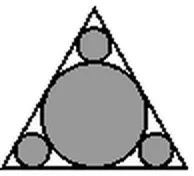
23. The diagram shows four touching circles, each of which also touches the sides of an equilateral triangle with sides of length 3.
What is the area of the shaded region?

  1. A \(\dfrac{11\pi}{12}\)
  2. B \(\pi\)
  3. C \(\dfrac{(4 + \sqrt{3})\pi}{6}\)
  4. D \(\dfrac{(3 + \sqrt{3})\pi}{4}\)
  5. E \(\dfrac{37\pi}{36}\)
An equilateral triangle containing a large shaded circle touching all three sides and three small shaded circles, one in each corner, each touching the large circle and two sides

Senior Mathematical Challenge 2005, Question 23. © UK Mathematics Trust. Original paper on ukmt.org.uk

SMC 2005 Q18

18. A cube exactly fits inside a sphere and another sphere exactly fits inside this cube. What is the ratio of the volume of the smaller sphere to the volume of the larger sphere?
  1. A \(1 : 3\sqrt{3}\)
  2. B \(1 : 4\)
  3. C \(1 : 3\)
  4. D \(2 : 3\)
  5. E \(1 : 2\)

Senior Mathematical Challenge 2005, Question 18. © UK Mathematics Trust. Original paper on ukmt.org.uk

SMC 2005 Q17

17. Eight identical regular octagons are placed edge to edge in a ring in such a way that a symmetrical star shape is formed by the interior edges.
If each octagon has sides of length 1, what is the area of the star?

  1. A \(5 + 10\sqrt{2}\)
  2. B \(8\sqrt{2}\)
  3. C \(9 + 4\sqrt{2}\)
  4. D \(16 - 4\sqrt{2}\)
  5. E \(8 + 4\sqrt{2}\)
Eight regular octagons joined edge to edge in a ring, enclosing a star-shaped region in the middle

Senior Mathematical Challenge 2005, Question 17. © UK Mathematics Trust. Original paper on ukmt.org.uk

SMC 2005 Q13

SMCCurrent spec4 marksGeometry & Angles

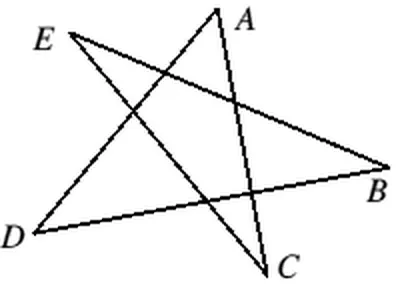
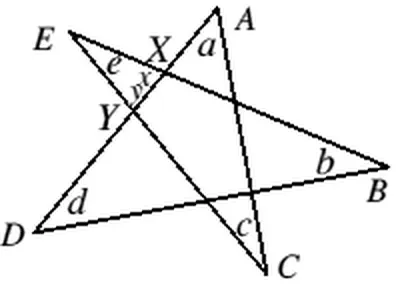
13. In the figure shown, what is the sum of the interior angles at \(A\), \(B\), \(C\), \(D\), \(E\)?

  1. A 90°
  2. B 135°
  3. C 150°
  4. D 180°
  5. E more information required.
A five-pointed star drawn with five straight lines, with points labelled A, B, C, D and E

Senior Mathematical Challenge 2005, Question 13. © UK Mathematics Trust. Original paper on ukmt.org.uk

SMC 2005 Q6

6. How many differently shaped triangles exist in which no two sides are the same length, each side is of integral unit length and the perimeter of the triangle is less than 13 units?

  1. A 2
  2. B 3
  3. C 4
  4. D 5
  5. E 6

Senior Mathematical Challenge 2005, Question 6. © UK Mathematics Trust. Original paper on ukmt.org.uk

SK 2020 Q20

20. Each square in this cross-number can be filled with a non-zero digit such that all of the conditions in the clues are fulfilled. The digits used are not necessarily distinct.
What is the answer to 3 ACROSS?

12
34
5
ACROSSDOWN
1. A multiple of 71. A multiple of a square of an odd prime; neither a
  square nor a cube
3. The answer to this Question2. The internal angle of a regular polygon;
  the exterior angle is between \(10^o\) and \(20^o\)
5. More than 104. A proper factor of 5 ACROSS but
  not a proper factor of 1 DOWN

Senior Kangaroo 2020, Question 20. © UK Mathematics Trust. Original paper on ukmt.org.uk

SK 2020 Q16

SKCurrent spec5 marksGeometry & Angles

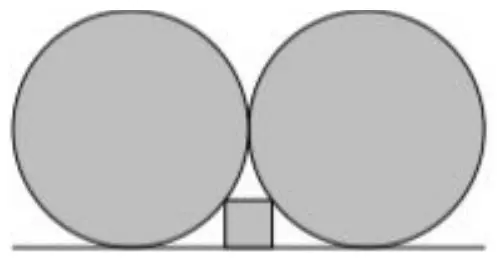
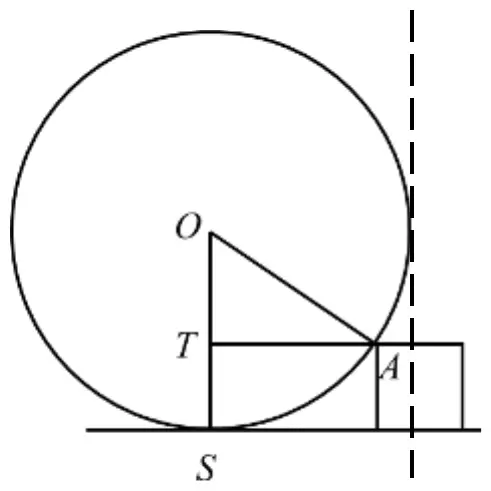
16. A square fits snugly between the horizontal line and two touching circles of radius 1000, as shown. The line is tangent to the circles.
What is the side-length of the square?

Two touching grey circles resting on a horizontal line with a small square between them under the point where they touch

Senior Kangaroo 2020, Question 16. © UK Mathematics Trust. Original paper on ukmt.org.uk

SK 2020 Q11

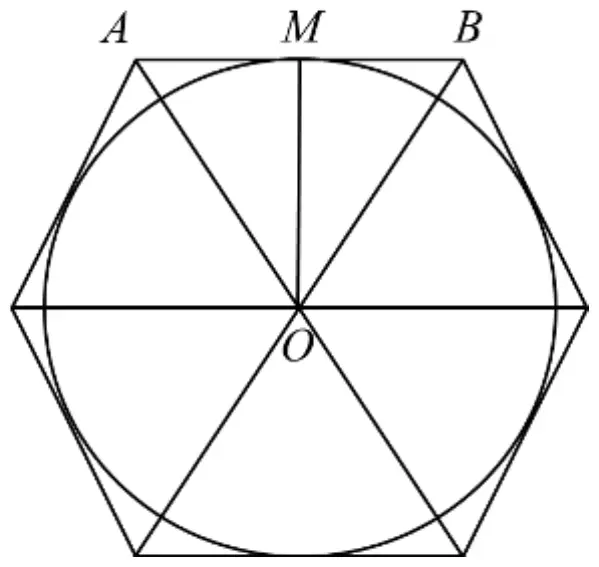
11. A circle is drawn inside a regular hexagon so that it touches all six sides of the hexagon.
The area of the circle is \(\pi \times 64\sqrt{3}\). What is the area of the hexagon?

Senior Kangaroo 2020, Question 11. © UK Mathematics Trust. Original paper on ukmt.org.uk

SK 2020 Q9

SKCurrent spec5 marksGeometry & Angles

9. The radii of two concentric circles are in the ratio \(1 : 3\).
\(AC\) is a diameter of the larger circle. \(BC\) is a chord of the larger circle and is tangent to the smaller circle. \(AB\) has length 140.
What is the radius of the larger circle?

Senior Kangaroo 2020, Question 9. © UK Mathematics Trust. Original paper on ukmt.org.uk

SK 2020 Q4

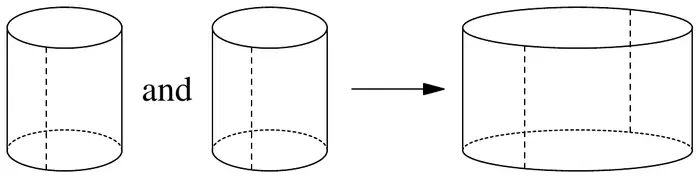
4. Two identical cylindrical sheets are cut open along the dotted lines and glued together to form one bigger cylindrical sheet, as shown. The smaller sheets each enclose a volume of 100. What volume is enclosed by the larger sheet?

Two identical cylinders with dotted vertical cut lines, and an arrow to a wider cylinder formed by joining them

Senior Kangaroo 2020, Question 4. © UK Mathematics Trust. Original paper on ukmt.org.uk

SK 2019 Q19

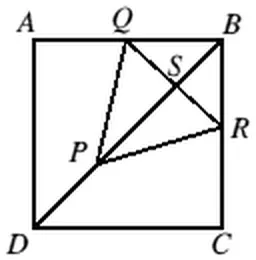
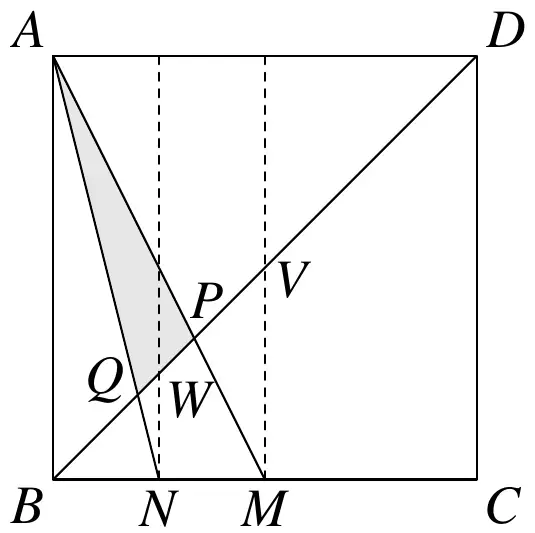
19. The square \(ABCD\) has sides of length 105. The point \(M\) is the midpoint of side \(BC\). The point \(N\) is the midpoint of \(BM\). The lines \(BD\) and \(AM\) meet at the point \(P\). The lines \(BD\) and \(AN\) meet at the point \(Q\).
What is the area of triangle \(APQ\)?

Senior Kangaroo 2019, Question 19. © UK Mathematics Trust. Original paper on ukmt.org.uk

SK 2019 Q17

SKCurrent spec5 marksGeometry & Angles

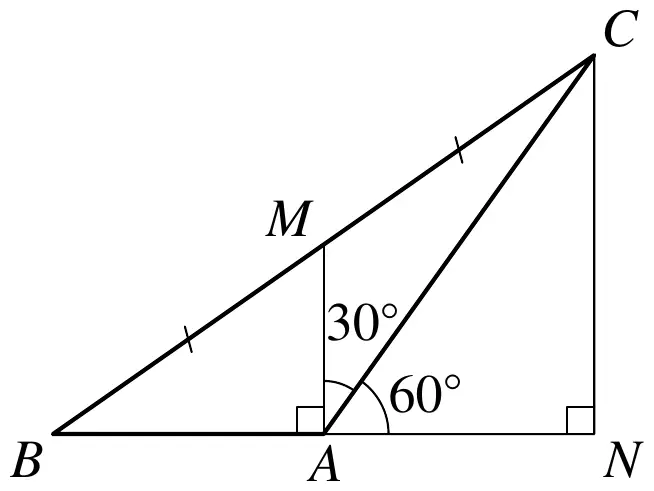
17. In triangle \(ABC\), \(\angle BAC\) is 120°. The length of \(AB\) is 123. The point \(M\) is the midpoint of side \(BC\). The line segments \(AB\) and \(AM\) are perpendicular.
What is the length of side \(AC\)?

Senior Kangaroo 2019, Question 17. © UK Mathematics Trust. Original paper on ukmt.org.uk

SK 2019 Q11

SKCurrent spec5 marksGeometry & Angles

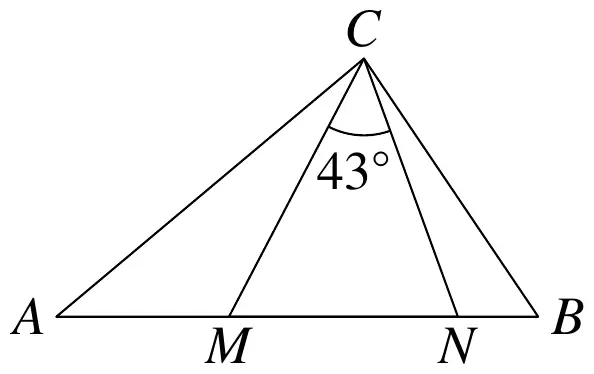
11. In the triangle \(ABC\) the points \(M\) and \(N\) lie on the side \(AB\) such that \(AN = AC\) and \(BM = BC\).

We know that \(\angle MCN = 43°\).

Find the size in degrees of \(\angle ACB\).

Triangle ABC with points M and N on AB; angle MCN is 43 degrees

Senior Kangaroo 2019, Question 11. © UK Mathematics Trust. Original paper on ukmt.org.uk

SK 2019 Q5

SKCurrent spec5 marksGeometry & Angles

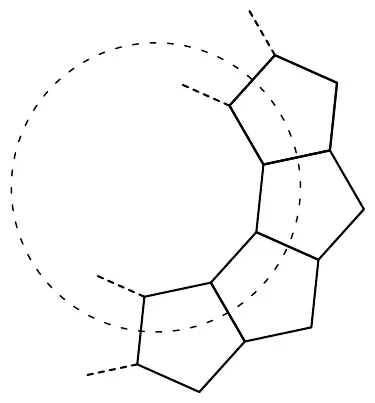
5. Identical regular pentagons are arranged in a ring. The partially completed ring is shown in the diagram. Each of the regular pentagons has a perimeter of 65. The regular polygon formed as the inner boundary of the ring has a perimeter of \(P\). What is the value of \(P\)?

Part of a ring of regular pentagons, with a dashed circle showing where the ring continues

Senior Kangaroo 2019, Question 5. © UK Mathematics Trust. Original paper on ukmt.org.uk

SK 2018 Q16

16. A right-angled triangle has sides of integer length. One of its sides has length 20. Toni writes down a list of all the different possible hypotenuses of such triangles.

What is the sum of all the numbers in Toni’s list?

Senior Kangaroo 2018, Question 16. © UK Mathematics Trust. Original paper on ukmt.org.uk

SK 2018 Q14

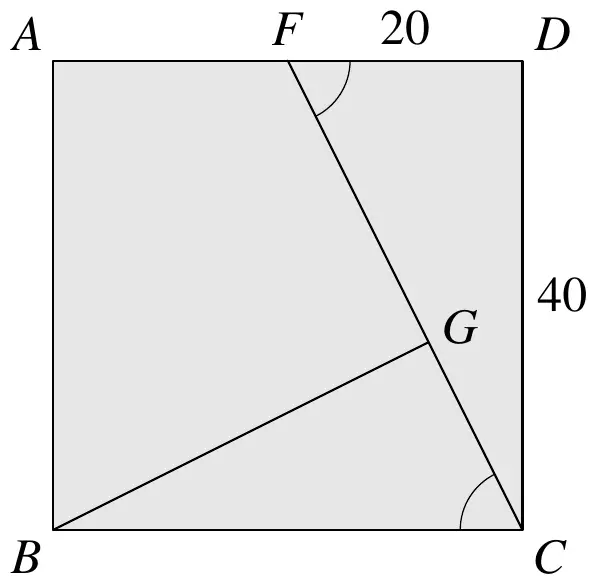
14. A square \(ABCD\) has side 40 units. Point \(F\) is the midpoint of side \(AD\). Point \(G\) lies on \(CF\) such that \(3CG = 2GF\).

What is the area of triangle \(BCG\)?

Senior Kangaroo 2018, Question 14. © UK Mathematics Trust. Original paper on ukmt.org.uk

SK 2018 Q6

SKCurrent spec5 marksGeometry & Angles

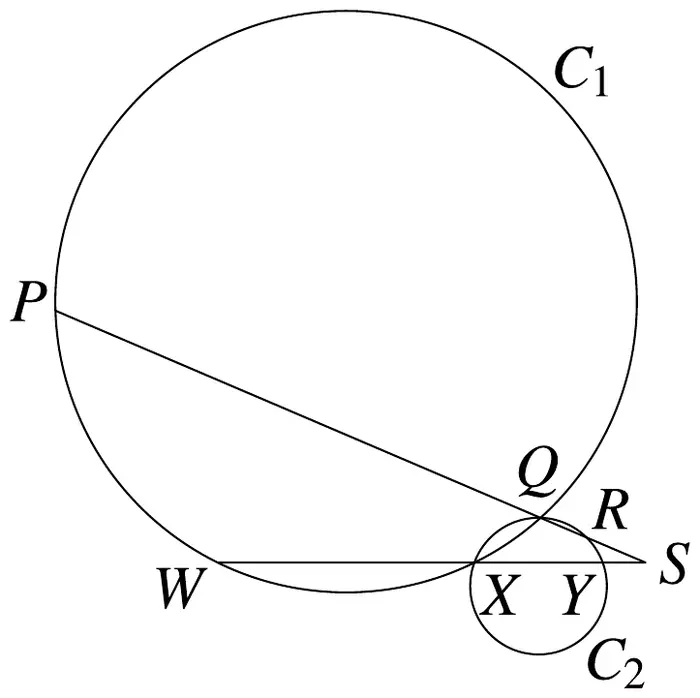
6. The line segments \(PQRS\) and \(WXYS\) intersect circle \(C_1\) at points \(P\), \(Q\), \(W\) and \(X\).

A large circle C1 and a small circle C2 meeting at Q and X; line PQRS crosses both circles and line WXYS crosses both circles, the lines meeting at S

The line segments intersect circle \(C_2\) at points \(Q\), \(R\), \(X\) and \(Y\). The lengths \(QR\), \(RS\) and \(XY\) are 7, 9 and 18 respectively. The length \(WX\) is six times the length \(YS\).

What is the sum of the lengths of \(PS\) and \(WS\)?

Senior Kangaroo 2018, Question 6. © UK Mathematics Trust. Original paper on ukmt.org.uk

SK 2018 Q3

SKCurrent spec5 marksGeometry & Angles

3. In triangle \(ABC\), we are given that \(AC = 5\sqrt{2}\), \(BC = 5\) and \(\angle BAC = 30°\).

What is the largest possible size in degrees of \(\angle ABC\)?

Senior Kangaroo 2018, Question 3. © UK Mathematics Trust. Original paper on ukmt.org.uk

SK 2017 Q18

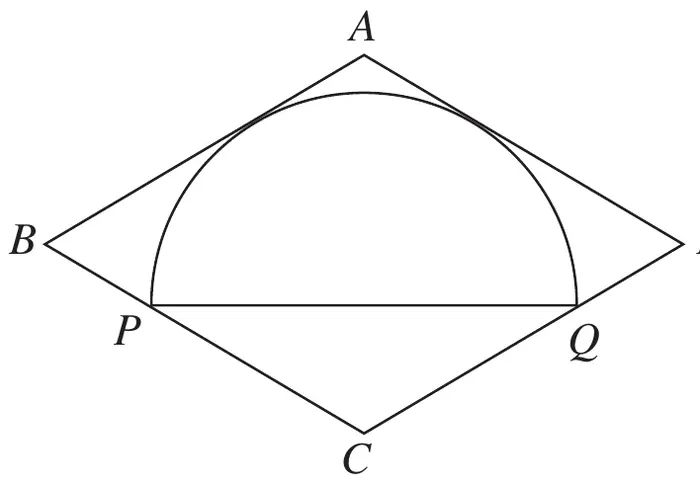
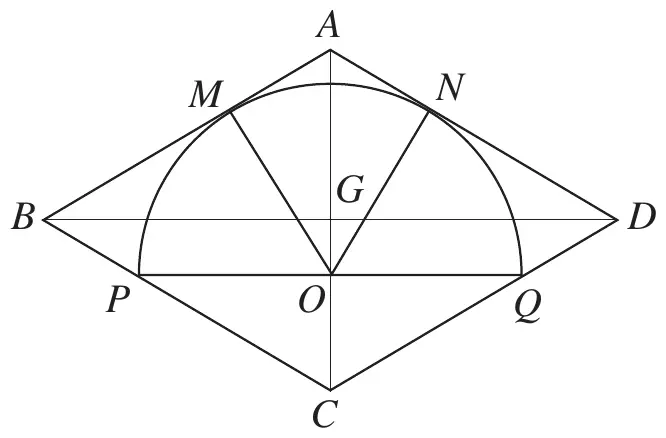
18. The diagram shows a semicircle with diameter \(PQ\) inscribed in a rhombus \(ABCD\). The rhombus is tangent to the arc of the semicircle in two places. Points \(P\) and \(Q\) lie on sides \(BC\) and \(CD\) of the rhombus respectively. The line of symmetry of the semicircle is coincident with the diagonal \(AC\) of the rhombus. It is given that \(\angle CBA = 60°\). The semicircle has radius 10. The area of the rhombus can be written in the form \(a\sqrt{b}\) where \(a\) and \(b\) are integers and \(b\) is prime. What is the value of \(ab + a + b\)?
Rhombus ABCD with a semicircle on diameter PQ, where P is on BC and Q is on CD, touching sides AB and AD

Senior Kangaroo 2017, Question 18. © UK Mathematics Trust. Original paper on ukmt.org.uk
SK 2017 Q16

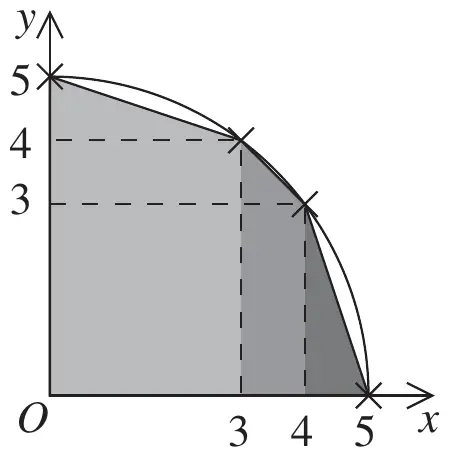
16. The curve \(x^2 + y^2 = 25\) is drawn. Points on the curve whose \(x\)-coordinate and \(y\)-coordinate are both integers are marked with crosses. All of those crosses are joined in turn to create a convex polygon \(P\). What is the area of \(P\)?

Senior Kangaroo 2017, Question 16. © UK Mathematics Trust. Original paper on ukmt.org.uk

SK 2017 Q8

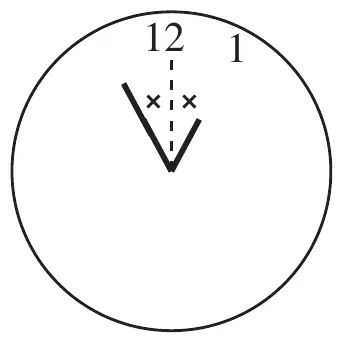
8. Priti is learning a new language called Tedio. During her one hour lesson, which started at midday, she looks at the clock and notices that the hour hand and the minute hand make exactly the same angle with the vertical, as shown in the diagram. How many whole seconds remain until the end of the lesson?

A clock face shortly before one o'clock with the hour and minute hands making equal angles with the vertical

Senior Kangaroo 2017, Question 8. © UK Mathematics Trust. Original paper on ukmt.org.uk

SK 2017 Q5

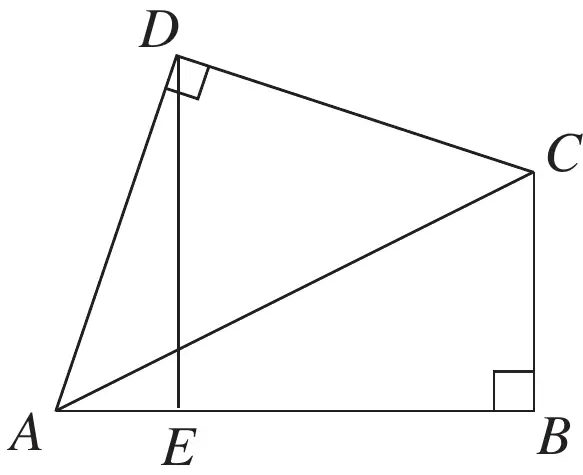
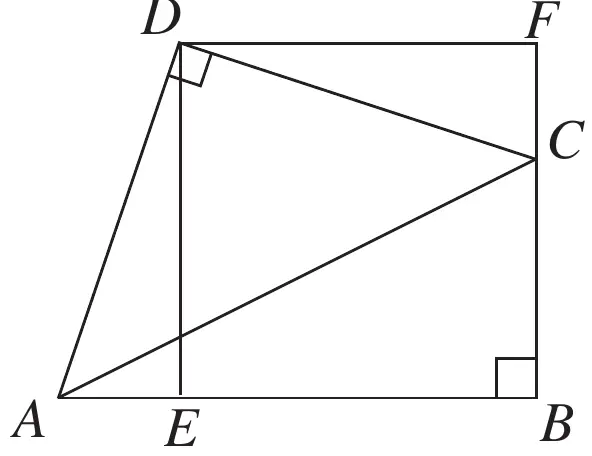
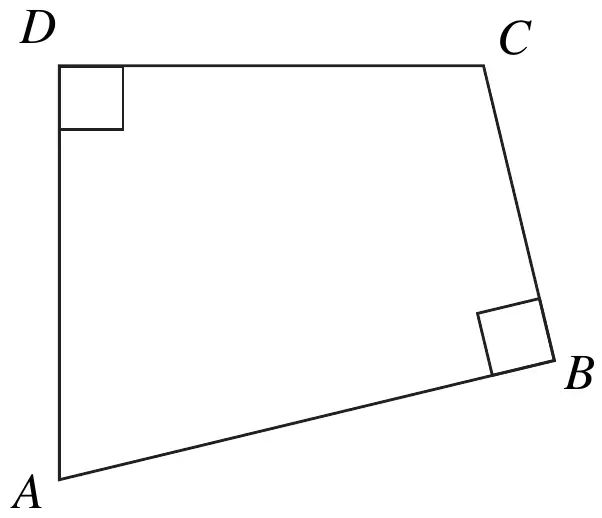
5. The figure shows a quadrilateral \(ABCD\) in which \(AD = DC\) and \(\angle ADC = \angle ABC = 90°\). The point \(E\) is the foot of the perpendicular from \(D\) to \(AB\). The length \(DE\) is 25. What is the area of quadrilateral \(ABCD\)?

Quadrilateral ABCD with right angles at D and B, diagonal AC, and the perpendicular DE from D to AB

Senior Kangaroo 2017, Question 5. © UK Mathematics Trust. Original paper on ukmt.org.uk

SK 2017 Q4

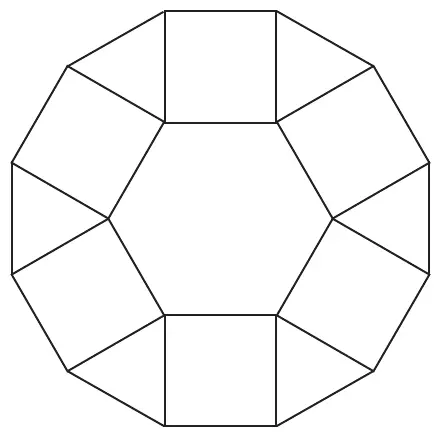
4. The figure shows a shape consisting of a regular hexagon of side 18 cm, six triangles and six squares. The outer perimeter of the shape is \(P\) cm. What is the value of \(P\)?

A regular hexagon with a square on each side and a triangle filling each gap between adjacent squares

Senior Kangaroo 2017, Question 4. © UK Mathematics Trust. Original paper on ukmt.org.uk

SK 2016 Q14

14. The lengths of the sides of a triangle are the integers 13, \(x\), \(y\). It is given that \(xy = 105\). What is the length of the perimeter of the triangle?

Senior Kangaroo 2016, Question 14. © UK Mathematics Trust. Original paper on ukmt.org.uk

SK 2016 Q12

12. Delia is joining three vertices of a square to make four right-angled triangles.
She can create four triangles doing this, as shown.

A square followed by the four right-angled triangles formed by joining three of its vertices

How many right-angled triangles can Delia make by joining three vertices of a regular polygon with 18 sides?

Senior Kangaroo 2016, Question 12. © UK Mathematics Trust. Original paper on ukmt.org.uk

SK 2016 Q9

9. The diagram shows two concentric circles. Chord \(AB\) of the larger circle is tangential to the smaller circle.
The length of \(AB\) is 32 cm and the area of the shaded region is \(k\pi\) cm2.
What is the value of \(k\)?

Two concentric circles with the ring between them shaded; chord AB of the larger circle touches the smaller circle

Senior Kangaroo 2016, Question 9. © UK Mathematics Trust. Original paper on ukmt.org.uk

SK 2016 Q6

SKCurrent spec5 marksGeometry & Angles

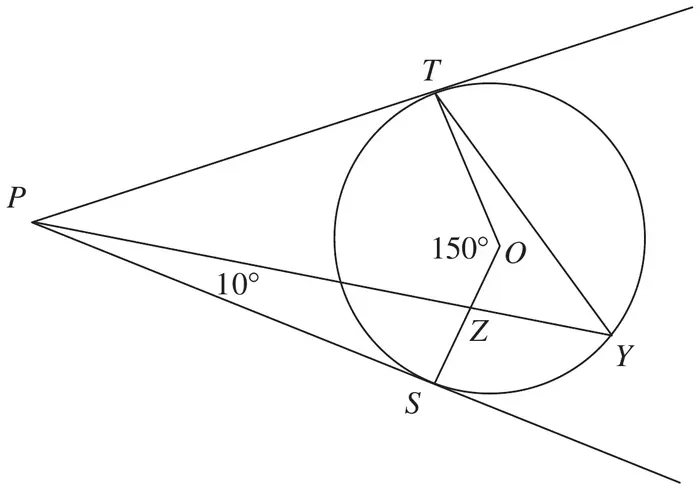
6. In the diagram, \(PT\) and \(PS\) are tangents to a circle with centre \(O\). The point \(Y\) lies on the circumference of the circle; and the point \(Z\) is where the line \(PY\) meets the radius \(OS\).

Also, \(\angle SPZ = 10°\) and \(\angle TOS = 150°\).

How many degrees are there in the sum of \(\angle PTY\) and \(\angle PYT\)?

Tangents PT and PS to a circle with centre O; the line PY crosses radius OS at Z; angle SPZ is 10 degrees and angle TOS is 150 degrees

Senior Kangaroo 2016, Question 6. © UK Mathematics Trust. Original paper on ukmt.org.uk

SK 2015 Q19

19. In quadrilateral \(ABCD\), \(\angle ABC = \angle ADC = 90°\), \(AD = DC\) and \(AB + BC = 20\) cm.

Quadrilateral ABCD with right angles at D and B

What is the area in cm2 of quadrilateral \(ABCD\)?

Senior Kangaroo 2015, Question 19. © UK Mathematics Trust. Original paper on ukmt.org.uk

SK 2015 Q17

SKCurrent spec5 marksGeometry & Angles

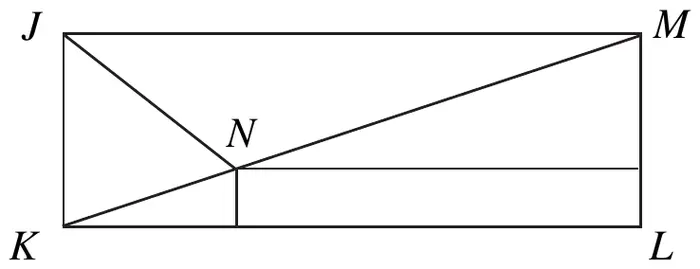
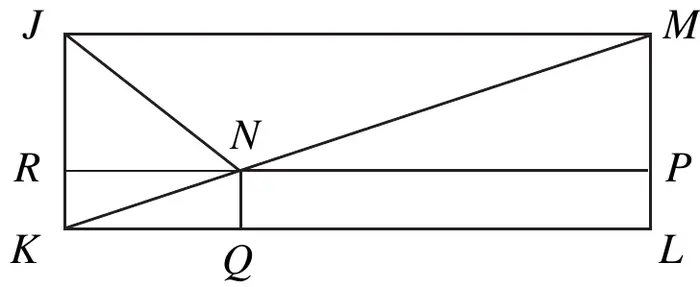
17. In rectangle \(JKLM\), the bisector of angle \(KJM\) cuts the diagonal \(KM\) at point \(N\) as shown. The distances between \(N\) and sides \(LM\) and \(KL\) are 8 cm and 1 cm respectively. The length of \(KL\) is \((a + \sqrt{b})\) cm. What is the value of \(a + b\)?

Rectangle JKLM with diagonal KM and the bisector of angle KJM meeting it at N; a horizontal line from N to side LM

Senior Kangaroo 2015, Question 17. © UK Mathematics Trust. Original paper on ukmt.org.uk

SK 2015 Q11

SKCurrent spec5 marksGeometry & Angles

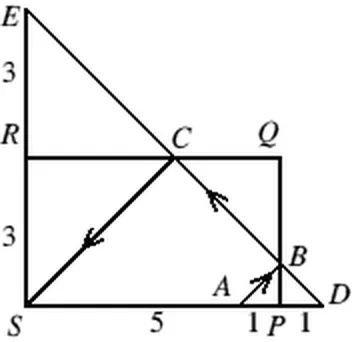
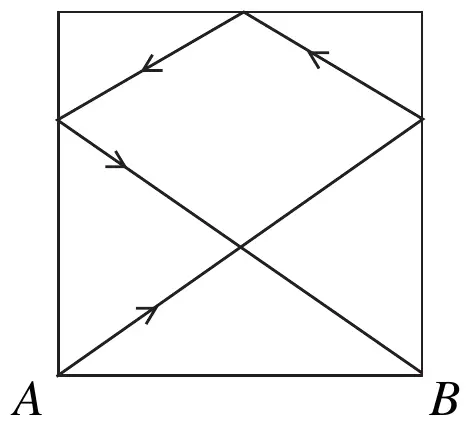
11. A ball is propelled from corner \(A\) of a square snooker table of side 2 metres. After bouncing off three cushions as shown, the ball goes into a pocket at \(B\). The total distance travelled by the ball is \(\sqrt{k}\) metres. What is the value of \(k\)?

A square table with corners A and B at the bottom; the ball's path from A bounces off the right, top and left cushions and ends at B

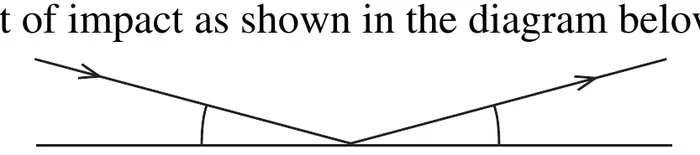
(Note that when the ball bounces off a cushion, the angle its path makes with the cushion as it approaches the point of impact is equal to the angle its path makes with the cushion as it moves away from the point of impact as shown in the diagram below.)

A path bouncing off a line, making equal angles with the line on either side of the point of impact

Senior Kangaroo 2015, Question 11. © UK Mathematics Trust. Original paper on ukmt.org.uk

SK 2015 Q5

SKCurrent spec5 marksGeometry & Angles

5. The diagram shows two circles and a square with sides of length 10 cm. One vertex of the square is at the centre of the large circle and two sides of the square are tangents to both circles. The small circle touches the large circle. The radius of the small circle is \((a - b\sqrt{2})\) cm.

A large circle with a square whose bottom-left vertex is at the centre of the circle; a small circle sits in the top-right corner of the square touching the large circle

What is the value of \(a + b\)?

Senior Kangaroo 2015, Question 5. © UK Mathematics Trust. Original paper on ukmt.org.uk

MOG 2020 Q2

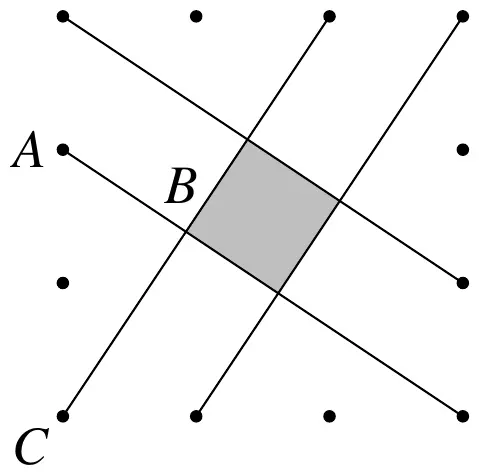
2.

Twelve points, four of which are vertices, lie on the perimeter of a square. The distance between adjacent points is one unit. Some of the points have been connected by straight lines. \(B\) is the intersection of two of those lines, as shown in the diagram.

A 3 by 3 square with twelve equally spaced points on its perimeter. Four lines join points on opposite sides, crossing to enclose a shaded quadrilateral in the middle; A is a point on the left side, C is the bottom left corner, and B is the corner of the shaded region nearest A
(a)

Find the ratio \(AB : BC\). Give your answer in its simplest form.(3 marks)

(b)

Find the area of the shaded region.(7 marks)

Mathematical Olympiad for Girls 2020, Question 2. © UK Mathematics Trust. Original paper on ukmt.org.uk

MOG 2019 Q4

MOGCurrent spec10 marksAlgebraGeometry & Angles
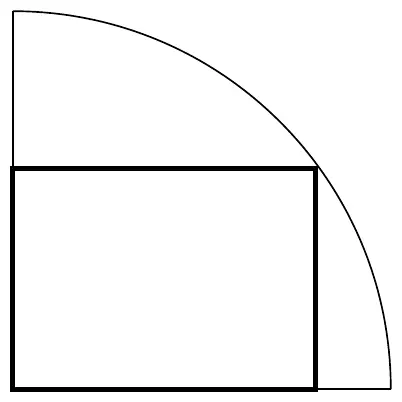
4.

The diagram shows a rectangle placed inside a quarter circle of radius 1, such that its vertices all lie on the perimeter of the quarter circle and one vertex coincides with the centre of the (whole) circle.
Let the perimeter of such a rectangle be \(P\).

(a)

Show that \(P = 3\) is impossible.(4 marks)

(b)

Find the largest possible value of \(P\). You must fully justify why the value that you find is the largest.

(4 marks)

Instead a rectangle is placed inside a whole circle of radius 1, such that its vertices all lie on the circumference of the circle.

(c)

If the perimeter of the rectangle is as large as possible, show that the rectangle must be a square and calculate its perimeter.(2 marks)

A quarter circle with a rectangle drawn inside it, one vertex at the centre and the opposite vertex on the arc

Mathematical Olympiad for Girls 2019, Question 4. © UK Mathematics Trust. Original paper on ukmt.org.uk

MOG 2018 Q2

MOGCurrent spec10 marksGeometry & Angles
2.

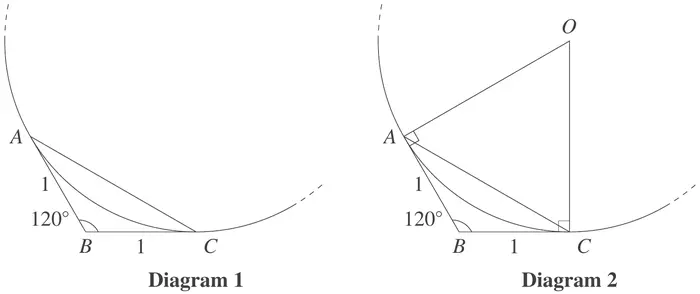
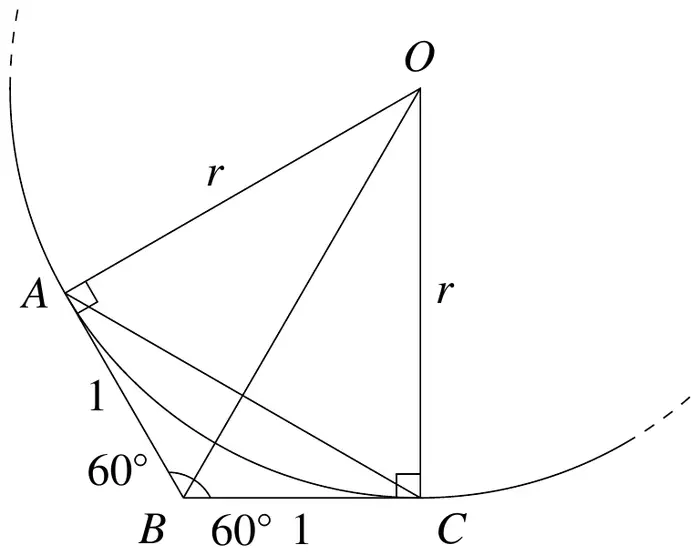
Triangle \(ABC\) is isosceles, with \(AB = BC = 1\) and angle \(ABC\) equal to \(120^\circ\). A circle is tangent to the line \(AB\) at \(A\) and to the line \(BC\) at \(C\).

What is the radius of the circle?(10 marks)

[You should state clearly any geometrical facts or theorems you use in each step of your calculation. For example, if one of your steps calculates the size of an angle in a triangle you might justify that particular step with “because angles in a triangle add up to 180 degrees.”]

Mathematical Olympiad for Girls 2018, Question 2. © UK Mathematics Trust. Original paper on ukmt.org.uk

MOG 2017 Q3

MOGCurrent spec10 marksAlgebraGeometry & Angles
3.

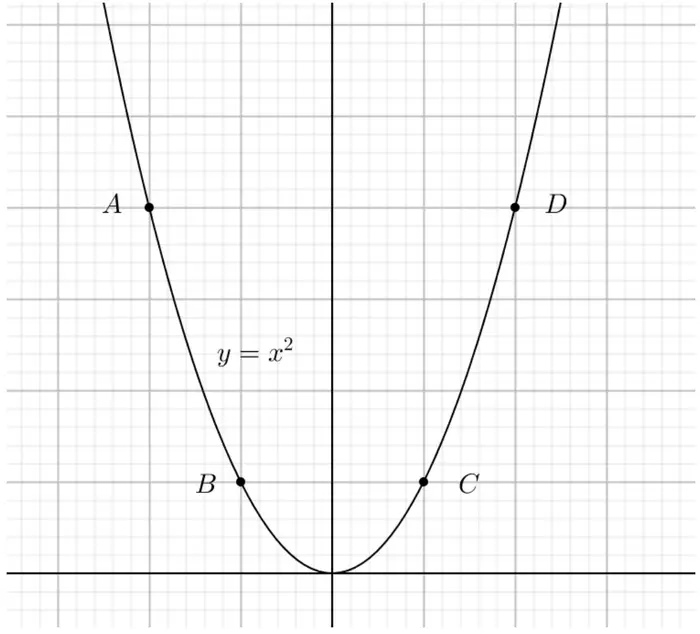
Four different points \(A\), \(B\), \(C\) and \(D\) lie on the curve with equation \(y = x^2\).

Prove that \(ABCD\) is never a parallelogram.

Mathematical Olympiad for Girls 2017, Question 3. © UK Mathematics Trust. Original paper on ukmt.org.uk

MOG 2016 Q4

4.
(a)

In the trapezium \(ABCD\), the edges \(AB\) and \(DC\) are parallel. The point \(M\) is the midpoint of \(BC\), and \(N\) is the midpoint of \(DA\).

Prove that \(2MN = AB + CD\).

(b)

The diagram shows part of a tiling of the plane by squares and equilateral triangles.

Each tile has edges of length 2. The points \(X\) and \(Y\) are at the centres of square tiles.

What is the distance \(XY\)?

Part of a tiling of the plane by squares and equilateral triangles, some tiles shaded grey, with points X and Y at the centres of two square tiles

Mathematical Olympiad for Girls 2016, Question 4. © UK Mathematics Trust. Original paper on ukmt.org.uk

MOG 2016 Q2

MOGCurrent spec10 marksGeometry & Angles
2.

The diagram shows two circles \(C_1\) and \(C_2\) with diameters \(PA\) and \(AQ\). The circles meet at the points \(A\) and \(B\), and the line \(PA\) is a tangent to \(C_2\) at \(A\).

Prove that\[\frac{PB}{BQ} = \frac{\text{area}\,C_1}{\text{area}\,C_2}.\]

Two circles C1 and C2 meeting at A and B, with diameters PA of C1 and AQ of C2

Mathematical Olympiad for Girls 2016, Question 2. © UK Mathematics Trust. Original paper on ukmt.org.uk

MOG 2015 Q2

MOGCurrent spec10 marksGeometry & Angles
2.

The diagram shows five polygons placed together edge-to-edge: two triangles, a regular hexagon and two regular nonagons.

Prove that each of the triangles is isosceles.

Two grey regular nonagons and a light grey regular hexagon placed edge-to-edge around two triangles, one white and one dark grey

Mathematical Olympiad for Girls 2015, Question 2. © UK Mathematics Trust. Original paper on ukmt.org.uk

BMO1 2020 Q5

BMO1Current spec10 marksGeometry & Angles
5.

Let points \(A\), \(B\) and \(C\) lie on a circle \(\Gamma\). Circle \(\Delta\) is tangent to \(AC\) at \(A\). It meets \(\Gamma\) again at \(D\) and the line \(AB\) again at \(P\). The point \(A\) lies between points \(B\) and \(P\). Prove that if \(AD = DP\), then \(BP = AC\).

British Mathematical Olympiad Round 1 2020, Question 5. © UK Mathematics Trust. Original paper on ukmt.org.uk

BMO1 2020 Q3

3.

A square piece of paper is folded in half along a line of symmetry. The resulting shape is then folded in half along a line of symmetry of the new shape. This process is repeated until \(n\) folds have been made, giving a sequence of \(n + 1\) shapes. If we do not distinguish between congruent shapes, find the number of possible sequences when:

(a)

\(n = 3\);

(b)

\(n = 6\);

(c)

\(n = 9\).

(When \(n = 1\) there are two possible sequences.)

British Mathematical Olympiad Round 1 2020, Question 3. © UK Mathematics Trust. Original paper on ukmt.org.uk

BMO1 2020 Q2

2.

A triangle has side lengths \(a\), \(a\) and \(b\). It has perimeter \(P\) and area \(A\). Given that \(b\) and \(P\) are integers, and that \(P\) is numerically equal to \(A^2\), find all possible pairs \((a, b)\).

British Mathematical Olympiad Round 1 2020, Question 2. © UK Mathematics Trust. Original paper on ukmt.org.uk

BMO1 2019 Q3

BMO1Current spec10 marksGeometry & Angles
3.

Two circles \(S_1\) and \(S_2\) are tangent at \(P\). A common tangent, not through \(P\), touches \(S_1\) at \(A\) and \(S_2\) at \(B\). Points \(C\) and \(D\), on \(S_1\) and \(S_2\) respectively, are outside the triangle \(APB\) and are such that \(P\) is on the line \(CD\).

Prove that \(AC\) is perpendicular to \(BD\).

British Mathematical Olympiad Round 1 2019, Question 3. © UK Mathematics Trust. Original paper on ukmt.org.uk

BMO1 2018 Q4

BMO1Current spec10 marksGeometry & Angles
4.

Let \(\Gamma\) be a semicircle with diameter \(AB\). The point \(C\) lies on the diameter \(AB\) and points \(E\) and \(D\) lie on the arc \(BA\), with \(E\) between \(B\) and \(D\). Let the tangents to \(\Gamma\) at \(D\) and \(E\) meet at \(F\). Suppose that \(\angle ACD = \angle ECB\).

Prove that \(\angle EFD = \angle ACD + \angle ECB\).

British Mathematical Olympiad Round 1 2018, Question 4. © UK Mathematics Trust. Original paper on ukmt.org.uk

BMO2 2020 Q2

BMO2Current spec10 marksGeometry & Angles
2.

Describe all collections \(S\) of at least four points in the plane such that no three points are collinear and such that every triangle formed by three points in \(S\) has the same circumradius.

(The circumradius of a triangle is the radius of the circle passing through all three of its vertices.)

British Mathematical Olympiad Round 2 2020, Question 2. © UK Mathematics Trust. Original paper on ukmt.org.uk

BMO2 2019 Q2

2.

For some integer \(n\), a set of \(n^2\) magical chess pieces arrange themselves on a square \(n^2 \times n^2\) chessboard composed of \(n^4\) unit squares. At a signal, the chess pieces all teleport to another square of the chessboard such that the distance between the centres of their old and new squares is \(n\). The chess pieces win if, both before and after the signal, there are no two chess pieces in the same row or column. For which values of \(n\) can the chess pieces win?

British Mathematical Olympiad Round 2 2019, Question 2. © UK Mathematics Trust. Original paper on ukmt.org.uk

BMO2 2019 Q1

BMO2Current spec10 marksGeometry & Angles
1.

Let \(ABC\) be a triangle. Let \(L\) be the line through \(B\) perpendicular to \(AB\). The perpendicular from \(A\) to \(BC\) meets \(L\) at the point \(D\). The perpendicular bisector of \(BC\) meets \(L\) at the point \(P\). Let \(E\) be the foot of the perpendicular from \(D\) to \(AC\).

Prove that triangle \(BPE\) is isosceles.

British Mathematical Olympiad Round 2 2019, Question 1. © UK Mathematics Trust. Original paper on ukmt.org.uk

BMO2 2018 Q1

BMO2Current spec10 marksGeometry & Angles
1.

Consider triangle \(ABC\). The midpoint of \(AC\) is \(M\). The circle tangent to \(BC\) at \(B\) and passing through \(M\) meets the line \(AB\) again at \(P\).
Prove that \(AB \times BP = 2BM^2\).

British Mathematical Olympiad Round 2 2018, Question 1. © UK Mathematics Trust. Original paper on ukmt.org.uk