
SMC 2015 Q12
12. A circle touches the sides of triangle \(PQR\) at the points \(S\), \(T\) and \(U\) as shown. Also \(\angle PQR = \alpha°\), \(\angle PRQ = \beta°\) and \(\angle TSU = \gamma°\).
Which of the following gives \(\gamma\) in terms of \(\alpha\) and \(\beta\)?
- A \(\tfrac{1}{2}(\alpha + \beta)\)
- B \(180 - \tfrac{1}{2}(\alpha + \beta)\)
- C \(180 - (\alpha + \beta)\)
- D \(\alpha + \beta\)
- E \(\tfrac{1}{3}(\alpha + \beta)\)
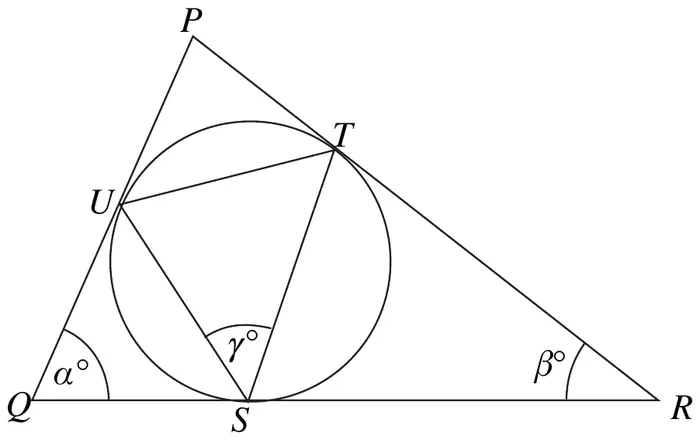
Senior Mathematical Challenge 2015, Question 12. © UK Mathematics Trust. Original paper on ukmt.org.uk
Answer: A \(\tfrac{1}{2}(\alpha + \beta)\)
Each of the three sides of triangle \(PQR\) is a tangent to the circle. Two tangents to a circle which meet at a point are of equal length. So \(QU\) and \(QS\) are of equal length. Similarly \(RT = RS\). This means that \(\angle QUS = \angle QSU = \tfrac{1}{2}(180 - \alpha)\) and also \(\angle RTS = \angle RST = \tfrac{1}{2}(180 - \beta)\). At \(S\) we can consider the sum of the three angles, so \(\tfrac{1}{2}(180 - \alpha) + \gamma + \tfrac{1}{2}(180 - \beta) = 180\). Simplifying gives \(90 - \tfrac{1}{2}\alpha + \gamma + 90 - \tfrac{1}{2}\beta = 180\) and so \(\gamma = \tfrac{1}{2}(\alpha + \beta)\).
Solution © UK Mathematics Trust, from the SMC 2015 solutions. Longer versions with investigations: Solutions and investigations (PDF).