
SMC 2017 Q19
19. The diagram shows a circle of radius 1 touching three sides of a \(2 \times 4\) rectangle. A diagonal of the rectangle intersects the circle at \(P\) and \(Q\), as shown. What is the length of the chord \(PQ\)?
- A \(\sqrt{5}\)
- B \(\dfrac{4}{\sqrt{5}}\)
- C \(\sqrt{5} - \dfrac{2}{\sqrt{5}}\)
- D \(\dfrac{5\sqrt{5}}{6}\)
- E 2
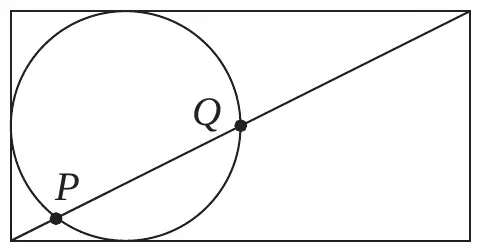
Senior Mathematical Challenge 2017, Question 19. © UK Mathematics Trust. Original paper on ukmt.org.uk
Answer: B \(\dfrac{4}{\sqrt{5}}\)
Let \(O\) be the centre of the circle, \(R\) be a corner of the rectangle, \(T\) be the point on the rectangle directly below \(Q\) and \(S\) be the midpoint of \(PQ\). In triangle \(QRT\) we have \(QT = 1\) and \(RT = 2\) and therefore \(RQ = \sqrt{5}\), by Pythagoras' Theorem. As \(RT\) and \(OQ\) are parallel, the right-angled triangles \(OQS\) and \(QRT\) are similar, so \(QS = \frac{2}{\sqrt{5}}\). Therefore the length of chord \(PQ\) is \(2 \times \frac{2}{\sqrt{5}} = \frac{4}{\sqrt{5}}\).
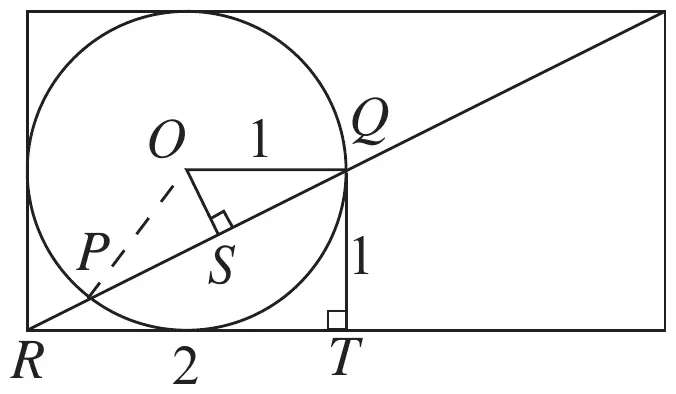
Solution © UK Mathematics Trust, from the SMC 2017 solutions. Longer versions with investigations: Solutions and investigations (PDF).