
SMC 2016 Q21
21. The diagram shows ten equal discs that lie between two concentric circles − an inner circle and an outer circle. Each disc touches two neighbouring discs and both circles. The inner circle has radius 1.
What is the radius of the outer circle?
- A \(2\tan 36°\)
- B \(\dfrac{\sin 36°}{1 - \sin 36°}\)
- C \(\dfrac{1 + \sin 18°}{1 - \sin 18°}\)
- D \(\dfrac{2}{\cos 18°}\)
- E \(\dfrac{9}{5}\)
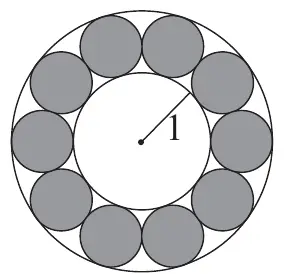
Senior Mathematical Challenge 2016, Question 21. © UK Mathematics Trust. Original paper on ukmt.org.uk
Answer: C \(\dfrac{1 + \sin 18°}{1 - \sin 18°}\)
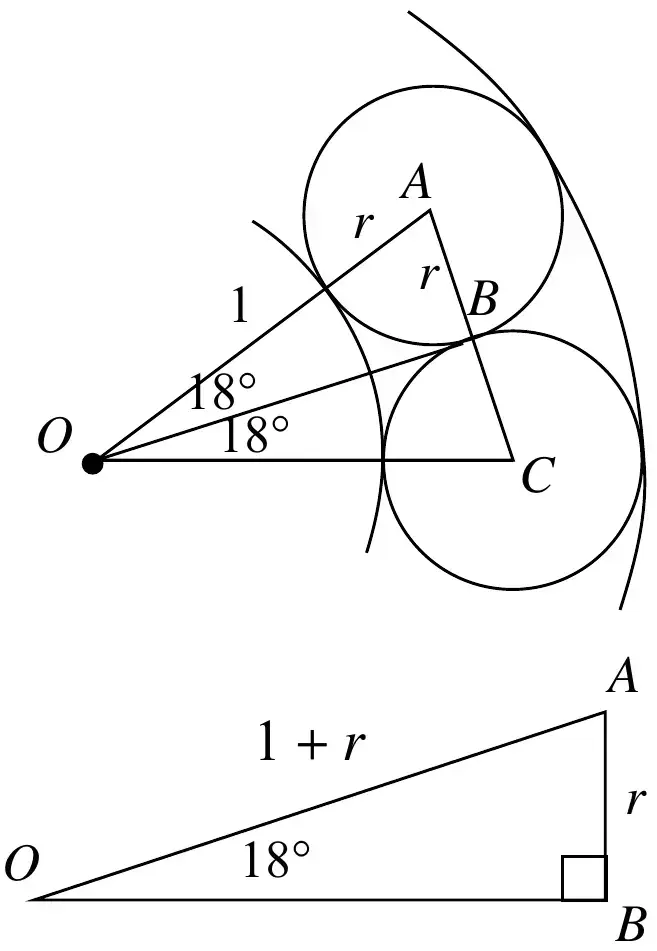
As there are 10 discs, the adjacent lines drawn from the centre of the inner circle to the centre of each disc are separated by an angle of 36°. The line \(OB\) is a tangent to both the disc with centre \(A\) and the disc with centre \(C\). So the points \(A\), \(B\) and \(C\) lie on a straight line as angles \(OBA\) and \(OBC\) are both 90°.
In the second diagram, from triangle \(OAB\) we have \(\sin 18° = \dfrac{r}{1 + r}\) which rearranges to
\[\frac{\sin 18°}{1 - \sin 18°} = r.\]
The radius of the outer circle is
\[1 + 2r = 1 + \frac{2\sin 18°}{1 - \sin 18°} = \frac{1 + \sin 18°}{1 - \sin 18°}.\]
Solution © UK Mathematics Trust, from the SMC 2016 solutions. Longer versions with investigations: Solutions and investigations (PDF).