
SMC 2018 Q22
22. The diagram shows two overlapping triangles; an isosceles triangle with an angle of 120° and an equilateral triangle with area 36. Two of the vertices of the equilateral triangle are midpoints of the equal sides of the isosceles triangle.
What is the total area of the shaded regions (inside the isosceles triangle but outside the equilateral triangle)?
- A 24
- B 26
- C 28
- D 30
- E 32
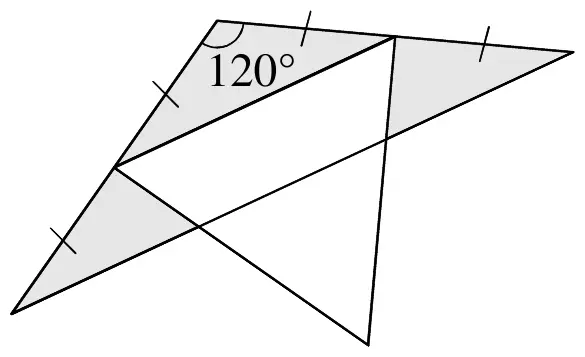
Senior Mathematical Challenge 2018, Question 22. © UK Mathematics Trust. Original paper on ukmt.org.uk
Answer: C 28
As two vertices of the equilateral triangle are given to be midpoints of the equal sides of the isosceles triangle, \(OT\) is a line of symmetry. Let \(P\) be the point where \(OT\) intersects an edge of the equilateral triangle, as shown. By using the line of symmetry through \(O\), \(P\) and \(T\), we can see the shaded region as four grey triangles. As we are given an angle of 120° at \(O\), and angles of an equilateral triangle are each 60°, the four grey triangles each have angles 30°, 60°, 90° and sides whose lengths are in the ratios \(1 : \sqrt{3} : 2\).
Let \(OP = b\). Then \(OQ = QR = 2b\). Also \(QP = \sqrt{3}b\) and \(QS = \frac{2b}{\sqrt{3}}\) using similar triangles. The total shaded area is then \(2(\frac{1}{2} \times b \times \sqrt{3}b + \frac{1}{2} \times \frac{2b}{\sqrt{3}} \times 2b) = \sqrt{3}b^2 + \frac{4b^2}{\sqrt{3}} = \frac{7b^2}{\sqrt{3}}\). Triangle \(QPT\) also has sides in the ratios \(1 : \sqrt{3} : 2\) and as \(QP = \sqrt{3}b\), \(PT = 3b\). The area of the equilateral triangle is then \(\frac{1}{2} \times 2\sqrt{3}b \times 3b = 3\sqrt{3}b^2\) which we are told is 36. So \(3\sqrt{3}b^2 = 36\) and therefore \(\frac{b^2}{\sqrt{3}} = 4\). Hence the area of the shaded region is \(\frac{7b^2}{\sqrt{3}} = 7 \times 4 = 28\).
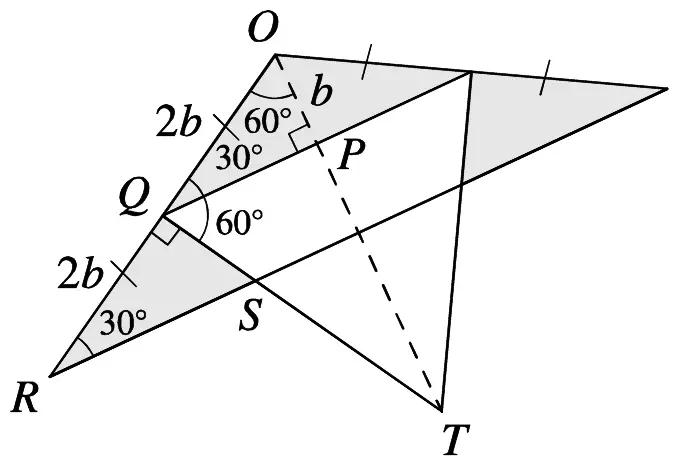
Solution © UK Mathematics Trust, from the SMC 2018 solutions. Longer versions with investigations: Solutions and investigations (PDF).