
SMC 2018 Q20
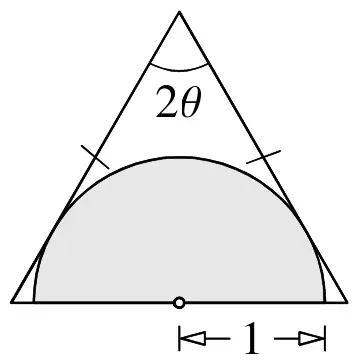
20. The diagram shows a semicircle of radius 1 inside an isosceles triangle. The diameter of the semicircle lies along the ‘base’ of the triangle, and the angle of the triangle opposite the ‘base’ is equal to \(2\theta\). Each of the two equal sides of the triangle is tangent to the semicircle.
What is the area of the triangle?
- A \(\frac{1}{2}\tan 2\theta\)
- B \(\sin\theta\cos\theta\)
- C \(\sin\theta + \cos\theta\)
- D \(\frac{1}{2}\cos 2\theta\)
- E \(\dfrac{1}{\sin\theta\cos\theta}\)
Senior Mathematical Challenge 2018, Question 20. © UK Mathematics Trust. Original paper on ukmt.org.uk
Answer: E \(\dfrac{1}{\sin\theta\cos\theta}\)
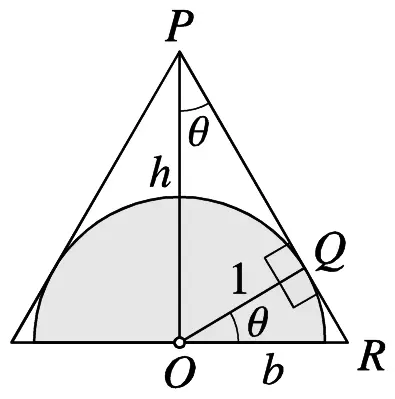
Let \(O\) be the centre of the circle, \(P\) be the vertex at the top of the triangle, \(R\) the vertex at one end of the ‘base’ and \(Q\) be the point where \(PR\) is tangent to the semicircle, as shown. Let \(OP\) have length \(h\) and \(OR\) have length \(b\). The line \(OQ\) is a radius of the semicircle so has length 1 and is perpendicular to \(PR\).
As \(OP\) and \(OR\) are perpendicular, triangles \(ROQ\) and \(OPQ\) are similar and so angle \(ROQ\) and angle \(OPQ\) are equal. Triangles \(ROQ\) and \(OPQ\) can be used to find expressions for the lengths of the base and height of the original isosceles triangle. Considering triangle \(ROQ\) gives \(\cos\theta = \frac{1}{b}\) so \(b = \frac{1}{\cos\theta}\). Considering the triangle \(OPQ\) gives \(\sin\theta = \frac{1}{h}\) so \(h = \frac{1}{\sin\theta}\). Then the area of the isosceles triangle is \(\frac{1}{2} \times 2b \times h = \frac{1}{\cos\theta} \times \frac{1}{\sin\theta} = \frac{1}{\sin\theta\cos\theta}\).
Solution © UK Mathematics Trust, from the SMC 2018 solutions. Longer versions with investigations: Solutions and investigations (PDF).