
MOG 2017 Q3
Four different points \(A\), \(B\), \(C\) and \(D\) lie on the curve with equation \(y = x^2\).
Prove that \(ABCD\) is never a parallelogram.
Mathematical Olympiad for Girls 2017, Question 3. © UK Mathematics Trust. Original paper on ukmt.org.uk
Commentary
All we know about the four points is that they lie on the given curve. It thus makes sense to work with their coordinates. Two sides of the quadrilateral \(ABCD\) are parallel if they have the same slope (gradient).
You need to prove that it is not possible for the quadrilateral \(ABCD\) to have two pairs of parallel sides. We present two slightly different proofs. The first picks a particular vertex and uses inequalities to show that at most one of the lines passing through it can be parallel to another line. The second is an example of proof by contradiction: we assume that there are two pairs of parallel sides and show that this contradicts one of the assumptions in the question (in this case, that all four points have different \(x\)-coordinates).
The question says nothing about the order in which the four points are arranged on the curve, so in your solution you need to be clear which pairs of sides you are considering.
Let the points \(A\), \(B\), \(C\), \(D\) be \((a, a^2)\), \((b, b^2)\), \((c, c^2)\), \((d, d^2)\) respectively, where, without loss of generality, \(a < b < c < d\). We investigate which of the sides through \(A\) could be parallel to another side. The slope of the line-segment \(AB\) is \((b^2 - a^2)/(b - a)\), which is \(a + b\). The slopes of \(AC\), \(AD\), \(BC\), \(BD\), and \(CD\) are given by the analogous expressions. Now \(a + b < c + d\) and \(a + c < b + d\) and so \(AB \nparallel CD\) and \(AC \nparallel BD\).
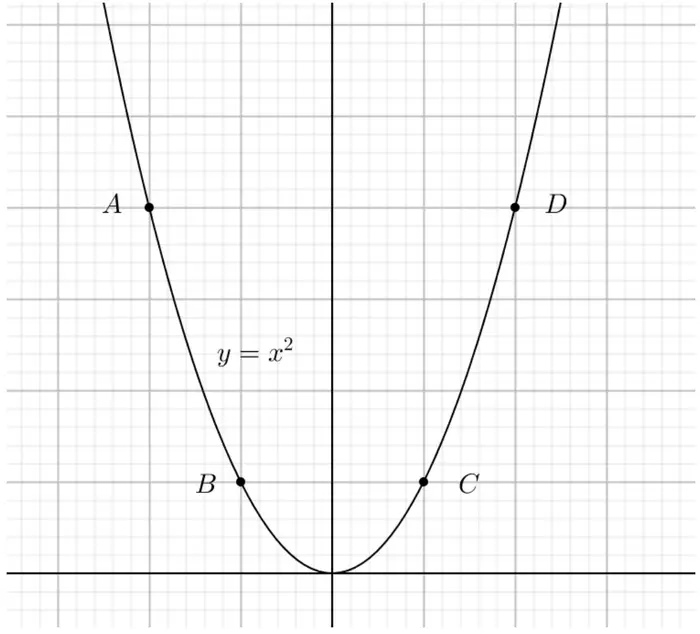
Thus at most one side through \(A\) (namely \(AD\)) can be parallel to another side, and therefore \(ABCD\) is not a parallelogram.
Alternative
Let the coordinates of the four points be defined as above. If \(ABCD\) is a parallelogram then \(AB\) is parallel to \(DC\) and \(BC\) is parallel to \(DA\).
From the calculation of gradients given above, this means that \(a + b = c + d\) and \(b + c = a + d\). Subtracting the second equation from the first gives \(a - c = c - a\) which implies that \(a = c\). But this is not possible, as the four points are different.
Thus our initial assumption that two pairs of sides are parallel must be false, so \(ABCD\) is not a parallelogram.
Note
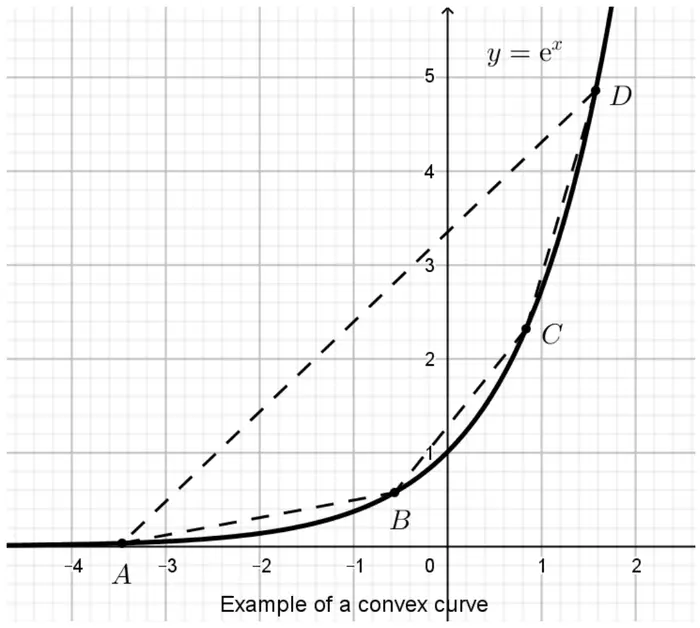
The result in question can be much generalised. A curve with equation \(y = f(x)\) is said to be convex if whenever \(u < v < w\), the point \((v, f(v))\) on the curve lies below (in the sense that its \(y\)-coordinate is smaller than that of) the corresponding point on the chord joining \((u, f(u))\) to \((w, f(w))\). We may write \(v = tu + (1 - t)w\) where \(0 < t < 1\) since \(t = (w - v)/(w - u)\). Algebraically convexity may be expressed as the inequality \(f(v) < tf(u) + (1 - t)f(w)\). Equivalently, the curve is convex if its slope is always increasing. The parabola with equation \(y = x^2\) is just one example. There are many others such as the exponential curve with equation \(y = \mathrm{e}^x\).
In general, if four different points \(A\), \(B\), \(C\), \(D\) lie on a convex curve with equation \(y = f(x)\), then the quadrilateral \(ABCD\) is never a parallelogram. Without loss of generality we may take the points \(A\), \(B\), \(C\), \(D\) to be \((a, f(a))\), \((b, f(b))\), \((c, f(c))\), \((d, f(d))\) respectively, where \(a < b < c < d\). The convexity condition tells us that \(B\) and \(C\) lie below the chord \(AD\), \(B\) lies below the chord \(AC\) and \(C\) lies below the chord \(BD\). It follows that the chords \(AC\) and \(BD\) meet (above the curve) and the chords \(AB\) and \(CD\) (both extended) meet (below the curve). Thus, as in the case of the parabola, at most one of the sides through \(A\) (namely \(AD\)) can be parallel to another side, and therefore \(ABCD\) is not a parallelogram.
Solution © UK Mathematics Trust, from the MOG 2017 solutions.