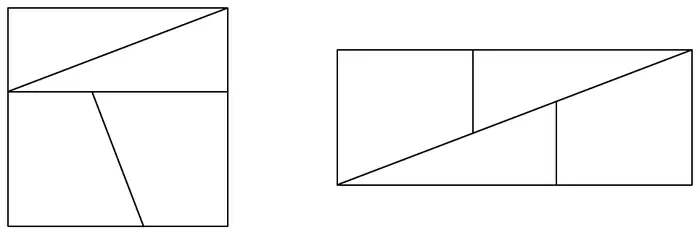
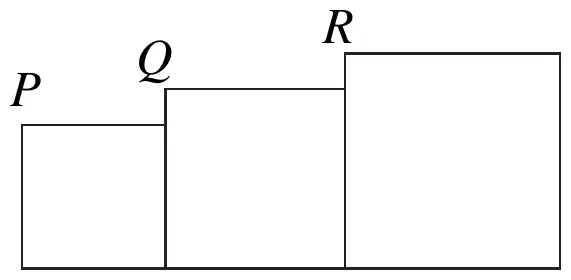
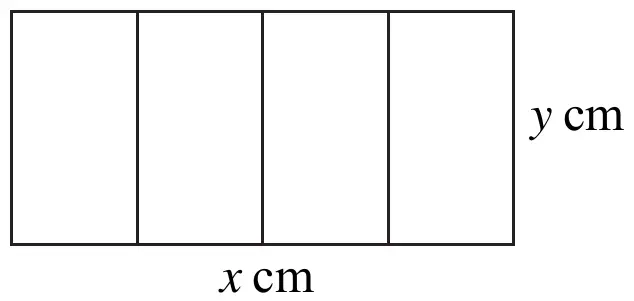
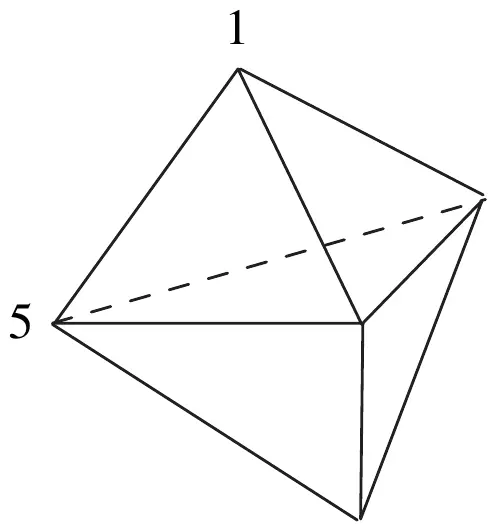
22. A square with perimeter 4 cm can be cut into two congruent right-angled triangles and two congruent trapezia as shown in the first diagram in such a way that the four pieces can be rearranged to form the rectangle shown in the second diagram.
What is the perimeter, in centimetres, of this rectangle?
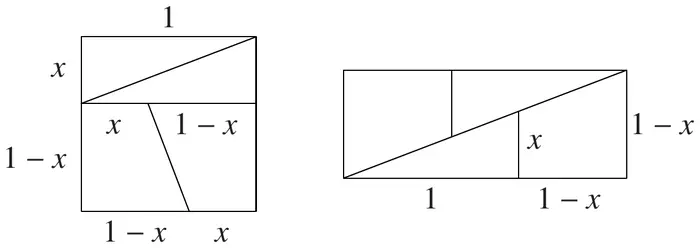
The perimeter of the square is 4 therefore each side is of length 1 and the area of the square is 1. The square must be cut so that the shortest side of each triangle matches the shorter of the two parallel sides of the trapezium when the pieces are rearranged.
Let each of these sides be of length \(x\) and then the remaining perpendicular sides of each trapezium have length \(1 - x\) as indicated on the first diagram. The perimeter of the rectangle has length \(2 \times 1 + 4(1 - x) = 6 - 4x\).
In order to find the value of \(x\), we can consider the area of the rectangle so \((1 + 1 - x)(1 - x) = 1\). This rearranges to give \(x^2 - 3x + 1 = 0\) and therefore, of the two possible solutions, \(x = \frac{3-\sqrt{5}}{2}\) as \(x < 1\). The perimeter is \(6 - 4(\frac{3-\sqrt{5}}{2}) = 2\sqrt{5}\).
Rewriting both sides of the first equation using a base of \(\sqrt{2}\) gives \(\left(\sqrt{2}^4\right)^y = \frac{1}{\sqrt{2}^6\sqrt{2}^{x+2}}\) so \(\sqrt{2}^{4y} = \sqrt{2}^{-(x+8)}\) and therefore \(4y = -(x + 8)\). Rewriting the second equation with a base of \(\sqrt{3}\) gives \(\left(\sqrt{3}^4\right)^x \times \left(\sqrt{3}^2\right)^y = \sqrt{3}^3\). Again, employing rules of indices leads to \(4x + 2y = 3\). Solving simultaneously the pair of linear equations shows that \(x = 2\) and \(y = -\frac{5}{2}\) and therefore \(x + y = -\frac{1}{2}\). The value of \(5^{x+y} = 5^{-\frac{1}{2}} = \frac{1}{\sqrt{5}}\).
Combining \(p - q = r\) and \(r - s = t\) gives \(p - q = s + t\) which rearranges to \(t = p - (q + s)\). The maximum value of \(t\) can be found by maximising \(p\) and minimising the sum of \(q\) and \(s\), so \(t_{\text{max}} = 9 - (1 + 2) = 6\). The minimum value of \(t\) is 1, for example \(t_{\text{min}} = 9 - (2 + 6) = 1\). All the values of \(t\) from 1 to 6 are possible in a similar way. Therefore \(t\) can have six different values.
As \(m\) is a positive integer, in this equation \(3m\) could equal 3, 6, 9, 12 or 15 leaving \(\dfrac{3}{n + \frac{1}{p}} = 14\), 11, 8, 5 or 2. However \(n, p > 1 \implies n + \frac{1}{p} > 1 \implies \dfrac{3}{n + \frac{1}{p}} < 3\). Therefore the only possibility here is that \(\dfrac{3}{n + \frac{1}{p}} = 2\). So \(\frac{3}{2} = n + \frac{1}{p}\) which is possible only when \(n = 1\) and \(p = 2\).
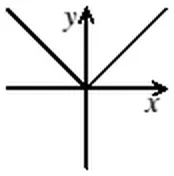
Rearranging \(y^2 - 2y = x^2 + 2x\) gives \(y^2 - x^2 = 2x + 2y\) then factorising on each side gives \((y + x)(y - x) = 2(x + y)\) and so \((y - x - 2)(y + x) = 0\). Therefore either \(y = x + 2\) or \(y = -x\). A sketch of those two straight lines is shown in option E.
12. A three-piece suit consists of a jacket, a pair of trousers and a waistcoat. Two jackets and three pairs of trousers cost £380. A pair of trousers costs the same as two waistcoats.
In pounds, let the price of a jacket = \(j\), the price of a pair of trousers = \(t\) and the price of a waistcoat = \(w\). We are given that \(2j + 3t = 380\) and that \(t = 2w\). We want to know the value of \(j + t + w\). Rewriting the first equation as \(2j + 2t + t = 380\) and substituting \(2w\) instead of the final \(t\) gives \(2j + 2t + 2w = 380\). Dividing by 2 then gives us \(j + t + w = 190\) and so the cost of the three-piece suit is £190.
4. The numbers \(p\),\(q\), \(r\) and \(s\) satisfy the equations \(p = 2\),\(p \times q = 20\), \(p \times q \times r = 202\) and \(p \times q \times r \times s = 2020\).
As \(p = 2\),\(q = \frac{20}{2} = 10\). Then \(20 \times r = 202\) so \(r = \frac{202}{20} = 10.1\). Finally, \(202 \times s = 2020\) so \(s = \frac{2020}{202} = 10\). The value of \(p + q + r + s = 2 + 10 + 10.1 + 10 = 32.1\).
Each of \(x\), \(y\) and \(z\) has the same form which is \(\sqrt{a - b} - \sqrt{a + b}\) for some \(a\) and \(b\). Squaring this expression gives \((a - b) - 2\sqrt{a + b} \times \sqrt{a - b} + (a + b) = 2a - 2\sqrt{(a^2 - b^2)}\). Applying this to \(x\) with \(a = 12\) and \(b = 3\sqrt{7}\) gives \(x^2 = 24 - 2\sqrt{81} = 6\). Similarly we can calculate that \(y^2 = 12\) and \(z^2 = 2\) . This gives us that \(x^2y^2z^2 = 6 \times 12 \times 2 = 144\). From the initial expressions \(x < 0\), \(y < 0\) and \(z > 0\), so \(xyz > 0\) and therefore \(xyz = 12\).
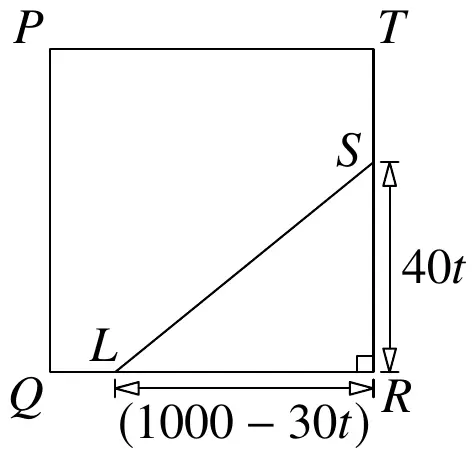
21. In a square garden \(PQRT\) of side 10 m, a ladybird sets off from \(Q\) and moves along edge \(QR\) at 30 cm per minute. At the same time, a spider sets off from \(R\) and moves along edge \(RT\) at 40 cm per minute.
What will be the shortest distance between them, in metres?
Let \(L\) be the position of the ladybird on \(QR\) and let \(S\) be the position of the spider on \(RT\) each after \(t\) minutes. The shortest distance between \(L\) and \(S\) is along the straight line which is the hypotenuse of the right-angled triangle \(LRS\). The distance \(QL\) is \(30t\) cm, so the distance \(LR\) is \((1000 - 30t)\) cm. Also, the distance \(RS\) is \(40t\) cm. So, \(LS^2 = (1000 - 30t)^2 + (40t)^2\) which expands and simplifies to \(2500(t^2 - 24t + 400) = 2500((t - 12)^2 + 256)\). The distance from \(L\) to \(S\) is shortest when \(t = 12\) and is \(\sqrt{2500 \times 256}\) cm = 800 cm = 8 m.
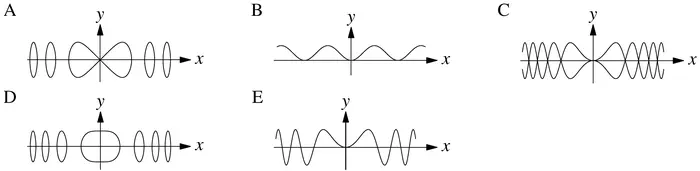
As \(\sin(0^2) = 0^2\) our graph must pass through the origin, so eliminating option D. As \(y^2 = \sin(x^2)\), \(y = \pm\sqrt{\sin(x^2)}\) and so the \(x\)-axis must be a line of symmetry, so eliminating options B and E. For some \(x\)-values, \(\sin(x^2)\) will be negative and so there will be no corresponding \(y\)-value, so eliminating option C, which has \(y\)-values for every \(x\)-value. The only possible remaining option is then A and it can be checked that the graph is indeed of this form.
The sum of the first 2019 positive integers is \(\frac{2019 \times 2020}{2}\) which is considerably larger than the required sum of 2019. In order for the sum of Jeroen’s 2019 integers to be only 2019, some of the integers must be positive and some must be negative. One of the integers will then be 0, so the product will also be 0. Jeroen’s list is \(-1008, \ldots - 2, -1, 0, 1, 2, \ldots, 1008, 1009, 1010\).
As \(9x + 3y - 5z = -4\) and \(5x + 2y - 2z = 13\), subtracting the first equation from twice the second gives \((10x + 4y - 4z) - (9x + 3y - 5z) = 2 \times 13 - (-4)\). The mean of \(x\), \(y\) and \(z\) which is \(\frac{(x+y+z)}{3}\) is therefore \(\frac{30}{3} = 10\).
13. Anish has a number of small congruent square tiles to use in a mosaic. When he forms the tiles into a square of side \(n\), he has 64 tiles left over. When he tries to form the tiles into a square of side \(n + 1\), he has 25 too few.
Considering some integer powers of 3, we have \(3^5 = 243\) and \(3^6 = 729\). As \(243 < 333 < 729\), \(3^5 < 3^{\left(3^x\right)} < 3^6\) implies that \(5 < 3^x < 6\). Rewriting once again to include powers of 3, gives \(3^1 < 5 < 3^x < 6 < 3^2\), so \(3^1 < 3^x < 3^2\) and finally, \(1 < x < 2\).
The expression \(n^2 + 2n\) factorises to \(n(n + 2)\). For \(n(n + 2)\) to be prime, one factor must equal 1 whilst the other must be equal to a prime. This happens when \(n = 1\), as \(n + 2 = 3\), but not when \(n + 2 = 1\) as \(n\) would be negative. There is therefore exactly one positive integer value of \(n\) which makes \(n^2 + 2n\) prime.
23. For particular real numbers \(a\) and \(b\), the function \(f\) is defined by \(f(x) = ax + b\), and is such that \(f\big(f\big(f(x)\big)\big) = 27x - 52\).
Which of the following formulas defines the function \(g\) such that, for all values of \(x\),\(g\big(f(x)\big) = x\)?
As \(f(x) = ax + b\), \(f(f(f(x))) = a(a(ax + b) + b) + b\) which expands to give \(a^3x + a^2b + ab + b\) and this can be written as \(a^3x + b(a^2 + a + 1)\). We therefore have \(a^3x + b(a^2 + a + 1) = 27x - 52\). Equating coefficients of \(x\) gives \(a^3 = 27\), so \(a = 3\). Equating the constants gives \(b(3^2 + 3 + 1) = -52\), so \(b = -4\). So the function \(f\) is given by \(f(x) = 3x - 4\). As we are given that \(g(f(x)) = x\), the function \(g\) uses inverse operations to undo the two steps in the function \(f\), in order to return to \(x\). As the operations in \(f\) are ‘multiply by 3’ then ‘subtract 4’, the operations in \(g\) are ‘add 4’ then ‘divide by 3’. Therefore the function \(g\) is given by \(g(x) = \frac{x + 4}{3} = \frac{1}{3}x + \frac{4}{3}\).
After reflecting the graph of \(y = \frac{1}{x}\) in the line \(y = 1\) we have a graph whose equation is \(y = 1 + (1 - \frac{1}{x})\), so \(y = -\frac{1}{x} + 2\). The second reflection is in the line \(y = -x\). Here, \(y\) is replaced by \(-x\) and \(-x\) is replaced by \(y\). Hence the equation \(y = -\frac{1}{x} + 2\) becomes \(-x = -\frac{1}{-y} + 2\) which rearranges to \(-(x + 2) = \frac{1}{y}\) and then to \(y = \dfrac{-1}{(x + 2)}\).
Let the number of 20p coins and 50p coins Bethany has be \(x\) and \(y\) respectively. Her total number of coins is then \(11 + x + y\). As the mean value of her coins is 52p, the total value of her coins is both \(52 \times (11 + x + y)\) and \(100 \times 11 + 20x + 50y\). The equation formed is \(52(11 + x + y) = 1100 + 20x + 50y\) which becomes \(572 + 52x + 52y = 1100 + 20x + 50y\) and this simplifies to \(32x + 2y = 528\) or \(16x + y = 264\). By rearranging we can see that \(11 + x + y = 275 - 15x\). So Bethany’s total number of coins is of the form \(275 - 15x\), or \(5 + 15(18 - x)\) which gives values that are 5 more than multiples of 15. Of the given options the only one which is not 5 more than a multiple of 15 is 40. We can also see that Bethany must have a large purse!
Considering the first set of equations \(4p = 3q = 2r = s\), we can see that \(p < q < r < s\). Also, \(s\) must be a multiple of 2, 3 and 4. The smallest such multiple is 12 which gives \(p = 3\),\(q = 4\), \(r = 6\) and \(s = 12\). In the equation \(p + 2q + 3r + 4s = k\) we then have \(3 + 2 \times 4 + 3 \times 6 + 4 \times 12 = k\), so \(k = 77\).
The mean of the twelve integers is given to be 7. Therefore \(1 + 3x + 5y + 8 + 9 + 11 = 12 \times 7\) so \(3x + 5y = 55\). As the twelve integers are written in ascending order, the median value is half way between the 6th and 7th values, each of which is \(y\), so the median is \(y\). Rearranging our equation gives \(y = \dfrac{55 - 3x}{5}\) and hence \(3x\) must be a multiple of 5 so that the numerator can be divided exactly by 5. To ensure that the twelve integers are in ascending order the minimum value of \(x\) is 1 and the maximum value of \(x\) is 8. The only value in this interval which makes \(3x\) a multiple of 5 is \(x = 5\), in which case \(y = \dfrac{55 - 15}{5} = 8\).
Since \(y = x\) and \(y = mx - 4\), it follows that \(x = mx - 4\) and so \(4 = mx - x = (m - 1)x\); therefore \(x = \frac{4}{m - 1}\). In order for \(x\) to be a positive integer, \(m - 1\) must be a positive factor of 4 therefore \(m - 1\) can equal 1, 2 or 4 and so \(m\) can equal 2, 3 or 5. The sum of these values of \(m\) is then 10.
For each equation, consider \(x = 0\). Then, \(y = x^4 + 1\) becomes \(y = 0^4 + 1 = 1\) and so the graph with this equation passes through \((0, 1)\) rather than \((0, 0)\). For the other three equations, using \(x = 0\) shows that \(y = 0\) too and so their graphs all pass through the origin. Hence only one graph does not pass through the origin.
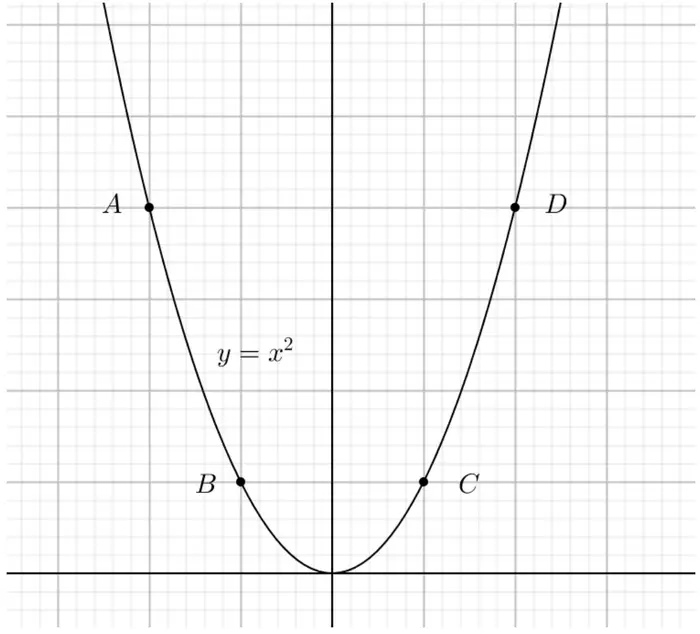
23. The parabola with equation \(y = x^2\) is reflected in the line with equation \(y = x + 2\). Which of the following is the equation of the reflected parabola?
Reflecting a graph in the line \(y = x + 2\) is algebraically equivalent to replacing \(y\) by \(x + 2\) and \(x + 2\) by \(y\) in the equation of the graph. So \(y = x^2\) becomes \((x + 2) = (y - 2)^2\). That is \(x + 2 = y^2 - 4y + 4\) which simplifies to \(x = y^2 - 4y + 2\).
The equation \(4^x = y^2 + 15\) can be rearranged to give \(\left(2^x\right)^2 - y^2 = 15\) which, using the difference of two squares, is \(\left(2^x + y\right)\left(2^x - y\right) = 15\). As we are looking for positive integer values then either \(2^x + y = 5\) and \(2^x - y = 3\) or \(2^x + y = 15\) and \(2^x - y = 1\). Solving each pair gives either \((x, y) = (2, 1)\) or \((x, y) = (3, 7)\) so there are just two possible pairs.
18. The arithmetic mean, \(A\), of any two positive numbers \(x\) and \(y\) is defined to be \(A = \tfrac{1}{2}(x + y)\) and their geometric mean, \(G\), is defined to be \(G = \sqrt{xy}\). For two particular values \(x\) and \(y\), with \(x > y\), the ratio \(A : G = 5 : 4\). For these values of \(x\) and \(y\), what is the ratio \(x : y\)?
Given the ratio \(A : G\) is \(5 : 4\), we have \(4A = 5G\), so \(4 \times \tfrac{1}{2}(x + y) = 5\sqrt{xy}\). Squaring gives \(4(x + y)^2 = 25xy\) and hence \(4x^2 + 8xy + 4y^2 = 25xy\). So \(4x^2 - 17xy + 4y^2 = 0\) which factorises to give \((4x - y)(x - 4y) = 0\) so that either \(4x = y\) or \(x = 4y\). However the first case is impossible as we are given \(x > y > 0\). Hence \(x = 4y\) and \(x : y\) is \(4 : 1\).
17. Amy, Beth and Claire each has some sweets. Amy gives one third of her sweets to Beth. Beth gives one third of all the sweets she now has to Claire. Then Claire gives one third of all the sweets she now has to Amy. All the girls end up having the same number of sweets. Claire begins with 40 sweets. How many sweets does Beth have originally?
Amy's number of sweets is a multiple of 3, so let her start with \(3a\) sweets. Once Amy has passed on \(a\) of them, Beth's number of sweets must be a multiple of 3. Likewise, after Beth passes on sweets to Claire, Claire's number of sweets must become a multiple of 3. Since \(40 = 3 \times 13 + 1\), Beth must pass on \(3b - 1\) sweets for some \(b\). So Beth must have had \(9b - 3\) sweets after receiving the \(a\) sweets from Amy and hence \(9b - 3 - a\) to start with. This allows us to fill in the table:
Amy
Beth
Claire
originally
\(3a\)
\(9b - 3 - a\)
40
after Amy's gift to Beth
\(2a\)
\(9b - 3\)
40
after Beth's gift to Claire
\(2a\)
\(6b - 2\)
\(3b + 39\)
after Claire's gift to Amy
\(2a + b + 13\)
\(6b - 2\)
\(2b + 26\)
As the girls end up with the same number of sweets, \(6b - 2 = 2b + 26\) and so \(b = 7\). As \(6 \times 7 - 2\) and \(2 \times 7 + 26\) both equal 40, the girls each have 40 sweets at the end. Hence Amy's finishing number \(2a + 7 + 13 = 40\) so \(a = 10\). Then Beth's original number is \(9 \times 7 - 10 - 3 = 50\).
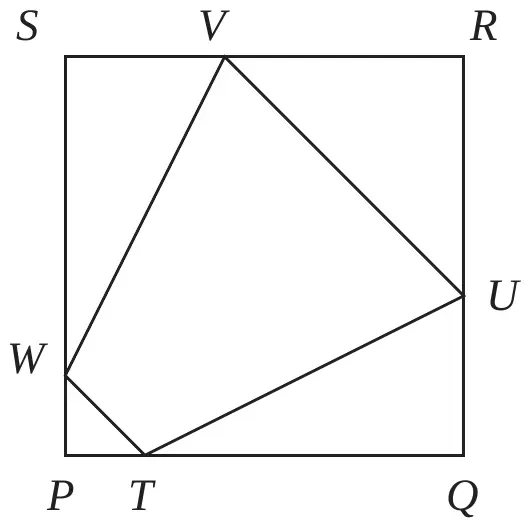
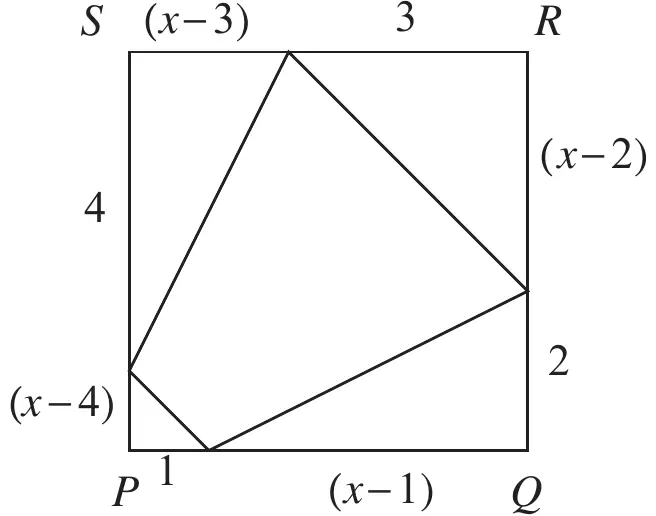
15. The diagram shows a square \(PQRS\). Points \(T\),\(U\), \(V\) and \(W\) lie on the edges of the square as shown, such that \(PT = 1\),\(QU = 2\), \(RV = 3\) and \(SW = 4\). The area of \(TUVW\) is half that of \(PQRS\). What is the length of \(PQ\)?
Let the length of \(PQ\) be \(x\). The sum of the areas of the four right-angled triangles is half the area of the square so \(\tfrac{1}{2}[1 \times (x - 4)] + \tfrac{1}{2}[4 \times (x - 3)] + \tfrac{1}{2}[3 \times (x - 2)] + \tfrac{1}{2}[2 \times (x - 1)] = \tfrac{1}{2}x^2\). This gives \((x - 4) + 4(x - 3) + 3(x - 2) + 2(x - 1) = x^2\) which simplifies to \(10x - 24 = x^2\). Factorising \(x^2 - 10x + 24 = 0\) gives \((x - 6)(x - 4) = 0\) so \(x = 4\) or 6. For there to be four triangles as shown, \((x - 4) > 0\), so \(x\), the length of \(PQ\), is 6.
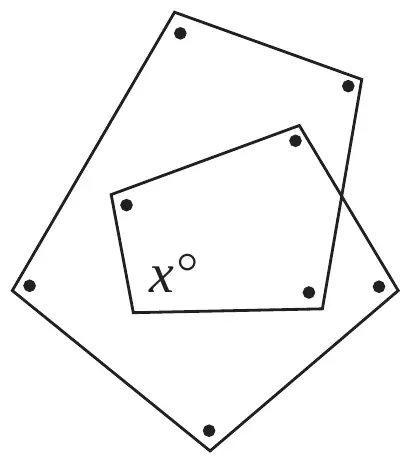
Viewing the diagram as a pentagon inside a hexagon and labelling the unmarked angle in the pentagon as \(y°\) gives \(4x + y = 540\ldots\) (1). For the hexagon, the exterior reflex angle is \(y°\) as opposite angles are equal. So the unmarked interior angle is \((360 - y)°\). This gives \(5x + 360 - y = 720\), so \(5x - y = 360\ldots\) (2). Adding equations (1) and (2) gives \(9x = 900\) and therefore \(x = 100\).
11. The teenagers Sam and Jo notice the following facts about their ages: The difference between the squares of their ages is four times the sum of their ages. The sum of their ages is eight times the difference between their ages. What is the age of the older of the two?
Let the ages of the teenagers be \(a\) and \(b\) with \(a > b\). Then \(4(a + b) = a^2 - b^2\) \(= (a + b)(a - b)\) and so \(4 = a - b\) as \(a + b \neq 0\). Also, \(a + b = 8(a - b) = 8 \times 4 = 32\). We now have \(a - b = 4\) and \(a + b = 32\) so \(a = 18\) and \(b = 14\). Thus the older of the two is 18.
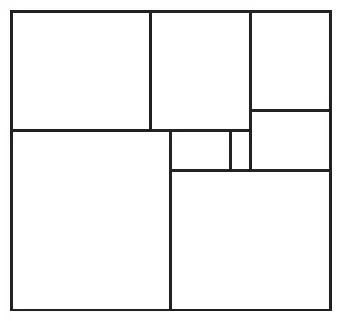
9. The diagram shows an \(n \times (n + 1)\) rectangle tiled with \(k \times (k + 1)\) rectangles, where \(n\) and \(k\) are integers and \(k\) takes each value from 1 to 8 inclusive. What is the value of \(n\)?
The sum of the areas of the tiles is \((1 \times 2) + (2 \times 3) + (3 \times 4) + \ldots + (8 \times 9)\) \(= 2 + 6 + 12 + 20 + 30 + 42 + 56 + 72 = 240 = 15 \times 16\). So the value of \(n\) is 15.
By making a common denominator, \(2017 - \dfrac{1}{2017} = \dfrac{2017^2 - 1}{2017}\). Then, using the difference of two squares on the numerator, this can be written as \(\dfrac{2018 \times 2016}{2017}\).
The expression \(\sqrt{2016} + \sqrt{56}\) can be written as \(\sqrt{2^5 \times 3^2 \times 7} + \sqrt{2^3 \times 7}\) which is \(\sqrt{4^2 \times 3^2 \times 2 \times 7} + \sqrt{2^2 \times 2 \times 7}\). This simplifies to \(12\sqrt{14} + 2\sqrt{14}\) which is \(14\sqrt{14}\) and, using index notation, this can be written as \(14^{3/2}\). Hence \(k = \tfrac{3}{2}\).
11. In the grid below each of the blank squares and the square marked \(X\) are to be filled by the mean of the two numbers in its adjacent squares. Which number should go in the square marked \(X\)?
For each square to be filled with the mean of the numbers in the adjacent squares, the differences between all five pairs of adjacent numbers must be equal. This common difference is \(\left(\dfrac{25 - 10}{5}\right)\) which is 3. The grid is then
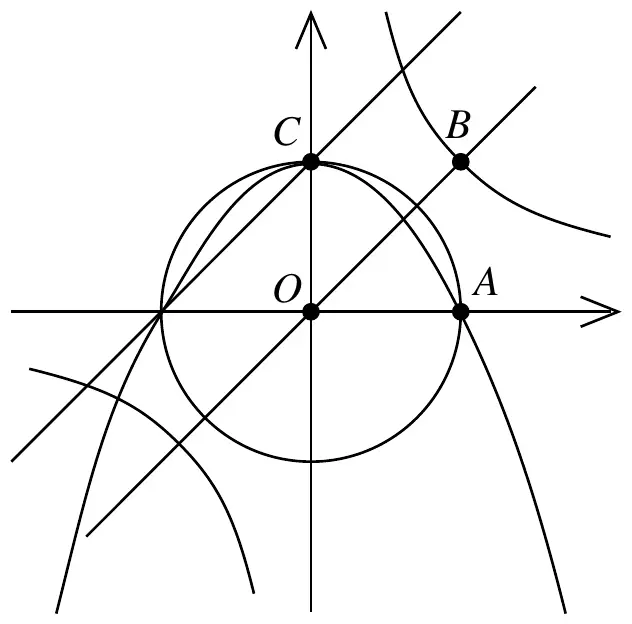
Let \(O = (0,0)\),\(A = (1,0)\),\(B = (1,1)\), \(C = (0,1)\) be the vertices of the square. The equation \(x^2 + y^2 = 1\) gives a circle passing through \(A\) and \(C\). The equation \(y = x + 1\) gives a straight line passing only through \(C\). The equation \(y = -x^2 + 1\) gives a parabola passing through \(A\) and \(C\). The equation \(y = x\) gives a straight line passing through \(O\) and \(B\). The equation \(y = \frac{1}{x}\) gives a rectangular hyperbola which has two branches and passes only through \(B\). So, only \(x^2 + y^2 = 1\), \(y = x\) and \(y = -x^2 + 1\) have graphs passing through exactly two of the vertices of the square.
25. A function, defined on the set of positive integers, is such that \(f(xy) = f(x) + f(y)\) for all \(x\) and \(y\). It is known that \(f(10) = 14\) and \(f(40) = 20\). What is the value of \(f(500)\)?
Repeatedly using the rule that \(f(xy) = f(x) + f(y)\) allows us to write \(f(500)\) as \(f(2 \times 2 \times 5 \times 5 \times 5) = f(2) + f(2) + f(5) + f(5) + f(5) = 2f(2) + 3f(5)\). We are given values for \(f(40)\) and \(f(10)\) and from them we need to calculate the values of \(f(2)\) and \(f(5)\). Now \(f(40)\) can be written as \(f(2) + f(2) + f(10)\) so \(20 = 2f(2) + 14\) and therefore \(f(2) = 3\). Similarly \(f(10) = f(2) + f(5)\) so \(14 = 3 + f(5)\) giving \(f(5) = 11\). So \(f(500) = 2f(2) + 3f(5) = 2 \times 3 + 3 \times 11 = 39\).
23. Given four different non-zero digits, it is possible to form 24 different four-digit numbers containing each of these four digits. What is the largest prime factor of the sum of the 24 numbers?
Let a four-digit positive integer be expressed as \(1000a + 100b + 10c + d\) where \(a\),\(b\), \(c\) and \(d\) are all different. In the 24 possible permutations of \(a\),\(b\), \(c\) and \(d\), each of the four letters appears in each position six times. Adding all 24 numbers together gives \(1000(6a + 6b + 6c + 6d) + 100(6a + 6b + 6c + 6d)\) \(+\, 10(6a + 6b + 6c + 6d) + 6a + 6b + 6c + 6d\). The total is therefore \(1111 \times 6(a + b + c + d)\) which factorises to \(2 \times 3 \times 11 \times 101(a + b + c + d)\). As \(a + b + c + d < 101\), the largest prime factor of the sum is 101.
19. Three squares are arranged as shown so that their bases lie on a straight line. Also, the corners \(P\), \(Q\) and \(R\) lie on a straight line. The middle square has sides that are 8 cm longer than the sides of the smallest square. The largest square has sides of length 50 cm. There are two possible values for the length (in cm) of the sides of the smallest square. Which of the following are they?
Let the length of the side of the smallest square be \(x\) cm. So the three squares have sides of lengths \(x\) cm, \((x + 8)\) cm and 50 cm respectively. The gradient of \(PQ\) is then \(\tfrac{8}{x}\) and the gradient of \(PR\) is \(\dfrac{50 - x}{x + x + 8}\). As \(P\), \(Q\) and \(R\) lie on a straight line, \(\dfrac{8}{x} = \dfrac{50 - x}{2x + 8}\) so \(8(2x + 8) = x(50 - x)\). Expanding gives \(16x + 64 = 50x - x^2\) and therefore \(x^2 - 34x + 64 = 0\), giving \(x = 2\) or 32.
10. The positive integer \(n\) is between 1 and 20. Milly adds up all the integers from 1 to \(n\) inclusive. Billy adds up all the integers from \(n + 1\) to 20 inclusive. Their totals are the same. What is the value of \(n\)?
The total of the numbers from 1 to 20 is \(\tfrac{1}{2} \times 20 \times (20 + 1) = 210\). If Milly and Billy have totals which are equal, their totals must each be 105. Milly's total, of the numbers from 1 to \(n\), is \(\tfrac{1}{2}n(n + 1)\) so \(\tfrac{1}{2}n(n + 1) = 105\) which gives \(n^2 + n = 210\). Therefore \(n^2 + n - 210 = 0\) which factorises to give \((n + 15)(n - 14) = 0\). As \(n\) is a positive integer, \(n = 14\).
The mean of 17, 23 and \(2n\) is given to be \(n\), so \(\dfrac{17 + 23 + 2n}{3} = n\) which gives \(40 + 2n = 3n\). As \(n\) is then 40, the sum of the digits of \(n\) is 4.
Rearranging \(6x = \dfrac{150}{x}\) gives \(x^2 = \dfrac{150}{6}\), so \(x^2 = 25\). This has two solutions, \(x = 5\) and \(x = -5\). Therefore the sum of the solutions is \(5 + (-5) = 0\).
The expression \(2015^2 - 2016 \times 2014\) can be written as \(2015^2 - (2015 + 1)(2015 - 1)\) which simplifies, using the difference of two squares, to \(2015^2 - \left(2015^2 - 1\right) = 1\).
If the graphs of \(y = 2x\), \(y = 2^x\) and \(y = x^2\) are sketched on the same axes it can be seen that case (i) holds for \(2 < x < 4\), case (ii) holds for \(0 < x < 1\), case (iv) holds for \(1 < x < 2\) and case (vi) holds for \(x > 4\). There are no real solutions for case (iii). Consider \(x^2 < 2x\), which is true for \(0 < x < 2\). However for \(0 < x < 2\) it can be seen that \(2^x > x^2\) rather than \(2^x < x^2\) as stated. There are no real solutions for case (v). Consider \(2x < x^2\), which is true for \(x < 0\) or \(x > 2\). However, when \(x < 0\) we have \(2^x > 2x\) as \(2^x\) is positive and \(2x\) is negative, rather than \(2^x < 2x\) as stated. Also, when \(x = 2\) we have \(2^x = 2x\), but for \(x > 2\), \(2^x > 2x\) rather than \(2^x < 2x\) as stated.
22. A bag contains \(m\) blue and \(n\) yellow marbles. One marble is selected at random from the bag and its colour is noted. It is then returned to the bag along with \(k\) other marbles of the same colour. A second marble is now selected at random from the bag. What is the probability that the second marble is blue?
The probability that the second marble is blue equals P(2nd marble is blue given that the 1st marble is blue) + P(2nd marble is blue given that the 1st marble is yellow), which is
\(\dfrac{m}{m + n} \times \dfrac{m + k}{m + n + k} + \dfrac{n}{m + n} \times \dfrac{m}{m + n + k} = \dfrac{m^2 + mk + mn}{(m + n)(m + n + k)} = \dfrac{m(m + k + n)}{(m + n)(m + n + k)} = \dfrac{m}{m + n}.\)
12. Karen has three times the number of cherries that Lionel has, and twice the number of cherries that Michael has. Michael has seven more cherries than Lionel. How many cherries do Karen, Lionel and Michael have altogether?
Let Lionel have \(x\) cherries. Michael then has \((x + 7)\) cherries. Karen's number of cherries is described in two ways. She has \(3x\) cherries and also \(2(x + 7)\) cherries. So \(3x = 2x + 14\) and therefore \(x = 14\). Lionel has 14 cherries, Michael 21 cherries and Karen 42 cherries giving a total of \(14 + 21 + 42 = 77\) cherries.
Let the length of the rectangle be \(x\) cm and its width be \(y\) cm. The area is given as 120 cm2 so \(xy = 120\). The perimeter is 46 cm, so \(46 = 2x + 2y\) and therefore \(23 = x + y\). Using Pythagoras' Theorem, the length of the diagonal is \(\sqrt{x^2 + y^2}\). As \(x^2 + y^2 = (x + y)^2 - 2xy\),\(\sqrt{x^2 + y^2} = \sqrt{23^2 - 2 \times 120} = \sqrt{529 - 240} = \sqrt{289} = 17\). So the diagonal has length 17 cm.
Working from right to left, the units column shows that \(S = 2\) or 7. If \(S = 2\), then \(I + I = 1\) or 11, neither of which is possible. Hence \(S = 7\) and it follows that \(I + I = 0\) or 10. However, as the digits are non-zero, \(I = 5\). The hundreds column then shows that \(H = 9\) and so \(T = 1\). This gives \(T + H + I + S = 1 + 9 + 5 + 7 = 22\).
Let the two positive numbers be \(x\) and \(y\) with \(x > y\). The sum of the numbers is greater than their difference, so the two ratios which are equal are \(x : y\) and \(x + y : x - y\). Therefore \(\dfrac{x}{y} = \dfrac{x + y}{x - y}\). By dividing the top and bottom of the right-hand side by \(y\) we obtain \(\dfrac{x}{y} = \dfrac{\frac{x}{y} + 1}{\frac{x}{y} - 1}\). Letting \(k = \tfrac{x}{y}\) gives \(k = \tfrac{k + 1}{k - 1}\) which gives the quadratic \(k^2 - 2k - 1 = 0\). Completing the square gives \((k - 1)^2 = 2\) whence \(k = 1 \pm \sqrt{2}\). However, as \(x\) and \(y\) are both positive, \(k \neq 1 - \sqrt{2}\). As the ratio \(\tfrac{x}{y} = 1 + \sqrt{2}\), the ratio \(x : y\) is \(1 + \sqrt{2} : 1\).
A prime number has exactly two factors, one of which is 1. The expression \(4^n - 1\) can be factorised as \(4^n - 1 = (2^n + 1)(2^n - 1)\). For \(4^n - 1\) to be prime, the smaller of the factors, \(2^n - 1\), must equal 1. If \(2^n - 1 = 1\) then \(2^n = 2\) giving \(n = 1\). So there is exactly one value of \(n\) for which \(4^n - 1\) is prime and this value is 1.
6. Rebecca went swimming yesterday. After a while she had covered one fifth of her intended distance. After swimming six more lengths of the pool, she had covered one quarter of her intended distance. How many lengths of the pool did she intend to complete?
Let \(d\) be the number of lengths that Rebecca intended to swim. Then \(6 = \dfrac{d}{4} - \dfrac{d}{5} = \dfrac{d}{20}\) and therefore \(d = 6 \times 20 = 120\).
\((x + y\sqrt{2})^2 = x^2 + 2xy\sqrt{2} + 2y^2\). Note that all of the alternatives given are of the form \(a + 12\sqrt{2}\) so we need \(xy = 6\). The only ordered pairs \((x, y)\) of positive integers which satisfy this are (1, 6), (2, 3), (3, 2), (6, 1). For these, the values of \(x^2 + 2y^2\) are 73, 22, 17, 38 respectively. So the required number is \(54 + 12\sqrt{2}\).
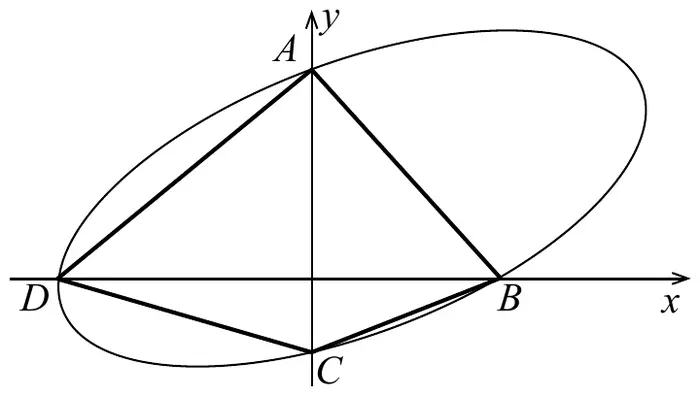
16. The diagram shows the ellipse whose equation is \(x^2 + y^2 - xy + x - 4y = 12\). The curve cuts the \(y\)-axis at points \(A\) and \(C\) and cuts the \(x\)-axis at points \(B\) and \(D\). What is the area of the inscribed quadrilateral \(ABCD\)?
At points \(A\) and \(C\),\(x = 0\). So \(y^2 - 4y = 12\), i.e. \((y - 6)(y + 2) = 0\), i.e. \(y = 6\) or \(y = -2\). So \(C\) is \((0, -2)\) and \(A\) is \((0, 6)\). At points \(B\) and \(D\),\(y = 0\). So \(x^2 + x = 12\), i.e. \((x - 3)(x + 4) = 0\), i.e. \(x = 3\) or \(x = -4\). So \(D\) is \((-4, 0)\) and \(B\) is \((3, 0)\). Therefore the areas of triangles \(DAB\) and \(DBC\) are \(\tfrac{1}{2} \times 7 \times 6 = 21\) and \(\tfrac{1}{2} \times 7 \times 2 = 7\). So \(ABCD\) has area 28. {It is left to the reader to prove that area\(ABCD = \tfrac{1}{2}BD \times AC\).}
15. Professor Rosseforp runs to work every day. On Thursday he ran 10% faster than his usual average speed. As a result, his journey time was reduced by \(x\) minutes. How many minutes did the journey take on Wednesday?
Let Professor Rosseforp's usual journey take \(t\) minutes at an average speed of \(v\) metres/minute. Then the distance to work is \(vt\) metres. On Thursday his speed increased by 10%, i.e. it was \(11v/10\) metres/minute. The time taken was \((t - x)\) minutes. Therefore \(11v/10 \times (t - x) = vt\). So \(11(t - x) = 10t\), i.e. \(t = 11x\).
Add the first and third equations: \(2x = 4\), so \(x = 2\). Add the first two equations: \(2x + 2y = 3\), so \(y = -\tfrac{1}{2}\). Substitute for \(x\) and \(y\) in the first equation: \(2 + \left(-\tfrac{1}{2}\right) + z = 1\) so \(z = -\tfrac{1}{2}\). Therefore \(xyz = 2 \times \left(-\tfrac{1}{2}\right) \times \left(-\tfrac{1}{2}\right) = \tfrac{1}{2}\).
20. Positive integers \(x\) and \(y\) satisfy the equation \(\sqrt{x} - \sqrt{11} = \sqrt{y}\). What is the maximum possible value of \(\dfrac{x}{y}\) ?
Squaring the equation \(\sqrt{x} - \sqrt{11} = \sqrt{y}\) gives \(x - 2\sqrt{11x} + 11 = y \ldots (1)\). You see here that \(2\sqrt{11x}\) is an integer. Thus \(x = 11a^2\) for some integer \(a\). Hence in (1), \(y = 11a^2 - 22a + 11 = 11(a^2 - 2a + 1)\). Thus \(\dfrac{x}{y} = \left(\dfrac{a}{a - 1}\right)^2\) whose maximum value, for integer \(a\), is easily seen to be \(\left(\tfrac{2}{1}\right)^2 = 4\).
If \(a\), \(b\) are roots of \(x^2 + ax + b = 0\) then \(x^2 + ax + b = 0\) must be \((x - a)(x - b) = 0\). As \((x - a)(x - b) = x^2 + (-a - b)x + ab\) then \(a = -a - b\) and \(b = ab\). If \(b = 0\) we see immediately that \(a = 0\). But this is not possible as \(a\) and \(b\) are different. If \(b \neq 0\) then \(a = 1\) and \(b = -2\). So there is just one solution pair.
6. Granny and her granddaughter Gill both had their birthday yesterday. Today, Granny's age in years is an even number and 15 times that of Gill. In 4 years' time Granny's age in years will be the square of Gill's age in years. How many years older than Gill is Granny today?
3. The robot Lumber9 moves along the number line. Lumber9 starts at 0, takes 1 step forward (to 1), then 2 steps backward (to −1), then 3 steps forward, 4 steps backward, and so on, moving alternately forwards and backwards, one more step each time. At what number is Lumber9 after 2011 steps?
After the \(n\) th step, Lumber9 is at number: \(\begin{cases} \frac{n+1}{2} & \text{for } n \text{ odd,} \\ \frac{-n}{2} & \text{for } n \text{ even.} \end{cases}\) Hence when \(n = 2011\),Lumber9 is at number \(\tfrac{2011 + 1}{2} = 1006\).
20. There are 10 girls in a mixed class. If two pupils from the class are selected at random to represent the class on the School Council, then the probability that both are girls is 0.15. How many boys are in the class?
Let the number of boys in the class be \(x\). Hence \(\dfrac{10}{10 + x} \times \dfrac{9}{9 + x} = \dfrac{3}{20}\). Simplifying gives \(1800 = 3(10 + x)(9 + x)\) and then \(x^2 + 19x - 510 = 0\). Factorising gives \((x + 34)(x - 15) = 0\) and, since \(x \neq -34\),\(x = 15\).
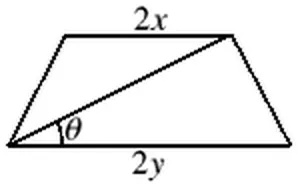
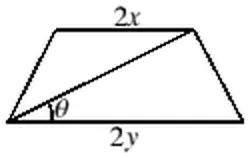
14. The parallel sides of a trapezium have lengths \(2x\) and \(2y\) respectively. The diagonals are equal in length, and a diagonal makes an angle \(\theta\) with the parallel sides, as shown. What is the length of each diagonal?
Drop perpendiculars from the top vertices to the bottom line. The distance from the foot to the nearer base vertex is \(\tfrac{1}{2}(2y - 2x) = y - x\). So the distance to the further base vertex is \(2y - (y - x) = y + x\). Hence \(\cos\theta = \dfrac{x + y}{d}\) where \(d\) is the length of the diagonal.
Let the original square have sides of length \(y\) cm and the single square which is not \(1 \times 1\) have sides of length \(x\) cm. Then \(y^2 = 36 + x^2\), and so \(y^2 - x^2 = 36\) and hence \((y + x)(y - x) = 36\). As \(36 = 2^2 \times 3^2\) and \(y + x > y - x\) the possible factors of 36 are:
\(y + x\)
\(y - x\)
\(y\)
\(x\)
9
4
\(6\tfrac{1}{2}\)
\(2\tfrac{1}{2}\)
impossible
12
3
\(7\tfrac{1}{2}\)
\(4\tfrac{1}{2}\)
impossible
18
2
10
8
possible
36
1
\(18\tfrac{1}{2}\)
\(17\tfrac{1}{2}\)
impossible
We can check that \(10^2 = 36 + 8^2 = 100\) and hence the length of the side of the original square is 10 cm.
9. The symbol \(\Diamond\) is defined by \(x \mathbin{\Diamond} y = x^y - y^x\). What is the value of \((2 \mathbin{\Diamond} 3) \mathbin{\Diamond} 4\)?
25. Four positive integers \(a\),\(b\), \(c\) and \(d\) are such that \[abcd + abc + bcd + cda + dab + ab + bc + cd + da + ac + bd + a + b + c + d = 2009.\] What is the value of \(a + b + c + d\)?
The left-hand side of the equation can be written as \[(a + 1)(b + 1)(c + 1)(d + 1) - 1.\] Hence \[(a + 1)(b + 1)(c + 1)(d + 1) = 2010.\] Now expressing 2010 as a product of primes gives 2010 = 2 × 3 × 5 × 67 hence \(a + b + c + d = 1 + 2 + 4 + 66 = 73\).
19. Hamish and his friend Ben live in villages which are 51 miles apart. During the summer holidays, they agreed to cycle towards each other along the same main road. Starting at noon, Hamish cycled at \(x\) mph. Starting at 2 pm, Ben cycled at \(y\) mph. They met at 4 pm. If they had both started at noon, they would have met at 2.50 pm. What is the value of \(y\)?
The distance cycled by Hamish between noon and 4 pm is \(4x\). The distance cycled by Ben between 2 pm and 4 pm is \(2y\). They meet at 4 pm hence \(4x + 2y = 51\) or \(2x + 2\,(x + y) = 51\) (*). If they had both started at noon then they would have met at 2:50 pm and so \(2\tfrac{5}{6}(x + y) = 51\). Hence \(x + y = 51 \times \dfrac{6}{17} = 18\). Hence from (*) \(2x + 2 \times 18 = 51\). Hence \(2x = 15\) giving \(x = 7\tfrac{1}{2}\). Thus \(y = 10\tfrac{1}{2}\).
We have \(y^2 = x\,(2 - x)\). Now \(y^2 \geqslant 0\) for all real \(y\) hence \(x\,(2 - x) \geqslant 0\). Hence \(0 \leqslant x \leqslant 2\). In fact we can rewrite the equation as \((x - 1)^2 + y^2 = 1\); so this is a circle of radius 1 with centre (1,0).
Let \(\dfrac{n}{100 - n} = x\) where \(x\) is an integer. Hence \(n = 100x - nx\). Hence \(n\,(1 + x) = 100x\) giving \(n = \dfrac{100x}{1 + x}\). Now \(x\) and \(1 + x\) can have no common factors. Therefore \(1 + x\) must be a factor of 100 and can be any of them. Hence \(1 + x \in \{\pm 1, \pm 2, \pm 4, \pm 5, \pm 10, \pm 20, \pm 25, \pm 50, \pm 100\}\) thus the number of possible integers \(n\) is 18.
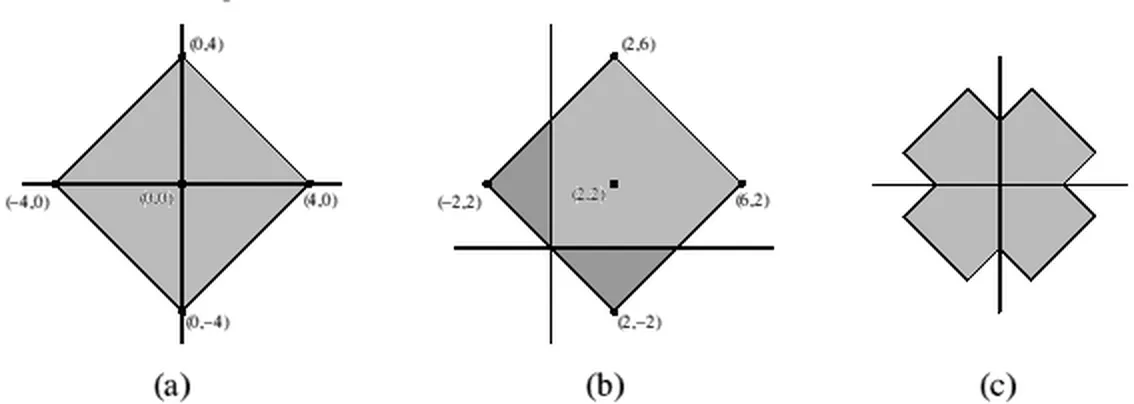
25. What is the area of the polygon formed by all points \((x,\ y)\) in the plane satisfying the inequality \(\big|\,|x| - 2\big| + \big|\,|y| - 2\big| \leqslant 4\) ?
To work out the area of \(\big||x| - 2\big| + \big||y| - 2\big| \leqslant 4\), we first consider the region \(|x| + |y| \leqslant 4\) which is shown in (a). This region is then translated to give \(|x - 2| + |y - 2| \leqslant 4\) as shown in (b). By properties of the modulus, if the point \((x,\ y)\) lies in the polygon, then so do \((x,\ -y)\), \((-x,\ y)\) and \((-x,\ -y)\). Thus \(\big||x| - 2\big| + \big||y| - 2\big| \leqslant 4\) can be obtained from (b) by reflecting in the axes and the origin, as shown in (c).
Hence the required area is 4 times the area in the first quadrant. From (b), the required area in the first quadrant is the area of a square of side \(4\sqrt{2}\) minus two triangles (cut off by the axes) which, combined, make up a square of side \(2\sqrt{2}\). So the area in the first quadrant is \((4\sqrt{2})^2 - (2\sqrt{2})^2 = 32 - 8 = 24\). Hence the area of the polygon is 4 × 24 = 96 square units.
24. The length of the hypotenuse of a particular right-angled triangle is given by \(\sqrt{1 + 3 + 5 + 7 + \;\ldots\; + 25}\). The lengths of the other two sides are given by \(\sqrt{1 + 3 + 5 + \;\ldots\; + x}\) and \(\sqrt{1 + 3 + 5 + \;\ldots\; + y}\) where \(x\) and \(y\) are positive integers. What is the value of \(x + y\)?
\(1 + 3 + 5 + 7 + \;\ldots\; + (2n + 1) = (n + 1)^2\). The \(n\) in the three cases given is 12, \(\tfrac{1}{2}(x - 1)\) and \(\tfrac{1}{2}(y - 1)\). So, the triangle has sides of length 12 + 1, \(\tfrac{1}{2}(x - 1) + 1\) and \(\tfrac{1}{2}(y - 1) + 1\). However the only right-angled triangle having sides of whole number length with hypotenuse 13 is the (5, 12, 13) triangle. So \(x = 9\) and \(y = 23\) (or vice versa). Hence \(x + y = 32\).
Let \(X = x + 3\) and \(Y = y - 3\). Then the given equation becomes \((X + Y)^2 = XY\). So \(X^2 + XY + Y^2 = 0\). However \(X^2\), \(Y^2\) and \(XY\) (\(= (X + Y)^2\)) are non-negative. Hence \(X = Y = 0\); so \(x = -3\) and \(y = 3\) is the only solution.
21. The fraction \(\dfrac{2008}{1998}\) may be written in the form \(a + \cfrac{1}{b + \cfrac{1}{c + \cfrac{1}{d}}}\) where \(a\),\(b\), \(c\) and \(d\) are positive integers. What is the value of \(d\)?
Since 2008/1998 lies between 1 and 2, \(a = 1\). Subtracting 1 and inverting gives \(b + 1/(c + 1/d) = 1998/10 = 199 + 4/5\) so that \(b = 199\). Then \(1/(c + 1/d) = 4/5\) so that \(c + 1\,/\,d = 5/4\) and this gives \(c = 1\) and \(d = 4\). {Note : This is an example of a continued fraction.}
17. Andy and his younger cousin Alice both have their birthdays today. Remarkably, Andy is now the same age as the sum of the digits of the year of his birth and the same is true of Alice. How many years older than Alice is Andy?
Let ‘\(X\)’ be a single digit. If \(2008 - 200X = 2 + 0 + 0 + X\) then \(8 - X = 2 + X\) so \(X = 3\). So Alice (being the younger) could have been born in 2003. Next if \(2008 - 199X = 1 + 9 + 9 + X\) then \(18 - X = 19 + X\), which is impossible. Similarly if \(2008 - 198X = 1 + 9 + 8 + X\) then \(28 - X = 18 + X\), so \(X = 5\). Thus Alice or Andy could have been born in 1985. Finally if \(2008 - 19YX = 1 + 9 + X + Y\) for some digit \(Y \leqslant 7\), then \(108 - YX = 10 + Y + X\). Hence \(98 = YX + Y + X\) which is impossible, since \(YX + Y + X\) is at most \(79 + 7 + 9 = 95\). Hence there are no more possible dates and so Andy was born in 1985 and Alice in 2003.
16. The numbers \(x\), \(y\) and \(z\) satisfy the equations \[x + y + 2z = 850, \qquad x + 2y + z = 950, \qquad 2x + y + z = 1200.\] What is their mean?
15. A sequence of positive integers \(t_1, t_2, t_3, t_4, \ldots\) is defined by: \(t_1 = 13\); \(t_{n+1} = \tfrac{1}{2}t_n\) if \(t_n\) is even; \(t_{n+1} = 3t_n + 1\) if \(t_n\) is odd. What is the value of \(t_{2008}\)?
The sequence proceeds as follows: 13, 40, 20, 10, 5, 16, 8, 4, 2, 1, 4, 2, 1 … . The block 4, 2, 1 repeats ad infinitum starting after \(t_7\). But 2008 − 7 = 2001 and 2001 = 3 × 667. Hence \(t_{2008}\) is the third term in the 667th such block and is therefore 1.
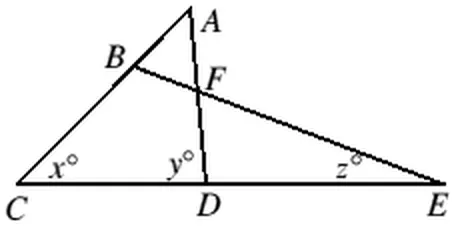
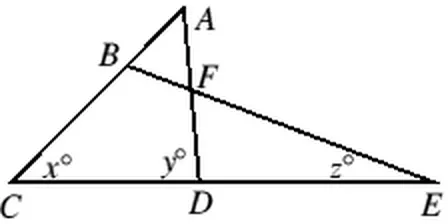
8. In the figure shown, \(AB = AF\) and \(ABC\),\(AFD\), \(BFE\) and \(CDE\) are all straight lines. Which of the following expressions gives \(z\) in terms of \(x\) and \(y\)?
From the units column we see that \(S = 0\). Then the tens column shows that \(R = 9\), the hundreds column that \(Q = 1\), and the thousands that \(P = 6\). So \(P + Q + R + S = 16\).
25. The line with equation \(y = x\) is an axis of symmetry of the curve with equation \(y = \dfrac{px + q}{rx + s}\), where \(p\),\(q\),\(r\), \(s\) are all non-zero. Which of the following is necessarily true?
As the line \(y = x\) is an axis of symmetry of the curve, if the point \((a,\ b)\) lies on the curve, so too does the point \((b,\ a)\). Hence the equation of the curve may also be written as \(x = \dfrac{py + q}{ry + s}\). Therefore, substituting for \(x\) in the original equation: \[y = \frac{p\left(\dfrac{py + q}{ry + s}\right) + q}{r\left(\dfrac{py + q}{ry + s}\right) + s} = \frac{p\,(py + q) + q\,(ry + s)}{r\,(py + q) + s\,(ry + s)}.\] Therefore \(\qquad y\,(r\,(py + q) + s\,(ry + s)) = p\,(py + q) + q\,(ry + s)\), that is \(y^2r\,(p + s) + y\left(qr + s^2 - p^2 - qr\right) - pq - qs = 0\), that is \(\qquad (p + s)\left(y^2r + y\,(s - p) - q\right) = 0\). Since \(r\) is non-zero, the expression in the second bracket is non-zero for all but at most two values of \(y\). Hence \(p + s = 0\).
23. The sum of the lengths of the 12 edges of a cuboid is \(x\) cm. The distance from one corner of the cuboid to the furthest corner is \(y\) cm. What, in cm2, is the total surface area of the cuboid?
Let the lengths of the sides of the cuboid, in cm, be \(a\), \(b\) and \(c\). So \(4\,(a + b + c) = x\). Also, by Pythagoras' Theorem \(a^2 + b^2 + c^2 = y^2\). Now the total surface area of the cuboid is \[2ab + 2bc + 2ca = (a + b + c)^2 - (a^2 + b^2 + c^2) = \left(\frac{x}{4}\right)^2 - y^2 = \frac{x^2 - 16y^2}{16}.\]
Let \(N\) be the two-digit number ‘\(ab\)’, that is \(N = 10a + b\). So the sum of \(N\) and its ‘reverse’ is \(10a + b + 10b + a = 11a + 11b = 11\,(a + b)\). As 11 is prime and \(a\) and \(b\) are both single digits, \(11\,(a + b)\) is a square if, and only if, \(a + b = 11\). So the possible values of \(N\) are 29, 38, 47, 56, 65, 74, 83, 92.
6. Cheryl finds a bag of coins. There are 50 coins inside and the value of the contents is £1.81. Given that it contains only two-pence and five-pence coins, how many more five-pence coins are there inside the bag than two-pence coins?
Let the number of five-pence coins be \(x\). Then \(5x + 2(50 - x) = 181\), that is \(3x = 81\), that is \(x = 27\). So there are 27 five-pence coins and 23 two-pence coins.
25. \(X\) is a positive integer in which each digit is 1; that is, \(X\) is of the form 11111… . Given that every digit of the integer \(pX^2 + qX + r\) (where \(p\), \(q\) and \(r\) are fixed integer coefficients and \(p > 0\)) is also 1, irrespective of the number of digits \(X\), which of the following is a possible value of \(q\)?
Let \(X\) consist of \(x\) digits, each of which is 1. So \(X = \tfrac{10^x - 1}{9}\). Let \(pX^2 + qX + r\) consist of \(y\) digits, each of which is 1. So \(pX^2 + qX + r = \tfrac{10^y - 1}{9}\). Then \(p\left(\tfrac{10^x - 1}{9}\right)^2 + q\left(\tfrac{10^x - 1}{9}\right) + r = \tfrac{10^y - 1}{9}\), that is \(p(10^{2x} - 2 \times 10^x + 1) + 9q(10^x - 1) + 81r = 9(10^y - 1)\), that is (on dividing throughout by \(10^{2x}\)) \(p + (9q - 2p)10^{-x} + (p - 9q + 81r)10^{-2x} = 9 \times 10^{y - 2x} - 9 \times 10^{-2x}\). We now let \(x\) tend to infinity (through integer values). The LHS of the above equation tends to \(p\), and the second term on the right goes to 0. By continuity of the function \(f(u) = 10^u = e^{u \log 10}\), we can deduce that \(y - 2x\) must tend to a limit. Let this limit be \(L\). Since \(y - 2x\) is always an integer, it must actually equal \(L\) for all \(x\) sufficiently large. Passing to the limit, therefore, we obtain \(p = 9 \times 10^L\). Since \(p\) is to be an integer, we must have that \(L\) (also an integer) is a non-negative integer. Substituting for \(p\) in the previous equation and simplifying leads to \[9q - 18 \times 10^L + (9 \times 10^L - 9q + 81r)10^{-x} = -9 \times 10^{-x}.\] Passing to the limit again leads to \(q = 2 \times 10^L\) and the previous line then also gives \(9 \times 10^L - 18 \times 10^L + 81r = -9\). So \(r = \tfrac{10^L - 1}{9}\). Possible values of \((p,\ q,\ r)\) therefore are (9, 2, 0), (90, 20, 1), (900, 200, 11), etc. So of the values given in the question for \(q\), only \(q = 2\) is possible. (Observe that the three triples above correspond to \(L = 0\),\(L = 1\), \(L = 2\) respectively and we note that increasing L by 1 corresponds to multiplying \(pX^2 + qX + r\) by 10 and adding 1. As \(pX^2 + qX + r\) consists only of 1s, \(10\,(pX^2 + qX + r) + 1\) will also consist only of 1s, explaining why there is an infinite family of quadratics which satisfy the required condition.)
The terms on the left-hand side of the equation form an arithmetic progression which has \(n^3 - 5\) terms. So the sum of these terms is \(\dfrac{n^3 - 5}{2}\left(\dfrac{3}{n^3} + \dfrac{n^3 - 3}{n^3}\right) = \dfrac{n^3 - 5}{2}\). Hence \(n^3 - 5 = 120\), so \(n = 5\).
20. A positive number \(a = [a] + \{a\}\) where \([a]\) is the integer part of \(a\) and \(\{a\}\) is the fractional part of \(a\). Given that \(x + [y] + \{z\} = 4.2\),\(y + [z] + \{x\} = 3.6\),\(z + [x] + \{y\} = 2.0\), and \(x\),\(y\),\(z > 0\), what is the value of \(\{y\}\) ?
Adding all three equations: \(x + [y] + \{z\} + y + [z] + \{x\} + z + [x] + \{y\} = 4.2 + 3.6 + 2.0 = 9.8\). Now \([x] + \{x\} = x\),\([y] + \{y\} = y\),\([z] + \{z\} = z\), so \(2x + 2y + 2z = 9.8\), that is \(x + y + z = 4.9\). Therefore: \(x + y + z - (x + [y] + \{z\}) = 4.9 - 4.2\), that is \(\{y\} + [z] = 0.7\). So \([z] = 0\),\(\{y\} = 0.7\). (It is not necessary to find the values of \(x\),\(y\), \(z\) to solve this problem, but their values may be shown to be 1.9, 2.7, 0.3 respectively.)
19. An engineer is directed to a faulty signal, one quarter of the way into a tunnel. Whilst there, he is warned of a train heading towards the tunnel entrance. The engineer can run at 12 mph and can either run back to the tunnel entrance or forward to the exit. In either case, the engineer and the front of the train would reach the entrance or exit together. What is the speed in mph of the train?
Let the length of the tunnel and the distance from the front of the train to the entrance of the tunnel when the engineer receives the warning be \(l\) and \(x\) respectively. If the engineer runs to the exit of the tunnel, he will take three times as long as he would if he ran to the entrance. So the train takes three times as long to travel a distance \(x + l\) as it does to travel a distance \(x\). Hence \(l = 2x\). The train, therefore, travels a distance \(x\) in the same time that the engineer would take to travel \(\tfrac{1}{2}l\), that is to travel \(\tfrac{1}{2}x\). So the speed of the train is twice that of the engineer.
18. What is the greatest number of the following five statements about numbers \(a\), \(b\) which can be true at the same time? \[\tfrac{1}{a} < \tfrac{1}{b} \qquad\qquad a^2 > b^2 \qquad\qquad a < b \qquad\qquad a < 0 \qquad\qquad b < 0\]
It is not possible for all five statements to be true at the same time since if \(a < b\),\(a < 0\), \(b < 0\) are all true then \(\tfrac{1}{a} < \tfrac{1}{b}\) is not true since \(\tfrac{1}{b} - \tfrac{1}{a} = \tfrac{a - b}{ab}\) which is negative. However, when these three statements are true, \(a^2 > b^2\) is also true, so it is possible for four of the statements to be true at the same time.
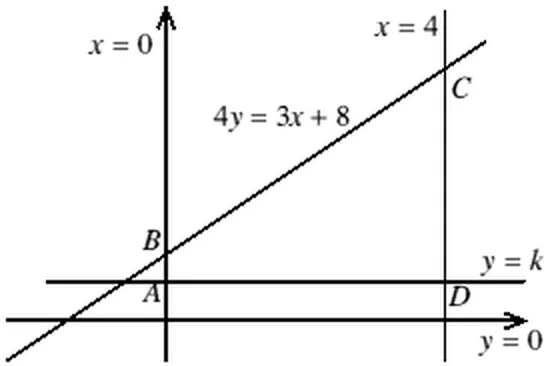
17. A trapezium is bounded by four lines, the equations of which are \(x = 0\),\(x = 4\), \(4y = 3x + 8\) and \(y = k\), where \(k < 2\). For which value of \(k\) is the numerical value of the perimeter of the trapezium equal to the numerical value of the area of the trapezium?
The trapezium in question is shown as \(ABCD\) in the diagram. The coordinates of its vertices are \(A(0,\ k)\),\(B(0,\ 2)\),\(C(4,\ 5)\),\(D(4,\ k)\). Using Pythagoras' Theorem: \(BC = \sqrt{4^2 + 3^2} = 5\). The perimeter of \(ABCD = (2 - k) + 5 + (5 - k) + 4\) \(= 16 - 2k\). The area of \(ABCD = 4(2 - k) + \tfrac{1}{2} \times 4 \times 3\) \(= 14 - 4k\). So \(16 - 2k = 14 - 4k\), that is \(k = -1\). (In the diagram it was assumed that \(k > 0\), although it transpires that \(k < 0\). However, this does not affect the validity of the solution.)
14. Heather and Rachel each has some pennies. Heather has more than Rachel. In fact, the number of pennies that Heather has is the square of the number that Rachel has. The total number of pennies they have between them makes a whole number of pounds. What is the smallest this total could be?
Let Rachel and Heather have \(x\) and \(x^2\) pennies respectively. So \(x + x^2 = 100n\), where \(x\) and \(n\) are positive integers. We require, therefore, that \(x(x + 1) = 100n = 2^2 \times 5^2 \times n\). Now \(x\) and \(x + 1\) cannot both be multiples of 5, so their product will be a multiple of 25 if and only if \(x\) or \(x + 1\) is a multiple of 25. The smallest value of \(x\) which satisfies this condition is 24 which is a multiple of 4 so 24 × 25 is a multiple of 100. Therefore Rachel has 24 pennies, Heather has 576 pennies and, in total, they have £6.
11. Three consecutive even numbers are such that the sum of four times the smallest and twice the largest exceeds three times the second by 2006. What is the sum of the digits of the smallest number?
Let the smallest of the three even numbers be \(n\). Then the other two numbers are \(n + 2\) and \(n + 4\). So \(4n + 2(n + 4) = 3(n + 2) + 2006\), that is \(6n + 8 = 3n + 2012\), that is \(n = 668\).
Subtracting the second equation from the first: \(6x - y - (6y - x) = 21 - 14\). So \(7x - 7y = 7\), that is \(x - y = 1\). (The equations may be solved to give \(x = 4\),\(y = 3\), but it is not necessary to do this in order to find the value of \(x - y\).)
22. Given that \(S = (x + 20) + (x + 21) + (x + 22) + \ldots + (x + 100)\), where \(x\) is a positive integer, what is the smallest value of \(x\) such that \(S\) is a perfect square?
There are 81 terms in the series, so, using the formula \(S = \tfrac{1}{2}n(a + l)\) for an arithmetic series: \[S = \frac{81}{2}(x + 20 + x + 100) = 81\,(x + 60)\,.\] Now 81 is a perfect square, so \(S\) is a perfect square if and only if \(x + 60\) is a perfect square. As \(x\) is a positive integer, the smallest possible value of \(x\) is 4.
Note that \(n^2 - 1\) is divisible by \(n - 1\). Thus: \[\frac{n^2 - 9}{n - 1} = \frac{n^2 - 1}{n - 1} - \frac{8}{n - 1} = n + 1 - \frac{8}{n - 1} \qquad (n \neq 1).\] So, if \(n\) is an integer, then \(\dfrac{n^2 - 9}{n - 1}\) is an integer if and only if \(n - 1\) divides exactly into 8. The possible values of \(n - 1\) are −8, −4, −2, −1, 1, 2, 4, 8, so \(n\) is −7, −3, −1, 0, 2, 3, 5, 9. The sum of these values is 8. (Note that the sum of the 8 values of \(n - 1\) is clearly 0, so the sum of the 8 values of \(n\) is 8.)
When \(x \geqslant 0\),\(|x| = x\), so \(x|x| = x^2\); when \(x < 0\),\(|x| = -x\), so \(x|x| = -x^2\). Only graph A has the same shape as the graph of \(y = x^2\) for \(x \geqslant 0\) and the same shape as the graph of \(y = -x^2\) for \(x < 0\).
10. Sam and Pat were counting their money. They discovered that if Sam gave Pat £5, then Pat would have 5 times as much as Sam, but if Pat gave Sam £5, then Sam would have 5 times as much as Pat. How much did they have altogether?
Let Sam and Pat have £\(x\) and £\(y\) respectively. Then \(y + 5 = 5(x - 5)\), that is \(y = 5x - 30\). Also, \(x + 5 = 5(y - 5)\), that is \(x = 5y - 30\). Solving these simultaneous equations gives \(x = 7.5\) and \(y = 7.5\) so the friends have £15 altogether. (Note: from the information given, we may deduce that Sam and Pat have the same amount of money and this leads to a shorter method: \(x + 5 = 5(x - 5)\), that is \(x = 5x - 30\), that is \(x = 7.5\).)
9. What is the value of the expression: \(\left(1 + \tfrac{1}{2}\right)\left(1 + \tfrac{1}{3}\right)\left(1 + \tfrac{1}{4}\right)\ldots\left(1 + \tfrac{1}{2004}\right)\left(1 + \tfrac{1}{2005}\right)\) ?
The sequences have common differences of 7 and 9 respectively. The lowest common multiple of 7 and 9 is 63, so the next term after 2005 to appear in both sequences is 2005 + 63, that is 2068.
Let the five consecutive positive integers be \(x - 2, x - 1, x, x + 1, x + 2\). Their sum is \(5x\), so \(5x = 2005\), that is \(x = 401\). The five numbers are 399, 400, 401, 402, 403.
17. How many solutions does equation \(|||x - 1| - 1| - 1| = 1\) have? The modulus function \(|x|\) evaluates the absolute value of a number; for example\(|6| = |-6| = 6\).
14. Let \(a\),\(b\), \(c\) and \(d\) be distinct positive integers such that \(a + b\), \(a + c\) and \(a + d\) are all odd and are all square. Let \(L\) be the least possible value of \(a + b + c + d\). What is the value of \(10L\)?
The numbers \(a\),\(b\), \(c\) and \(d\) are distinct, so \(a + b\), \(a + c\) and \(a + d\) must also be distinct. The smallest three odd squares which may be formed in this way are 9, 25 and 49. Therefore, \((a + b) + (a + c) + (a + d) = 9 + 25 + 49 = 83\). We may write \(L = a + b + c + d = 83 - 2a\). So we may minimise \(L\) by maximising \(a\). Since \(a + b = 9\), the largest possible value for \(a\) is 8. This means that \(L = 83 - 2 \times 8 = 67\). We must check that a solution exists. The values \(a = 8\),\(b = 1\), \(c = 17\) and \(d = 41\) satisfy all the conditions provided. If one started with a different set of odd squares, then at least one would be 81 or larger. However, \(a + b + c + d\) is greater than each of the odd squares involved. Hence 67 is indeed the least possible value. Therefore \(L\) is indeed 67 and \(10L = 670\).
Let \(y = 20202020\). We may express the quantity under the square-root as \((y + 10000) \times (y + 1) - (y + 10001) \times y = y^2 + 10001y + 10000 - y^2 - 10001y = 10000\). The square root of 10000 is 100.
Complete the square on \(x^2 - 600x + 369\) to obtain \((x - 300)^2 - 300^2 + 369\). The minimum value of this expression will occur when \((x - 300)^2 = 0\). This is when \(x = 300\).
We may assume that \(x \leq y\) as the expressions \(yx^2 + xy^2\) and \(x^4 + y^4\) are symmetrical in \(x\) and \(y\). If \(x \geq 4\) (and so \(y \geq 4\)) then \(yx^2 + xy^2 \geq 2 \times 4^3 = 128 > 70\). So \(x\) must be one of 1, 2, 3. When \(x = 2\) we obtain the equation \(4y + 2y^2 = 70\) which has the integer solution \(y = 5\). The analogous equations in \(y\) obtained for \(x = 1, 3\) do not have integer solutions. Therefore, \(x = 2\), \(y = 5\) and \(x^4 + y^4 = 2^4 + 5^4 = 16 + 625 = 641\).
16. The real numbers \(x\) and \(y\) satisfy the equations: \[xy - x = 180 \qquad \text{and} \qquad y + xy = 208.\] Let the two solutions be \((x_1, y_1)\) and \((x_2, y_2)\). What is the value of \(x_1 + 10y_1 + x_2 + 10y_2\)?
Subtracting the two equations yields \(y + x = 28\). Substituting \(y = 28 - x\) into \(xy - x = 180\) leads to the quadratic equation \(0 = x^2 - 27x + 180\). This has solutions 12, 15. The solution sets are therefore \((15, 13)\) and \((12, 16)\). The value of \(x_1 + 10y_1 + x_2 + 10y_2\) is \(15 + 10 \times 13 + 12 + 10 \times 16 = 317\).
13. The real numbers \(a\) and \(b\), where \(a > b\), are solutions to the equation \(3^{2x} - 10 \times 3^{x+1} + 81 = 0\). What is the value of \(20a^2 + 18b^2\)?
In the equation \(3^{2x} - 10 \times 3^{x+1} + 81 = 0\), replace \(3^x\) with \(y\). The equation becomes \(y^2 - 10 \times 3 \times y + 81 = 0\). This factorises as \((y - 3)(y - 27) = 0\) with solutions \(y = 3, 27\). This means \(3^x = 3\) or \(3^x = 27\). The \(x\)-values are 1, 3 respectively, so \(a = 3\) and \(b = 1\). The value of \(20a^2 + 18b^2 = 20 \times 9 + 18 \times 1 = 198\).
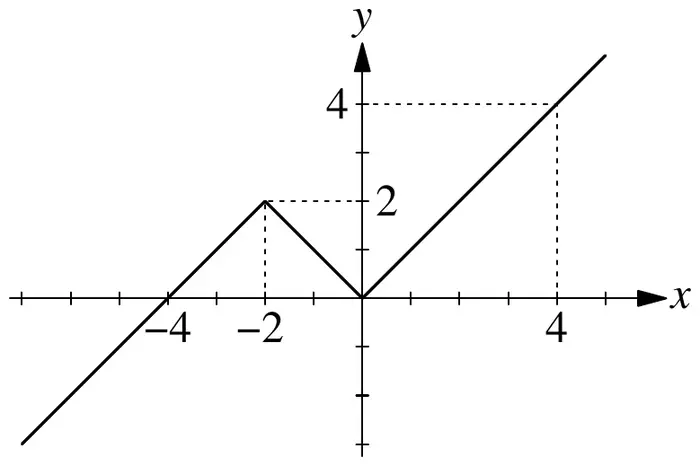
8. The function \(J(x)\) is defined by: \[J(x) = \begin{cases} 4 + x & \text{for } x \leq -2, \\ -x & \text{for } -2 < x \leq 0, \\ x & \text{for } x > 0. \end{cases}\]
How many distinct real solutions has the equation \(J(J(J(x))) = 0\)?
The only solutions to \(J(x) = 0\) are \(x = 0, -4\). Since \(J(0) = 0\), both will also be solutions of \(J(J(J(x))) = 0\). Any solution to \(J(x) = -4\) will also be a solution to \(J(J(x)) = 0\). The only solution to \(J(x) = -4\) is \(x = -8\). Since \(J(x) = 0\), \(x = -8\) is also a solution of \(J(J(J(x))) = 0\). Any solution to \(J(x) = -8\) will also be a solution to \(J(J(J(x))) = 0\). The only solution to \(J(x) = -8\) is \(x = -12\). Therefore, there are four distinct solutions, \(x = 0, -4, -8\) and \(-12\).
For \(\tfrac{n+1}{3}\) to be a three-figure integer we require \(99 < \tfrac{n+1}{3} < 999\). This simplifies to \(297 < n + 1 < 2997\), that is \(296 < n < 2996\). For \(3n + 1\) to be a three-figure integer we require \(99 < 3n + 1 < 999\). This simplifies to \(98 < 3n < 998\), that is \(\tfrac{98}{3} < n < \tfrac{998}{3}\). These inequalities are simultaneously solved when \(296 < n < \tfrac{998}{3} = 332\tfrac{2}{3}\). For every integer value of \(n\) between 297 and 332 it is clear that \(3n + 1\) will be a three-figure integer. However, \(\tfrac{n+1}{3}\) will only be an integer for those values of \(n + 1\) which are divisible by 3. These are 299, 302, 305, 308, 311, 314, 317, 320, 323, 326, 329 and 332. There are 12 numbers in this list.
We can write \(2019 = (a + b)(a - b)\). The integers \(a + b\) and \(a - b\) must be a factor pair of 2019. There are two such factor pairs: 2019, 1 and 673, 3. These yield \((a, b) = (1010, 1009)\) and \((a, b) = (338, 335)\) respectively. As the answer must be at most 999, we conclude that \(a = 338\).
20. Determine the value of the integer \(y\) given that \(y = 3x^2\) and \[\dfrac{2x}{5} = \dfrac{1}{1 - \dfrac{2}{3 + \dfrac{1}{4 - \dfrac{5}{6 - x}}}}\]
19. Shan solves the simultaneous equations \[xy = 15 \text{ and } (2x - y)^4 = 1\] where \(x\) and \(y\) are real numbers. She calculates \(z\), the sum of the squares of all the \(y\)-values in her solutions.
From \((2x - y)^4 = 1\) we know \((2x - y)^2 = \pm 1\). Since any squared quantity must be non-negative, we know \((2x - y)^2 = 1\) from which \(2x - y = \pm 1\). Consider the case \(2x - y = 1\). Multiplying by \(y\) gives \(2xy - y^2 = y\), but \(xy = 15\) and so \(30 - y^2 = y\). Therefore \(y = -6, 5\). Consider the case \(2x - y = -1\). Multiplying by \(y\) gives \(2xy - y^2 = -y\), but \(xy = 15\) and so \(30 - y^2 = -y\). Therefore \(y = -5, 6\). Hence \(z = (-6)^2 + 5^2 + (-5)^2 + 6^2 = 122\).
17. Sarah chooses two numbers \(a\) and \(b\) from the set \(\{1, 2, 3, \ldots, 26\}\). The product \(ab\) is equal to the sum of the remaining 24 numbers.
The sum of the numbers in the set is \(\tfrac{1}{2} \times 26 \times 27 = 351\). Numbers \(a\) and \(b\) will satisfy the equation \(351 - a - b = ab\). Therefore \(352 = ab + a + b + 1 = (a + 1)(b + 1)\). We now search for a factor pair \((a + 1, b + 1)\) of 352 with \(a, b \leq 26\) and \(a \leq b\). The only such pair \((a + 1, b + 1)\) is \((16, 22)\). Therefore \(a\) and \(b\) are 15 and 21 respectively and their difference is 6.
15. In the sequence \(20, 18, 2, 20, -18, \ldots\) the first two terms \(a_1\) and \(a_2\) are 20 and 18 respectively. The third term is found by subtracting the second from the first, \(a_3 = a_1 - a_2\). The fourth is the sum of the two preceding elements, \(a_4 = a_2 + a_3\). Then \(a_5 = a_3 - a_4\),\(a_6 = a_4 + a_5\), and so on.
What is the sum of the first 2018 terms of this sequence?
The sequence is \(20, 18, 2, 20, -18, 2, -20, -18, -2, -20, 18, -2, 20, 18, \ldots\). This is periodic and will repeat every twelve terms. The sum of the first twelve terms is 0. Note also that \(2018 = 12 \times 168 + 2\). Therefore the first 2018 terms will consist of 168 cycles of the first twelve terms with zero sum, followed by \(a_{2017} = 20\) and \(a_{2018} = 18\). Therefore the sum of the first 2018 terms is \(168 \times 0 + 20 + 18 = 38\).
8. An integer \(x\) satisfies the inequality \(x^2 \leq 729 \leq -x^3\). \(P\) and \(Q\) are possible values of \(x\). What is the maximum possible value of \(10(P - Q)\)?
We observe that \(729 = 3^6\). First consider \(x^2 \leq 729\). This has solution \(-27 \leq x \leq 27\). Now consider \(729 \leq -x^3\). This may be rearranged to give \(x^3 \leq -729\) with solution \(x \leq -9\). These inequalities are simultaneously satisfied when \(-27 \leq x \leq -9\). The maximum value of \(P - Q\) is therefore \(-9 - (-27) = 18\). So the answer to the question is \(10 \times 18 = 180\).
7. The volume of a cube in cubic metres and its surface area in square metres is numerically equal to four-thirds of the sum of the lengths of its edges in metres.
What is the total volume in cubic metres of twenty-seven such cubes?
Let each of the twelve edges of the cube have length \(x\) metres. Then \(x^3 + 6x^2 = \tfrac{4}{3} \times 12x\). This simplifies to \(x^3 + 6x^2 - 16x = 0\) or \(x(x - 2)(x + 8)\) which has solutions \(x = -8, 0, 2\). However \(x\) must be positive and so \(x = 2\). Then 27 such cubes have a volume of \(27 \times 2^3 = 27 \times 8 = 216\).
4. In a list of five numbers, the first number is 60 and the last number is 300. The product of the first three numbers is 810 000, the product of the three in the middle is 2 430 000 and the product of the last three numbers is 8 100 000.
Let the list be \(60, x, y, z, 300\). (i) Since \(60xy = 810\,000\) we find that \(xy = 13\,500\). (ii) Since \(xyz = 2\,430\,000\) and \(xy = 13\,500\), we find that \(z = 180\). (iii) Since \(300yz = 8\,100\,000\) and \(z = 180\), we find that \(y = 150\). We may also find \(x = \tfrac{13\,500}{150} = 90\). As \(y\) is the middle number in the list the answer to the problem is 150.
We may rewrite the inequality as \((n^2)^{100} < (5^3)^{100} = 125^{100}\). It follows that \(n^2 < 5^3 = 125\). The maximum integer value of \(n\) is therefore 11. Therefore \(K = 11\) and \(10K = 110\).
19. The sequence of functions \(F_1(x)\),\(F_2(x)\), … satisfies the following conditions: \[F_1(x) = x, \qquad F_{n+1}(x) = \dfrac{1}{1 - F_n(x)}.\] The integer \(C\) is a three-digit cube such that \(F_C(C) = C\). What is the largest possible value of \(C\)?
\[F_1(x) = x;\ F_2(x) = \dfrac{1}{1 - x};\ F_3(x) = \dfrac{1}{1 - \frac{1}{1 - x}} = 1 - \dfrac{1}{x};\ F_4(x) = \dfrac{1}{1 - \left(1 - \frac{1}{x}\right)} = x.\] Hence we have, \(F_1(x) = F_4(x) = F_7(x) = \ldots = F_{3k-2}(x)\). Therefore we are required to solve \(F_{3k-2}(3k - 2) = 3k - 2\) where \(3k - 2\) is a three-digit cube (given). The cubes are 125, 216, 343, 512, 729. The only one of the format \(3k - 2\) for some positive integer \(k\) is 343.
11. An infinite arithmetic progression of positive integers contains the terms 7, 11, 15, 71, 75 and 79. The first term in the progression is 7. Kim writes down all the possible values of the one-hundredth term in the progression. What is the sum of the numbers Kim writes down?
The difference between any two terms is either 4 or is a multiple of 4. So the term-to-term difference in the progression must be a divisor of 4. Since all the terms of the progression are integers the only feasible differences are 1, 2 and 4. If the term-to-term difference is 1 then the one-hundredth term will be \(7 + 99 \times 1 = 106\). If the term-to-term difference is 2 then the one-hundredth term will be \(7 + 99 \times 2 = 205\). If the term-to-term difference is 4 then the one-hundredth term will be \(7 + 99 \times 4 = 403\). The sum of these numbers is 714.
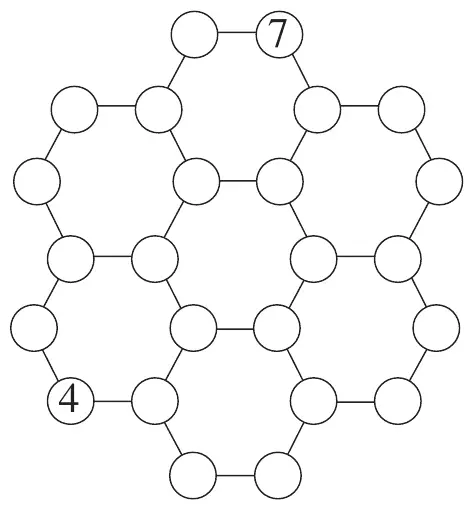
1. An integer is to be written in each circle of the network shown. The integers must be written so that the sum of the numbers at the end of each line segment is the same. Two of the integers have already been written. What is the total of all the integers in the completed diagram?
Each circle immediately adjacent to the initial ‘4’ must contain the same integer, \(x\) say, in order for the sum of those numbers at the end of each line segment to be the same. Those circles immediately adjacent to those with the integer \(x\) must contain the integer 4 to preserve the sum of those numbers at the end of each line segment. Continuation of this pattern throughout the network eventually yields that the circle marked with a ‘7’ must contain the integer \(x\). Therefore \(x = 7\). The completed network contains twelve ‘4’s and twelve ‘7’s with a total of \(12 \times 4 + 12 \times 7 = 132\).
18. The sum of the squares of four consecutive positive integers is equal to the sum of the squares of the next three consecutive integers. What is the square of the smallest of these integers?
The function \(f(x)\) has the property that \(3f(x) + 7f\left(\dfrac{2016}{x}\right) = 2x\). First observe that \(\dfrac{2016}{8} = 252\). Therefore \(3f(8) + 7f(252) = 16\) and \(3f(252) + 7f(8) = 2 \times 252\). Let \(f(8) = V\) and \(f(252) = W\). Therefore \(3V + 7W = 16\) and \(3W + 7V = 504\). When these equations are solved simultaneously, we obtain \(V = 87\) and \(W = -35\) so that \(f(8) = 87\).
13. This year, 2016, can be written as the sum of two positive integers \(p\) and \(q\) where \(2p = 5q\) (as \(2016 = 1440 + 576\)). How many years between 2000 and 3000 inclusive have this property?
For a year \(Y\) to be expressible as as the sum of two positive integers \(p\) and \(q\) where \(2p = 5q\) we require \(p + q = Y\) and \(2p = 5q\). From the first of these, it follows that \(2p + 2q = 2Y\) and hence \(5q + 2q = 2Y\). Therefore \(7q = 2Y\) from which it follows that \(Y\) is also divisible by 7 (since 2 and 7 are coprime). We observe that \(q = \tfrac{2Y}{7}\) will be an integer less than \(Y\) for all \(Y\) that are multiples of 7. Then \(p = Y - q\) will also be an integer. We now must count all the multiples of 7 between 2000 and 3000 inclusive. Since \(1995 = 285 \times 7\) and \(2996 = 428 \times 7\) there are \(428 - 285 = 143\) multiples of 7 between 2000 and 3000 and hence there are 143 such years.
8. The real numbers \(x\), \(y\) and \(z\) are a solution \((x,\ y,\ z)\) of the equation \((x^2 - 9)^2 + (y^2 - 4)^2 + (z^2 - 1)^2 = 0\). How many different possible values are there for \(x + y + z\)?
Since squares of real numbers are non-negative, the sum can only be 0 if each expression in brackets is zero. Therefore the solutions of the equation are \(x = \pm 3\), \(y = \pm 2\) and \(z = \pm 1\). We observe that the maximum and minimum values for \(x + y + z\) are 6 and \(-6\), and that since \(x + y + z\) is the sum of one even and two odd numbers, that \(x + y + z\) itself will be even. It suffices to show that each even total between \(+6\) and \(-6\) can be attained.
\((+3) + (+2) + (+1) = +6\)
\((+3) + (+2) + (-1) = +4\)
\((+3) + (-2) + (+1) = +2\)
\((+3) + (-2) + (-1) = 0\)
\((-3) + (+2) + (-1) = -2\)
\((-3) + (-2) + (+1) = -4\)
\((-3) + (-2) + (-1) = -6\)
Hence there are seven possible values for \(x + y + z\).
5. The notation \(|\,x\,|\) is used to denote the absolute value of a number, regardless of sign. For example, \(|\,7\,| = |-7\,| = 7\). The graphs \(y = |\,2x\,| - 3\) and \(y = |\,x\,|\) are drawn on the same set of axes. What is the area enclosed by them?
The enclosed area is a concave quadrilateral with vertices at \((-3,\ 3)\),\((0,\ 0)\), \((3,\ 3)\) and \((0,\ -3)\). Considering this as two conjoined congruent triangles we find the area as \(2 \times \tfrac{1}{2} \times 3 \times 3 = 9\).
18. Numbers \(a\), \(b\) and \(c\) are such that \(\dfrac{a}{b + c} = \dfrac{b}{c + a} = \dfrac{c}{a + b} = k\). How many possible values of \(k\) are there?
Consider the equation \(\dfrac{a}{b + c} = \dfrac{b}{c + a}\). Multiply each side by \((b + c)(c + a)\) to get \(a^2 + ac = b^2 + bc\) and so \(a^2 - b^2 + ac - bc = 0\). Therefore \((a - b)(a + b + c) = 0\). Hence \(a = b\) or \(a + b + c = 0\). Similarly, if we consider the equations \(\dfrac{b}{c + a} = \dfrac{c}{a + b}\) and \(\dfrac{c}{a + b} = \dfrac{a}{b + c}\), then \(b = c\) or \(a + b + c = 0\) and \(c = a\) or \(a + b + c = 0\) respectively. Therefore, the possible values of \(k\) when all three equations are satisfied simultaneously occur when \(a = b = c\), giving \(k = \tfrac{1}{2}\), or when \(a + b + c = 0\), giving \(k = -1\). Hence there are two possible values of \(k\).
12. Chris planned a 210 km bike ride. However, he rode 5 km/h faster than he planned and finished his ride 1 hour earlier than he planned. His average speed for the ride was \(x\) km/h. What is the value of \(x\)?
Chris's time for the ride when he rode at an average speed of \(x\) km/h was \(\dfrac{210}{x}\) hours. His planned speed was \((x - 5)\) km/h when his time would have been \(\dfrac{210}{x - 5}\) hours. The question tells us that he completed the ride 1 hour earlier than planned, so \(\dfrac{210}{x - 5} - \dfrac{210}{x} = 1\). Therefore \(210x - 210(x - 5) = x(x - 5)\) and hence \(1050 = x^2 - 5x\). Thus \(x^2 - 5x - 1050 = 0\) and hence \((x - 35)(x + 30) = 0\). Therefore, since \(x\) is positive, \(x = 35\).
9. A large rectangle is divided into four identical smaller rectangles by slicing parallel to one of its sides. The perimeter of the large rectangle is 18 metres more than the perimeter of each of the smaller rectangles. The area of the large rectangle is 18 m2 more than the area of each of the smaller rectangles. What is the perimeter in metres of the large rectangle?
Let the length of the original rectangle be \(x\) metres and let the height be \(y\) metres. Without losing any generality, assume the rectangle is sliced parallel to the height, as shown. The information in the question tells us that \(2x + 2y = 2\left(\dfrac{x}{4}\right) + 2y + 18\) and that \(xy = \left(\dfrac{x}{4}\right)y + 18\). From the first equation, we have \(\dfrac{3x}{2} = 18\) which has solution \(x = 12\). Substitute this value into the second equation to obtain \(12y = 3y + 18\), which has solution \(y = 2\). Hence the perimeter of the large rectangle in metres is \(2 \times 12 + 2 \times 2 = 28\).
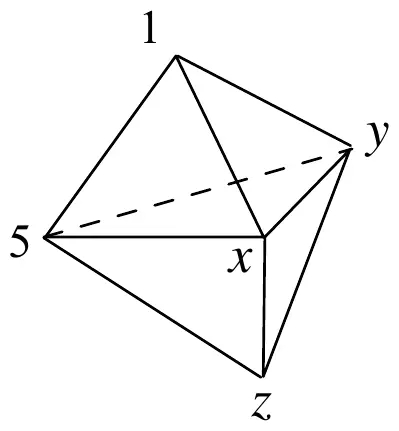
3. The diagram shows a solid with six triangular faces and five vertices. Andrew wants to write an integer at each of the vertices so that the sum of the numbers at the three vertices of each face is the same. He has already written the numbers 1 and 5 as shown.
What is the sum of the other three numbers he will write?
Let the three missing integers be \(x\), \(y\) and \(z\), as shown. Consider the ‘top’ three faces. Since the sum of the three numbers at the vertices of each face is the same, we have \[1 + 5 + x = 1 + x + y = 1 + 5 + y\] and hence \(x = y = 5\). Therefore the sum of the numbers on a face is equal to \(5 + 5 + 1 = 11\). But \(x + y + z\) is equal to the sum of the numbers on a face. Hence the sum of the other three numbers that Andrew will write is 11.
Freya creates a sequence with first term 1 and each subsequent term 5 more than the previous term. Hilary creates a different sequence with first term \(a\) and each subsequent term 3 less than the previous term. Both sequences are continued forever.
(a)
There is at least one number that appears in both sequences. Let \(c\) be the smallest of those numbers. Find the possible values of \(c\).(3 marks)
(b)
Given that there are exactly 100 numbers which appear in both sequences, find the possible values of \(a\).
The best way to approach a problem like this is to play around and see if you make any interesting observations. Freya’ sequence goes: \(1, 6, 11, 16, 21, \ldots\). Hilary’s sequence is decreasing, so it may be easiest to write it out “backwards” starting from a common term. For example, the smallest common term for the two sequences could be 1, in which case Hilary’s (backwards) sequence would go \(1, 4, 7, 10, 13, 16, 19, \ldots\). Can you see a pattern in the terms which overlap with Freya’s sequence? Can you prove your observation?
Could 6 be the smallest common term? What about 11, or 16, or 21? How is this related to the observation you made above?
For part (b), you may want to start by creating a sequence that has only two or three common terms with Freya’s (rather than 100). For example, if \(a = 16\) then Hilary’s sequence has exactly two terms in common with Freya’s (1 and 16). If \(a = 19\), there are still the same two common terms, and this is also the case if \(a = 22, 25\) or \(28\). However, if \(a = 31\) there are three common terms, \(1, 16, 31\). Can you see how to use similar reasoning to create a sequence which has exactly 100 terms in common with Freya’s? Do you have to start from 1 as the smallest common term?
(a)
Any common term must appear in Freya’s sequence. 1 can clearly appear in both sequences, in which case it is the smallest common term (as there are no terms smaller than 1 in Freya’s sequence). If 6 appears in Hilary’s sequence, then it continues \(3, 0, -3, \ldots\) and none of these overlap with Freya’s sequence. So 6 could be the smallest common term. Similarly, if 11 appears in Hilary’s sequence, then it continues \(8, 5, 2, -1, \ldots\) which again does not overlap with Freya’s, so the smallest common term could be 11. However, if 16 appears in Hilary’s sequence, then so does 1, so 16 cannot be the smallest common term.
In general, suppose \(x\) appears in both sequences. Then Freya’s sequence contains \(x - 5, x - 10, x - 15\) and Hilary’s sequence contains \(x - 3, x - 6, x - 9, x - 12, x - 15\). So \(x - 15\) also appears in both sequences. Moreover, there are no other terms between \(x\) and \(x - 15\) which appear in both sequences.
Therefore the smallest common term can be at most 15, and the possible values of \(c\) are \(1, 6\) and \(11\).
(b)
We have shown in part (a) that successive common terms differ by 15. Therefore the 100 common terms are \(c + 15k\), where \(k = 0, 1, \ldots, 99\) and \(c = 1, 6\) or \(11\).
When \(c = 1\), the 100th common term is \(1 + 15 \times 99 = 1486\), and this could be the first term of Hillary’s sequence. However, Hilary’s sequence could also start from \(1489, 1492, 1495\) or \(1498\) and the largest common term would still be 1486. But if Hilary’s sequence started from 1501, then this would be the 101st common term. So when \(c = 1\) there are five possible values of \(a\).
Similarly, when \(c = 6\), the first term of Hilary’s sequence could be \(6 + 15 \times 99 = 1491\), and also \(1494, 1497, 1500\) or \(1503\), but not 1506. Finally, when \(c = 11\), the first term of Hillary’s sequence could be \(1496, 1499, 1502, 1505\) or \(1508\).
Therefore, there are 15 possible values of \(a\), the smallest being 1486 and the largest 1508.
It is a good idea to try some examples to develop your understanding of the rules. For example, with Alessia’s game, how many balloons do you need in box 1 in order to be able to get a balloon into box 2, or box 3? You may already be spotting a pattern, which you should try to explain. It may help to think “backwards”, starting with one balloon in box 8 and asking how many were needed in box 7, then box 6, and so on.
With Daniel’s game, the pattern is a bit harder to spot. You may quickly realise that it is more efficient to use the second move whenever you can, because it enables you to move a balloon two boxes forward. Can you write a more rigorous proof of this observation?
Thinking back from the final box is still a good idea. For example, to get a balloon in box 4 using the second move, you need two balloons in box 3 and another one in box 2. To get two balloons in box 3, you need four balloons in box 2 and another one in box 1. However, to get a balloon in box 2, you need to use the first move, which needs three balloons in box 1. You need to do one more step to complete the solution to part (b)(i).
If you want to use this method to work back from box 8, you need a systematic way to record the number of balloons needed at each “stage”. Try completing this table:\[\begin{array}{|c|c|c|c|c|c|c|c|}\hline 8&7&6&\quad 5\quad&4&3&2&1\\\hline 1&&&&&&&\\\hline &2&1&&&&&\\\hline &&4&2+2=4&1&&&\\\hline\end{array}\]An alternative method is to come up with a recurrence relation. This is an equation that tells you how many balloons you need to get into box \(m\) if you know how many balloons you need to get into previous boxes. For example, the recurrence relation for part (a) is \(a_m = 2a_{m-1}\): the number of balloons needed to get into box \(m\) is twice the number of balloons needed to get into box \(m - 1\). In part (b), if you are using the second move then the number of balloons required to get into box \(m\) will depend on the numbers required to get into both boxes \(m - 1\) and \(m - 2\). You just need to work out how many balloons are needed to get into boxes 1 and 2, and then you can use the recurrence relation to find the number required to any subsequent box. We will use this method in our first solution for part (b).
(a)
To get a balloon in a given box, Alessia needs two balloons in the previous box. Let \(b_m\) be the number of balloons required to get a single balloon into box \(m\). Then \(b_m = 2b_{m-1}\). Since \(b_1 = 1\) (we only need one balloon in box 1), \(b_8 = 2^7 = 128\).
(b)
Let \(a_m\) be the least number of balloons that Daniel needs to have in box 1 at the beginning, to allow him (eventually) to get a single balloon into box \(m\) —so the question is asking us to find the values of \(a_4\) and \(a_8\) , but it turns out to be useful to find the values of \(a_m\) for other small values of \(m\) too.
Clearly \(a_1 = 1\) and \(a_2 = 3\).
Now suppose \(m \ge 3\) : as getting a balloon into box \(m\) can’t be done without first getting a balloon into box \(m - 1\), we see that \(a_m \ge a_{m-1}\) (and \(a_{m-1} \ge a_{m-2}\) which we’ll use later).
Below we’ll find the key recurrence relation \(a_m = 2a_{m-1} + a_{m-2}\) (true for \(m \ge 3\)) and then use it to calculate the values of \(a_4\) and \(a_8\).
Each move Daniel makes consists of removing two balloons and moving a third. Equivalently we could think of this as removing three balloons and adding a new one, which we could call the ‘successor’ of each of these three balloons. Then at any fixed point in the future, each individual balloon which was in box 1 at the beginning will either still exist, or it will have been replaced by a successor, or it will have been replaced by a successor which will in turn have been replaced by its own successor, or \(\ldots\) (and so on). So each balloon at the start has ‘contributed’ towards exactly one balloon which exists at any particular point in the future – it can’t have contributed to more than one balloon existing at the same time.
To get a balloon into box \(m\) (where \(m \ge 3\)) we need three immediate ‘predecessor’ balloons – either three balloons in box \(m - 1\), or two balloons in box \(m - 1\) and one balloon in box \(m - 2\). Any balloon which existed at the beginning (in box 1) can only have contributed to at most one of these three balloons, by the previous paragraph.
This means that to get a balloon into box \(m\) there will need to be at least \(2a_{m-1}\) original balloons to allow two balloons to reach box \(m - 1\) and at least \(a_{m-1}\) or \(a_{m-2}\) different original balloons contributing to the other ‘predecessor’ balloon (which is in box \(m - 1\) or \(m - 2\)). But \(a_{m-1} \ge a_{m-2}\) and so we need a total of at least \(2a_{m-1} + a_{m-2}\) balloons at the start. And in fact, if you have \(2a_{m-1} + a_{m-2}\) balloons at the start, then you can get all three predecessor balloons and so you can get a single balloon into box \(m\).
So \(a_m = 2a_{m-1} + a_{m-2}\) which is the key result in this question, and is the recurrence relation which will help us to find the final answers; this recurrence gives that \(a_3 = 6 + 1 = 7\), and then \(a_4 = 14 + 3 = 17\),\(a_5 = 34 + 7 = 41\),\(a_6 = 82 + 17 = 99\), \(a_7 = 198 + 41 = 239\) and \(a_8 = 478 + 99 = 577\).
Hence Daniel needs at least 17 balloons to get a single balloon into box 4, and at least 577 balloons to get a single balloon into box 8.
Alternative
This is the solution for part (b)(ii). The answer for part (b)(ii) can be found by starting from box 4.
We can complete the table started in the commentary. To get one balloon in box 8, we need two balloons in box 7 and one balloon in box 6. This completes the first two lines of the table. To complete the third line, for each balloon in box \(m\) shown on the second line, we add two balloons to box \(m - 1\) and one balloon to box \(m - 2\). We continue this process, competing each line in turn, until we get to box 2. For each balloon in box 2, we need three balloons in box 1. The completed table is shown below.\[\begin{array}{|c|c|c|c|c|c|c|c|}\hline 8&7&6&5&4&3&2&1\\\hline 1&&&&&&&\\\hline &2&1&&&&&\\\hline &&4&2+2=4&1&&&\\\hline &&&8&4+8=12&4+2=6&1&\\\hline &&&&16&8+24=32&12+12=24&6+3=9\\\hline &&&&&32&16+64=80&32+72=104\\\hline &&&&&&64&32+240=272\\\hline &&&&&&&192\\\hline\end{array}\]The total number of balloons required is the sum of all the numbers in box 1:\[9 + 104 + 272 + 192 = 577.\]We have not explained why this strategy gives the smallest possible number of balloons; for example, could using the first move somewhere in the middle (and not just after getting to box 2) give a smaller total? To complete the argument, we need to explain why it is best to use the second move whenever possible, as was done at the start of the first solution.
The expression \(10xy - 2x + 5y - 1\) factorises as \((ax + b)(cy + d)\) where \(a, b, c, d\) are integers and \(a > 0\). Find the values of \(a, b, c, d\).(1 mark)
(b)
Using the factorisation above and considering factor pairs of 99, find all integer pairs \((x, y)\) such that \(10xy - 2x + 5y = 100\). Enter \(y\) values only on the answer sheet.(4 marks)
(c)
Find all integer pairs \((x, y)\) such that \(10xy - 2x + 5y = 100000001\). Enter \(y\) values only on the answer sheet.(5 marks)
You are probably used to factorising quadratic expressions such as \(10x^2 + 3x - 1\). One method you may have been taught is to re-write the expression as \(10x^2 - 2x + 5x - 1\) and then factorise in pairs. Can you see how to adapt this method to answer part (a)?
When you solve quadratic equations, you usually want one side of the equation to be zero. If \(ab = 0\), then at least one of \(a\) and \(b\) must be zero. An equation like \(ab = 99\) has infinitely many solutions: for any \(a \neq 0\) you can take \(b = \frac{99}{a}\). However, if you want your solutions to be integers, then there is only a finite number of possible pairs, corresponding to the factors of 99. This observation should help with both parts (b) and (c).
You will notice that some factor pairs do not lead to integer solutions. You should also remember that integers can be negative!
(a)
We can factorise in pairs:\[10xy - 2x + 5y - 1 = 2x(5y - 1) + (5y - 1) = (2x + 1)(5y - 1).\]Hence \(a = 2, b = 1, c = 5, d = -1\).
(b)
We need to subtract 1 from both sides so we can use the factorisation from part (a). The equation is equivalent to \((2x + 1)(5y - 1) = 99\).
The factor pairs of 99 are \(1 \times 99, 3 \times 33\) and \(9 \times 11\). These can be in either order, and can also be negative. This gives twelve different possibilities to be checked. We can cut out some of the work by noticing that \(5y - 1\) is one less than a multiple of 5, which only leaves the options \(5y - 1 = 99, 9, -1, -11\), with the corresponding \(2x + 1 = 1, 11, -99, -9\).
Hence the solutions for \((x, y)\) are \((0, 20), (5, 2), (-50, 0)\) and \((-5, -2)\).
(c)
Subtracting 1 from both sides and factorising gives the equation \((2x + 1)(5y - 1) = 10^8\).
This has a lot of factors, all of the form \(\pm 2^a \times 5^b\) where \(0 \le a, b \le 8\). However, notice that \(2x + 1\) is not a multiple of 2 and \(5y - 1\) is not a multiple of 5.
So the only options are \(2x + 1 = 5^8, 5y - 1 = 2^8\) and \(2x + 1 = -5^8, 5y - 1 = -2^8\). The first of these gives \(y = \frac{257}{2}\), which is not an integer, so the only integer solution is \(x = -\frac{5^8 + 1}{2}, y = -\frac{255}{5} = -51\).
The diagram shows a rectangle placed inside a quarter circle of radius 1, such that its vertices all lie on the perimeter of the quarter circle and one vertex coincides with the centre of the (whole) circle. Let the perimeter of such a rectangle be \(P\).
(a)
Show that \(P = 3\) is impossible.(4 marks)
(b)
Find the largest possible value of \(P\). You must fully justify why the value that you find is the largest.
(4 marks)
Instead a rectangle is placed inside a whole circle of radius 1, such that its vertices all lie on the circumference of the circle.
(c)
If the perimeter of the rectangle is as large as possible, show that the rectangle must be a square and calculate its perimeter.(2 marks)
Call the sides of the rectangle \(x\) and \(y\). It seems reasonable to start by writing some equations connecting \(x\), \(y\) and \(P\). Looking at parts (a) and (b) together, it sounds like these equations will only have a solution for some values of \(P\).
One vertex of the rectangle is the centre of the circle and the opposite vertex is on the circumference, so you can use Pythagoras’s Theorem to link \(x\) and \(y\) with the radius of the circle. This means that the equation you get will be quadratic, so you can expect to use the discriminant to determine whether it has any solutions.
In part (b) you need to show two things: that the value of \(P\) cannot be larger than the one you found, but also that there is a rectangle with this value of \(P\).
In part (c), you could start again by writing equations connecting the sides and the perimeter of the second rectangle. However, if you split the circle into quarters, then each quarter has a rectangle inscribed in it in the same way as in part (b). You can therefore use the results you fond in part (b) about the largest possible value of the perimeter.
In the solution below we start by deriving the quadratic equation which will be used in all three parts.
Let \(x\) and \(y\) be the sides of the rectangle. The diagonal of the rectangle is a radius of the circle, so \(x^2 + y^2 = 1\). The perimeter of the rectangle is \(P = 2x + 2y\). Substituting \(y = \dfrac{P - 2x}{2}\) from the second equation into the first gives\[x^2 + \left(\frac{P - 2x}{2}\right)^2 = 1,\]which is equivalent to\[8x^2 - (4P)x + (P^2 - 4) = 0.\]
(a)
When \(P = 3\) this quadratic equation becomes \(8x^2 - 12x + 5 = 0\). The discriminant is \(12^2 - 4 \times 8 \times 5 = -16 < 0\) so there are no solutions for \(x\). It is therefore not possible that \(P = 3\).
(b)
We now look for values of \(P\) for which the quadratic equation \(8x^2 - (4P)x + (P^2 - 4) = 0\) has a solution. The discriminant needs to be non-negative, so we need\[(4P)^2 - 32(P^2 - 4) \ge 0.\]This is equivalent to \(16P^2 \le 128\) and, since \(P > 0\), we must have \(P \le 2\sqrt{2}\). For this value of \(P\), solving the quadratic equation gives \(x = \frac{\sqrt{2}}{2}\) and, substituting back into \(2x + 2y = 2\sqrt{2}\),\(y = \frac{\sqrt{2}}{2}\). Thus it is possible that \(P = 2\sqrt{2}\) and this is the largest possible value of \(P\).
(c)
Let the sides of the rectangle be \(2x\) and \(2y\). The diagonal of the rectangle is a diameter of the circle, so \(x^2 + y^2 = 1\). (Note that this is the same relationship between \(x\) and \(y\) as in part (b).) The perimeter of the rectangle is \(4x + 4y = 2(2x + 2y)\), which is twice the perimeter from part (b).
We know from part (b) that the largest possible value of \(2x + 2y\) is \(2\sqrt{2}\), and that this value only occurs when \(x = y = \frac{\sqrt{2}}{2}\). Therefore the largest possible value of our perimeter is \(4\sqrt{2}\) and it occurs when the sides of the rectangle are equal, i.e. when it is a square.
At Mathsland Animal Shelter there are only cats and dogs. Unfortunately, one day 60 of the animals managed to escape. Once a volunteer had realised, they counted the remaining animals. They noted that half of the cats and a third of the dogs had escaped.
(a)
(i)
If the number of cats before the escape was \(C\) and the number of dogs before the escape was \(D\), write down an equation linking \(C\) and \(D\).
(ii)
If the total number of animals before the escape was \(T\), write down an equation linking \(C\), \(D\) and \(T\).
(4 marks)
(b)
Given that more cats than dogs escaped, find the largest possible value of \(T\). You must justify why the value you have found is the largest.(6 marks)
This is similar to standard simultaneous equations questions you have probably met at school. The difference is that, once you have written down the two equations, you will see that you don’t have enough information to uniquely determine the values of \(C\), \(D\) and \(T\).
You may want to start by trying to find the values of \(C\) and \(D\) for various values of \(T\). Can you always find a solution that works? Remember that the question places some constraints on possible values of \(C\) and \(D\).
To justify that the value you have found for \(T\) is the largest possible, you must show that this value can be achieved (by showing an example of \(C\) and \(D\) in that case) and also that any value larger that is cannot be achieved.
(a)
The total number of escaped animals is 60, and the total number of animals before the escape is \(T\).
(i)
\(\frac{1}{2}C + \frac{1}{3}D = 60\)
(ii)
\(C + D = T\)
(b)
From the first equation, \(D = 180 - \frac{3}{2}C\). Substituting into the second equation,\[T = C + (180 - \tfrac{3}{2}C) = 180 - \tfrac{1}{2}C.\]Therefore \(T\) is the largest possible when \(C\) is the smallest possible. Since more half of the 60 escaped animals were cats, \(\frac{1}{2}C \ge 31\), so \(T \le 180 - 31 = 149\). This value is achieved with \(C = 62\) and \(D = 87\).
Hence the largest possible value of \(T\) is 149.
Commentary
An alternative approach for part (b) is to solve the equations for \(C\) and \(D\) in terms of \(T\).
Rewrite the first equation as \(3C + 2D = 360\). Multiplying the second equation by 2 and subtracting from the first gives \(C = 360 - 2T\). Substituting back then gives \(D = 3T - 360\).
You now need to consider the constraints on \(C\) and \(D\). First, both need to be non-negative, so \(T \le 180\) and \(T \ge 120\). The condition that more cats and dogs escaped means that \(\frac{1}{2}C > \frac{1}{3}D\) or, equivalently, \(3C > 2D\). Substituting the expressions for \(C\) and \(D\) in terms of \(T\) gives:\[3(360 - 2T) > 2(3T - 360).\]Rearranging this inequality gives \(T < 150\) so, since \(T\) is an integer, the largest possible value of \(T\) is 149. This value is achieved when \(C = 62\) and \(D = 87\), which satisfy the conditions of the problem.
One way to show that a number is not prime is to factorise it. A good way to do this in the particular cases in the question is to find values of \(a\) and \(b\) that allow us to express the numbers we are asked to show are not prime in the form \(a^2 - b^2\) or the form \(a^2 + 2ab + b^2\), which then allows us to use the factorisations of these expressions to find factors.
It may not initially be clear how to choose good values of \(a\) and \(b\). In part (a), we know that we want to add a square number, \(b^2\), onto the numbers that we are trying to factorise to get another square number, \(a^2\). Since the numbers in question both have six digits, it would be really nice if \(359999 + b^2\) and \(249919 + b^2\) were multiples of \(10000 = 100^2\). This motivates a choice of \(b = 1\) for 359999 and \(b = 9\) for 249919, giving \(359999 + 1^2 = 360000 = 600^2\) and \(249919 + 9^2 = 250000 = 500^2\).
A similar approach works for the second part.
(a)
\(a^2 - b^2 = (a - b)(a + b)\).
(i)
\(359999 = 360000 - 1 = 600^2 - 1^2 = 599 \times 601\), so 599 and 601 are factors of 359999, and so 359999 is not prime.
(ii)
\(249919 = 250000 - 81 = 500^2 - 9^2 = 491 \times 509\), so 491 and 509 are factors of 249919, and so 249919 is not prime.
(b)
\(a^2 + 2ab + b^2 = (a + b)^2\).
(i)
\(9006001 = 9000000 + 6000 + 1 = 3000^2 + 2 \times 3000 \times 1 + 1^2 = 3001^2\), so 3001 is a factor of 9006001, and so 9006001 is not prime.
(ii)
\(11449 = 10000 + 1400 + 49 = 100^2 + 2 \times 100 \times 7 + 7^2 = 107^2\), so 107 is a factor of 11449, and so 11449 is not prime.
This question is about factors of \(M\) so it makes sense to try and factorise the expression. The expression in terms of \(n\) does not factorise, but we have not yet used the fact that \(n\) is odd. Writing \(n = 2k + 1\) gives an expression that can be factorised.
Once you have identified four factors of \(M\) you need to show that they are all different, and that neither of them equal 1.
Since \(n\) is odd and \(n > 3\) we may write \(n = 2k + 1\) where \(k\) is an integer and \(k \ge 2\). Then \(M = 4k^2 + 8k - 4 = 4(k^2 + 2k - 1)\). Even if \(k^2 + 2k - 1\) is prime, we see that \(M\) has the four positive integral divisors 2, 4, \(k^2 + 2k - 1\) and \(2(k^2 + 2k - 1)\), all of them different from 1 and \(M\). Clearly they are all different since (given that \(k \ge 2\)) \(k^2 + 2k - 1 \ge 7\).
Note
When \(k^2 + 2k - 1\) is prime (as happens, for example, when \(k\) is 2 or 4 or 6 or 8), \(M\) has exactly four different factors (excluding 1 and itself). But it can have more than four different factors: for example, when \(k\) is 3, \(M\) is divisible by 2, 4, 7, 8, 14 and 28. These examples show that every algebraic factor of an expression gives a numerical factor, but there may be numerical factors that don’t come from an algebraic factor.
All we know about the four points is that they lie on the given curve. It thus makes sense to work with their coordinates. Two sides of the quadrilateral \(ABCD\) are parallel if they have the same slope (gradient).
You need to prove that it is not possible for the quadrilateral \(ABCD\) to have two pairs of parallel sides. We present two slightly different proofs. The first picks a particular vertex and uses inequalities to show that at most one of the lines passing through it can be parallel to another line. The second is an example of proof by contradiction: we assume that there are two pairs of parallel sides and show that this contradicts one of the assumptions in the question (in this case, that all four points have different \(x\)-coordinates).
The question says nothing about the order in which the four points are arranged on the curve, so in your solution you need to be clear which pairs of sides you are considering.
Let the points \(A\),\(B\),\(C\), \(D\) be \((a, a^2)\),\((b, b^2)\),\((c, c^2)\), \((d, d^2)\) respectively, where, without loss of generality, \(a < b < c < d\). We investigate which of the sides through \(A\) could be parallel to another side. The slope of the line-segment \(AB\) is \((b^2 - a^2)/(b - a)\), which is \(a + b\). The slopes of \(AC\),\(AD\),\(BC\),\(BD\), and \(CD\) are given by the analogous expressions. Now \(a + b < c + d\) and \(a + c < b + d\) and so \(AB \nparallel CD\) and \(AC \nparallel BD\).
Thus at most one side through \(A\) (namely \(AD\)) can be parallel to another side, and therefore \(ABCD\) is not a parallelogram.
Alternative
Let the coordinates of the four points be defined as above. If \(ABCD\) is a parallelogram then \(AB\) is parallel to \(DC\) and \(BC\) is parallel to \(DA\).
From the calculation of gradients given above, this means that \(a + b = c + d\) and \(b + c = a + d\). Subtracting the second equation from the first gives \(a - c = c - a\) which implies that \(a = c\). But this is not possible, as the four points are different.
Thus our initial assumption that two pairs of sides are parallel must be false, so \(ABCD\) is not a parallelogram.
Note
The result in question can be much generalised. A curve with equation \(y = f(x)\) is said to be convex if whenever \(u < v < w\), the point \((v, f(v))\) on the curve lies below (in the sense that its \(y\)-coordinate is smaller than that of) the corresponding point on the chord joining \((u, f(u))\) to \((w, f(w))\). We may write \(v = tu + (1 - t)w\) where \(0 < t < 1\) since \(t = (w - v)/(w - u)\). Algebraically convexity may be expressed as the inequality \(f(v) < tf(u) + (1 - t)f(w)\). Equivalently, the curve is convex if its slope is always increasing. The parabola with equation \(y = x^2\) is just one example. There are many others such as the exponential curve with equation \(y = \mathrm{e}^x\).
In general, if four different points \(A\),\(B\),\(C\), \(D\) lie on a convex curve with equation \(y = f(x)\), then the quadrilateral \(ABCD\) is never a parallelogram. Without loss of generality we may take the points \(A\),\(B\),\(C\), \(D\) to be \((a, f(a))\),\((b, f(b))\),\((c, f(c))\), \((d, f(d))\) respectively, where \(a < b < c < d\). The convexity condition tells us that \(B\) and \(C\) lie below the chord \(AD\), \(B\) lies below the chord \(AC\) and \(C\) lies below the chord \(BD\). It follows that the chords \(AC\) and \(BD\) meet (above the curve) and the chords \(AB\) and \(CD\) (both extended) meet (below the curve). Thus, as in the case of the parabola, at most one of the sides through \(A\) (namely \(AD\)) can be parallel to another side, and therefore \(ABCD\) is not a parallelogram.
This question is about sums of numbers, so a sensible first step seems to be to give each number a name so we can write some equations.
Label the numbers as shown in the diagram below. There are seven unknowns and we can write seven equations. You may know several different methods for solving such systems of equations, for example elimination and substitution. In this case, substituting from one equation into another is likely to produce long expressions.
A better method is to look for equations which share one or more unknowns and eliminate those unknowns. For example, \(a + b + c = T\) and \(a + d + e = T\). You can subtract the two equations to obtain \(b + c - d - e = 0\) and so \(b + c = d + e\).
You can then look for another two equations that contain those four unknowns, for example \(g + d + b = T\) and \(g + e + c = T\). Subtracting those two gives \(d + b = e + c\). Adding this to the equation we found above gives \(2b + c + d = 2e + c + d\) and so \(b = e\).
You can use the symmetry of the situation to see that we can produce an analogous proof showing that \(b = f\). Having found that several of the unknowns are equal to each other, it may be a good idea to relabel the diagram to show this. We can then complete the proof, as we have done below.
Let the numbers labelling the points be as shown in the diagram.
Since \(T = a + b + c = a + d + e\), we have \(b + c = d + e\). Also, \(T = b + d + g = c + e + g\) and so \(b + d = c + e\). Therefore \(2b + c + d = 2e + c + d\) and so \(b = e\).
Substituting this back into \(b + d = c + e\) we obtain \(d = c\).
Analogously, we can prove that \(b = f\), and that \(d = a\) and \(d = g\).
We can therefore relabel the diagram as shown on the right.
Considering the three points on the circle, we have \(3b = T\) and so \(b = \tfrac{1}{3}T\). Considering the base of the triangle, \(2d + b = T\) and so \(d = \tfrac{1}{3}T\) as well.
Thus each number is equal to \(\tfrac{1}{3}T\), as required.
Note
The configuration in the question is known as the Fano plane (after Gino Fano, 1871–1952). The Fano plane is an example of a “finite projective plane”. It has only seven points and seven lines (represented as the six line segments and the circle in our diagram). Notice that every pair of lines have one common point; hence, in this plane, every two lines intersect and there are no parallel lines.
A tournament has \(n\) contestants. Each contestant plays exactly one game against every other contestant. Explain why the total number of games is \(\tfrac{1}{2}n(n - 1)\).
(b)
In a particular chess tournament, every contestant is supposed to play exactly one game against every other contestant. However, contestant \(A\) withdrew from the tournament after playing only ten games, and contestant \(B\) withdrew after just one game.
Answer: (b) Yes, \(A\) and \(B\) did play each other.
Solution (UKMT)
(a)
Commentary
There are quite a lot of ways of counting the number of games! We give some examples.
We could consider each contestant in turn. The first contestant plays \(n - 1\) games (against every contestant other than themselves). For the second contestant we have already counted the game against the first contestant, so she plays \(n - 2\) other games. Continuing this reasoning, we find that the total number of games is\[(n - 1) + (n - 2) + \dots + 2 + 1.\]There are a good few ways of working out this sum.
One way is to compare the sum to its reverse. If we call the sum \(S\), then we have both\[\begin{aligned}(n - 1) + (n - 2) + \dots + 2 + 1 &= S,\\ \text{and } 1 + 2 + \dots + (n - 2) + (n - 1) &= S.\end{aligned}\]By adding corresponding terms, we get\[(n - 1 + 1) + (n - 2 + 2) + \dots + (2 + n - 2) + (1 + n - 1) = 2S.\]The left-hand side of this equation is a sum of \(n - 1\) bracketed terms, each of which is equal to \(n\), so the sum is equal to \(n(n - 1)\). Thus \(S = \tfrac{1}{2}n(n - 1)\).
Yet another way is more geometrical. The sum can be represented by a triangle of dots: one dot in the first row, two dots in a second, and so on. The diagram shows two such triangle fitted together to form a rectangle.
If there are \(n - 1\) rows of dots, the rectangle has \(n - 1\) rows and \(n\) columns, and hence contains \(n(n - 1)\) dots in total. But the original sum represents half of this rectangle, so the result follows.
On the other hand, you may know about arithmetic series in general. This is an arithmetic series with \(n - 1\) terms, first term 1 and common difference 1. Therefore the sum is\[\frac{n - 1}{2}[2 + (n - 2)] = \frac{1}{2}n(n - 1).\]Finally, we can go about it differently. Instead of forming a sum, we can look at the number of ways to pair the contestants. We need to be careful not to count pairs twice. This is the solution we present below.
Contestants never play themselves but do play all the other \(n - 1\) competitors. Therefore there are \(n(n - 1)\) pairs \((X, Y)\) such that \(X\) plays \(Y\), with the contestants named in that order.
The game in which \(X\) plays \(Y\) is the same as that in which \(Y\) plays \(X\) however, so naming the contestants in order means that each game is counted twice. Therefore the total number of games is \(\tfrac{1}{2}n(n - 1)\).
(b)
Commentary
We need to check whether it is possible to have a total of 55 games in the two cases: when \(A\) and \(B\) played each other, and when they didn’t.
One way to do this would be to count the number of games that don’t involve \(A\) or \(B\) and then to add in the number of games played by \(A\) and by \(B\). Another way would be to count the total number of games if \(A\) and \(B\) had played the whole tournament, and then to subtract the numbers of games missed by \(A\) and \(B\) because they withdrew early.
In each case, we know that the total number of games played is 55. We don’t know how many contestants there were at the start, so give this number a name (say \(m\)). We’ll get an equation involving \(m\) that we can then try to solve. We’ll also need to be careful to remember that \(A\) and \(B\) were scheduled to play each other, so we mustn’t count that game twice.
Suppose that there are \(m\) contestants other than \(A\) and \(B\). The number of games those \(m\) contestants played with each other is \(\tfrac{1}{2}m(m - 1)\).
There are an additional 10 games played by \(A\). If those include a game between \(A\) and \(B\), then there are no additional games played by \(B\), so the total number of games played is\[\frac{1}{2}m(m - 1) + 10 = 55.\]If \(B\) did not play \(A\) then there is one additional game played by \(B\), so the total number of games is\[\frac{1}{2}m(m - 1) + 10 + 1 = 55.\]In the first case, \(m(m - 1) = 90\), which is possible when \(m = 10\). In the second case, \(m(m - 1) = 88\). The last equation has no integer solutions, since \(m(m - 1) \le 72\) when \(m \le 9\) and \(m(m - 1) \ge 90\) when \(m \ge 10\).
Thus \(A\) and \(B\) did play each other.
Note
There were 12 contestants at the start of the tournament.
The result in part (a) is called the difference of two cubes. Notice that part (b) involves a sum of two cubes in the numerator of the fraction. You will probably need to adapt the result of part (a) in order to use it in part (b).
One possibility in part (b) would be to do some calculations. However, this will be very time-consuming, so let’s try to find a quicker approach. We might try to simplify the fraction by factorising both the numerator and the denominator and looking for common factors.
To avoid writing out long numbers (and the risk of making numerical errors) it is a good idea to rewrite the expression using algebraic symbols. We will substitute the numbers back in at the end. This means that we are trying to simplify the fraction\[\frac{m^3 + n^3}{m^2 - n^2},\]where \(m = 2016\) and \(n = 2015\).
The denominator factorises as \((m-n)(m+n)\). (You might know this as the “difference of two squares”.) In our case, we know that \(m - n = 1\), so in fact the denominator is just \(m + n\).
This is where part (a) can give us a useful suggestion. We know from (a) how to factorise \(a^3 - b^3\). Can we do something similar to factorise \(a^3 + b^3\)?
There are various ways to see how to adapt part (a), including experimentation with changing signs. We find that\[a^3 + b^3 = (a + b)(a^2 - ab + b^2).\]This will be really helpful in simplifying the fraction, and then we can substitute the numbers back in.
The final expression still looks a little long to evaluate. Some clever use of factorising can simplify the calculation a little.
(a)
Expanding out the brackets and simplifying, we find that\[\begin{aligned}(a - b)(a^2 + ab + b^2) &= a^3 + a^2b + ab^2 - a^2b - ab^2 - b^3\\ &= a^3 - b^3.\end{aligned}\]
(b)
Let \(m = 2016\) and \(n = 2015\).
Using the factorisation\[m^3 + n^3 = (m + n)(m^2 - mn + n^2),\]and the difference of two squares \(m^2 - n^2 = (m - n)(m + n)\), we may write the fraction as\[\frac{(m + n)(m^2 - mn + n^2)}{(m - n)(m + n)} = \frac{m^2 - mn + n^2}{m - n}.\]Since in our case \(m - n = 1\), the value of this expression is\[\begin{aligned}2016^2 - 2016 \times 2015 + 2015^2 &= 2016(2016 - 2015) + 2015^2\\ &= 2016 + 2015^2\\ &= 4\,062\,241.\end{aligned}\]
Alternative
(This solution does not use the result of part (a).)
Write \(m = 2016\),\(n = 2015\); then \(m = n + 1\). Using the binomial expansion, we get\[(n + 1)^3 = n^3 + 3n^2 + 3n + 1.\]Therefore the fraction is\[\frac{(n^3 + 3n^2 + 3n + 1) + n^3}{(n^2 + 2n + 1) - n^2} = \frac{2n^3 + 3n^2 + 3n + 1}{2n + 1}.\]Using algebraic division, we obtain\[n^2 + n + 1 = 2015^2 + 2015 + 1 = 4\,062\,241.\]
A triangle has side lengths \(a\), \(a\) and \(b\). It has perimeter \(P\) and area \(A\). Given that \(b\) and \(P\) are integers, and that \(P\) is numerically equal to \(A^2\), find all possible pairs \((a, b)\).
Answer: \((a, b) = (\frac{17}{2}, 1), (3, 2), (\frac{5}{2}, 4)\)
Solution (UKMT)
Proposed by Tom Bowler
We have that \(P = 2a + b\) and, by Pythagoras’ theorem, the height is \(\sqrt{a^2 - \frac{b^2}{4}}\) which means that \(A = \frac{b}{2}\sqrt{a^2 - \frac{b^2}{4}}\).
The condition in the question gives us the equation \(2a + b = \left(\frac{b^2}{4}\right)\left(a^2 - \frac{b^2}{4}\right)\).
We may divide by the (positive) \(2a + b\) to get \(b^2(2a - b) = 16\). (If \(a = b = 0\) we do get a solution to the equation, but this corresponds to a single point rather than a triangle.)
Since \(b\) and \((2a - b) = P - 2b\) are both integers, \(b^2\) must be a square factor of 16. The possible values are 1, 4 and 16 and we can substitute these into the equation in turn to find that \((a, b) = (\frac{17}{2}, 1), (3, 2)\) or \((\frac{5}{2}, 4)\).
Remark
Candidates were not penalised for including the solution \((a, b) = (0, 0)\) but it was not required to get full marks.
Remark
It is also possible to obtain the same equation linking \(a\) and \(b\) by using Heron’s formula for the area of a triangle.
Alice and Bob take it in turns to write numbers on a blackboard. Alice starts by writing an integer \(a\) between \(-100\) and 100 inclusive on the board. On each of Bob’s turns he writes twice the number Alice wrote last. On each of Alice’s subsequent turns she writes the number 45 less than the number Bob wrote last. At some point, the number \(a\) is written on the board for a second time. Find the possible values of \(a\).
There are four possible starting numbers \(a\) which generate a repeat: 0, 30, 42 and 45.
We call the terms of the sequence written on the board \(a_1, a_2, a_3, \ldots\) where \(a_1 = a\). We will consider a more general version of the problem by writing \(s\) in place of 45. Now the sequence is determined by the rules \(a_{2n} = 2a_{2n-1}\) and \(a_{2n+1} = a_{2n} - s\) for \(n \ge 1\).
In general we see that \(a_{2k} = 2^ka - (2^k - 2)s\) while \(a_{2k+1} = 2^ka - (2^k - 1)s\). These can be proved formally by induction, but this is obviously not required for the question.
We now have two cases to consider:
Case 1: \(a_{2k} = a\) for some \(k \ge 0\).
In this case \((2^k - 1)a = (2^k - 2)s\). The numbers \(2^k - 1\) and \(2^k - 2\) cannot share any factors great than one since any factor of both would divide their difference. Thus we must have \(2^k - 1\) is a factor of \(s\).
Turning to the specific problem at hand, we need \(2^k - 1\) to be a factor 45. The possible factors are \(1 = 2^1 - 1\), \(3 = 2^2 - 1\) and \(15 = 2^4 - 1\). These correspond to \(a = 0\), \(a = 30\) and \(a = 42\) respectively, all of which work.
Case 2: \(a_{2k+1} = a\) for some \(k \ge 1\).
In this case we have \((2^k - 1)a = (2^k - 1)s\) and, since \(k \neq 0\), this implies \(a = s = 45\) which also works.
Alternative
It is also fairly straightforward to solve the problem by trying values of \(a\) in turn.
If at any stage \(a_{2k} > 90\), then the subsequent odd and even numbered terms both form increasing sequences, so once their terms are larger than \(a\), the number \(a\) can never be repeated. Similarly if \(a_{2k} < 0\) at any stage, then the subsequent odd and even numbered terms both form decreasing sequences, so once their terms are less than \(a\), the number \(a\) can never be repeated.
Most values of \(a\) in the range \(-100\) to 100 give sequences which rapidly fall into the two categories above, meaning the four exceptional cases can be easily identified.
A function \(f\) is called good if it assigns an integer value \(f(m, n)\) to every ordered pair of integers \((m, n)\) in such a way that for every pair of integers \((m, n)\) we have:\[2f(m, n) = f(m - n, n - m) + m + n = f(m + 1, n) + f(m, n + 1) - 1.\]Find all good functions.
A sequence of integers \(a_1, a_2, a_3, \ldots\) satisfies the relation:\[4a_{n+1}^2 - 4a_na_{n+1} + a_n^2 - 1 = 0\]for all positive integers \(n\). What are the possible values of \(a_1\)?
Two solid cylinders are mathematically similar. The sum of their heights is 1. The sum of their surface areas is \(8\pi\). The sum of their volumes is \(2\pi\). Find all possibilities for the dimensions of each cylinder.
Ares multiplies two integers which differ by 9. Grace multiplies two integers which differ by 6. They obtain the same product \(T\). Determine all possible values of \(T\).
A sequence \(b_1, b_2, b_3, \ldots\) of nonzero real numbers has the property that\[b_{n+2} = \frac{b_{n+1}^2 - 1}{b_n}\]for all positive integers \(n\).
Suppose that \(b_1 = 1\) and \(b_2 = k\) where \(1 < k < 2\). Show that there is some constant \(B\), depending on \(k\), such that \(-B \le b_n \le B\) for all \(n\). Also show that, for some \(1 < k < 2\), there is a value of \(n\) such that \(b_n > 2020\).
A sequence \(a_1, a_2, a_3, \ldots\) has \(a_1 > 2\) and satisfies:\[a_{n+1} = \frac{a_n(a_n - 1)}{2}\]for all positive integers \(n\). For which values of \(a_1\) are all the terms of the sequence odd integers?
Find all functions \(f\) from the positive real numbers to the positive real numbers for which \(f(x) \le f(y)\) whenever \(x \le y\) and\[f(x^4) + f(x^2) + f(x) + f(1) = x^4 + x^2 + x + 1\]for all \(x > 0\).
Let \(f\) be a function defined on the real numbers and taking real values. We say that \(f\) is absorbing if \(f(x) \le f(y)\) whenever \(x \le y\) and \(f^{2018}(z)\) is an integer for all real numbers \(z\).
a) Does there exist an absorbing function \(f\) such that \(f(x)\) is an integer for only finitely many values of \(x\)?
b) Does there exist an absorbing function \(f\) and an increasing sequence of real numbers \(a_1 < a_2 < a_3 < \ldots\) such that \(f(x)\) is an integer only if \(x = a_i\) for some \(i\)?
Note that if \(k\) is a positive integer and \(f\) is a function, then \(f^k\) denotes the composition of \(k\) copies of \(f\). For example \(f^3(t) = f(f(f(t)))\) for all real numbers \(t\).
It is well known that, for each positive integer \(n\),\[1^3 + 2^3 + \cdots + n^3 = \frac{n^2(n + 1)^2}{4}\]and so is a square. Determine whether or not there is a positive integer \(m\) such that\[(m + 1)^3 + (m + 2)^3 + \cdots + (2m)^3\]is a square.
We'd like to use Google Analytics cookies to count visits and see which pages help most. They're optional, and the site works exactly the same either way. Privacy policy