
SMC 2010 Q14
14. The parallel sides of a trapezium have lengths \(2x\) and \(2y\) respectively. The diagonals are equal in length, and a diagonal makes an angle \(\theta\) with the parallel sides, as shown. What is the length of each diagonal?
- A \(x + y\)
- B \(\dfrac{x + y}{\sin\theta}\)
- C \((x + y)\cos\theta\)
- D \((x + y)\tan\theta\)
- E \(\dfrac{x + y}{\cos\theta}\)
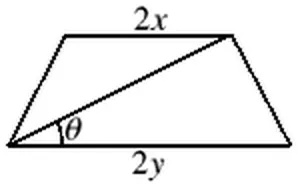
Senior Mathematical Challenge 2010, Question 14. © UK Mathematics Trust. Original paper on ukmt.org.uk
Answer: E \(\dfrac{x + y}{\cos\theta}\)
Drop perpendiculars from the top vertices to the bottom line. The distance from the foot to the nearer base vertex is \(\tfrac{1}{2}(2y - 2x) = y - x\).
So the distance to the further base vertex is \(2y - (y - x) = y + x\).
Hence \(\cos\theta = \dfrac{x + y}{d}\) where \(d\) is the length of the diagonal.
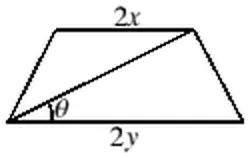
Solution © UK Mathematics Trust, from the SMC 2010 solutions. Longer versions with investigations: Solutions and investigations (PDF).