Factors, Primes & Digits

Your progress
0 of 127 done
Ticks are kept only in this browser: clearing your browsing data or changing device loses them. · ·

Senior Mathematical Challenge (SMC)

Senior Kangaroo (SK)

Mathematical Olympiad for Girls (MOG)

British Mathematical Olympiad Round 1 (BMO1)

British Mathematical Olympiad Round 2 (BMO2)

SMC 2020 Q21

SMCCurrent spec5 marksFactors, Primes & Digits

21. When written out in full, the number \((10^{2020} + 2020)^2\) has 4041 digits.

What is the sum of the digits of this 4041-digit number?

  1. A 9
  2. B 17
  3. C 25
  4. D 2048
  5. E 4041

Senior Mathematical Challenge 2020, Question 21. © UK Mathematics Trust. Original paper on ukmt.org.uk

SMC 2020 Q17

SMCCurrent spec5 marksAlgebraFactors, Primes & Digits

17. The positive integers \(m\), \(n\) and \(p\) satisfy the equation \(\quad 3m + \dfrac{3}{n + \frac{1}{p}} = 17\).

What is the value of \(p\)?

  1. A 2
  2. B 3
  3. C 4
  4. D 6
  5. E 9

Senior Mathematical Challenge 2020, Question 17. © UK Mathematics Trust. Original paper on ukmt.org.uk

SMC 2020 Q13

SMCCurrent spec4 marksFactors, Primes & Digits

13. The number \(16! \div 2^k\) is an odd integer. Note that \(n! = 1 \times 2 \times 3 \times \cdots \times (n - 1) \times n\).

What is the value of \(k\)?

  1. A 9
  2. B 11
  3. C 13
  4. D 15
  5. E 17

Senior Mathematical Challenge 2020, Question 13. © UK Mathematics Trust. Original paper on ukmt.org.uk

SMC 2020 Q8

SMCCurrent spec4 marksFactors, Primes & Digits

8. What is the largest prime factor of \(106^2 - 15^2\)?

  1. A 3
  2. B 7
  3. C 11
  4. D 13
  5. E 17

Senior Mathematical Challenge 2020, Question 8. © UK Mathematics Trust. Original paper on ukmt.org.uk

SMC 2020 Q6

6. There are fewer than 30 students in the A-level mathematics class. One half of them play the piano, one quarter play hockey and one seventh are in the school play.

How many of the students play hockey?

  1. A 3
  2. B 4
  3. C 5
  4. D 6
  5. E 7

Senior Mathematical Challenge 2020, Question 6. © UK Mathematics Trust. Original paper on ukmt.org.uk

SMC 2020 Q2

SMCCurrent spec4 marksFactors, Primes & Digits

2. What is the remainder when \(1234 \times 5678\) is divided by 5?

  1. A 0
  2. B 1
  3. C 2
  4. D 3
  5. E 4

Senior Mathematical Challenge 2020, Question 2. © UK Mathematics Trust. Original paper on ukmt.org.uk

SMC 2019 Q15

SMCCurrent spec4 marksFactors, Primes & Digits

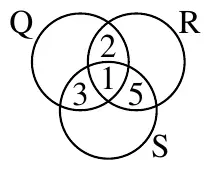
15. The highest common factors of all the pairs chosen from the positive integers \(Q\), \(R\) and \(S\) are three different primes.

What is the smallest possible value of \(Q + R + S\)?

  1. A 41
  2. B 31
  3. C 30
  4. D 21
  5. E 10

Senior Mathematical Challenge 2019, Question 15. © UK Mathematics Trust. Original paper on ukmt.org.uk

SMC 2019 Q14

SMCCurrent spec4 marksFactors, Primes & Digits

14. One of the following is the largest square that is a factor of \(10!\). Which one?

Note that, \(n! = 1 \times 2 \times 3 \times \cdots \times (n - 1) \times n\).

  1. A \((4!)^2\)
  2. B \((5!)^2\)
  3. C \((6!)^2\)
  4. D \((7!)^2\)
  5. E \((8!)^2\)

Senior Mathematical Challenge 2019, Question 14. © UK Mathematics Trust. Original paper on ukmt.org.uk

SMC 2019 Q11

11. For how many integer values of \(k\) is \(\sqrt{200 - \sqrt{k}}\) also an integer?

  1. A 11
  2. B 13
  3. C 15
  4. D 17
  5. E 20

Senior Mathematical Challenge 2019, Question 11. © UK Mathematics Trust. Original paper on ukmt.org.uk

SMC 2019 Q10

SMCCurrent spec4 marksFactors, Primes & Digits

10. Which of the following five values of \(n\) is a counterexample to the statement in the box below?

For a positive integer \(n\), at least one of \(6n - 1\) and \(6n + 1\) is prime.
  1. A 10
  2. B 19
  3. C 20
  4. D 21
  5. E 30

Senior Mathematical Challenge 2019, Question 10. © UK Mathematics Trust. Original paper on ukmt.org.uk

SMC 2019 Q6

SMCCurrent spec4 marksFactors, Primes & Digits

6. Each of the factors of 100 is to be placed in a 3 by 3 grid, one per cell, in such a way that the products of the three numbers in each row, column and diagonal are all equal. The positions of the numbers 1, 2, 50 and \(x\) are shown in the diagram.

What is the value of \(x\)?

  1. A 4
  2. B 5
  3. C 10
  4. D 20
  5. E 25
\(x\)150
2

Senior Mathematical Challenge 2019, Question 6. © UK Mathematics Trust. Original paper on ukmt.org.uk

SMC 2019 Q4

SMCCurrent spec4 marksAlgebraFactors, Primes & Digits

4. For how many positive integer values of \(n\) is \(n^2 + 2n\) prime?

  1. A 0
  2. B 1
  3. C 2
  4. D 3
  5. E more than 3

Senior Mathematical Challenge 2019, Question 4. © UK Mathematics Trust. Original paper on ukmt.org.uk

SMC 2018 Q19

19. How many pairs of numbers \((m, n)\) are there such that the following statement is true?

‘A regular \(m\)-sided polygon has an exterior angle of size \(n°\) and
a regular \(n\)-sided polygon has an exterior angle of size \(m°\).’
  1. A 24
  2. B 22
  3. C 20
  4. D 18
  5. E 16

Senior Mathematical Challenge 2018, Question 19. © UK Mathematics Trust. Original paper on ukmt.org.uk

SMC 2018 Q13

SMCCurrent spec4 marksAlgebraFactors, Primes & Digits

13. The lines \(y = x\) and \(y = mx - 4\) intersect at the point \(P\).

What is the sum of the positive integer values of \(m\) for which the coordinates of \(P\) are also positive integers?

  1. A 3
  2. B 5
  3. C 7
  4. D 8
  5. E 10

Senior Mathematical Challenge 2018, Question 13. © UK Mathematics Trust. Original paper on ukmt.org.uk

SMC 2018 Q8

SMCCurrent spec4 marksFactors, Primes & Digits

8. What are the last two digits of \(7^{2018}\)?

  1. A 07
  2. B 49
  3. C 43
  4. D 01
  5. E 18

Senior Mathematical Challenge 2018, Question 8. © UK Mathematics Trust. Original paper on ukmt.org.uk

SMC 2018 Q6

6. Which of the following is equal to \(25 \times 15 \times 9 \times 5.4 \times 3.24\)?

  1. A \(3^9\)
  2. B \(3^{10}\)
  3. C \(3^{11}\)
  4. D \(3^{14}\)
  5. E \(3^{17}\)

Senior Mathematical Challenge 2018, Question 6. © UK Mathematics Trust. Original paper on ukmt.org.uk

SMC 2018 Q4

SMCCurrent spec4 marksFactors, Primes & Digits

4. Which of the following is not a multiple of 5?

  1. A \(2019^2 - 2014^2\)
  2. B \(2019^2 \times 10^2\)
  3. C \(2020^2 \div 101^2\)
  4. D \(2010^2 - 2005^2\)
  5. E \(2015^2 \div 5^2\)

Senior Mathematical Challenge 2018, Question 4. © UK Mathematics Trust. Original paper on ukmt.org.uk

SMC 2018 Q2

SMCCurrent spec4 marksFactors, Primes & Digits

2. The positive integer 2018 is the product of two primes.

What is the sum of these two primes?

  1. A 1001
  2. B 1010
  3. C 1011
  4. D 1100
  5. E 1101

Senior Mathematical Challenge 2018, Question 2. © UK Mathematics Trust. Original paper on ukmt.org.uk

SMC 2018 Q1

SMCCurrent spec4 marksFactors, Primes & Digits

1. When the following are evaluated, how many of the answers are odd numbers?

\(1^2,\ 2^3,\ 3^4,\ 4^5,\ 5^6\)
  1. A 1
  2. B 2
  3. C 3
  4. D 4
  5. E 5

Senior Mathematical Challenge 2018, Question 1. © UK Mathematics Trust. Original paper on ukmt.org.uk

SMC 2017 Q24

24. There is a set of straight lines in a plane such that each line intersects exactly ten others. Which of the following could not be the number of lines in that set?

  1. A 11
  2. B 12
  3. C 15
  4. D 16
  5. E 20

Senior Mathematical Challenge 2017, Question 24. © UK Mathematics Trust. Original paper on ukmt.org.uk

SMC 2017 Q21

SMCCurrent spec5 marksAlgebraFactors, Primes & Digits

21. How many pairs \((x, y)\) of positive integers satisfy the equation \(4^x = y^2 + 15\)?

  1. A 0
  2. B 1
  3. C 2
  4. D 4
  5. E an infinite number

Senior Mathematical Challenge 2017, Question 21. © UK Mathematics Trust. Original paper on ukmt.org.uk

SMC 2017 Q1

SMCCurrent spec4 marksFactors, Primes & Digits

1. One of the following numbers is prime. Which is it?

  1. A 2017 − 2
  2. B 2017 − 1
  3. C 2017
  4. D 2017 + 1
  5. E 2017 + 2

Senior Mathematical Challenge 2017, Question 1. © UK Mathematics Trust. Original paper on ukmt.org.uk

SMC 2016 Q25

SMCCurrent spec5 marksFactors, Primes & Digits

25. Let \(n\) be the smallest integer for which \(7n\) has 2016 digits.
What is the units digit of \(n\)?

  1. A 0
  2. B 1
  3. C 4
  4. D 6
  5. E 8

Senior Mathematical Challenge 2016, Question 25. © UK Mathematics Trust. Original paper on ukmt.org.uk

SMC 2016 Q14

SMCCurrent spec4 marksFactors, Primes & Digits

14. Which of the following values of the positive integer \(n\) is a counterexample to the statement: “If \(n\) is not prime then \(n - 2\) is not prime”?

  1. A 6
  2. B 11
  3. C 27
  4. D 33
  5. E 51

Senior Mathematical Challenge 2016, Question 14. © UK Mathematics Trust. Original paper on ukmt.org.uk

SMC 2016 Q12

SMCCurrent spec4 marksFactors, Primes & Digits

12. What is the smallest square that has 2016 as a factor?

  1. A \(42^2\)
  2. B \(84^2\)
  3. C \(168^2\)
  4. D \(336^2\)
  5. E \(2016^2\)

Senior Mathematical Challenge 2016, Question 12. © UK Mathematics Trust. Original paper on ukmt.org.uk

SMC 2016 Q10

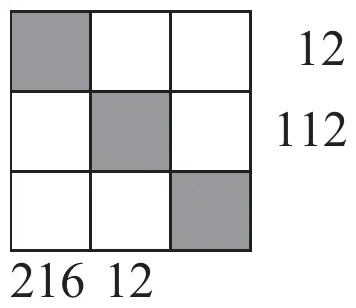
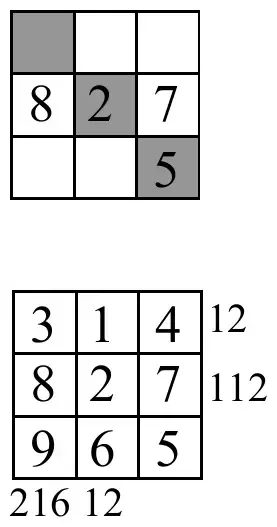
10. The digits from 1 to 9 are to be written in the nine cells of the \(3 \times 3\) grid shown, one digit in each cell.
The product of the three digits in the first row is 12.
The product of the three digits in the second row is 112.
The product of the three digits in the first column is 216.
The product of the three digits in the second column is 12.
What is the product of the digits in the shaded cells?

  1. A 24
  2. B 30
  3. C 36
  4. D 48
  5. E 140
A 3 by 3 grid with the three cells on the leading diagonal shaded; rows labelled 12 and 112, columns labelled 216 and 12

Senior Mathematical Challenge 2016, Question 10. © UK Mathematics Trust. Original paper on ukmt.org.uk

SMC 2016 Q5

SMCCurrent spec4 marksFactors, Primes & Digits

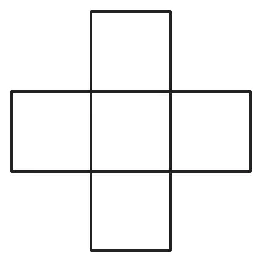
5. All the digits 2, 3, 4, 5 and 6 are placed in the grid, one in each cell, to form two three-digit numbers that are squares.
Which digit is placed in the centre of the grid?

  1. A 2
  2. B 3
  3. C 4
  4. D 5
  5. E 6
A cross-shaped grid of five cells: a row of three cells crossed by a column of three cells sharing the centre

Senior Mathematical Challenge 2016, Question 5. © UK Mathematics Trust. Original paper on ukmt.org.uk

SMC 2016 Q1

1. How many times does the digit 9 appear in the answer to \(987654321 \times 9\)?

  1. A 0
  2. B 1
  3. C 5
  4. D 8
  5. E 9

Senior Mathematical Challenge 2016, Question 1. © UK Mathematics Trust. Original paper on ukmt.org.uk

SMC 2015 Q24

24. Peter has 25 cards, each printed with a different integer from 1 to 25. He wishes to place \(N\) cards in a single row so that the numbers on every adjacent pair of cards have a prime factor in common.
What is the largest value of \(N\) for which this is possible?

  1. A 16
  2. B 18
  3. C 20
  4. D 22
  5. E 24

Senior Mathematical Challenge 2015, Question 24. © UK Mathematics Trust. Original paper on ukmt.org.uk

SMC 2015 Q23

SMCCurrent spec5 marksAlgebraFactors, Primes & Digits

23. Given four different non-zero digits, it is possible to form 24 different four-digit numbers containing each of these four digits. What is the largest prime factor of the sum of the 24 numbers?

  1. A 23
  2. B 93
  3. C 97
  4. D 101
  5. E 113

Senior Mathematical Challenge 2015, Question 23. © UK Mathematics Trust. Original paper on ukmt.org.uk

SMC 2015 Q18

SMCCurrent spec5 marksFactors, Primes & Digits

18. What is the largest integer \(k\) whose square \(k^2\) is a factor of \(10!\)?
\([10! = 10 \times 9 \times 8 \times 7 \times 6 \times 5 \times 4 \times 3 \times 2 \times 1.]\)

  1. A 6
  2. B 256
  3. C 360
  4. D 720
  5. E 5040

Senior Mathematical Challenge 2015, Question 18. © UK Mathematics Trust. Original paper on ukmt.org.uk

SMC 2015 Q6

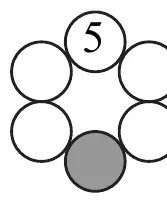
6. The numbers 5, 6, 7, 8, 9, 10 are to be placed, one in each of the circles in the diagram, so that the sum of the numbers in each pair of touching circles is a prime number. The number 5 is placed in the top circle.
Which number is placed in the shaded circle?

  1. A 6
  2. B 7
  3. C 8
  4. D 9
  5. E 10
Six circles in a ring; the top circle contains 5 and the bottom circle is shaded

Senior Mathematical Challenge 2015, Question 6. © UK Mathematics Trust. Original paper on ukmt.org.uk

SMC 2014 Q11

SMCCurrent spec4 marksFactors, Primes & Digits

11. A Mersenne prime is a prime of the form \(2^p - 1\), where \(p\) is also a prime. One of the following is not a Mersenne prime. Which one is it?

  1. A \(2^2 - 1\)
  2. B \(2^3 - 1\)
  3. C \(2^5 - 1\)
  4. D \(2^7 - 1\)
  5. E \(2^{11} - 1\)

Senior Mathematical Challenge 2014, Question 11. © UK Mathematics Trust. Original paper on ukmt.org.uk

SMC 2014 Q9

SMCCurrent spec4 marksFactors, Primes & Digits

9. Which of the following is divisible by 9?

  1. A \(10^{2014} + 5\)
  2. B \(10^{2014} + 6\)
  3. C \(10^{2014} + 7\)
  4. D \(10^{2014} + 8\)
  5. E \(10^{2014} + 9\)

Senior Mathematical Challenge 2014, Question 9. © UK Mathematics Trust. Original paper on ukmt.org.uk

SMC 2014 Q5

SMCCurrent spec4 marksFactors, Primes & Digits

5. How many integers between 1 and 2014 are multiples of both 20 and 14?

  1. A 7
  2. B 10
  3. C 14
  4. D 20
  5. E 28

Senior Mathematical Challenge 2014, Question 5. © UK Mathematics Trust. Original paper on ukmt.org.uk

SMC 2013 Q22

22. Consider numbers of the form \(10n + 1\), where \(n\) is a positive integer. We shall call such a number ‘grime’ if it cannot be expressed as the product of two smaller numbers, possibly equal, both of which are of the form \(10k + 1\), where \(k\) is a positive integer.
How many ‘grime numbers’ are there in the sequence 11, 21, 31, 41, ..., 981, 991?

  1. A 0
  2. B 8
  3. C 87
  4. D 92
  5. E 99

Senior Mathematical Challenge 2013, Question 22. © UK Mathematics Trust. Original paper on ukmt.org.uk

SMC 2013 Q18

SMCCurrent spec5 marksFactors, Primes & Digits

18. The numbers 2, 3, 12, 14, 15, 20, 21 may be divided into two sets so that the product of the numbers in each set is the same. What is this product?

  1. A 420
  2. B 1260
  3. C 2520
  4. D 6720
  5. E 6350400

Senior Mathematical Challenge 2013, Question 18. © UK Mathematics Trust. Original paper on ukmt.org.uk

SMC 2013 Q16

SMCCurrent spec5 marksFactors, Primes & Digits

16. Andrew states that every composite number of the form \(8n + 3\), where \(n\) is an integer, has a prime factor of the same form. Which of these numbers is an example showing that Andrew's statement is false?

  1. A 19
  2. B 33
  3. C 85
  4. D 91
  5. E 99

Senior Mathematical Challenge 2013, Question 16. © UK Mathematics Trust. Original paper on ukmt.org.uk

SMC 2013 Q15

SMCCurrent spec4 marksAlgebraFactors, Primes & Digits

15. For how many positive integers \(n\) is \(4^n - 1\) a prime number?

  1. A 0
  2. B 1
  3. C 2
  4. D 3
  5. E infinitely many

Senior Mathematical Challenge 2013, Question 15. © UK Mathematics Trust. Original paper on ukmt.org.uk

SMC 2013 Q3

3. What is the ‘tens’ digit of \(2013^2 - 2013\)?

  1. A 0
  2. B 1
  3. C 4
  4. D 5
  5. E 6

Senior Mathematical Challenge 2013, Question 3. © UK Mathematics Trust. Original paper on ukmt.org.uk

SMC 2012 Q10

SMCCurrent spec4 marksFactors, Primes & Digits

10. Let \(N\) be the smallest positive integer whose digits add up to 2012. What is the first digit of \(N + 1\)?

  1. A 2
  2. B 3
  3. C 4
  4. D 5
  5. E 6

Senior Mathematical Challenge 2012, Question 10. © UK Mathematics Trust. Original paper on ukmt.org.uk

SMC 2012 Q6

SMCCurrent spec4 marksFactors, Primes & Digits

6. What is the sum of the digits of the largest 4-digit palindromic number which is divisible by 15? [Palindromic numbers read the same backwards and forwards, e.g. 7227.]

  1. A 18
  2. B 20
  3. C 24
  4. D 30
  5. E 36

Senior Mathematical Challenge 2012, Question 6. © UK Mathematics Trust. Original paper on ukmt.org.uk

SMC 2012 Q5

5. All six digits of three 2-digit numbers are different. What is the largest possible sum of three such numbers?

  1. A 237
  2. B 246
  3. C 255
  4. D 264
  5. E 273

Senior Mathematical Challenge 2012, Question 5. © UK Mathematics Trust. Original paper on ukmt.org.uk

SMC 2012 Q1

SMCCurrent spec4 marksFactors, Primes & Digits

1. Which of the following cannot be written as the sum of two prime numbers?

  1. A 5
  2. B 7
  3. C 9
  4. D 10
  5. E 11

Senior Mathematical Challenge 2012, Question 1. © UK Mathematics Trust. Original paper on ukmt.org.uk

SMC 2011 Q12

SMCCurrent spec4 marksFactors, Primes & Digits

12. The primorial of a number is the product of all of the prime numbers less than or equal to that number. For example, the primorial of 6 is \(2 \times 3 \times 5 = 30\). How many different whole numbers have a primorial of 210?

  1. A 1
  2. B 2
  3. C 3
  4. D 4
  5. E 5

Senior Mathematical Challenge 2011, Question 12. © UK Mathematics Trust. Original paper on ukmt.org.uk

SMC 2011 Q4

SMCCurrent spec4 marksFactors, Primes & Digits

4. What is the last digit of \(3^{2011}\) ?

  1. A 1
  2. B 3
  3. C 5
  4. D 7
  5. E 9

Senior Mathematical Challenge 2011, Question 4. © UK Mathematics Trust. Original paper on ukmt.org.uk

SMC 2011 Q1

SMCCurrent spec4 marksFactors, Primes & Digits

1. Which of the numbers below is not a whole number?

  1. A \(\dfrac{2011 + 0}{1}\)
  2. B \(\dfrac{2011 + 1}{2}\)
  3. C \(\dfrac{2011 + 2}{3}\)
  4. D \(\dfrac{2011 + 3}{4}\)
  5. E \(\dfrac{2011 + 4}{5}\)

Senior Mathematical Challenge 2011, Question 1. © UK Mathematics Trust. Original paper on ukmt.org.uk

SMC 2010 Q25

25. All the digits of a number are different, the first digit is not zero, and the sum of the digits is 36. There are \(N \times 7!\) such numbers. What is the value of \(N\)?

  1. A 72
  2. B 97
  3. C 104
  4. D 107
  5. E 128

Senior Mathematical Challenge 2010, Question 25. © UK Mathematics Trust. Original paper on ukmt.org.uk

SMC 2010 Q15

SMCCurrent spec4 marksFactors, Primes & Digits

15. What is the smallest prime number that is equal to the sum of two prime numbers and is also equal to the sum of three different prime numbers?

  1. A 7
  2. B 11
  3. C 13
  4. D 17
  5. E 19

Senior Mathematical Challenge 2010, Question 15. © UK Mathematics Trust. Original paper on ukmt.org.uk

SMC 2010 Q13

13. How many two-digit numbers have remainder 1 when divided by 3 and remainder 2 when divided by 4?

  1. A 8
  2. B 7
  3. C 6
  4. D 5
  5. E 4

Senior Mathematical Challenge 2010, Question 13. © UK Mathematics Trust. Original paper on ukmt.org.uk

SMC 2010 Q4

SMCCurrent spec4 marksFactors, Primes & Digits

4. The year 2010 is one in which the sum of its digits is a factor of the year itself. How many more years will it be before this is next the case?

  1. A 3
  2. B 6
  3. C 9
  4. D 12
  5. E 15

Senior Mathematical Challenge 2010, Question 4. © UK Mathematics Trust. Original paper on ukmt.org.uk

SMC 2010 Q1

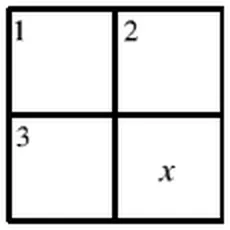
1. What is the digit \(x\) in this cross-number?

AcrossDown
1. A cube1. One less than a cube
3. A cube
  1. A 2
  2. B 3
  3. C 4
  4. D 5
  5. E 6
A 2 by 2 cross-number grid; the top left cell is numbered 1, the top right 2, the bottom left 3, and the bottom right cell contains x

Senior Mathematical Challenge 2010, Question 1. © UK Mathematics Trust. Original paper on ukmt.org.uk

SMC 2009 Q25

SMCCurrent spec5 marksAlgebraFactors, Primes & Digits

25. Four positive integers \(a\), \(b\), \(c\) and \(d\) are such that
\[abcd + abc + bcd + cda + dab + ab + bc + cd + da + ac + bd + a + b + c + d = 2009.\]
What is the value of \(a + b + c + d\)?

  1. A 73
  2. B 75
  3. C 77
  4. D 79
  5. E 81

Senior Mathematical Challenge 2009, Question 25. © UK Mathematics Trust. Original paper on ukmt.org.uk

SMC 2009 Q15

SMCCurrent spec4 marksAlgebraFactors, Primes & Digits

15. For how many integers \(n\) is \(\dfrac{n}{100 - n}\) also an integer?

  1. A 1
  2. B 6
  3. C 10
  4. D 18
  5. E 100

Senior Mathematical Challenge 2009, Question 15. © UK Mathematics Trust. Original paper on ukmt.org.uk

SMC 2009 Q10

10. Consider all three-digit numbers formed by using different digits from 0, 1, 2, 3 and 5. How many of these numbers are divisible by 6?

  1. A 4
  2. B 7
  3. C 10
  4. D 15
  5. E 20

Senior Mathematical Challenge 2009, Question 10. © UK Mathematics Trust. Original paper on ukmt.org.uk

SMC 2009 Q2

SMCCurrent spec4 marksFactors, Primes & Digits

2. Which of the following is not a multiple of 15?

  1. A 135
  2. B 315
  3. C 555
  4. D 785
  5. E 915

Senior Mathematical Challenge 2009, Question 2. © UK Mathematics Trust. Original paper on ukmt.org.uk

SMC 2008 Q19

SMCCurrent spec5 marksFactors, Primes & Digits

19. How many prime numbers \(p\) are there such that \(199p + 1\) is a perfect square?

  1. A 0
  2. B 1
  3. C 2
  4. D 4
  5. E 8

Senior Mathematical Challenge 2008, Question 19. © UK Mathematics Trust. Original paper on ukmt.org.uk

SMC 2008 Q13

13. Positive integers \(m\) and \(n\) are such that \(2^m + 2^n = 1280\). What is the value of \(m + n\)?

  1. A 14
  2. B 16
  3. C 18
  4. D 32
  5. E 640

Senior Mathematical Challenge 2008, Question 13. © UK Mathematics Trust. Original paper on ukmt.org.uk

SMC 2008 Q9

SMCCurrent spec4 marksFactors, Primes & Digits

9. What is the remainder when the 2008-digit number 222 ... 22 is divided by 9?

  1. A 8
  2. B 6
  3. C 4
  4. D 2
  5. E 0

Senior Mathematical Challenge 2008, Question 9. © UK Mathematics Trust. Original paper on ukmt.org.uk

SMC 2007 Q16

SMCCurrent spec5 marksFactors, Primes & Digits

16. Damien wishes to find out if 457 is a prime number. In order to do this he needs to check whether it is exactly divisible by some prime numbers. What is the smallest number of possible prime number divisors that Damien needs to check before he can be sure that 457 is a prime number?

  1. A 8
  2. B 9
  3. C 10
  4. D 11
  5. E 12

Senior Mathematical Challenge 2007, Question 16. © UK Mathematics Trust. Original paper on ukmt.org.uk

SMC 2007 Q13

13. Which of the following gives the exact number of seconds in the last six complete weeks of 2007?

  1. A 9!
  2. B 10!
  3. C 11!
  4. D 12!
  5. E 13!

{Note that \(n! = 1 \times 2 \times 3 \times \;\ldots\; \times n\).}

Senior Mathematical Challenge 2007, Question 13. © UK Mathematics Trust. Original paper on ukmt.org.uk

SMC 2007 Q12

SMCCurrent spec4 marksAlgebraFactors, Primes & Digits

12. How many two-digit numbers \(N\) have the property that the sum of \(N\) and the number formed by reversing the digits of \(N\) is a square?

  1. A 2
  2. B 5
  3. C 6
  4. D 7
  5. E 8

Senior Mathematical Challenge 2007, Question 12. © UK Mathematics Trust. Original paper on ukmt.org.uk

SMC 2007 Q7

7. How many whole numbers between 1 and 2007 are divisible by 2 but not by 7?

  1. A 857
  2. B 858
  3. C 859
  4. D 860
  5. E 861

Senior Mathematical Challenge 2007, Question 7. © UK Mathematics Trust. Original paper on ukmt.org.uk

SMC 2006 Q25

SMCCurrent spec5 marksAlgebraFactors, Primes & Digits

25. \(X\) is a positive integer in which each digit is 1; that is, \(X\) is of the form 11111… .
Given that every digit of the integer \(pX^2 + qX + r\) (where \(p\), \(q\) and \(r\) are fixed integer coefficients and \(p > 0\)) is also 1, irrespective of the number of digits \(X\), which of the following is a possible value of \(q\)?

  1. A −2
  2. B −1
  3. C 0
  4. D 1
  5. E 2

Senior Mathematical Challenge 2006, Question 25. © UK Mathematics Trust. Original paper on ukmt.org.uk

SMC 2006 Q14

SMCCurrent spec4 marksAlgebraFactors, Primes & Digits

14. Heather and Rachel each has some pennies. Heather has more than Rachel. In fact, the number of pennies that Heather has is the square of the number that Rachel has. The total number of pennies they have between them makes a whole number of pounds. What is the smallest this total could be?

  1. A £1
  2. B £6
  3. C £57
  4. D £99
  5. E £101

Senior Mathematical Challenge 2006, Question 14. © UK Mathematics Trust. Original paper on ukmt.org.uk

SMC 2006 Q12

SMCCurrent spec4 marksFactors, Primes & Digits

12. The factorial of \(n\), written \(n!\), is defined by \(n! = 1 \times 2 \times 3 \times \;\ldots\; \times (n - 2) \times (n - 1) \times n\).
Which of the following values of \(n\) provides a counterexample to the statement:

“If \(n\) is a prime number, then \(n! + 1\) is also a prime number”?
  1. A 1
  2. B 2
  3. C 3
  4. D 4
  5. E 5

Senior Mathematical Challenge 2006, Question 12. © UK Mathematics Trust. Original paper on ukmt.org.uk

SMC 2006 Q11

SMCCurrent spec4 marksAlgebraFactors, Primes & Digits

11. Three consecutive even numbers are such that the sum of four times the smallest and twice the largest exceeds three times the second by 2006. What is the sum of the digits of the smallest number?

  1. A 8
  2. B 11
  3. C 14
  4. D 17
  5. E 20

Senior Mathematical Challenge 2006, Question 11. © UK Mathematics Trust. Original paper on ukmt.org.uk

SMC 2005 Q24

24. The factorial of \(n\), written \(n!\), is defined by \(n! = 1 \times 2 \times 3 \times \ldots \times (n - 2) \times (n - 1) \times n\). For how many positive integer values of \(k\) less than 50 is it impossible to find a value of \(n\) such that \(n!\) ends in exactly \(k\) zeros?

  1. A 0
  2. B 5
  3. C 8
  4. D 9
  5. E 10

Senior Mathematical Challenge 2005, Question 24. © UK Mathematics Trust. Original paper on ukmt.org.uk

SMC 2005 Q22

SMCCurrent spec5 marksAlgebraFactors, Primes & Digits

22. Given that \(S = (x + 20) + (x + 21) + (x + 22) + \ldots + (x + 100)\), where \(x\) is a positive integer, what is the smallest value of \(x\) such that \(S\) is a perfect square?

  1. A 1
  2. B 2
  3. C 4
  4. D 8
  5. E 64

Senior Mathematical Challenge 2005, Question 22. © UK Mathematics Trust. Original paper on ukmt.org.uk

SMC 2005 Q21

SMCCurrent spec5 marksAlgebraFactors, Primes & Digits

21. What is the sum of the values of \(n\) for which both \(n\) and \(\dfrac{n^2 - 9}{n - 1}\) are integers?

  1. A −8
  2. B −4
  3. C 0
  4. D 4
  5. E 8

Senior Mathematical Challenge 2005, Question 21. © UK Mathematics Trust. Original paper on ukmt.org.uk

SMC 2005 Q14

SMCCurrent spec4 marksFactors, Primes & Digits

14. A square number is divided by 6. Which of the following could not be the remainder?

  1. A 0
  2. B 1
  3. C 2
  4. D 3
  5. E 4

Senior Mathematical Challenge 2005, Question 14. © UK Mathematics Trust. Original paper on ukmt.org.uk

SMC 2005 Q12

SMCCurrent spec4 marksFactors, Primes & Digits

12. The positive integer \(x\) is a multiple of 7, and \(\sqrt{x}\) is between 15 and 16. What is the number of possible values of \(x\)?

  1. A 1
  2. B 2
  3. C 3
  4. D 4
  5. E 5

Senior Mathematical Challenge 2005, Question 12. © UK Mathematics Trust. Original paper on ukmt.org.uk

SMC 2005 Q7

SMCCurrent spec4 marksAlgebraFactors, Primes & Digits

7. Consider the arithmetic sequences 1998, 2005, 2012, … and 1996, 2005, 2014, …. Which is the next number after 2005 that appears in both sequences?

  1. A 2054
  2. B 2059
  3. C 2061
  4. D 2063
  5. E 2068

Senior Mathematical Challenge 2005, Question 7. © UK Mathematics Trust. Original paper on ukmt.org.uk

SK 2020 Q20

20. Each square in this cross-number can be filled with a non-zero digit such that all of the conditions in the clues are fulfilled. The digits used are not necessarily distinct.
What is the answer to 3 ACROSS?

12
34
5
ACROSSDOWN
1. A multiple of 71. A multiple of a square of an odd prime; neither a
  square nor a cube
3. The answer to this Question2. The internal angle of a regular polygon;
  the exterior angle is between \(10^o\) and \(20^o\)
5. More than 104. A proper factor of 5 ACROSS but
  not a proper factor of 1 DOWN

Senior Kangaroo 2020, Question 20. © UK Mathematics Trust. Original paper on ukmt.org.uk

SK 2020 Q18

SKCurrent spec5 marksFactors, Primes & Digits

18. The operation \(\diamond\) is defined on two positive whole numbers as the number of distinct prime factors of the product of the two numbers. For example \(8 \diamond 15 = 3\).
What is the cube of the value of \((720 \diamond 1001)\)?

Senior Kangaroo 2020, Question 18. © UK Mathematics Trust. Original paper on ukmt.org.uk

SK 2020 Q14

SKCurrent spec5 marksAlgebraFactors, Primes & Digits

14. Let \(a\), \(b\), \(c\) and \(d\) be distinct positive integers such that \(a + b\), \(a + c\) and \(a + d\) are all odd and are all square. Let \(L\) be the least possible value of \(a + b + c + d\). What is the value of \(10L\)?

Senior Kangaroo 2020, Question 14. © UK Mathematics Trust. Original paper on ukmt.org.uk

SK 2020 Q13

13. How many ordered triples of positive integers \((x, y, z)\) satisfy \(\left(x^y\right)^z = 1024\)?

Senior Kangaroo 2020, Question 13. © UK Mathematics Trust. Original paper on ukmt.org.uk

SK 2020 Q10

SKCurrent spec5 marksFactors, Primes & Digits

10. What is the smallest 3-digit positive integer \(N\) such that \(2^N + 1\) is a multiple of 5?

Senior Kangaroo 2020, Question 10. © UK Mathematics Trust. Original paper on ukmt.org.uk

SK 2020 Q8

SKCurrent spec5 marksFactors, Primes & Digits

8. The number \(\left(2^{222}\right)^5 \times \left(5^{555}\right)^2\) is \(Q\) digits long. What is the largest prime factor of \(Q\)?

Senior Kangaroo 2020, Question 8. © UK Mathematics Trust. Original paper on ukmt.org.uk

SK 2020 Q3

3. How many distinct integer solutions \((x, y)\) are there to the equation \(5^1 + 4^2 + 3^3 + 2^4 = x^y\)?

Senior Kangaroo 2020, Question 3. © UK Mathematics Trust. Original paper on ukmt.org.uk

SK 2019 Q20

SKCurrent spec5 marksFactors, Primes & Digits

20. Each square in this cross-number can be filled with a non-zero digit such that all of the conditions in the clues are fulfilled. The digits used are not necessarily distinct.
What is the answer to 3 ACROSS?

12
34
5
ACROSSDOWN
1. A composite factor of 10011. One more than a prime, one less than a prime
3. Not a palindrome2. A multiple of 9
5. \(pq^3\) where \(p, q\) prime and \(p \neq q\)4. \(p^3q\) using the same \(p, q\) as 5 ACROSS

Senior Kangaroo 2019, Question 20. © UK Mathematics Trust. Original paper on ukmt.org.uk

SK 2019 Q18

18. An integer is said to be chunky if it consists only of non-zero digits by which it is divisible when written in base 10.
For example, the number 936 is Chunky since it is divisible by 9, 3 and 6.
How many chunky integers are there between 13 and 113?

Senior Kangaroo 2019, Question 18. © UK Mathematics Trust. Original paper on ukmt.org.uk

SK 2019 Q14

SKCurrent spec5 marksFactors, Primes & Digits

14. A number \(N\) is the product of three distinct primes. How many distinct factors does \(N^5\) have?

Senior Kangaroo 2019, Question 14. © UK Mathematics Trust. Original paper on ukmt.org.uk

SK 2019 Q6

SKCurrent spec5 marksAlgebraFactors, Primes & Digits

6. For natural numbers \(a\) and \(b\) we are given that \(2019 = a^2 - b^2\). It is known that \(a < 1000\). What is the value of \(a\)?

Senior Kangaroo 2019, Question 6. © UK Mathematics Trust. Original paper on ukmt.org.uk

SK 2018 Q18

SKCurrent spec5 marksFactors, Primes & Digits

18. How many zeros are there at the end of \(\dfrac{2018!}{30! \times 11!}\)?

Senior Kangaroo 2018, Question 18. © UK Mathematics Trust. Original paper on ukmt.org.uk

SK 2018 Q17

SKCurrent spec5 marksAlgebraFactors, Primes & Digits

17. Sarah chooses two numbers \(a\) and \(b\) from the set \(\{1, 2, 3, \ldots, 26\}\). The product \(ab\) is equal to the sum of the remaining 24 numbers.

What is the difference between \(a\) and \(b\)?

Senior Kangaroo 2018, Question 17. © UK Mathematics Trust. Original paper on ukmt.org.uk

SK 2018 Q16

16. A right-angled triangle has sides of integer length. One of its sides has length 20. Toni writes down a list of all the different possible hypotenuses of such triangles.

What is the sum of all the numbers in Toni’s list?

Senior Kangaroo 2018, Question 16. © UK Mathematics Trust. Original paper on ukmt.org.uk

SK 2018 Q13

SKCurrent spec5 marksFactors, Primes & Digits

13. A nine-digit number is odd. The sum of its digits is 10. The product of the digits of the number is non-zero. The number is divisible by seven.

When rounded to three significant figures, how many millions is the number equal to?

Senior Kangaroo 2018, Question 13. © UK Mathematics Trust. Original paper on ukmt.org.uk

SK 2018 Q11

SKCurrent spec5 marksFactors, Primes & Digits

11. A sequence \(U_1, U_2, U_3, \ldots\) is defined as follows:

  • \(U_1 = 2\);
  • if \(U_n\) is prime then \(U_{n+1}\) is the smallest positive integer not yet in the sequence;
  • if \(U_n\) is not prime then \(U_{n+1}\) is the smallest prime not yet in the sequence.

The integer \(k\) is the smallest such that \(U_{k+1} - U_k > 10\).

What is the value of \(k \times U_k\)?

Senior Kangaroo 2018, Question 11. © UK Mathematics Trust. Original paper on ukmt.org.uk

SK 2018 Q10

SKCurrent spec5 marksFactors, Primes & Digits

10. The function \(\mathrm{SPF}(n)\) denotes the sum of the prime factors of \(n\), where the prime factors are not necessarily distinct. For example, \(120 = 2^3 \times 3 \times 5\), so \(\mathrm{SPF}(120) = 2 + 2 + 2 + 3 + 5 = 14\).

Find the value of \(\mathrm{SPF}(2^{22} - 4)\).

Senior Kangaroo 2018, Question 10. © UK Mathematics Trust. Original paper on ukmt.org.uk

SK 2018 Q1

SKCurrent spec5 marksFactors, Primes & Digits

1. My age is a two-digit number that is a power of 5. My cousin’s age is a two-digit number that is a power of 2. The sum of the digits of our ages is an odd number.

What is the product of the digits of our ages?

Senior Kangaroo 2018, Question 1. © UK Mathematics Trust. Original paper on ukmt.org.uk

SK 2017 Q20

SKCurrent spec5 marksFactors, Primes & Digits

20. Let \(a\), \(b\) and \(c\) be positive integers such that \(a^2 = 2b^3 = 3c^5\). What is the minimum possible number of factors of \(abc\) (including 1 and \(abc\))?

Senior Kangaroo 2017, Question 20. © UK Mathematics Trust. Original paper on ukmt.org.uk

SK 2017 Q17

17. Matthew writes a list of all three-digit squares backwards. For example, in his list Matthew writes the three-digit square ‘625’ as ‘526’. Norma looks at Matthew's list and notices that some of the numbers are prime numbers. What is the mean of those prime numbers in Matthew's list?

Senior Kangaroo 2017, Question 17. © UK Mathematics Trust. Original paper on ukmt.org.uk

SK 2017 Q15

SKCurrent spec5 marksFactors, Primes & Digits

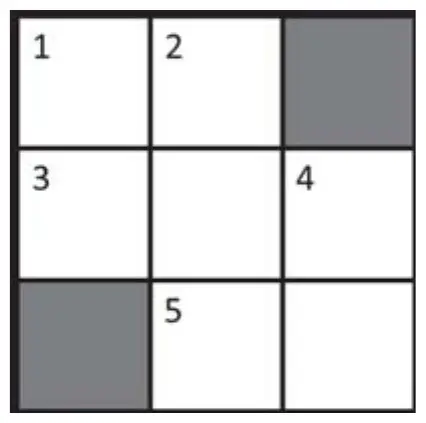
15. Each square in this cross-number can be filled with a non-zero digit such that all of the conditions in the clues are fulfilled. The digits used are not necessarily distinct.

A 3 by 3 cross-number grid with the top-right and bottom-left squares shaded; squares numbered 1, 2, 3, 4 and 5
ACROSSDOWN
1.A square1.4 down minus eleven
3.The answer to this
Kangaroo question
2.One less than a cube
5.A square4.The highest common factor
of 1 down and 4 down is
greater than one

Senior Kangaroo 2017, Question 15. © UK Mathematics Trust. Original paper on ukmt.org.uk

SK 2017 Q14

14. The set \(S\) is given by \(S = \{1,\ 2,\ 3,\ 4,\ 5,\ 6\}\). A non-empty subset \(T\) of \(S\) has the property that it contains no pair of integers that share a common factor other than 1. How many distinct possibilities are there for \(T\)?

Senior Kangaroo 2017, Question 14. © UK Mathematics Trust. Original paper on ukmt.org.uk

SK 2017 Q13

SKCurrent spec5 marksFactors, Primes & Digits

13. In the expression \(\dfrac{k.a.n.g.a.r.o.o}{g.a.m.e}\), different letters stand for different non-zero digits but the same letter always stands for the same digit. What is the smallest possible integer value of the expression?

Senior Kangaroo 2017, Question 13. © UK Mathematics Trust. Original paper on ukmt.org.uk

SK 2017 Q6

6. Winnie wrote all the integers from 1 to 2017 inclusive on a board. She then erased all the integers that are a multiple of 3. Next she reinstated all those integers that are a multiple of 6. Finally she erased all integers then on the board which are a multiple of 27. Of the 2017 integers that began in the list, how many are now missing?

Senior Kangaroo 2017, Question 6. © UK Mathematics Trust. Original paper on ukmt.org.uk

SK 2017 Q3

3. All three-digit positive integers whose digit sum is 5 are listed in ascending order. What is the median of this list?

Senior Kangaroo 2017, Question 3. © UK Mathematics Trust. Original paper on ukmt.org.uk

SK 2016 Q19

SKCurrent spec5 marksFactors, Primes & Digits

19. Erin lists all three-digit primes that are 21 less than a square. What is the mean of the numbers in Erin's list?

Senior Kangaroo 2016, Question 19. © UK Mathematics Trust. Original paper on ukmt.org.uk

SK 2016 Q14

14. The lengths of the sides of a triangle are the integers 13, \(x\), \(y\). It is given that \(xy = 105\). What is the length of the perimeter of the triangle?

Senior Kangaroo 2016, Question 14. © UK Mathematics Trust. Original paper on ukmt.org.uk

SK 2016 Q13

SKCurrent spec5 marksAlgebraFactors, Primes & Digits

13. This year, 2016, can be written as the sum of two positive integers \(p\) and \(q\) where \(2p = 5q\) (as \(2016 = 1440 + 576\)). How many years between 2000 and 3000 inclusive have this property?

Senior Kangaroo 2016, Question 13. © UK Mathematics Trust. Original paper on ukmt.org.uk

SK 2016 Q10

10. Consider the expression \(1 * 2 * 3 * 4 * 5 * 6\).
Each star in the expression is to be replaced with either ‘+’ or ‘×’.
\(N\) is the largest possible value of the expression. What is the largest prime factor of \(N\)?

Senior Kangaroo 2016, Question 10. © UK Mathematics Trust. Original paper on ukmt.org.uk

SK 2016 Q7

SKCurrent spec5 marksFactors, Primes & Digits

7. Bav is counting the edges on a particular prism. The prism has more than 310 edges, it has fewer than 320 edges and its number of edges is odd. How many edges does the prism have?

Senior Kangaroo 2016, Question 7. © UK Mathematics Trust. Original paper on ukmt.org.uk

SK 2016 Q4

4. How many four-digit numbers formed only of odd digits are divisible by five?

Senior Kangaroo 2016, Question 4. © UK Mathematics Trust. Original paper on ukmt.org.uk

SK 2015 Q20

SKCurrent spec5 marksFactors, Primes & Digits

20. The number \(N = 3^{16} - 1\) has a divisor of 193. It also has some divisors between 75 and 85 inclusive. What is the sum of these divisors?

Senior Kangaroo 2015, Question 20. © UK Mathematics Trust. Original paper on ukmt.org.uk

SK 2015 Q15

SKCurrent spec5 marksFactors, Primes & Digits

15. The 5-digit number ‘\(XX4XY\)’ is exactly divisible by 165. What is the value of \(X + Y\)?

Senior Kangaroo 2015, Question 15. © UK Mathematics Trust. Original paper on ukmt.org.uk

MOG 2020 Q3

MOGCurrent spec10 marksAlgebraFactors, Primes & Digits
3.
(a)

The expression \(10xy - 2x + 5y - 1\) factorises as \((ax + b)(cy + d)\) where \(a, b, c, d\) are integers and \(a > 0\). Find the values of \(a, b, c, d\).(1 mark)

(b)

Using the factorisation above and considering factor pairs of 99, find all integer pairs \((x, y)\) such that \(10xy - 2x + 5y = 100\).
Enter \(y\) values only on the answer sheet.(4 marks)

(c)

Find all integer pairs \((x, y)\) such that \(10xy - 2x + 5y = 100000001\).
Enter \(y\) values only on the answer sheet.(5 marks)

Mathematical Olympiad for Girls 2020, Question 3. © UK Mathematics Trust. Original paper on ukmt.org.uk

MOG 2020 Q1

1.
(a)

Let \(p\) and \(q\) be different prime numbers, and let \(a = p^2\), \(b = pq\) and \(c = p^3q\).
Which of \(ab\), \(bc\) and \(ca\) is a square number?(1 mark)

Halle would like to place nine of the ten integers \(1, 2, \ldots, 9, 10\) into the cells of a \(3 \times 3\) grid in such a way that the three numbers within each row are written in increasing order from left to right and the product of the three numbers within each row is equal to a square number.

(b)

Give an example showing that Halle’s task is possible.(4 marks)

(c)

How many different grids can Halle produce?(5 marks)

Mathematical Olympiad for Girls 2020, Question 1. © UK Mathematics Trust. Original paper on ukmt.org.uk

MOG 2019 Q3

3.
(a)

Seth wants to know how many positive whole numbers from one to one hundred are divisible by two or five. He thinks that the answer is 70 because there are fifty multiples of two and twenty multiples of five from one to one hundred. Explain why his answer is too large.(2 marks)

(b)

Consider the list of 1800 fractions\[\frac{1}{1800}, \frac{2}{1800}, \dots, \frac{1799}{1800}, \frac{1800}{1800}.\]How many are not in simplest form? Explain your reasoning.(8 marks)

[Note: The fraction \(\frac{900}{1800}\) is not in simplest form because it can be simplified to \(\frac{1}{2}\).]

Mathematical Olympiad for Girls 2019, Question 3. © UK Mathematics Trust. Original paper on ukmt.org.uk

MOG 2018 Q1

MOGCurrent spec10 marksAlgebraFactors, Primes & Digits
1.
(a)

Write down the full factorisation of the expression \(a^2 - b^2\).

(i)

Show that 359999 is not prime.

(ii)

Show that 249919 is not prime.

Hint You can use your factorisation of \(a^2 - b^2\) if you like.(5 marks)

(b)

Write down the full factorisation of \(a^2 + 2ab + b^2\).

(i)

Show that 9006001 is not prime.

(ii)

Show that 11449 is not prime.

(5 marks)

Mathematical Olympiad for Girls 2018, Question 1. © UK Mathematics Trust. Original paper on ukmt.org.uk

MOG 2017 Q5

5.

Claire and Stuart play a game called Nifty Nines:

(i)

they take turns to choose one number at a time, with Claire choosing first;

(ii)

numbers can only be chosen from the integers 1 to 5 inclusive;

(iii)

the game ends when \(n\) numbers have been chosen (repetitions are permitted).

Stuart wins the game if the sum of the chosen numbers is a multiple of 9, otherwise Claire wins.

Find all values of \(n\) for which Claire can ensure a win, whatever Stuart’s choices were. You must prove that you have found them all.

Mathematical Olympiad for Girls 2017, Question 5. © UK Mathematics Trust. Original paper on ukmt.org.uk

MOG 2017 Q4

MOGCurrent spec10 marksAlgebraFactors, Primes & Digits
4.

Let \(n\) be an odd integer greater than 3 and let \(M = n^2 + 2n - 7\).

Prove that, for all such \(n\), at least four different positive integers (excluding 1 and \(M\)) divide \(M\) exactly.

Mathematical Olympiad for Girls 2017, Question 4. © UK Mathematics Trust. Original paper on ukmt.org.uk

MOG 2017 Q2

2.

A positive integer is said to be jiggly if it has four digits, all non-zero, and no matter how you arrange those digits you always obtain a multiple of 12.

How many jiggly positive integers are there?

Mathematical Olympiad for Girls 2017, Question 2. © UK Mathematics Trust. Original paper on ukmt.org.uk

MOG 2016 Q5

5.

Alia, Bella and Catherine are multiplying fractions, aiming to obtain integers. Each of them can multiply as many fractions as she likes (including just one), and can use the same fraction more than once.

Alia’s fractions are of the form \(\dfrac{n + 1}{n}\), where \(n\) is a positive integer.

Bella’s fractions are of the form \(\dfrac{6p - 5}{3p + 6}\), where \(p\) is a positive integer.

Catherine’s fractions are of the form \(\dfrac{4q - 1}{2q + 1}\), where \(q\) is a positive integer.

Which integers can each of them obtain?

Mathematical Olympiad for Girls 2016, Question 5. © UK Mathematics Trust. Original paper on ukmt.org.uk

MOG 2015 Q5

5.
(a)

The integer \(N\) is a square. Find, with proof, all possible remainders when \(N\) is divided by 16.

(b)

Find all positive integers \(m\) and \(n\) such that\[m! + 76 = n^2.\]

[The notation \(m!\) stands for the factorial of \(m\), that is, \(m! = m \times (m - 1) \times \dots \times 2 \times 1\).
For example, \(4! = 4 \times 3 \times 2 \times 1\).]

Mathematical Olympiad for Girls 2015, Question 5. © UK Mathematics Trust. Original paper on ukmt.org.uk

BMO1 2020 Q6

6.

Given that an integer \(n\) is the sum of two different powers of 2 and also the sum of two different Mersenne primes, prove that \(n\) is the sum of two different square numbers.

(A Mersenne prime is a prime number which is one less than a power of two.)

British Mathematical Olympiad Round 1 2020, Question 6. © UK Mathematics Trust. Original paper on ukmt.org.uk

BMO1 2020 Q4

4.

In the equation\[\mathsf{A}^{\mathsf{AA}} + \mathsf{AA} = \mathsf{B{,}BBC{,}DED{,}BEE{,}BBB{,}BBE}\]the letters \(\mathsf{A}\), \(\mathsf{B}\), \(\mathsf{C}\), \(\mathsf{D}\) and \(\mathsf{E}\) represent different base 10 digits (so the right hand side is a sixteen digit number and \(\mathsf{AA}\) is a two digit number). Given that \(\mathsf{C} = 9\), find \(\mathsf{A}\), \(\mathsf{B}\), \(\mathsf{D}\) and \(\mathsf{E}\).

British Mathematical Olympiad Round 1 2020, Question 4. © UK Mathematics Trust. Original paper on ukmt.org.uk

BMO1 2019 Q4

4.

There are 2019 penguins waddling towards their favourite restaurant. As the penguins arrive, they are handed tickets numbered in ascending order from 1 to 2019, and told to join the queue. The first penguin starts the queue. For each \(n > 1\) the penguin holding ticket number \(n\) finds the greatest \(m < n\) which divides \(n\) and enters the queue directly behind the penguin holding ticket number \(m\). This continues until all 2019 penguins are in the queue.

(a)

How many penguins are in front of the penguin with ticket number 2?

(b)

What numbers are on the tickets held by the penguins just in front of and just behind the penguin holding ticket 33?

British Mathematical Olympiad Round 1 2019, Question 4. © UK Mathematics Trust. Original paper on ukmt.org.uk

BMO1 2019 Q1

BMO1Current spec10 marksFactors, Primes & Digits
1.

Show that there are at least three prime numbers \(p\) less than 200 for which \(p + 2\), \(p + 6\), \(p + 8\) and \(p + 12\) are all prime. Show also that there is only one prime number \(q\) for which \(q + 2\), \(q + 6\), \(q + 8\), \(q + 12\) and \(q + 14\) are all prime.

British Mathematical Olympiad Round 1 2019, Question 1. © UK Mathematics Trust. Original paper on ukmt.org.uk

BMO1 2018 Q6

6.

Ada the ant starts at a point \(O\) on a plane. At the start of each minute she chooses North, South, East or West, and marches 1 metre in that direction. At the end of 2018 minutes she finds herself back at \(O\). Let \(n\) be the number of possible journeys which she could have made. What is the highest power of 10 which divides \(n\)?

British Mathematical Olympiad Round 1 2018, Question 6. © UK Mathematics Trust. Original paper on ukmt.org.uk

BMO1 2018 Q2

2.

For each positive integer \(n \ge 3\), we define an \(n\)-ring to be a circular arrangement of \(n\) (not necessarily different) positive integers such that the product of every three neighbouring integers is \(n\). Determine the number of integers \(n\) in the range \(3 \le n \le 2018\) for which it is possible to form an \(n\)-ring.

British Mathematical Olympiad Round 1 2018, Question 2. © UK Mathematics Trust. Original paper on ukmt.org.uk

BMO1 2018 Q1

1.

A list of five two-digit positive integers is written in increasing order on a blackboard. Each of the five integers is a multiple of 3, and each digit 0,1,2,3,4,5,6,7,8,9 appears exactly once on the blackboard. In how many ways can this be done? Note that a two-digit number cannot begin with the digit 0.

British Mathematical Olympiad Round 1 2018, Question 1. © UK Mathematics Trust. Original paper on ukmt.org.uk

BMO2 2018 Q3

BMO2Current spec10 marksAlgebraFactors, Primes & Digits
3.

It is well known that, for each positive integer \(n\),\[1^3 + 2^3 + \cdots + n^3 = \frac{n^2(n + 1)^2}{4}\]and so is a square. Determine whether or not there is a positive integer \(m\) such that\[(m + 1)^3 + (m + 2)^3 + \cdots + (2m)^3\]is a square.

British Mathematical Olympiad Round 2 2018, Question 3. © UK Mathematics Trust. Original paper on ukmt.org.uk

BMO2 2018 Q2

2.

There are \(n\) places set for tea around a circular table, and every place has a small cake on a plate. Alice arrives first, sits at the table, and eats her cake (but it isn’t very nice). Next the Mad Hatter arrives, and tells Alice that she will have a lonely tea party, and that she must keep on changing her seat, and each time she must eat the cake in front of her (if it has not yet been eaten). In fact the Mad Hatter is very bossy, and tells Alice that, for \(i = 1, 2, \ldots, n - 1\), when she moves for the \(i\)-th time, she must move \(a_i\) places and he hands Alice the list of instructions \(a_1, a_2, \ldots, a_{n-1}\). Alice does not like the cakes, and she is free to choose, at every stage, whether to move clockwise or anticlockwise. For which values of \(n\) can the Mad Hatter force Alice to eat all the cakes?

British Mathematical Olympiad Round 2 2018, Question 2. © UK Mathematics Trust. Original paper on ukmt.org.uk