Number & Arithmetic

Your progress
0 of 77 done
Ticks are kept only in this browser: clearing your browsing data or changing device loses them. · ·

Senior Mathematical Challenge (SMC)

Senior Kangaroo (SK)

Mathematical Olympiad for Girls (MOG)

British Mathematical Olympiad Round 1 (BMO1)

British Mathematical Olympiad Round 2 (BMO2)

SMC 2020 Q5

SMCCurrent spec4 marksNumber & Arithmetic

5. What is \(\sqrt{123454321}\)?

  1. A 1111111
  2. B 111111
  3. C 11111
  4. D 1111
  5. E 111

Senior Mathematical Challenge 2020, Question 5. © UK Mathematics Trust. Original paper on ukmt.org.uk

SMC 2020 Q4

SMCCurrent spec4 marksAlgebraNumber & Arithmetic

4. The numbers \(p\), \(q\), \(r\) and \(s\) satisfy the equations \(p = 2\), \(p \times q = 20\), \(p \times q \times r = 202\) and \(p \times q \times r \times s = 2020\).

What is the value of \(p + q + r + s\)?

  1. A 32
  2. B 32.1
  3. C 33
  4. D 33.1
  5. E 34

Senior Mathematical Challenge 2020, Question 4. © UK Mathematics Trust. Original paper on ukmt.org.uk

SMC 2019 Q24

SMCCurrent spec5 marksAlgebraNumber & Arithmetic

24. The numbers \(x\), \(y\) and \(z\) are given by \(x = \sqrt{12 - 3\sqrt{7}} - \sqrt{12 + 3\sqrt{7}}\), \(y = \sqrt{7 - 4\sqrt{3}} - \sqrt{7 + 4\sqrt{3}}\) and \(z = \sqrt{2 + \sqrt{3}} - \sqrt{2 - \sqrt{3}}\).

What is the value of \(xyz\) ?

  1. A 1
  2. B –6
  3. C –8
  4. D 18
  5. E 12

Senior Mathematical Challenge 2019, Question 24. © UK Mathematics Trust. Original paper on ukmt.org.uk

SMC 2019 Q17

SMCCurrent spec5 marksAlgebraNumber & Arithmetic

17. Jeroen writes a list of 2019 consecutive integers. The sum of his integers is 2019.

What is the product of all the integers in Jeroen’s list?

  1. A \(2019^2\)
  2. B \(\dfrac{2019 \times 2020}{2}\)
  3. C \(2^{2019}\)
  4. D 2019
  5. E 0

Senior Mathematical Challenge 2019, Question 17. © UK Mathematics Trust. Original paper on ukmt.org.uk

SMC 2019 Q11

11. For how many integer values of \(k\) is \(\sqrt{200 - \sqrt{k}}\) also an integer?

  1. A 11
  2. B 13
  3. C 15
  4. D 17
  5. E 20

Senior Mathematical Challenge 2019, Question 11. © UK Mathematics Trust. Original paper on ukmt.org.uk

SMC 2019 Q2

SMCCurrent spec4 marksNumber & Arithmetic

2. What is the value of \((2019 - (2000 - (10 - 9))) - (2000 - (10 - (9 - 2019)))\)?

  1. A 4040
  2. B 40
  3. C \(-400\)
  4. D \(-4002\)
  5. E \(-4020\)

Senior Mathematical Challenge 2019, Question 2. © UK Mathematics Trust. Original paper on ukmt.org.uk

SMC 2019 Q1

SMCCurrent spec4 marksAlgebraNumber & Arithmetic

1. What is the value of \(123^2 - 23^2\)?

  1. A 10 000
  2. B 10 409
  3. C 12 323
  4. D 14 600
  5. E 15 658

Senior Mathematical Challenge 2019, Question 1. © UK Mathematics Trust. Original paper on ukmt.org.uk

SMC 2018 Q18

18. \(P\), \(Q\) and \(R\) are the three angles of a triangle, when each has been rounded to the nearest degree.

Which of the following is the complete list of possible values of \(P + Q + R\)?

  1. A 179°, 180° or 181°
  2. B 180°, 181° or 182°
  3. C 178°, 179° or 180°
  4. D 180°
  5. E 178°, 179°, 180°, 181° or 182°

Senior Mathematical Challenge 2018, Question 18. © UK Mathematics Trust. Original paper on ukmt.org.uk

SMC 2018 Q6

6. Which of the following is equal to \(25 \times 15 \times 9 \times 5.4 \times 3.24\)?

  1. A \(3^9\)
  2. B \(3^{10}\)
  3. C \(3^{11}\)
  4. D \(3^{14}\)
  5. E \(3^{17}\)

Senior Mathematical Challenge 2018, Question 6. © UK Mathematics Trust. Original paper on ukmt.org.uk

SMC 2017 Q8

SMCCurrent spec4 marksNumber & Arithmetic

8. When evaluated, which of the following is not an integer?

  1. A \(1^{-1}\)
  2. B \(4^{-\frac{1}{2}}\)
  3. C \(6^{0}\)
  4. D \(8^{\frac{2}{3}}\)
  5. E \(16^{\frac{3}{4}}\)

Senior Mathematical Challenge 2017, Question 8. © UK Mathematics Trust. Original paper on ukmt.org.uk

SMC 2017 Q7

SMCCurrent spec4 marksNumber & Arithmetic

7. The positive integer \(k\) satisfies the equation \(\sqrt{2} + \sqrt{8} + \sqrt{18} = \sqrt{k}\). What is the value of \(k\)?

  1. A 28
  2. B 36
  3. C 72
  4. D 128
  5. E 288

Senior Mathematical Challenge 2017, Question 7. © UK Mathematics Trust. Original paper on ukmt.org.uk

SMC 2017 Q5

SMCCurrent spec4 marksNumber & Arithmetic

5. One light-year is nearly \(6 \times 10^{12}\) miles. In 2016, the Hubble Space Telescope set a new cosmic record, observing a galaxy 13.4 thousand million light-years away.
Roughly how many miles is that?

  1. A \(8 \times 10^{20}\)
  2. B \(8 \times 10^{21}\)
  3. C \(8 \times 10^{22}\)
  4. D \(8 \times 10^{23}\)
  5. E \(8 \times 10^{24}\)

Senior Mathematical Challenge 2017, Question 5. © UK Mathematics Trust. Original paper on ukmt.org.uk

SMC 2017 Q3

3. The five integers 2, 5, 6, 9, 14 are arranged into a different order. In the new arrangement, the sum of the first three integers is equal to the sum of the last three integers. What is the middle number in the new arrangement?

  1. A 2
  2. B 5
  3. C 6
  4. D 9
  5. E 14

Senior Mathematical Challenge 2017, Question 3. © UK Mathematics Trust. Original paper on ukmt.org.uk

SMC 2016 Q16

SMCCurrent spec5 marksAlgebraNumber & Arithmetic

16. For which value of \(k\) is \(\sqrt{2016} + \sqrt{56}\) equal to \(14^k\)?

  1. A \(\tfrac{1}{2}\)
  2. B \(\tfrac{3}{4}\)
  3. C \(\tfrac{5}{4}\)
  4. D \(\tfrac{3}{2}\)
  5. E \(\tfrac{5}{2}\)

Senior Mathematical Challenge 2016, Question 16. © UK Mathematics Trust. Original paper on ukmt.org.uk

SMC 2016 Q7

SMCCurrent spec4 marksNumber & Arithmetic

7. Which of these has the smallest value?

  1. A \(2016^{-1}\)
  2. B \(2016^{-1/2}\)
  3. C \(2016^{0}\)
  4. D \(2016^{1/2}\)
  5. E \(2016^{1}\)

Senior Mathematical Challenge 2016, Question 7. © UK Mathematics Trust. Original paper on ukmt.org.uk

SMC 2016 Q1

1. How many times does the digit 9 appear in the answer to \(987654321 \times 9\)?

  1. A 0
  2. B 1
  3. C 5
  4. D 8
  5. E 9

Senior Mathematical Challenge 2016, Question 1. © UK Mathematics Trust. Original paper on ukmt.org.uk

SMC 2015 Q10

SMCCurrent spec4 marksAlgebraNumber & Arithmetic

10. The positive integer \(n\) is between 1 and 20. Milly adds up all the integers from 1 to \(n\) inclusive. Billy adds up all the integers from \(n + 1\) to 20 inclusive. Their totals are the same. What is the value of \(n\)?

  1. A 11
  2. B 12
  3. C 13
  4. D 14
  5. E 15

Senior Mathematical Challenge 2015, Question 10. © UK Mathematics Trust. Original paper on ukmt.org.uk

SMC 2015 Q1

SMCCurrent spec4 marksAlgebraNumber & Arithmetic

1. What is \(2015^2 - 2016 \times 2014\)?

  1. A −2015
  2. B −1
  3. C 0
  4. D 1
  5. E 2015

Senior Mathematical Challenge 2015, Question 1. © UK Mathematics Trust. Original paper on ukmt.org.uk

SMC 2014 Q24

SMCCurrent spec5 marksNumber & Arithmetic

24. Which of the following is smallest?

  1. A \(10 - 3\sqrt{11}\)
  2. B \(8 - 3\sqrt{7}\)
  3. C \(5 - 2\sqrt{6}\)
  4. D \(9 - 4\sqrt{5}\)
  5. E \(7 - 4\sqrt{3}\)

Senior Mathematical Challenge 2014, Question 24. © UK Mathematics Trust. Original paper on ukmt.org.uk

SMC 2014 Q6

SMCCurrent spec4 marksAlgebraNumber & Arithmetic

6. In the addition sum shown, each of the letters \(T\), \(H\), \(I\) and \(S\) represents a non-zero digit.
What is \(T + H + I + S\)?

  1. A 34
  2. B 22
  3. C 15
  4. D 9
  5. E 7
\(\begin{array}{ccccc} & T & H & I & S\\ + & & & I & S\\ \hline & 2 & 0 & 1 & 4\\ \hline \end{array}\)

Senior Mathematical Challenge 2014, Question 6. © UK Mathematics Trust. Original paper on ukmt.org.uk

SMC 2014 Q3

3. December 31st 1997 was a Wednesday. How many Wednesdays were there in 1997?

  1. A 12
  2. B 51
  3. C 52
  4. D 53
  5. E 365

Senior Mathematical Challenge 2014, Question 3. © UK Mathematics Trust. Original paper on ukmt.org.uk

SMC 2013 Q7

SMCCurrent spec4 marksNumber & Arithmetic

7. In a ‘ninety nine’ shop, all items cost a number of pounds and 99 pence. Susanna spent £65.76. How many items did she buy?

  1. A 23
  2. B 24
  3. C 65
  4. D 66
  5. E 76

Senior Mathematical Challenge 2013, Question 7. © UK Mathematics Trust. Original paper on ukmt.org.uk

SMC 2013 Q3

3. What is the ‘tens’ digit of \(2013^2 - 2013\)?

  1. A 0
  2. B 1
  3. C 4
  4. D 5
  5. E 6

Senior Mathematical Challenge 2013, Question 3. © UK Mathematics Trust. Original paper on ukmt.org.uk

SMC 2013 Q1

SMCCurrent spec4 marksNumber & Arithmetic

1. Which of these is the largest number?

  1. A \(2 + 0 + 1 + 3\)
  2. B \(2 \times 0 + 1 + 3\)
  3. C \(2 + 0 \times 1 + 3\)
  4. D \(2 + 0 + 1 \times 3\)
  5. E \(2 \times 0 \times 1 \times 3\)

Senior Mathematical Challenge 2013, Question 1. © UK Mathematics Trust. Original paper on ukmt.org.uk

SMC 2012 Q5

5. All six digits of three 2-digit numbers are different. What is the largest possible sum of three such numbers?

  1. A 237
  2. B 246
  3. C 255
  4. D 264
  5. E 273

Senior Mathematical Challenge 2012, Question 5. © UK Mathematics Trust. Original paper on ukmt.org.uk

SMC 2012 Q4

SMCCurrent spec4 marksNumber & Arithmetic

4. According to one astronomer, there are one hundred thousand million galaxies in the universe, each containing one hundred thousand million stars. How many stars is that altogether?

  1. A \(10^{13}\)
  2. B \(10^{22}\)
  3. C \(10^{100}\)
  4. D \(10^{120}\)
  5. E \(10^{121}\)

Senior Mathematical Challenge 2012, Question 4. © UK Mathematics Trust. Original paper on ukmt.org.uk

SMC 2012 Q3

SMCCurrent spec4 marksNumber & Arithmetic

3. The price of my favourite soft drink has gone up by leaps and bounds over the past ten years. In four of those years it has leapt up by 5p each year, whilst in the other six years it has bounded up by 2p each year. The drink cost 70p in 2002. How much does it cost now?

  1. A £0.77
  2. B £0.90
  3. C £0.92
  4. D £1.02
  5. E £1.05

Senior Mathematical Challenge 2012, Question 3. © UK Mathematics Trust. Original paper on ukmt.org.uk

SMC 2011 Q3

SMCCurrent spec4 marksAlgebraNumber & Arithmetic

3. The robot Lumber9 moves along the number line. Lumber9 starts at 0, takes 1 step forward (to 1), then 2 steps backward (to −1), then 3 steps forward, 4 steps backward, and so on, moving alternately forwards and backwards, one more step each time. At what number is Lumber9 after 2011 steps?

  1. A 1006
  2. B 27
  3. C 11
  4. D 0
  5. E −18

Senior Mathematical Challenge 2011, Question 3. © UK Mathematics Trust. Original paper on ukmt.org.uk

SMC 2010 Q11

11. What is the median of the following numbers?

  1. A \(9\sqrt{2}\)
  2. B \(3\sqrt{19}\)
  3. C \(4\sqrt{11}\)
  4. D \(5\sqrt{7}\)
  5. E \(6\sqrt{5}\)

Senior Mathematical Challenge 2010, Question 11. © UK Mathematics Trust. Original paper on ukmt.org.uk

SMC 2010 Q9

SMCCurrent spec4 marksAlgebraNumber & Arithmetic

9. The symbol \(\Diamond\) is defined by \(x \mathbin{\Diamond} y = x^y - y^x\). What is the value of \((2 \mathbin{\Diamond} 3) \mathbin{\Diamond} 4\)?

  1. A \(-3\)
  2. B \(-\dfrac{3}{4}\)
  3. C 0
  4. D \(\dfrac{3}{4}\)
  5. E 3

Senior Mathematical Challenge 2010, Question 9. © UK Mathematics Trust. Original paper on ukmt.org.uk

SMC 2010 Q5

5. A notice on Morecambe promenade reads: ‘It would take 20 million years to fill Morecambe Bay from a bath tap.’ Assuming that the flow from the bath tap is 6 litres a minute, what does the notice imply is the approximate capacity of Morecambe Bay in litres?

  1. A \(6 \times 10^{10}\)
  2. B \(6 \times 10^{11}\)
  3. C \(6 \times 10^{12}\)
  4. D \(6 \times 10^{13}\)
  5. E \(6 \times 10^{14}\)

Senior Mathematical Challenge 2010, Question 5. © UK Mathematics Trust. Original paper on ukmt.org.uk

SMC 2010 Q1

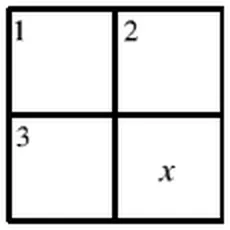
1. What is the digit \(x\) in this cross-number?

AcrossDown
1. A cube1. One less than a cube
3. A cube
  1. A 2
  2. B 3
  3. C 4
  4. D 5
  5. E 6
A 2 by 2 cross-number grid; the top left cell is numbered 1, the top right 2, the bottom left 3, and the bottom right cell contains x

Senior Mathematical Challenge 2010, Question 1. © UK Mathematics Trust. Original paper on ukmt.org.uk

SMC 2009 Q11

SMCCurrent spec4 marksNumber & Arithmetic

11. For what value of \(x\) is \(\sqrt{2} + \sqrt{2} + \sqrt{2} + \sqrt{2} = 2^x\) true?

  1. A \(\tfrac{1}{2}\)
  2. B \(1\tfrac{1}{2}\)
  3. C \(2\tfrac{1}{2}\)
  4. D \(3\tfrac{1}{2}\)
  5. E \(4\tfrac{1}{2}\)

Senior Mathematical Challenge 2009, Question 11. © UK Mathematics Trust. Original paper on ukmt.org.uk

SMC 2008 Q17

SMCCurrent spec5 marksAlgebraNumber & Arithmetic

17. Andy and his younger cousin Alice both have their birthdays today. Remarkably, Andy is now the same age as the sum of the digits of the year of his birth and the same is true of Alice. How many years older than Alice is Andy?

  1. A 10
  2. B 12
  3. C 14
  4. D 16
  5. E 18

Senior Mathematical Challenge 2008, Question 17. © UK Mathematics Trust. Original paper on ukmt.org.uk

SMC 2008 Q13

13. Positive integers \(m\) and \(n\) are such that \(2^m + 2^n = 1280\). What is the value of \(m + n\)?

  1. A 14
  2. B 16
  3. C 18
  4. D 32
  5. E 640

Senior Mathematical Challenge 2008, Question 13. © UK Mathematics Trust. Original paper on ukmt.org.uk

SMC 2008 Q4

SMCCurrent spec4 marksAlgebraNumber & Arithmetic

4. In this subtraction, \(P\), \(Q\), \(R\) and \(S\) are digits. What is the value of \(P + Q + R + S\)?

  1. A 12
  2. B 14
  3. C 16
  4. D 18
  5. E 20
\(\begin{array}{ccccc} & 8 & Q & 0 & S\\ - & P & 0 & R & 2\\ \hline & 2 & 0 & 0 & 8\end{array}\)

Senior Mathematical Challenge 2008, Question 4. © UK Mathematics Trust. Original paper on ukmt.org.uk

SMC 2008 Q3

3. What is the value of \(\sqrt{\dfrac{1}{2^6} + \dfrac{1}{6^2}}\) ?

  1. A \(\dfrac{1}{10}\)
  2. B \(\dfrac{1}{9}\)
  3. C \(\dfrac{1}{3}\)
  4. D \(\dfrac{5}{24}\)
  5. E \(\dfrac{7}{24}\)

Senior Mathematical Challenge 2008, Question 3. © UK Mathematics Trust. Original paper on ukmt.org.uk

SMC 2007 Q5

SMCCurrent spec4 marksNumber & Arithmetic

5. Which of the five expressions shown has a different value from the other four?

  1. A \(2^8\)
  2. B \(4^4\)
  3. C \(8^{8/3}\)
  4. D \(16^2\)
  5. E \(32^{6/5}\)

Senior Mathematical Challenge 2007, Question 5. © UK Mathematics Trust. Original paper on ukmt.org.uk

SMC 2007 Q3

SMCCurrent spec4 marksAlgebraNumber & Arithmetic

3. What is the value of 2006 × 2008 − 2007 × 2007?

  1. A −2007
  2. B −1
  3. C 0
  4. D 1
  5. E 4 026 042

Senior Mathematical Challenge 2007, Question 3. © UK Mathematics Trust. Original paper on ukmt.org.uk

SMC 2006 Q20

SMCCurrent spec5 marksAlgebraNumber & Arithmetic

20. A positive number \(a = [a] + \{a\}\) where \([a]\) is the integer part of \(a\) and \(\{a\}\) is the fractional part of \(a\).
Given that \(x + [y] + \{z\} = 4.2\), \(y + [z] + \{x\} = 3.6\), \(z + [x] + \{y\} = 2.0\), and \(x\), \(y\), \(z > 0\), what is the value of \(\{y\}\) ?

  1. A 0.1
  2. B 0.3
  3. C 0.5
  4. D 0.7
  5. E 0.9

Senior Mathematical Challenge 2006, Question 20. © UK Mathematics Trust. Original paper on ukmt.org.uk

SMC 2006 Q10

10. The digits 1, 2, 3, 4, 5, 6, 7, 8, and 9 are to be written in the squares so that every row and every column of three squares has a total of 13.
Two numbers have already been entered. What is the value of \(n\)?

  1. A 2
  2. B 4
  3. C 6
  4. D 7
  5. E 8
9
\(n\)
5

Senior Mathematical Challenge 2006, Question 10. © UK Mathematics Trust. Original paper on ukmt.org.uk

SMC 2006 Q6

SMCCurrent spec4 marksNumber & Arithmetic

6. Which symbol should replace \(\oplus\) to make the following equation true?
\[1 \times 2 \times (3 \oplus 4 + 5) \times (6 \times 7 + 8 + 9) = 2006.\]

  1. A +
  2. B −
  3. C ÷
  4. D ×
  5. E none of these

Senior Mathematical Challenge 2006, Question 6. © UK Mathematics Trust. Original paper on ukmt.org.uk

SMC 2006 Q4

SMCCurrent spec4 marksNumber & Arithmetic

4. What is the value of \(\sqrt{2^4 + \sqrt{3^4}}\) ?

  1. A 4
  2. B \(\sqrt{20}\)
  3. C 5
  4. D 7
  5. E \(\sqrt{97}\)

Senior Mathematical Challenge 2006, Question 4. © UK Mathematics Trust. Original paper on ukmt.org.uk

SMC 2005 Q25

SMCCurrent spec5 marksAlgebraNumber & Arithmetic

25. Which of the following is equal to \(\dfrac{1}{\sqrt{2005 + \sqrt{2005^2 - 1}}}\) ?

  1. A \(\sqrt{1003} - \sqrt{1002}\)
  2. B \(\sqrt{1005} - \sqrt{1004}\)
  3. C \(\sqrt{1007} - \sqrt{1005}\)
  4. D \(\sqrt{2005} - \sqrt{2003}\)
  5. E \(\sqrt{2007} - \sqrt{2005}\)

Senior Mathematical Challenge 2005, Question 25. © UK Mathematics Trust. Original paper on ukmt.org.uk

SMC 2005 Q8

8. An examination paper is made by taking 5 large sheets of paper, folding the pile in half and stapling it. The pages are then numbered in order from 1 to 20. What is the sum of the three page numbers that are on the same sheet of paper as page number 5?

  1. A 13
  2. B 21
  3. C 33
  4. D 37
  5. E 41

Senior Mathematical Challenge 2005, Question 8. © UK Mathematics Trust. Original paper on ukmt.org.uk

SMC 2005 Q3

3. What is the mean of the five numbers \(1^5\), \(2^4\), \(3^3\), \(4^2\) and \(5^1\) ?

  1. A 6.2
  2. B 11.4
  3. C 12.2
  4. D 13
  5. E 13.8

Senior Mathematical Challenge 2005, Question 3. © UK Mathematics Trust. Original paper on ukmt.org.uk

SMC 2005 Q2

SMCCurrent spec4 marksAlgebraNumber & Arithmetic

2. The number 2005 is the sum of a sequence of five consecutive positive integers. Which of the following numbers occurs in this sequence?

  1. A 395
  2. B 400
  3. C 405
  4. D 410
  5. E 415

Senior Mathematical Challenge 2005, Question 2. © UK Mathematics Trust. Original paper on ukmt.org.uk

SK 2020 Q12

SKCurrent spec5 marksAlgebraNumber & Arithmetic

12. What is the value of \(\sqrt{20212020 \times 20202021 - 20212021 \times 20202020}\) ?

Senior Kangaroo 2020, Question 12. © UK Mathematics Trust. Original paper on ukmt.org.uk

SK 2020 Q5

SKCurrent spec5 marksAlgebraNumber & Arithmetic

5. Let \(a^b = \tfrac{1}{8}\). What is the value of \(a^{-3b}\)?

Senior Kangaroo 2020, Question 5. © UK Mathematics Trust. Original paper on ukmt.org.uk

SK 2020 Q3

3. How many distinct integer solutions \((x, y)\) are there to the equation \(5^1 + 4^2 + 3^3 + 2^4 = x^y\)?

Senior Kangaroo 2020, Question 3. © UK Mathematics Trust. Original paper on ukmt.org.uk

SK 2020 Q1

SKCurrent spec5 marksNumber & Arithmetic

1. What is the difference between the greatest and the least of the following five quantities?

\(20 + 20\)   \(20 \times 20\)   \(202 + 0\)   \(\left(2^0\right)^{\left(2^0\right)}\)   \(20 + 2 + 0\)

Senior Kangaroo 2020, Question 1. © UK Mathematics Trust. Original paper on ukmt.org.uk

SK 2019 Q15

SKCurrent spec5 marksNumber & Arithmetic

15. Five Bunchkins sit in a horizontal field. No three of the Bunchkins are sitting in a straight line. Each Bunchkin knows the four distances between her and each of the others. Each Bunchkin calculates and then announces the total of these distances. These totals are 17, 43, 56, 66 and 76. A straight line is painted joining each pair of Bunchkins. What is the total length of paint required?

Senior Kangaroo 2019, Question 15. © UK Mathematics Trust. Original paper on ukmt.org.uk

SK 2019 Q12

SKCurrent spec5 marksNumber & Arithmetic

12. What is the value of \(A^2 + B^3 + C^5\), given that:

\(A = \sqrt[3]{16\sqrt{2}}\)

\(B = \sqrt{9\sqrt[3]{9}}\)

\(C = [(\sqrt[5]{2})^2]^2\)

Senior Kangaroo 2019, Question 12. © UK Mathematics Trust. Original paper on ukmt.org.uk

SK 2019 Q10

SKCurrent spec5 marksAlgebraNumber & Arithmetic

10. What is the value of \(\sqrt{13 + \sqrt{28 + \sqrt{281}}} \times \sqrt{13 - \sqrt{28 + \sqrt{281}}} \times \sqrt{141 + \sqrt{281}}\) ?

Senior Kangaroo 2019, Question 10. © UK Mathematics Trust. Original paper on ukmt.org.uk

SK 2019 Q9

SKCurrent spec5 marksNumber & Arithmetic

9. What is the smallest three-digit number \(K\) which can be written as \(K = a^b + b^a\), where both \(a\) and \(b\) are one-digit positive integers?

Senior Kangaroo 2019, Question 9. © UK Mathematics Trust. Original paper on ukmt.org.uk

SK 2019 Q2

SKCurrent spec5 marksNumber & Arithmetic

2. When I noticed that \(2^4 = 4^2\), I tried to find other pairs of numbers with this property. Trying 2 and 16, I realised that \(2^{16}\) is larger than \(16^2\). How many times larger is \(2^{16}\)?

Senior Kangaroo 2019, Question 2. © UK Mathematics Trust. Original paper on ukmt.org.uk

SK 2018 Q4

SKCurrent spec5 marksAlgebraNumber & Arithmetic

4. In a list of five numbers, the first number is 60 and the last number is 300. The product of the first three numbers is 810 000, the product of the three in the middle is 2 430 000 and the product of the last three numbers is 8 100 000.

Which number is third in the list?

Senior Kangaroo 2018, Question 4. © UK Mathematics Trust. Original paper on ukmt.org.uk

SK 2018 Q2

SKCurrent spec5 marksAlgebraNumber & Arithmetic

2. Let \(K\) be the largest integer for which \(n^{200} < 5^{300}\). What is the value of \(10K\)?

Senior Kangaroo 2018, Question 2. © UK Mathematics Trust. Original paper on ukmt.org.uk

SK 2017 Q1

SKCurrent spec5 marksAlgebraNumber & Arithmetic

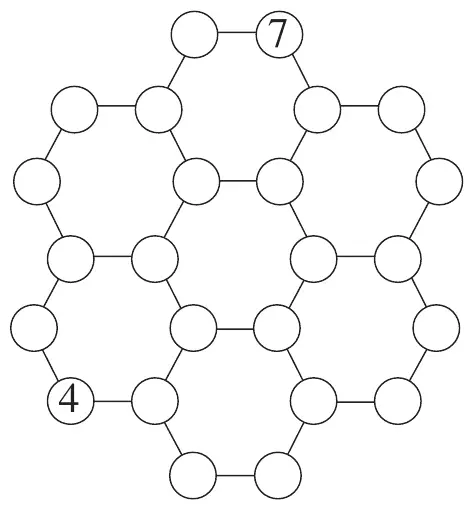
1. An integer is to be written in each circle of the network shown. The integers must be written so that the sum of the numbers at the end of each line segment is the same. Two of the integers have already been written. What is the total of all the integers in the completed diagram?

A network of 24 circles arranged in hexagons joined by line segments; one circle at the top contains 7 and one at the lower left contains 4

Senior Kangaroo 2017, Question 1. © UK Mathematics Trust. Original paper on ukmt.org.uk

SK 2016 Q17

SKCurrent spec5 marksNumber & Arithmetic

17. Students in a class take turns to practise their arithmetic skills. Initially a board contains the integers from 1 to 10 inclusive, each written ten times. On each turn a student first deletes two of the integers and then writes on the board the number that is one more than the sum of those two deleted integers. Turns are taken until there is only one number remaining on the board. Assuming no student makes a mistake, what is the remaining number?

Senior Kangaroo 2016, Question 17. © UK Mathematics Trust. Original paper on ukmt.org.uk

SK 2016 Q10

10. Consider the expression \(1 * 2 * 3 * 4 * 5 * 6\).
Each star in the expression is to be replaced with either ‘+’ or ‘×’.
\(N\) is the largest possible value of the expression. What is the largest prime factor of \(N\)?

Senior Kangaroo 2016, Question 10. © UK Mathematics Trust. Original paper on ukmt.org.uk

SK 2016 Q2

SKCurrent spec5 marksNumber & Arithmetic

2. Both rows of the following grid have the same sum. What is the value of * ?

123456789101050
11121314151617181920*

Senior Kangaroo 2016, Question 2. © UK Mathematics Trust. Original paper on ukmt.org.uk

SK 2016 Q1

SKCurrent spec5 marksNumber & Arithmetic

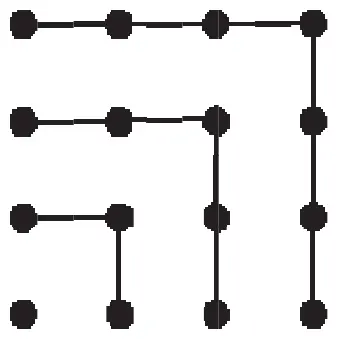
1. Using this picture we can observe that
\(1 + 3 + 5 + 7 = 4 \times 4\).
What is the value of
\(1 + 3 + 5 + 7 + 9 + 11 + 13 + 15 + 17 + 19 + 21\)?

A 4 by 4 array of dots joined into nested L-shapes containing 1, 3, 5 and 7 dots

Senior Kangaroo 2016, Question 1. © UK Mathematics Trust. Original paper on ukmt.org.uk

MOG 2020 Q5

MOGCurrent spec10 marksAlgebraNumber & Arithmetic
5.

Freya creates a sequence with first term 1 and each subsequent term 5 more than the previous term. Hilary creates a different sequence with first term \(a\) and each subsequent term 3 less than the previous term. Both sequences are continued forever.

(a)

There is at least one number that appears in both sequences. Let \(c\) be the smallest of those numbers. Find the possible values of \(c\).(3 marks)

(b)

Given that there are exactly 100 numbers which appear in both sequences, find the possible values of \(a\).

Enter the following on the answer sheet:

(i)

How many possible values of \(a\) are there?

(ii)

The smallest possible value of \(a\).

(iii)

The largest possible value of \(a\).

(7 marks)

Mathematical Olympiad for Girls 2020, Question 5. © UK Mathematics Trust. Original paper on ukmt.org.uk

MOG 2020 Q1

1.
(a)

Let \(p\) and \(q\) be different prime numbers, and let \(a = p^2\), \(b = pq\) and \(c = p^3q\).
Which of \(ab\), \(bc\) and \(ca\) is a square number?(1 mark)

Halle would like to place nine of the ten integers \(1, 2, \ldots, 9, 10\) into the cells of a \(3 \times 3\) grid in such a way that the three numbers within each row are written in increasing order from left to right and the product of the three numbers within each row is equal to a square number.

(b)

Give an example showing that Halle’s task is possible.(4 marks)

(c)

How many different grids can Halle produce?(5 marks)

Mathematical Olympiad for Girls 2020, Question 1. © UK Mathematics Trust. Original paper on ukmt.org.uk

MOG 2017 Q1

1.

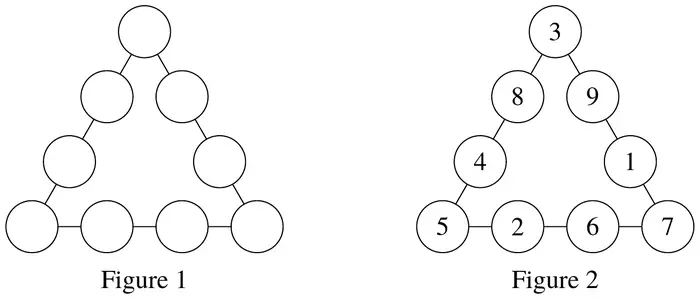
All the digits 1 to 9 are to be placed in the circles in Figure 1, one in each, so that the total of the numbers in any line of four circles is the same. In the example shown in Figure 2, the total is equal to 20.

Figure 1: nine empty circles arranged in a triangle with four circles on each side. Figure 2: the same triangle filled with 3 at the top, 8 and 9 below it, 4 and 1 below those, and 5, 2, 6, 7 along the bottom

Prove that if the total \(T\) is possible then the total \(40 - T\) is possible.

Mathematical Olympiad for Girls 2017, Question 1. © UK Mathematics Trust. Original paper on ukmt.org.uk

MOG 2015 Q5

5.
(a)

The integer \(N\) is a square. Find, with proof, all possible remainders when \(N\) is divided by 16.

(b)

Find all positive integers \(m\) and \(n\) such that\[m! + 76 = n^2.\]

[The notation \(m!\) stands for the factorial of \(m\), that is, \(m! = m \times (m - 1) \times \dots \times 2 \times 1\).
For example, \(4! = 4 \times 3 \times 2 \times 1\).]

Mathematical Olympiad for Girls 2015, Question 5. © UK Mathematics Trust. Original paper on ukmt.org.uk

BMO1 2020 Q6

6.

Given that an integer \(n\) is the sum of two different powers of 2 and also the sum of two different Mersenne primes, prove that \(n\) is the sum of two different square numbers.

(A Mersenne prime is a prime number which is one less than a power of two.)

British Mathematical Olympiad Round 1 2020, Question 6. © UK Mathematics Trust. Original paper on ukmt.org.uk

BMO1 2020 Q4

4.

In the equation\[\mathsf{A}^{\mathsf{AA}} + \mathsf{AA} = \mathsf{B{,}BBC{,}DED{,}BEE{,}BBB{,}BBE}\]the letters \(\mathsf{A}\), \(\mathsf{B}\), \(\mathsf{C}\), \(\mathsf{D}\) and \(\mathsf{E}\) represent different base 10 digits (so the right hand side is a sixteen digit number and \(\mathsf{AA}\) is a two digit number). Given that \(\mathsf{C} = 9\), find \(\mathsf{A}\), \(\mathsf{B}\), \(\mathsf{D}\) and \(\mathsf{E}\).

British Mathematical Olympiad Round 1 2020, Question 4. © UK Mathematics Trust. Original paper on ukmt.org.uk

BMO1 2020 Q1

BMO1Current spec5 marksAlgebraNumber & Arithmetic
1.

Alice and Bob take it in turns to write numbers on a blackboard. Alice starts by writing an integer \(a\) between \(-100\) and 100 inclusive on the board. On each of Bob’s turns he writes twice the number Alice wrote last. On each of Alice’s subsequent turns she writes the number 45 less than the number Bob wrote last. At some point, the number \(a\) is written on the board for a second time. Find the possible values of \(a\).

British Mathematical Olympiad Round 1 2020, Question 1. © UK Mathematics Trust. Original paper on ukmt.org.uk

BMO1 2019 Q5

5.

Six children are evenly spaced around a circular table. Initially, one has a pile of \(n > 0\) sweets in front of them, and the others have nothing. If a child has at least four sweets in front of them, they may perform the following move: eat one sweet and give one sweet to each of their immediate neighbours and to the child directly opposite them. An arrangement is called perfect if there is a sequence of moves which results in each child having the same number of sweets in front of them. For which values of \(n\) is the initial arrangement perfect?

British Mathematical Olympiad Round 1 2019, Question 5. © UK Mathematics Trust. Original paper on ukmt.org.uk

BMO2 2020 Q1

BMO2Current spec10 marksAlgebraNumber & Arithmetic
1.

A sequence \(a_1, a_2, a_3, \ldots\) has \(a_1 > 2\) and satisfies:\[a_{n+1} = \frac{a_n(a_n - 1)}{2}\]for all positive integers \(n\). For which values of \(a_1\) are all the terms of the sequence odd integers?

British Mathematical Olympiad Round 2 2020, Question 1. © UK Mathematics Trust. Original paper on ukmt.org.uk