
SK 2015 Q3
3. The diagram shows a solid with six triangular faces and five vertices. Andrew wants to write an integer at each of the vertices so that the sum of the numbers at the three vertices of each face is the same. He has already written the numbers 1 and 5 as shown.
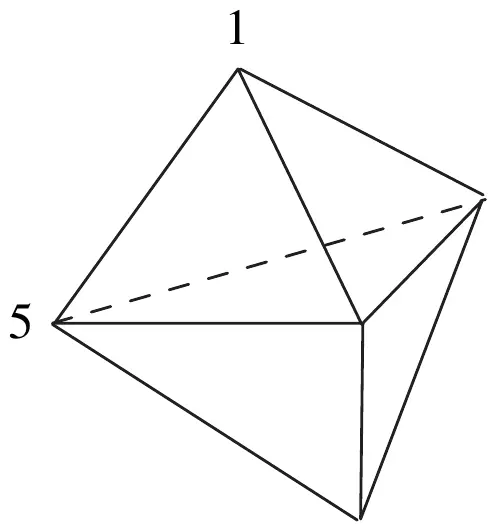
What is the sum of the other three numbers he will write?
Senior Kangaroo 2015, Question 3. © UK Mathematics Trust. Original paper on ukmt.org.uk
Answer: 11
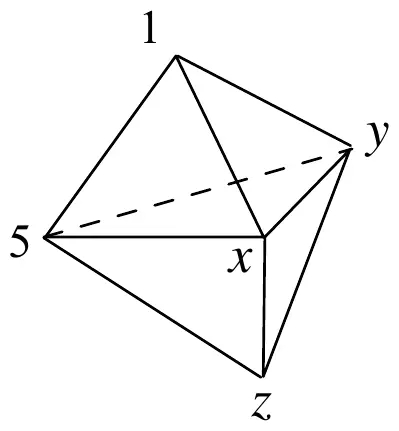
Let the three missing integers be \(x\), \(y\) and \(z\), as shown.
Consider the ‘top’ three faces. Since the sum of the three numbers at the vertices of each face is the same, we have
\[1 + 5 + x = 1 + x + y = 1 + 5 + y\]
and hence \(x = y = 5\). Therefore the sum of the numbers on a face is equal to \(5 + 5 + 1 = 11\). But \(x + y + z\) is equal to the sum of the numbers on a face. Hence the sum of the other three numbers that Andrew will write is 11.
Solution © UK Mathematics Trust, from the SK 2015 solutions.