
MOG 2019 Q4
The diagram shows a rectangle placed inside a quarter circle of radius 1, such that its vertices all lie on the perimeter of the quarter circle and one vertex coincides with the centre of the (whole) circle.
Let the perimeter of such a rectangle be \(P\).
Show that \(P = 3\) is impossible.(4 marks)
Find the largest possible value of \(P\). You must fully justify why the value that you find is the largest.
(4 marks)
Instead a rectangle is placed inside a whole circle of radius 1, such that its vertices all lie on the circumference of the circle.
If the perimeter of the rectangle is as large as possible, show that the rectangle must be a square and calculate its perimeter.(2 marks)
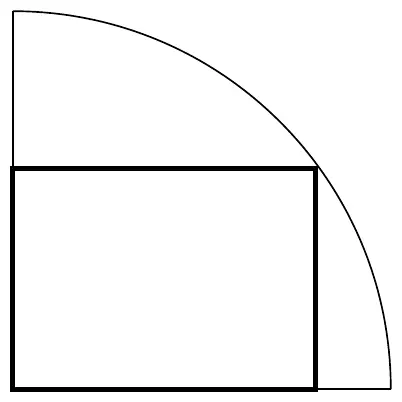
Mathematical Olympiad for Girls 2019, Question 4. © UK Mathematics Trust. Original paper on ukmt.org.uk
Answer: (b) \(2\sqrt{2}\) (c) \(4\sqrt{2}\)
Commentary
Call the sides of the rectangle \(x\) and \(y\). It seems reasonable to start by writing some equations connecting \(x\), \(y\) and \(P\). Looking at parts (a) and (b) together, it sounds like these equations will only have a solution for some values of \(P\).
One vertex of the rectangle is the centre of the circle and the opposite vertex is on the circumference, so you can use Pythagoras’s Theorem to link \(x\) and \(y\) with the radius of the circle. This means that the equation you get will be quadratic, so you can expect to use the discriminant to determine whether it has any solutions.
In part (b) you need to show two things: that the value of \(P\) cannot be larger than the one you found, but also that there is a rectangle with this value of \(P\).
In part (c), you could start again by writing equations connecting the sides and the perimeter of the second rectangle. However, if you split the circle into quarters, then each quarter has a rectangle inscribed in it in the same way as in part (b). You can therefore use the results you fond in part (b) about the largest possible value of the perimeter.
In the solution below we start by deriving the quadratic equation which will be used in all three parts.
Let \(x\) and \(y\) be the sides of the rectangle. The diagonal of the rectangle is a radius of the circle, so \(x^2 + y^2 = 1\). The perimeter of the rectangle is \(P = 2x + 2y\). Substituting \(y = \dfrac{P - 2x}{2}\) from the second equation into the first gives\[x^2 + \left(\frac{P - 2x}{2}\right)^2 = 1,\]which is equivalent to\[8x^2 - (4P)x + (P^2 - 4) = 0.\]
When \(P = 3\) this quadratic equation becomes \(8x^2 - 12x + 5 = 0\). The discriminant is \(12^2 - 4 \times 8 \times 5 = -16 < 0\) so there are no solutions for \(x\). It is therefore not possible that \(P = 3\).
We now look for values of \(P\) for which the quadratic equation \(8x^2 - (4P)x + (P^2 - 4) = 0\) has a solution. The discriminant needs to be non-negative, so we need\[(4P)^2 - 32(P^2 - 4) \ge 0.\]This is equivalent to \(16P^2 \le 128\) and, since \(P > 0\), we must have \(P \le 2\sqrt{2}\). For this value of \(P\), solving the quadratic equation gives \(x = \frac{\sqrt{2}}{2}\) and, substituting back into \(2x + 2y = 2\sqrt{2}\), \(y = \frac{\sqrt{2}}{2}\). Thus it is possible that \(P = 2\sqrt{2}\) and this is the largest possible value of \(P\).
Let the sides of the rectangle be \(2x\) and \(2y\). The diagonal of the rectangle is a diameter of the circle, so \(x^2 + y^2 = 1\). (Note that this is the same relationship between \(x\) and \(y\) as in part (b).) The perimeter of the rectangle is \(4x + 4y = 2(2x + 2y)\), which is twice the perimeter from part (b).
We know from part (b) that the largest possible value of \(2x + 2y\) is \(2\sqrt{2}\), and that this value only occurs when \(x = y = \frac{\sqrt{2}}{2}\). Therefore the largest possible value of our perimeter is \(4\sqrt{2}\) and it occurs when the sides of the rectangle are equal, i.e. when it is a square.
Solution © UK Mathematics Trust, from the MOG 2019 solutions.