
SMC 2020 Q22
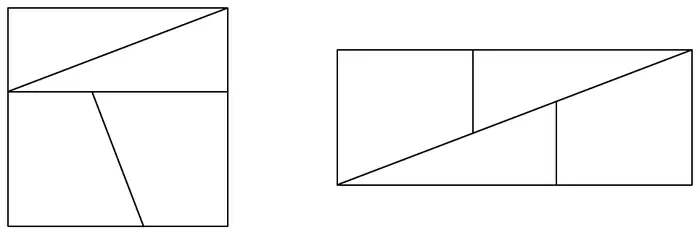
22. A square with perimeter 4 cm can be cut into two congruent right-angled triangles and two congruent trapezia as shown in the first diagram in such a way that the four pieces can be rearranged to form the rectangle shown in the second diagram.
What is the perimeter, in centimetres, of this rectangle?
- A \(2\sqrt{5}\)
- B \(4\sqrt{2}\)
- C 5
- D \(4\sqrt{3}\)
- E \(3\sqrt{7}\)
Senior Mathematical Challenge 2020, Question 22. © UK Mathematics Trust. Original paper on ukmt.org.uk
Answer: A \(2\sqrt{5}\)
The perimeter of the square is 4 therefore each side is of length 1 and the area of the square is 1. The square must be cut so that the shortest side of each triangle matches the shorter of the two parallel sides of the trapezium when the pieces are rearranged.
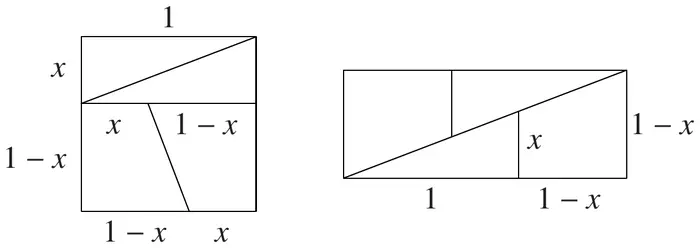
Let each of these sides be of length \(x\) and then the remaining perpendicular sides of each trapezium have length \(1 - x\) as indicated on the first diagram. The perimeter of the rectangle has length \(2 \times 1 + 4(1 - x) = 6 - 4x\).
In order to find the value of \(x\), we can consider the area of the rectangle so \((1 + 1 - x)(1 - x) = 1\). This rearranges to give \(x^2 - 3x + 1 = 0\) and therefore, of the two possible solutions, \(x = \frac{3-\sqrt{5}}{2}\) as \(x < 1\). The perimeter is \(6 - 4(\frac{3-\sqrt{5}}{2}) = 2\sqrt{5}\).
Solution © UK Mathematics Trust, from the SMC 2020 solutions. Longer versions with investigations: Solutions and investigations (PDF).