
SMC 2017 Q15
15. The diagram shows a square \(PQRS\). Points \(T\), \(U\), \(V\) and \(W\) lie on the edges of the square as shown, such that \(PT = 1\), \(QU = 2\), \(RV = 3\) and \(SW = 4\).
The area of \(TUVW\) is half that of \(PQRS\). What is the length of \(PQ\)?
- A 5
- B 6
- C 7
- D 8
- E 9
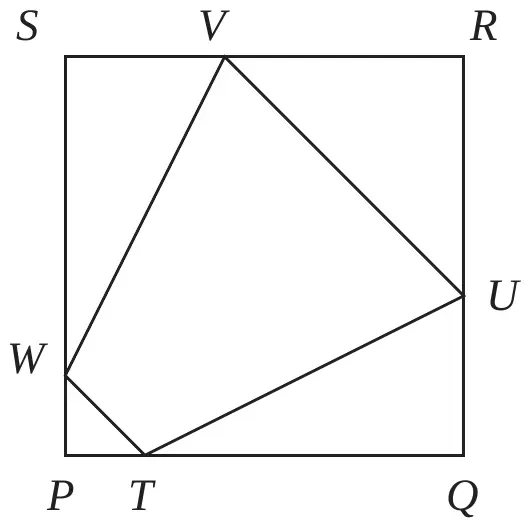
Senior Mathematical Challenge 2017, Question 15. © UK Mathematics Trust. Original paper on ukmt.org.uk
Answer: B 6
Let the length of \(PQ\) be \(x\). The sum of the areas of the four right-angled triangles is half the area of the square so
\(\tfrac{1}{2}[1 \times (x - 4)] + \tfrac{1}{2}[4 \times (x - 3)] + \tfrac{1}{2}[3 \times (x - 2)] + \tfrac{1}{2}[2 \times (x - 1)] = \tfrac{1}{2}x^2\). This gives \((x - 4) + 4(x - 3) + 3(x - 2) + 2(x - 1) = x^2\) which simplifies to \(10x - 24 = x^2\). Factorising \(x^2 - 10x + 24 = 0\) gives \((x - 6)(x - 4) = 0\) so \(x = 4\) or 6. For there to be four triangles as shown, \((x - 4) > 0\), so \(x\), the length of \(PQ\), is 6.
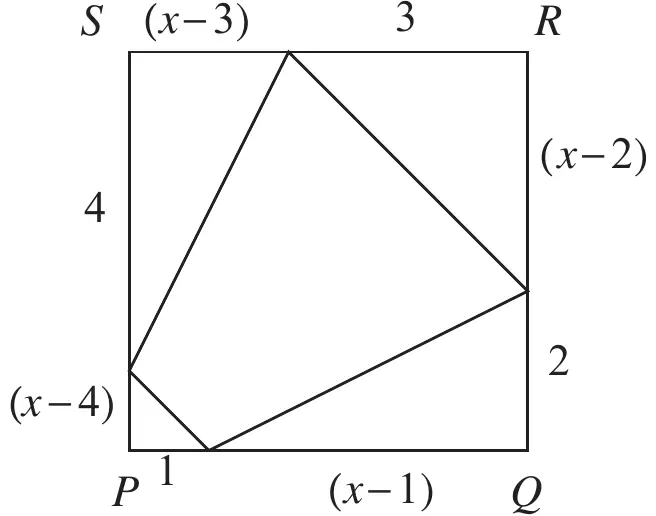
Solution © UK Mathematics Trust, from the SMC 2017 solutions. Longer versions with investigations: Solutions and investigations (PDF).