
SK 2015 Q19
19. In quadrilateral \(ABCD\), \(\angle ABC = \angle ADC = 90°\), \(AD = DC\) and \(AB + BC = 20\) cm.
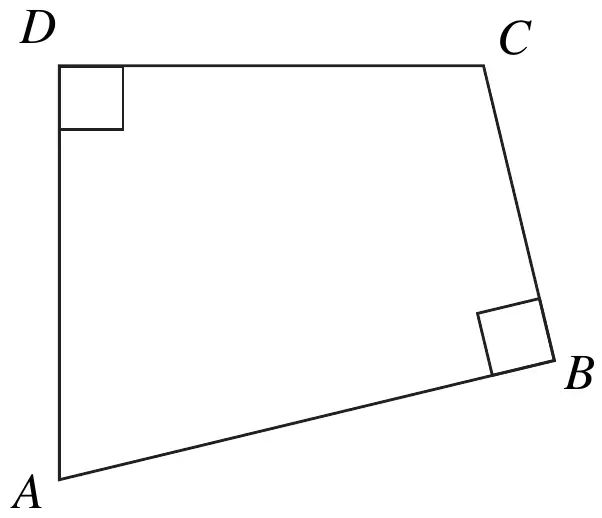
What is the area in cm2 of quadrilateral \(ABCD\)?
Senior Kangaroo 2015, Question 19. © UK Mathematics Trust. Original paper on ukmt.org.uk
Answer: 100
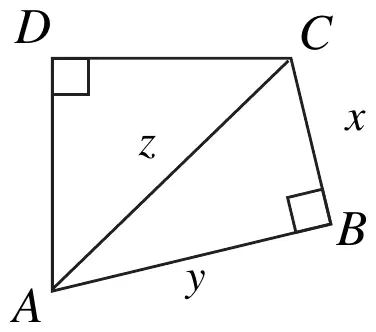
Let the lengths of \(BC\), \(AB\) and \(AC\) be \(x\), \(y\) and \(z\) centimetres respectively. Let the area of \(\triangle ACD\) be \(U\) cm2 and let the area of \(\triangle ABC\) be \(V\) cm2. Note that \(\triangle ACD\) is one quarter of the square which has \(AC\) as an edge. Hence \(U = \tfrac{1}{4}z^2\). Next, using Pythagoras, \(z^2 = x^2 + y^2 = (x + y)^2 - 2xy = 20^2 - 4V\). Hence \(U = \tfrac{1}{4}(400 - 4V) = 100 - V\). Therefore the area in cm2 of \(ABCD\) is \(U + V = 100\).
(Note: Since the answer to the problem is independent of x and y, one could observe that the given properties of quadrilateral ABCD are satisfied by a square of side 10 cm which has area 100 cm2 and conclude that this is therefore the required answer.)
Solution © UK Mathematics Trust, from the SK 2015 solutions.