
SMC 2020 Q24
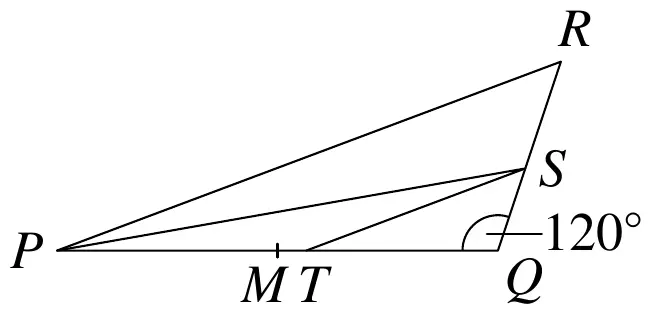
24. In the diagram shown, \(M\) is the mid-point of \(PQ\). The line \(PS\) bisects \(\angle RPQ\) and intersects \(RQ\) at \(S\). The line \(ST\) is parallel to \(PR\) and intersects \(PQ\) at T. The length of \(PQ\) is 12 and the length of \(MT\) is 1. The angle \(SQT\) is 120°.
What is the length of \(SQ\)?
- A 2
- B 3
- C 3.5
- D 4
- E 5
Senior Mathematical Challenge 2020, Question 24. © UK Mathematics Trust. Original paper on ukmt.org.uk
Answer: B 3
Triangle \(PTS\) can be shown to be isosceles as follows. Let \(\angle STQ = 2x°\). Therefore \(\angle RPT = 2x°\) as \(PR\) and \(ST\) are parallel. We can then deduce that \(\angle SPT = x°\) as \(PS\) bisects \(\angle RPQ\). Considering angles at point \(T\), \(\angle STP = 180° - 2x°\). Finally, considering angles inside triangle \(PTS\), \(\angle PST = 180° - x° - (180° - 2x°) = x° = \angle SPT\). Therefore the length of \(ST\) = the length of \(PT = \frac{12}{2} + 1 = 7\).
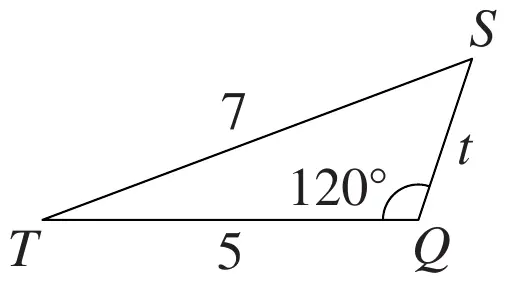
Now considering triangle \(STQ\), we have two known lengths and an angle so we can find the length of \(SQ\) using the cosine rule. Let the length of \(SQ = t\). So \(7^2 = 5^2 + t^2 - 2 \times 5 \times t \times \cos 120°\). As \(\cos 120° = -\frac{1}{2}\), this quadratic simplifies to \(t^2 + 5t - 24 = 0\) which factorises to \((t + 8)(t - 3) = 0\). As \(t > 0\), \(t = 3\).
Solution © UK Mathematics Trust, from the SMC 2020 solutions. Longer versions with investigations: Solutions and investigations (PDF).