
SMC 2020 Q25
25. A regular \(m\)-gon, a regular \(n\)-gon and a regular \(p\)-gon share a vertex and pairwise share edges, as shown in the diagram.
What is the largest possible value of \(p\)?
- A 6
- B 20
- C 42
- D 50
- E 100
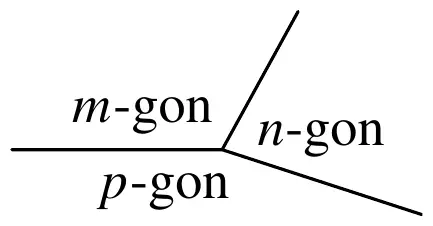
Senior Mathematical Challenge 2020, Question 25. © UK Mathematics Trust. Original paper on ukmt.org.uk
Answer: C 42
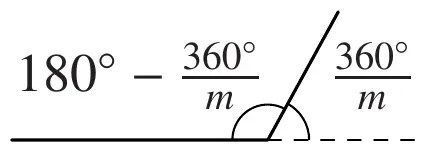
The exterior angle of the regular \(m\)-gon is \(\frac{360°}{m}\) so the interior angle is \(180° - \frac{360°}{m}\). Similarly for the \(n\)-gon and \(p\)-gon.
Possible interior angles, in order of size, are then 60°, 90°, 108°, 120°, \((180° - \frac{360°}{7})\), 135°, 140°, 144°, ... . In order to maximise \(p\), the interior angles of the \(m\)-gon and \(n\)-gon must have a sum which exceeds 180° by as little as possible. This excess gives the exterior angle of the \(p\)-gon, so must fit into 360° an exact number of times. As a starting point, note that when \((m, n) = (4, 4)\) or \((m, n) = (6, 3)\) the interior angles of the \(m\)-gon and \(n\)-gon sum to exactly 180°. By increasing exactly one of \(m\) or \(n\) in these pairs, possible candidates for pairings which will give us a sum of interior angles in excess of 180° by a suitable amount are then \((5, 4)\), \((4, 5)\), \((6, 4)\), and \((7, 3)\). The value of \(p\) is then found from \(p = \dfrac{360°}{[180° - \frac{360°}{m}] + [180° - \frac{360°}{n}] - 180°}\). Without loss, we can assume \(m \geq n\) and therefore discount \((m, n) = (4, 5)\). When \((m, n) = (5, 4)\), \(p = \frac{360°}{[180° - \frac{360°}{5}] + [180° - \frac{360°}{4}] - 180°} = \frac{360°}{18°} = 20\). As this is an integer, we don’t need to try \((m, n) = (6, 4)\) as that could only give a smaller value of \(p\). When \((m, n) = (7, 3)\), \(p = \frac{360°}{[180° - \frac{360°}{7}] + [180° - \frac{360°}{3}] - 180°} = \frac{360°}{60° - \frac{360°}{7}} = \frac{360°}{\frac{60°}{7}} = 42\). As increasing \(m\) or \(n\) or both any further could only give a smaller value of \(p\), no further pairs need to be tested. Hence the largest value of \(p\) is 42.
Solution © UK Mathematics Trust, from the SMC 2020 solutions. Longer versions with investigations: Solutions and investigations (PDF).