
SMC 2010 Q21
21. The diagram shows a regular hexagon, with sides of length 1, inside a square. Two vertices of the hexagon lie on a diagonal of the square and the other four lie on the edges.
What is the area of the square?
- A \(2 + \sqrt{3}\)
- B 4
- C \(3 + \sqrt{2}\)
- D \(1 + \dfrac{3\sqrt{3}}{2}\)
- E \(\dfrac{7}{2}\)
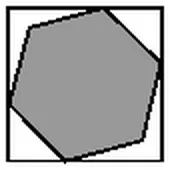
Senior Mathematical Challenge 2010, Question 21. © UK Mathematics Trust. Original paper on ukmt.org.uk
Answer: A \(2 + \sqrt{3}\)
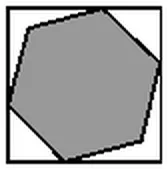
The hypotenuse of one of the small right-angled triangles is parallel to the diagonal and hence makes angles of 45°. Since the hypotenuse has length 1, the other two sides have length \(\tfrac{1}{\sqrt{2}}\), by Pythagoras' Theorem.
As the internal angle of a regular hexagon is 120°, drawing a diagonal from NW to SE forms two triangles, bottom right, each with angles 45°, 120° and 15°. (The sum of the angles in a triangle is 180°).
Let the square have length \(y\) units. Using the Sine Rule gives \(\dfrac{y - \frac{1}{\sqrt{2}}}{\sin 120°} = \dfrac{1}{\sin 45°}\).
Hence \(y - \dfrac{1}{\sqrt{2}} = \dfrac{\sqrt{3}}{2} \div \dfrac{1}{\sqrt{2}} = \dfrac{\sqrt{3}}{\sqrt{2}}\) and therefore \(y = \dfrac{\sqrt{3} + 1}{\sqrt{2}}\).
Hence the area of the square is \(y^2 = \left(\dfrac{\sqrt{3} + 1}{\sqrt{2}}\right)^2 = \dfrac{4 + 2\sqrt{3}}{2} = 2 + \sqrt{3}\).
Solution © UK Mathematics Trust, from the SMC 2010 solutions. Longer versions with investigations: Solutions and investigations (PDF).