
SMC 2010 Q23
23. The diagram shows two different semicircles inside a square with sides of length 2. The common centre of the semicircles lies on a diagonal of the square.
What is the total shaded area?
- A \(\pi\)
- B \(6\pi(3 - 2\sqrt{2})\)
- C \(\pi\sqrt{2}\)
- D \(3\pi(2 - \sqrt{2})\)
- E \(8\pi(2\sqrt{2} - 3)\)
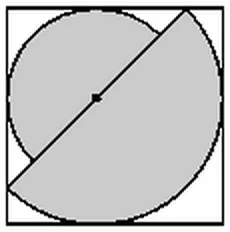
Senior Mathematical Challenge 2010, Question 23. © UK Mathematics Trust. Original paper on ukmt.org.uk
Answer: B \(6\pi(3 - 2\sqrt{2})\)
Let \(r_1\) and \(r_2\) represent the radii of the smaller and larger semicircles respectively. A vertical line through the common centre of the semicircles gives \(r_1 + r_2 = 2 \ldots (1)\). Also, together with the diameter of the larger semicircle, this line forms a right-angled, isosceles triangle giving \(\sin 45° = \dfrac{r_1}{r_2}\). Hence \(r_2 = \sqrt{2}r_1 \ldots (2)\).
Substituting (2) into (1) gives \((1 + \sqrt{2})r_1 = 2\) so that \(r_1 = 2(\sqrt{2} - 1)\).
Therefore \(r_2 = 2\sqrt{2}(\sqrt{2} - 1)\).
Hence the total shaded area is \(\tfrac{1}{2}\pi(r_1^2 + r_2^2) = \tfrac{1}{2}\pi\left[4(\sqrt{2} - 1)^2 + 8(\sqrt{2} - 1)^2\right] = 6\pi(3 - 2\sqrt{2})\).

Solution © UK Mathematics Trust, from the SMC 2010 solutions. Longer versions with investigations: Solutions and investigations (PDF).