
MOG 2015 Q2
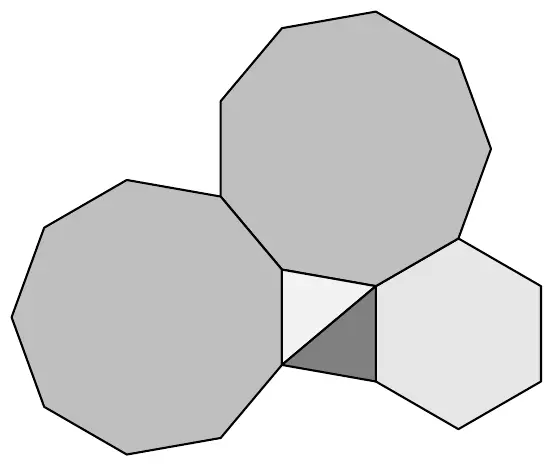
The diagram shows five polygons placed together edge-to-edge: two triangles, a regular hexagon and two regular nonagons.
Prove that each of the triangles is isosceles.
Mathematical Olympiad for Girls 2015, Question 2. © UK Mathematics Trust. Original paper on ukmt.org.uk
Commentary
A triangle is isosceles if it has two sides of equal length. There are several regular polygons in this question, so it seems reasonable to start by identifying all lines of equal length.
If this doesn’t complete the proof we can start looking at angles. If a triangle has two equal angles then it is isosceles.
We will almost certainly need to work out angles in a regular hexagon and a regular nonagon. We can do this in various ways. For example, we can find the sum of angles in a nonagon by splitting it into seven triangles (by drawing all the diagonals from one vertex). Alternatively, we can use the fact that the exterior angles of any polygon add up to \(360^\circ\); this means that in a regular \(n\)-sided polygon each exterior angle is \(360^\circ \div n\) so each interior angle is \(180^\circ - 360^\circ \div n\). We could also draw isosceles triangles with one vertex at the centre of the regular polygon. Either way, we find that each interior angle of a regular hexagon is \(120^\circ\) and each interior angle of a regular nonagon is \(140^\circ\).
It is a good idea to label some points on the diagram so you can refer to various triangles and sides.
Our alternative solution uses properties of parallel lines and parallelograms. More precisely, it uses converses of two results about parallel lines and parallelograms.
The first result is about angles on parallel lines. If two parallel lines are intersected by a third line, then the interior angles (marked \(x\) and \(y\) in the diagram) add up to \(180^\circ\).
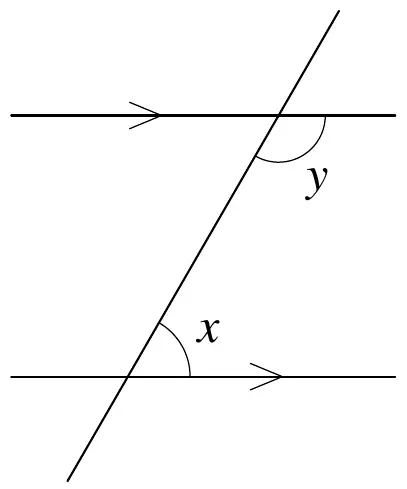
The converse of this result states that, if two lines are intersected by a third line so that angles \(x\) and \(y\) add up to \(180^\circ\), then the two lines are parallel.
The second result is about sides of a parallelogram. A parallelogram is defined as a quadrilateral with two pairs of parallel sides. One property of a parallelogram is that opposite sides are equal in length. One possible converse of this result is that, if a quadrilateral has one pair of equal and parallel sides, then it is a parallelogram.
You should note that converse statements aren’t always true. The two converse statements above are true and here you can use them without proof, although it is a good exercise to try to prove them.
Label some of the vertices, as shown in the diagram.
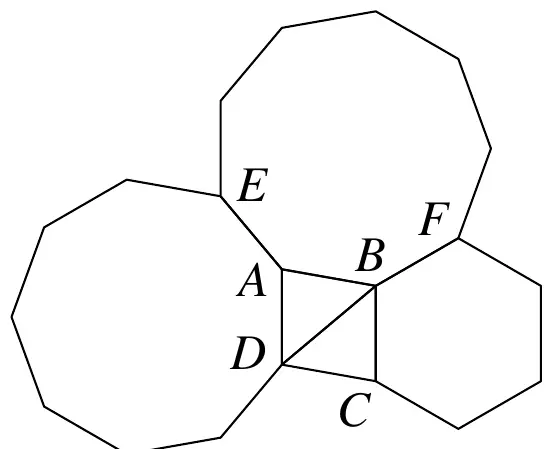
First we show that triangle \(ABD\) is isosceles.
Since the nonagons and the hexagon are regular and meet edge-to-edge„ we have\[DA = AE = AB.\]This means that triangle \(ABD\) is isosceles.
We now look at triangle \(BCD\). From the regular polygons, we find that\[BC = BF = AB,\]but we don’t know anything about sides \(CD\) and \(BD\). So let’s calculate some angles.
Each angle in a regular hexagon is \(120^\circ\) and each angle in a regular nonagon is \(140^\circ\). Therefore,\[\begin{aligned}\angle DAB &= 360^\circ - 140^\circ - 140^\circ\\ &= 80^\circ\end{aligned}\]and\[\begin{aligned}\angle ABC &= 360^\circ - 140^\circ - 120^\circ\\ &= 100^\circ.\end{aligned}\]Since we already know that the triangle \(ABD\) is isosceles, we can calculate\[\begin{aligned}\angle ABD &= \frac{180^\circ - 80^\circ}{2}\\ &= 50^\circ\end{aligned}\]and therefore\[\begin{aligned}\angle DBC &= 100^\circ - 50^\circ\\ &= 50^\circ.\end{aligned}\]
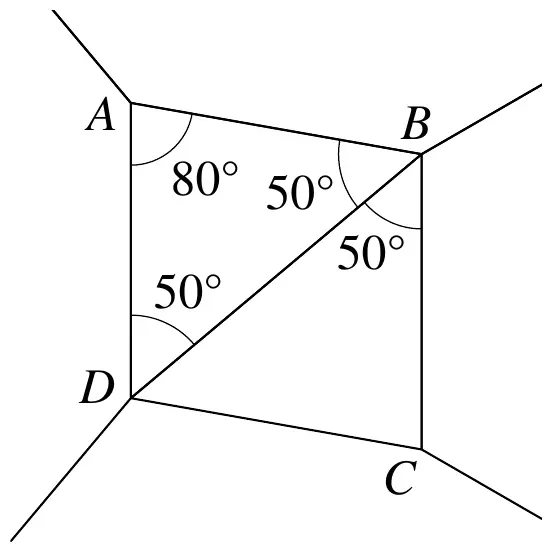
We cannot directly find any other angles in triangle \(BCD\). However, triangle \(BCD\) is congruent to triangle \(BAD\) because\[\begin{alignedat}{2}BC &= AB, &\qquad\qquad& \text{(from regular polygons)}\\ BD &= BD && \text{(common side)}\\ \text{and } \angle CBD &= \angle ABC. && \text{(each equals } 50^\circ\text{)}\end{alignedat}\]Since triangle \(BAD\) is isosceles, so is triangle \(BCD\) (with \(BC = CD\)).
Alternative
Each angle in a regular hexagon is \(120^\circ\) and each angle in a regular nonagon is \(140^\circ\). Therefore,\[\begin{aligned}\angle DAB &= 360^\circ - 140^\circ - 140^\circ\\ &= 80^\circ\end{aligned}\]and\[\begin{aligned}\angle ABC &= 360^\circ - 140^\circ - 120^\circ\\ &= 100^\circ.\end{aligned}\]
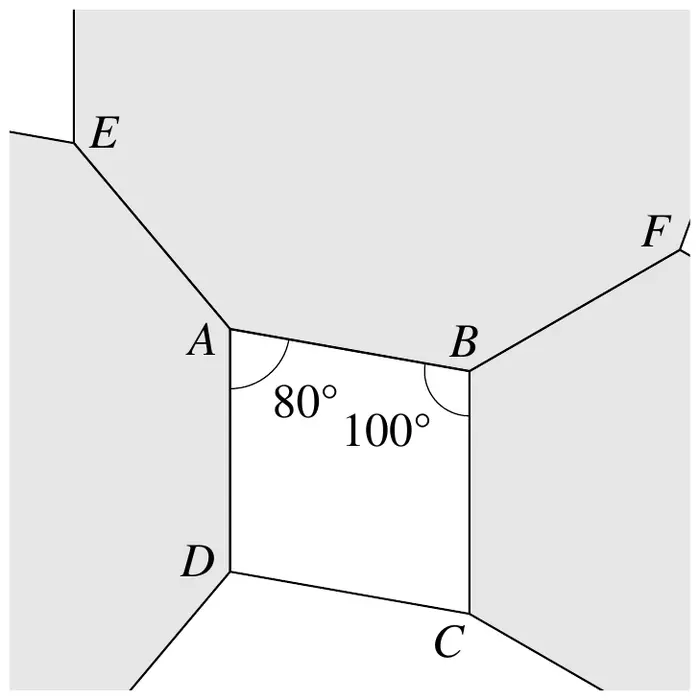
These two angles add up to \(180^\circ\) so, by the converse of internal angles on parallel lines, we find that \(AD\) and \(BC\) are parallel.
Since the nonagons and the hexagon are regular and meet edge-to-edge, we have\[AD = EA = AB = BF = BC.\]Hence \(AD\) and \(BC\) are equal and parallel. It follows that the quadrilateral \(ABCD\) is a parallelogram. Therefore the sides \(AB\) and \(CD\) are equal.
But we already know that \(AB = BC = DA\), so all four sides of \(ABCD\) are in fact equal. Therefore the two required triangles are isosceles.
Note
The two triangles are in fact congruent, and the quadrilateral \(ABCD\) is a rhombus.
Solution © UK Mathematics Trust, from the MOG 2015 solutions.