
SMC 2012 Q17
17. The diagram shows a pattern found on a floor tile in the cathedral in Spoleto, Umbria. A circle of radius 1 surrounds four quarter circles, also of radius 1, which enclose a square. The pattern has four axes of symmetry. What is the side length of the square?
- A \(\dfrac{1}{\sqrt{2}}\)
- B \(2 - \sqrt{2}\)
- C \(\dfrac{1}{\sqrt{3}}\)
- D \(\dfrac{1}{2}\)
- E \(\sqrt{2} - 1\)
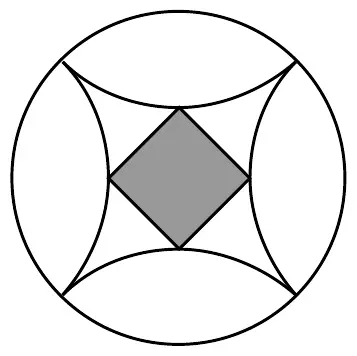
Senior Mathematical Challenge 2012, Question 17. © UK Mathematics Trust. Original paper on ukmt.org.uk
Answer: B \(2 - \sqrt{2}\)
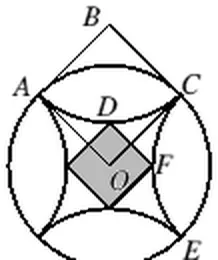
In the diagram, \(B\) is the centre of the quarter-circle arc \(AC\); \(D\) is the point where the central square touches arc \(AC\); \(F\) is the point where the central square touches arc \(CE\); \(O\) is the centre of the circle.
As both the circle and arc \(AC\) have radius 1, \(OABC\) is a square of side 1. By Pythagoras' Theorem: \(OB^2 = 1^2 + 1^2\). So \(OB = \sqrt{2}\). Therefore \(OD = OB - DB = \sqrt{2} - 1\). By a similar argument, \(OF = \sqrt{2} - 1\). Now \(DF^2 = OD^2 + OF^2 = 2 \times OD^2\) since \(OD = OF\). So the side of the square is \(\sqrt{2} \times OD = \sqrt{2}(\sqrt{2} - 1) = 2 - \sqrt{2}\).
Solution © UK Mathematics Trust, from the SMC 2012 solutions. Longer versions with investigations: Solutions and investigations (PDF).