
SMC 2009 Q24
24. A figure in the shape of a cross is made from five 1 × 1 squares, as shown. The cross is inscribed in a large square whose sides are parallel to the dashed square, formed by four of the vertices of the cross. What is the area of the large outer square?
- A 9
- B \(\dfrac{49}{5}\)
- C 10
- D \(\dfrac{81}{8}\)
- E \(\dfrac{32}{3}\)
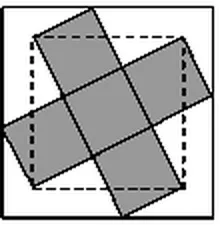
Senior Mathematical Challenge 2009, Question 24. © UK Mathematics Trust. Original paper on ukmt.org.uk
Answer: B \(\dfrac{49}{5}\)
A shaded triangle is congruent to an unshaded triangle (ASA).
Hence the area of the dashed square is equal to the area of the cross and both are 5.
Thus the side-length of the dashed square is \(\sqrt{5}\).
Hence the sides of a shaded triangle are: \(\tfrac{1}{2}\), 1 and \(\tfrac{1}{2}\sqrt{5}\).
Now the perpendicular distance between the squares is equal to the altitude, \(h\), of the shaded triangle. The area of such a triangle is \(\tfrac{1}{2} \times \left(\tfrac{1}{2} \times 1\right) = \tfrac{1}{4}\) so that \(\tfrac{1}{2} \times \left(\tfrac{1}{2}\sqrt{5} \times h\right) = \tfrac{1}{4}\) which gives \(h = \dfrac{1}{\sqrt{5}}\).
Hence the length of the sides of the outer square are \(\sqrt{5} + 2 \times \dfrac{1}{\sqrt{5}} = \dfrac{5}{\sqrt{5}} + \dfrac{2}{\sqrt{5}} = \dfrac{7}{\sqrt{5}}\).
Thus the area of the large square is \(\left(\dfrac{7}{\sqrt{5}}\right)^2 = \dfrac{49}{5}\).
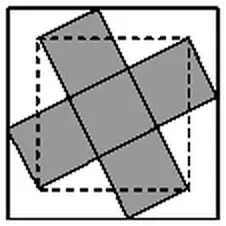
Solution © UK Mathematics Trust, from the SMC 2009 solutions.