
SMC 2005 Q23
23. The diagram shows four touching circles, each of which also touches the sides of an equilateral triangle with sides of length 3.
What is the area of the shaded region?
- A \(\dfrac{11\pi}{12}\)
- B \(\pi\)
- C \(\dfrac{(4 + \sqrt{3})\pi}{6}\)
- D \(\dfrac{(3 + \sqrt{3})\pi}{4}\)
- E \(\dfrac{37\pi}{36}\)
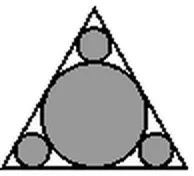
Senior Mathematical Challenge 2005, Question 23. © UK Mathematics Trust. Original paper on ukmt.org.uk
Answer: B \(\pi\)
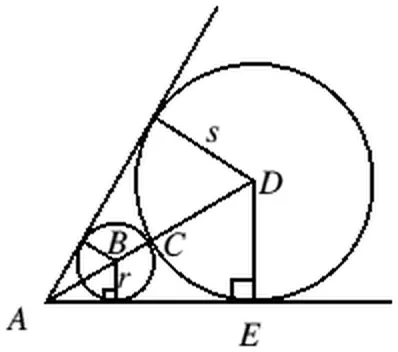
We note from the symmetry of the figure that the three small circles have the same radius. Let this be \(r\) and let the radius of the large circle be \(s\). Let \(A\), \(B\), \(C\), \(D\), \(E\) be the points shown on the diagram.
By symmetry, \(\angle DAE = 30°\).
Now \(\tfrac{DE}{AD} = \sin 30° = \tfrac{1}{2}\) so \(AD\) has length \(2s\). Similarly, \(AB\) has length \(2r\).
Since \(AD = AB + BC + CD\), the length of \(AD\) is also given by \(2r + r + s\). Hence \(2s = 3r + s\), i.e. \(s = 3r\).
Also, \(\tfrac{DE}{AE} = \tfrac{s}{3/2} = \tan 30° = \tfrac{1}{\sqrt{3}}\) so \(s = \tfrac{3}{2\sqrt{3}}\). Hence \(r = \tfrac{1}{2\sqrt{3}}\).
Thus the shaded area \(= \pi s^2 + 3\pi r^2 = \pi \times \tfrac{9}{12} + 3\pi \times \tfrac{1}{12} = \pi\).
Solution © UK Mathematics Trust, from the SMC 2005 solutions.