
SMC 2014 Q19
19. The diagram shows a quadrant of radius 2, and two touching semicircles. The larger semicircle has radius 1. What is the radius of the smaller semicircle?
- A \(\dfrac{\pi}{6}\)
- B \(\dfrac{\sqrt{3}}{2}\)
- C \(\dfrac{1}{2}\)
- D \(\dfrac{1}{\sqrt{3}}\)
- E \(\dfrac{2}{3}\)
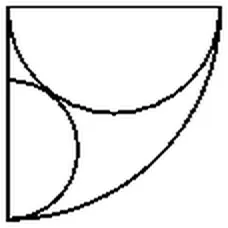
Senior Mathematical Challenge 2014, Question 19. © UK Mathematics Trust. Original paper on ukmt.org.uk
Answer: E \(\dfrac{2}{3}\)
Let the centre of the quadrant be \(O\), the centre of the larger semicircle be \(A\) and the centre of the smaller semicircle be \(B\). Let the radius of the smaller semicircle be \(r\). It is given that \(OA = 1\). The common tangent to the two semicircles at the point of contact makes an angle of 90° with the radius of each semicircle. Therefore the line \(AB\) passes through the point of contact, as \(2 \times 90° = 180°\) and angles on a straight line sum to 180°. So the line \(AB\) has length \(r + 1\). This is the hypotenuse of the right-angled triangle \(OAB\) in which \(OA = 1\) and \(OB = 2 - r\). By Pythagoras' Theorem \((2 - r)^2 + 1^2 = (r + 1)^2\), so \(4 - 4r + r^2 + 1 = r^2 + 2r + 1\) and therefore \(4 = 6r\) and so \(r = \tfrac{2}{3}\).
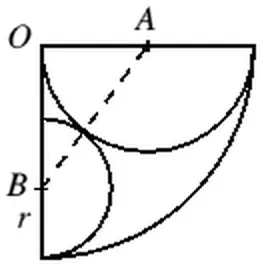
Solution © UK Mathematics Trust, from the SMC 2014 solutions. Longer versions with investigations: Solutions and investigations (PDF).