
SMC 2014 Q20
20. The diagram shows six squares with sides of length 2 placed edge-to-edge. What is the radius of the smallest circle containing all six squares?
- A \(2\sqrt{5}\)
- B \(2\sqrt{6}\)
- C 5
- D \(\sqrt{26}\)
- E \(2\sqrt{7}\)
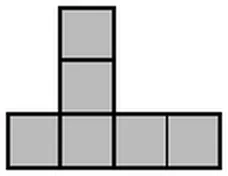
Senior Mathematical Challenge 2014, Question 20. © UK Mathematics Trust. Original paper on ukmt.org.uk
Answer: A \(2\sqrt{5}\)
It is always possible to draw a circle through three points which are not on a straight line. The smallest circle containing all six squares must pass through (at least) three of the eight vertices of the diagram. Of all such circles, the smallest passes through \(S\), \(V\) and \(Z\) and has its centre at \(X\). The radius is then \(\sqrt{4^2 + 2^2} = \sqrt{16 + 4} = \sqrt{20} = 2\sqrt{5}\).
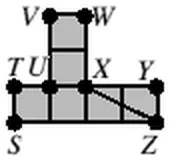
Solution © UK Mathematics Trust, from the SMC 2014 solutions. Longer versions with investigations: Solutions and investigations (PDF).