
SMC 2011 Q19
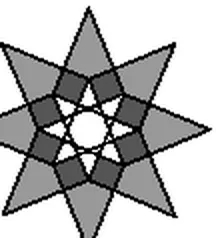
19. The diagram shows a small regular octagram (an eight-sided star) surrounded by eight squares (dark grey) and eight kites (light grey) to make a large regular octagram. Each square has area 1.
What is the area of one of the light grey kites?
- A 2
- B \(\sqrt{2} + 1\)
- C \(\dfrac{21}{8}\)
- D \(4\sqrt{2} - 3\)
- E \(\dfrac{11}{4}\)
Senior Mathematical Challenge 2011, Question 19. © UK Mathematics Trust. Original paper on ukmt.org.uk
Answer: B \(\sqrt{2} + 1\)
As each square has area 1 its side length must be 1.
The external angle of the small regular octagon is \(\tfrac{1}{8} \times 360° = 45°\).
Hence, as the sum of the angles on a straight line is 180° and the sum of the angles in a kite is 360°, the four angles in each of the eight kites (white) are: 90°, 90°, 135° and 45°.
As the light grey kites and the white kites are similar, the interior angles are the same. Two of the sides of the grey kite have length 1. Let the other sides have length \(a\). Using the Cosine Rule twice within a light grey kite, the square of the short diagonal is \(1^2 + 1^2 - 2 \times 1 \times 1\cos 135° = a^2 + a^2 - 2a \times a\cos 45°\). Hence \(2 + 2 \times 1/\sqrt{2} = 2a^2 - 2a^2 \times 1/\sqrt{2}\).
Thus \(a^2 = \dfrac{1 + \frac{1}{\sqrt{2}}}{1 - \frac{1}{\sqrt{2}}} = \dfrac{\sqrt{2} + 1}{\sqrt{2} - 1}\) and so \(a = \sqrt{2} + 1\).
But the area of one of the light grey kites is \(2 \times \tfrac{1}{2}a \times 1 = a\).
Hence the area of one of the light grey kites is \(\sqrt{2} + 1\).
Solution © UK Mathematics Trust, from the SMC 2011 solutions. Longer versions with investigations: Solutions and investigations (PDF).