
SMC 2011 Q25
25. A solid sculpture consists of a \(4 \times 4 \times 4\) cube with a \(3 \times 3 \times 3\) cube sticking out, as shown. Three vertices of the smaller cube lie on edges of the larger cube, the same distance along each.
What is the total volume of the sculpture?
- A 79
- B 81
- C 82
- D 84
- E 85
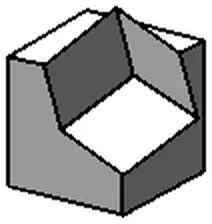
Senior Mathematical Challenge 2011, Question 25. © UK Mathematics Trust. Original paper on ukmt.org.uk
Answer: C 82
Three vertices of the smaller cube lie on edges of the larger cube, the same distance along each. Let this distance be \(x\) and let the distance between any two of these vertices be \(y\). Hence, by Pythagoras' Theorem, \(y^2 = x^2 + x^2\) and, as the side length of the smaller cube is 3, \(y^2 = 3^2 + 3^2\). Thus \(x = 3\) and \(y = 3\sqrt{2}\).
The intersection of the cubes forms two congruent tetrahedra of base area equal to \(\tfrac{1}{2}y^2\sin 60° = \tfrac{1}{2}(3\sqrt{2})^2 \times \tfrac{\sqrt{3}}{2} = \tfrac{9\sqrt{3}}{2}\). Let \(h\) be the perpendicular height of the tetrahedra. Hence, using Pythagoras' Theorem twice gives \(9 = h^2 + 6\), thus \(h = \sqrt{3}\).
Thus the total volume of the sculpture is \(4^3 + 3^3 - 2 \times \tfrac{1}{3} \times \tfrac{9\sqrt{3}}{2} \times \sqrt{3} = 91 - 9 = 82\).
Solution © UK Mathematics Trust, from the SMC 2011 solutions. Longer versions with investigations: Solutions and investigations (PDF).