
SMC 2009 Q21
21. A frustum is the solid obtained by slicing a right-circular cone perpendicular to its axis and removing the small cone above the slice. This leaves a shape with two circular faces and a curved surface. The original cone has base radius 6 cm and height 8 cm, and the curved surface area of the frustum is equal to the area of the two circles. What is the height of the frustum?
- A 3 cm
- B 4 cm
- C 5 cm
- D 6 cm
- E 7 cm
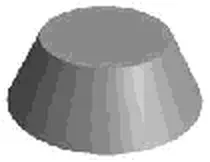
Senior Mathematical Challenge 2009, Question 21. © UK Mathematics Trust. Original paper on ukmt.org.uk
Answer: B 4 cm
Let \(r\) be the radius of the small cone and \(h\) the height.
Let \(l_1\) and \(l_2\) be the slant heights of the small and large cones respectively.
By Pythagoras' Theorem \(l_2 = \sqrt{6^2 + 8^2} = 10\).
Using similar triangles, \(\dfrac{l_1}{r} = \dfrac{10}{6}\) so \(l_1 = \dfrac{5}{3}r\) and \(\dfrac{h}{8} = \dfrac{r}{6}\) giving \(h = \dfrac{4}{3}r\).
Thus the area of the curved surface of the frustum is
\[\pi \times 6 \times 10 - \pi \times r \times \frac{5}{3} \times r = \pi\left(60 - \frac{5r^2}{3}\right).\]
The sum of the areas of the two circles is \(\pi \times 6^2 + \pi \times r^2 = \pi\,(36 + r^2)\).
Hence \(\pi\left(60 - \dfrac{5r^2}{3}\right) = \pi\,(36 + r^2)\) and so \(24 = \dfrac{8r^2}{3}\) giving \(r = 3\), so \(h = \dfrac{4}{3} \times 3 = 4\).
Therefore, in cms, the height of the frustum is 8 − 4 = 4.
Solution © UK Mathematics Trust, from the SMC 2009 solutions.