
SMC 2009 Q9
9. A square \(PQRS\) has sides of length \(x\). \(T\) is the midpoint of \(QR\) and \(U\) is the foot of the perpendicular from \(T\) to \(QS\). What is the length of \(TU\)?
- A \(\dfrac{x}{2}\)
- B \(\dfrac{x}{3}\)
- C \(\dfrac{x}{\sqrt{2}}\)
- D \(\dfrac{x}{2\sqrt{2}}\)
- E \(\dfrac{x}{4}\)
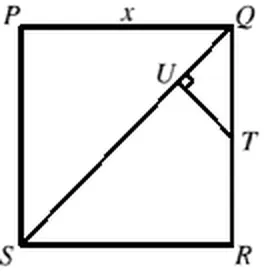
Senior Mathematical Challenge 2009, Question 9. © UK Mathematics Trust. Original paper on ukmt.org.uk
Answer: D \(\dfrac{x}{2\sqrt{2}}\)
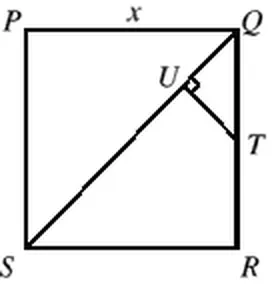
As \(T\) is the midpoint of \(QR\) then \(QT = \tfrac{1}{2}x\).
Since \(\angle UQT = \angle SQR = 45°\) and \(\angle QUT = 90°\), \(\angle UTQ = 45°\).
Thus triangle \(QTU\) is isosceles with \(UQ = UT\).
In triangle \(QTU\), by Pythagoras' Theorem, \(QT^2 = QU^2 + TU^2\).
Hence \(\left(\tfrac{1}{2}x\right)^2 = 2TU^2\) so \(TU^2 = \tfrac{1}{8}x^2\) giving \(TU = \dfrac{x}{2\sqrt{2}}\).
Solution © UK Mathematics Trust, from the SMC 2009 solutions.