
SK 2015 Q17
17. In rectangle \(JKLM\), the bisector of angle \(KJM\) cuts the diagonal \(KM\) at point \(N\) as shown. The distances between \(N\) and sides \(LM\) and \(KL\) are 8 cm and 1 cm respectively. The length of \(KL\) is \((a + \sqrt{b})\) cm. What is the value of \(a + b\)?
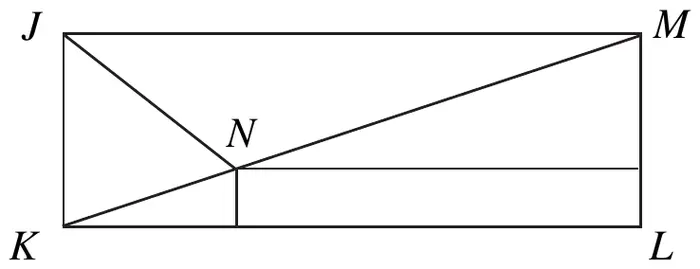
Senior Kangaroo 2015, Question 17. © UK Mathematics Trust. Original paper on ukmt.org.uk
Answer: 16
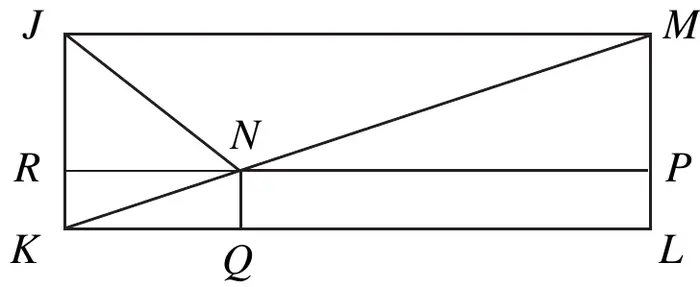
Let points \(P\) and \(Q\) be the points where the perpendiculars from \(N\) to \(ML\) and \(KL\) meet the lines and extend line \(PN\) so it meets \(JK\) at \(R\), as shown in the diagram. Since \(JN\) is the bisector of angle \(MJK\), angle \(NJR = 45°\). Since angle \(JRN\) is 90°, triangle \(JRN\) is isosceles and \(JR = RN\). Let the length of \(RN\) be \(x\) cm. Hence the lengths of \(JR\) and \(PM\) are also \(x\) cm. Observe that triangles \(NKQ\) and \(MNP\) are similar since they have the same angles. Therefore \(\dfrac{1}{x} = \dfrac{x}{8}\) and so \(x = \sqrt{8}\) since \(x\) is positive. The length of \(KL\) is equal to the sum of the lengths of \(NP\) and \(NR\). Therefore, the length of \(KL\) is \((8 + \sqrt{8})\) cm. Hence, the value of \(a + b\) is 16.
Solution © UK Mathematics Trust, from the SK 2015 solutions.