
MOG 2016 Q4
In the trapezium \(ABCD\), the edges \(AB\) and \(DC\) are parallel. The point \(M\) is the midpoint of \(BC\), and \(N\) is the midpoint of \(DA\).
Prove that \(2MN = AB + CD\).
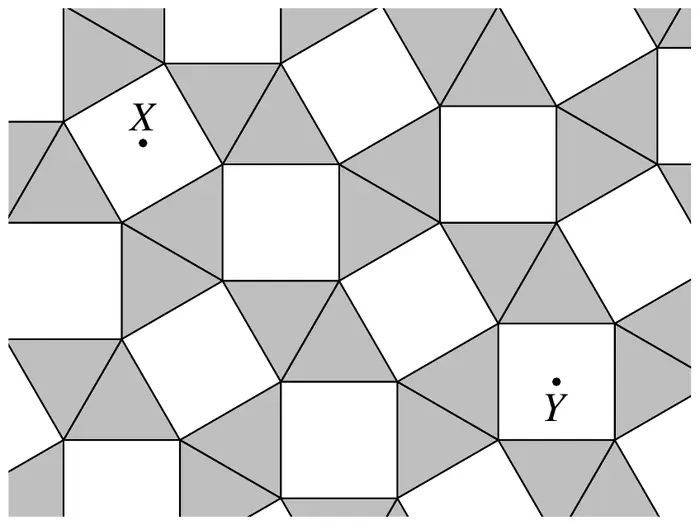
The diagram shows part of a tiling of the plane by squares and equilateral triangles.
Each tile has edges of length 2. The points \(X\) and \(Y\) are at the centres of square tiles.
What is the distance \(XY\)?
Mathematical Olympiad for Girls 2016, Question 4. © UK Mathematics Trust. Original paper on ukmt.org.uk
Answer: (b) \(XY = 3 + 3\sqrt{3}\)
Commentary
There are several different ways to approach this part, and we present two possible proofs here.
In the first proof, since we are interested in the length \(AB + CD\), we are going to extend the two bases of the trapezium, as shown in the diagram below. The two identical copies of the trapezium make up a parallelogram with base length \(AB + CD\), so we just need to prove that \(NMP\) is a straight line parallel to the base.
You may have seen this construction when deriving the formula for the area of the trapezium. Our second proof explicitly uses the area of the trapezium: we create a rectangle with base length \(NM\) and the area equal to the area of the trapezium.
Method 1
Extend the side \(AB\) to point \(E\) and the side \(DC\) to point \(F\) such that \(BE = DC\) and \(CF = AB\). Then \(AEFD\) is a parallelogram, since the opposite sides \(AE\) and \(DF\) are parallel and both have length \(AB + CD\). It follows that \(EF\) and \(AD\) are parallel and equal in length.
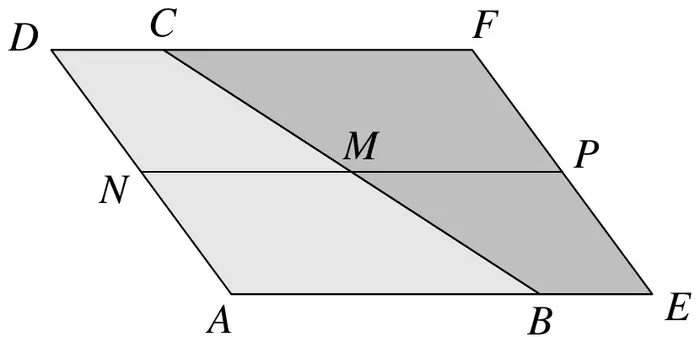
Let \(P\) be the midpoint of \(EF\). Then \(AN\) and \(EP\) are parallel and have equal lengths, so \(AEPN\) is also a parallelogram, and hence \(NP = AE = AB + CD\).
The trapezia \(ABCD\) and \(FCBE\) are congruent: we have already proved that the corresponding sides are equal, \(\angle BAD = \angle CFE\) and \(\angle ADC = \angle FEB\) from the parallelogram, and \(\angle ABC = \angle FCB\) because the lines \(AE\) and \(DF\) are parallel.
\(M\) is the midpoint of \(BC\), which is the shared side of the two trapezia.Therefore \(\angle NMC = \angle BMP\). It follows that \(NMP\) is a straight line. The congruence of the two trapezia also implies that \(NM = MP\).
Therefore \(NP = 2MN\) and so \(2MN = AB + CD\), as required.
Method 2
Draw a line through \(N\) perpendicular to \(AB\), and let it meet \(AB\) at \(P\) and \(DC\) at \(S\). Draw another line perpendicular to \(AB\) through \(M\), and let it meet \(AB\) at \(Q\) and \(DC\) at \(R\), as shown in the diagram. Note that some of the \(P\), \(Q\), \(R\) and \(S\) will be on the sides and some on the extensions of sides \(AB\) and \(DC\); it can be checked that the proof works in all possible cases.
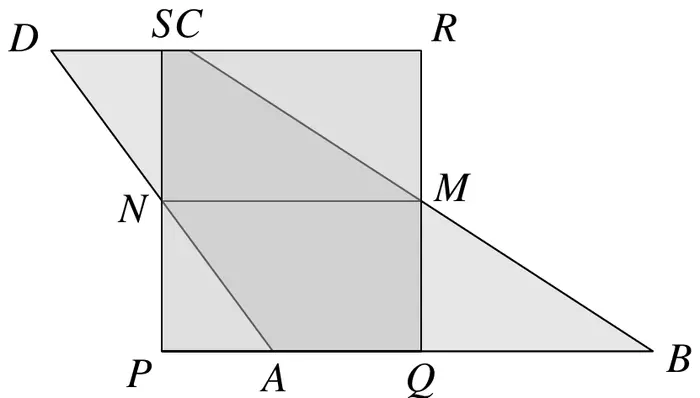
\(PQRS\) has four right angles, so it is a rectangle. Its base is equal in length to \(MN\) and its height is equal to the height of the trapezium, \(h\). Hence the area of the rectangle \(PQRS\) is \(MN \times h\).
Triangles \(PAN\) and \(SDN\) are congruent: they are both right-angled, have equal angles at \(N\) and \(AN{=}DN\) (since \(N\) is the midpoint of \(AD\)). Similarly, triangles \(QBM\) and \(RCM\) are congruent. Hence the area of the rectangle \(PQRS\) equals the area of the trapezium \(ABCD\). Therefore we have:\[MN \times h = \tfrac{1}{2}(AB + CD)h.\]It follows that \(2MN = AB + CD\), as required.
Commentary
The first thing you should ask is how you can use the result from part (a). \(X\) and \(Y\) are midpoints of the diagonals of the two squares, so it seems sensible to look for a trapezium with those two diagonals as sides. The parallel sides of this trapezium are made up of the sides and heights of the equilateral triangle, so you can calculate their lengths.
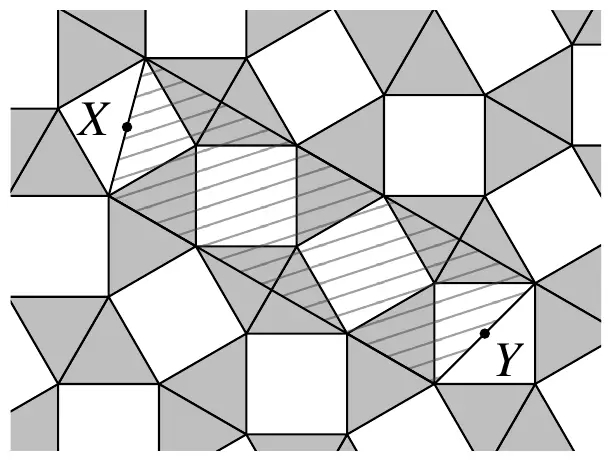
There are two things you need to prove before you can do the calculations. First, you need to show that the sides labeled \(DC\) and \(AB\) in the diagram below are in fact parallel. Second, you need to show that those lines pass through the points \(S\), \(R\), \(P\) and \(Q\).
We claim that \(XY = 3 + 3\sqrt{3}\). Here is a proof.
Extract four squares from the shaded part of the pattern, as shown in the diagram below. Let \(A\), \(B\), \(C\), \(D\) be the vertices of the squares containing the points \(X\), \(Y\), as shown. Also, going from left to right on the “lower” zig-zag boundary of the figure, label the “bottom” vertices of the two inner squares \(P\), \(Q\), and going from right to left on its “upper” boundary, label the two “top” vertices of those squares \(R\), \(S\).
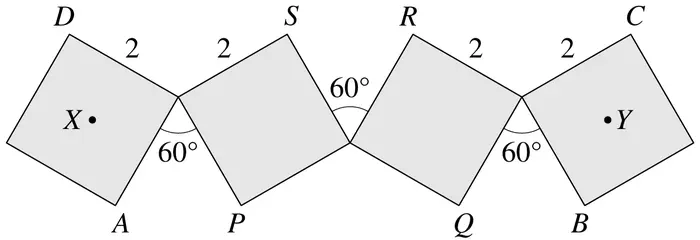
The bisector of the middle \(60^\circ\) angle is a line of symmetry of the figure. Reflection in that line interchanges \(A\) and \(B\) and interchanges \(C\) and \(D\). Consequently both \(AB\) and \(CD\) are perpendicular to that line, and so \(AB\) is parallel to \(CD\), that is, \(ABCD\) is a trapezium. Therefore, using the result of part (a), \(2XY = AB + CD\).
The isosceles triangle with base \(AP\) has angle \(60^\circ\) at its apex, so its other two angles are \(60^\circ\) also, and therefore it is equilateral. The isosceles triangle that has \(PQ\) as its base has angle \(120^\circ\) at its apex, hence angles \(30^\circ\) at \(P\) and \(Q\).
Consequently \(\angle APQ = 60^\circ + 90^\circ + 30^\circ = 180^\circ\), that is, \(APQ\) is a straight line. Similarly (or by symmetry) \(PQB\) is a straight line. Thus the line segment \(AB\) passes through \(P\) and \(Q\). A very similar argument shows that the line segment \(CD\) passes through \(R\) and \(S\).
Now \(AP = QB = SR = 2\), since those are the sides of equilateral triangles.
The length \(PQ\) is equal to twice the height of the equilateral triangle, as can be seen from the diagram of the full tiling above (in the commentary). Using Pythagoras’ Theorem, the height of the equilateral triangle of side 2 is \(\sqrt{3}\). Hence \(PQ = DS = RC = 2\sqrt{3}\).
Therefore \(AB = 2 + x + 2 = 4 + 2\sqrt{3}\) and \(DC = x + 2 + x = 2 + 4\sqrt{3}\). By part (a), \(2XY = (AB + CD) = 6 + 6\sqrt{3}\), so \(XY = 3 + 3\sqrt{3}\) as claimed.
Solution © UK Mathematics Trust, from the MOG 2016 solutions.