
MOG 2018 Q2
Triangle \(ABC\) is isosceles, with \(AB = BC = 1\) and angle \(ABC\) equal to \(120^\circ\). A circle is tangent to the line \(AB\) at \(A\) and to the line \(BC\) at \(C\).
What is the radius of the circle?(10 marks)
[You should state clearly any geometrical facts or theorems you use in each step of your calculation. For example, if one of your steps calculates the size of an angle in a triangle you might justify that particular step with “because angles in a triangle add up to 180 degrees.”]
Mathematical Olympiad for Girls 2018, Question 2. © UK Mathematics Trust. Original paper on ukmt.org.uk
Answer: \(\sqrt{3}\)
Commentary
The first thing to do when faced with a geometry problem is to draw a large, labelled diagram, showing all the information given in the question. You should be careful not to assume any additional “facts” that are not explicitly given in the question, such as right angles or equal lengths that are not explicitly mentioned. If there are any further properties you need to use in your solution, you should explain why they follow from the given information.
When you try to draw the diagram for this question you will probably find that you need to extend the sides of the triangle past the points \(A\) and \(C\) to make it obvious that they are tangents to the circle.
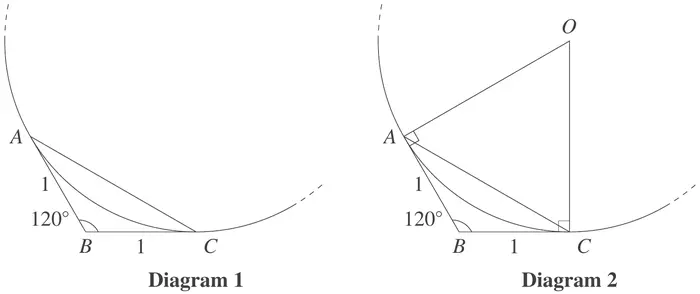
Since the question asks for the radius of the circle, it seems useful to label the centre and connect it to the points on the circumference, as in the Diagram 2 above. You can now see how to use the fact that the lines \(AB\) and \(BC\) are tangents to the circle: The angle between a tangent and a radius is a right angle.
Another useful tip for solving geometry problems is to always bear in mind what you are given and what you are trying to find. Here you want to find the value of \(r\), which is the length of \(OA\), and you know the length \(AB{=}1\) and the angle \(OAB = 90^\circ\). This suggest that it might be useful to look at the right angled triangle \(OAB\). Notice that in this triangle, you also know that the angle at \(B\) is \(60^\circ\).
You can now complete the calculation using trigonometry. If you don’t remember the exact value of \(\tan(60^\circ)\) you can also use the fact that the triangle \(OAB\) is half of an equilateral triangle and then use Pythagoras.
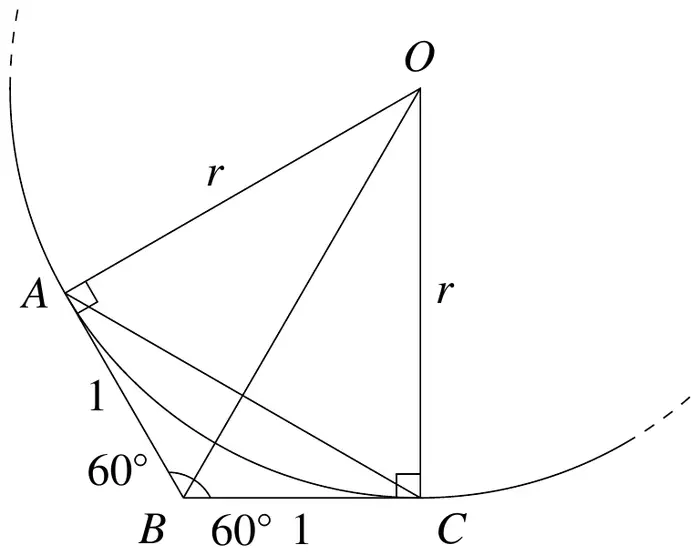
Label the centre of the circle \(O\) and the radius of the circle \(r\). Then angle \(OAB = 90^\circ\), since a tangent to a circle is perpendicular to the radius at the point of contact.
Also, by symmetry of the diagram, the line \(BO\) bisects the angle \(ABC\).
Now consider triangle \(OAB\). It has a right angle at \(A\), angle \(ABO = 60^\circ\), \(AB = 1\) and \(OA = r\). Therefore \(\frac{r}{1} = \tan(60^\circ) = \sqrt{3}\) and so \(r = \sqrt{3}\).
Note
In the above solution, we stated that the line \(BO\) bisects the angle \(ABC\), ‘by symmetry’. This is an acceptable assertion in this case but, strictly speaking, you should prove it. This can be done by noting that triangles \(OAB\) and \(OCB\) have three equal sides and are therefore congruent.
Alternative
We can use the cosine rule in triangle \(ABC\), knowing \(\cos(120^\circ) = -\frac{1}{2}\), to find \(AC = \sqrt{3}\). Then note that angle \(AOC = 360 - 90 - 90 = 60^\circ\) (using the sum of the angles in the quadrilateral \(OABC\)), so triangle \(AOC\) is equilateral, and hence \(r = \sqrt{3}\).
Solution © UK Mathematics Trust, from the MOG 2018 solutions.