
SMC 2017 Q25
25. The diagram shows a regular nonagon \(N\). Moving clockwise around \(N\), at each vertex a line segment is drawn perpendicular to the preceding edge. This produces a smaller nonagon \(S\), shown shaded.
What fraction of the area of \(N\) is the area of \(S\)?
- A \(\dfrac{1 - \cos 40°}{1 + \cos 40°}\)
- B \(\dfrac{\cos 40°}{1 + \cos 40°}\)
- C \(\dfrac{\sin 40°}{1 + \sin 40°}\)
- D \(\dfrac{1 - \sin 40°}{1 + \sin 40°}\)
- E \(\dfrac{1}{9}\)
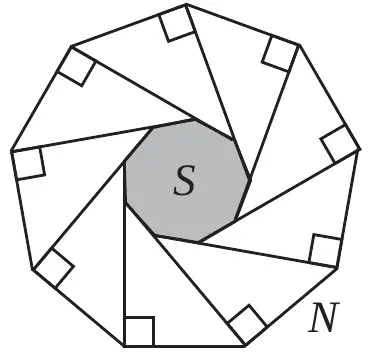
Senior Mathematical Challenge 2017, Question 25. © UK Mathematics Trust. Original paper on ukmt.org.uk
Answer: A \(\dfrac{1 - \cos 40°}{1 + \cos 40°}\)
Let the side-length of \(S\) be 1 and the side-length of \(N\) be \(x\). The fraction of the area of \(N\) that is the area of \(S\) is then \(\left(\dfrac{1}{x}\right)^2 = \dfrac{1}{x^2}\). Let the length of the hypotenuse of each of the nine triangles be \(1 + h\), then the third side of each triangle is \(h\). Using Pythagoras' Theorem, \(h^2 + x^2 = (1 + h)^2\) so \(h^2 + x^2 = 1 + 2h + h^2\) and the fraction we want, \(\frac{1}{x^2}\), is then \(\frac{1}{1 + 2h}\). The angle in each triangle which is adjacent to \(S\) is also an exterior angle of \(S\), so is \(\tfrac{1}{9} \times 360° = 40°\). We have \(\cos 40° = \dfrac{h}{1 + h}\) which rearranges to give \(h = \dfrac{\cos 40°}{1 - \cos 40°}\). Therefore \(1 + 2h = \left(\dfrac{1 - \cos 40°}{1 - \cos 40°}\right) + \dfrac{2\cos 40°}{1 - \cos 40°} = \dfrac{1 + \cos 40°}{1 - \cos 40°}\). So the fraction of the area \(N\) which is the area of \(S\) is \(\dfrac{1}{1 + 2h} = \dfrac{1 - \cos 40°}{1 + \cos 40°}\).
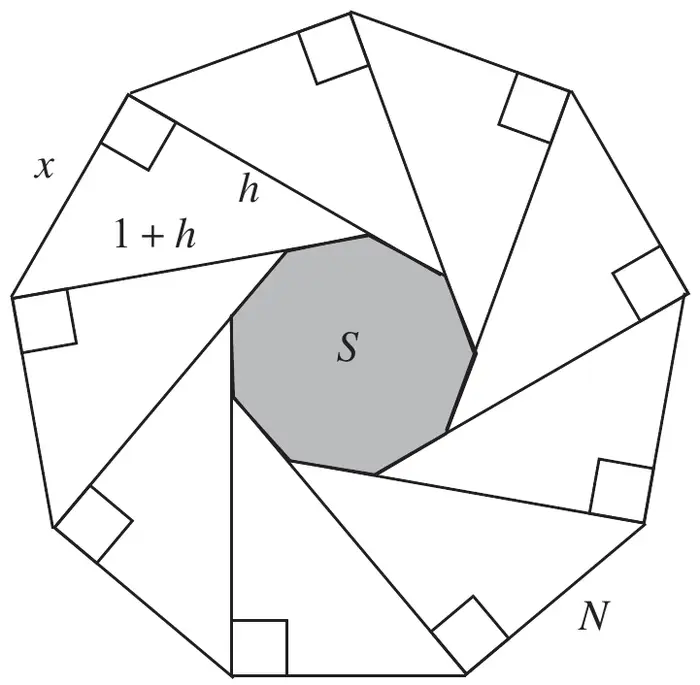
Solution © UK Mathematics Trust, from the SMC 2017 solutions. Longer versions with investigations: Solutions and investigations (PDF).