
SMC 2019 Q12
12. A circle with radius 1 touches the sides of a rhombus, as shown. Each of the smaller angles between the sides of the rhombus is 60°.
What is the area of the rhombus?
- A 6
- B 4
- C \(2\sqrt{3}\)
- D \(3\sqrt{3}\)
- E \(\dfrac{8\sqrt{3}}{3}\)
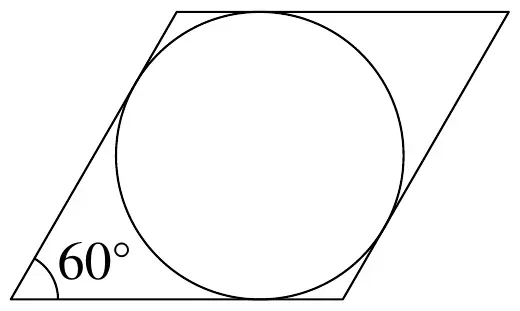
Senior Mathematical Challenge 2019, Question 12. © UK Mathematics Trust. Original paper on ukmt.org.uk
Answer: E \(\dfrac{8\sqrt{3}}{3}\)
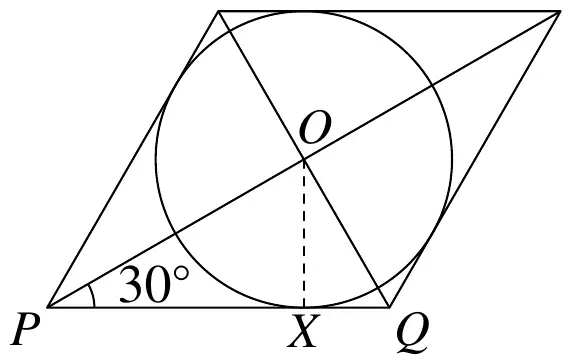
Let the centre of the rhombus and circle be \(O\). Let two of the vertices along an edge of the rhombus be \(P\) and \(Q\) and let \(X\) be the point on \(PQ\) where the rhombus is tangent to the circle. In order to relate the radius of the inscribed circle to a useful measurement on the rhombus, we can split the rhombus along its diagonals into four congruent triangles, one of which is \(POQ\). As \(PQ\) is tangent to the circle at \(X\), \(PQ\) and \(OX\) are perpendicular. Triangles \(OXP\) and \(OXQ\) are then similar 30°, 60°, 90° triangles with \(OX = 1\), \(XP = \sqrt{3}\) and \(XQ = \frac{1}{\sqrt{3}}\). The area of the rhombus is then \(4 \times \frac{1}{2} \times (\sqrt{3} + \frac{1}{\sqrt{3}}) \times 1 = 2 \times \frac{(3+1)}{\sqrt{3}} = \frac{8}{3}\sqrt{3}\).
Solution © UK Mathematics Trust, from the SMC 2019 solutions. Longer versions with investigations: Solutions and investigations (PDF).