The whole Senior Mathematical Challenge 2008 paper, one question at a time in order (25 questions). Press Mark as done after each one: your marks add up below.
2. A giant thresher shark weighing 1250 pounds, believed to be the heaviest ever caught, was landed by fisherman Roger Nowell off the Cornish coast in November 2007. The fish was sold by auction at Newlyn Fish Market for £255. Roughly, what was the cost per pound?
From the units column we see that \(S = 0\). Then the tens column shows that \(R = 9\), the hundreds column that \(Q = 1\), and the thousands that \(P = 6\). So \(P + Q + R + S = 16\).
5. 200 T-shirts have been bought for a Fun Run at a cost of £400 plus VAT at \(17\tfrac{1}{2}\)%. The cost of entry for the run is £5 per person. What is the minimum number of entries needed in order to cover the total cost of the T-shirts?
Since 1% of £400 = £4, the total VAT charged was £4 × 17.5 = £70, giving a total cost of £400 + £70 = £470. Therefore the minimum number of entries needed is 94.
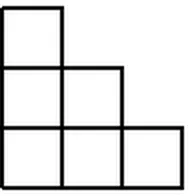
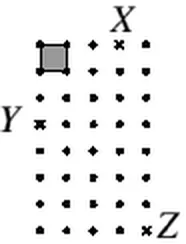
6. It is required to shade at least one of the six small squares in the diagram on the right so that the resulting figure has exactly one axis of symmetry. In how many different ways can this be done?
We number the squares to identify them. The only line of symmetry possible is the diagonal through 1 and 5. For a symmetric shading, if 4 is shaded, then so too must be 2; so either both are shaded or neither. Likewise 3 and 6 go together and provide 2 more choices. Whether 1 is shaded or not will not affect a symmetry, and this gives a further 2 choices; and the same applies to 5. Overall, therefore, there are \(2^4 = 16\) choices. However, one of these is the choice to shade no squares, which is excluded by the question.
7. A newspaper headline read ‘Welsh tortoise recaptured 1.8 miles from home after 8 months on the run’. Assuming the tortoise travelled in a straight line, roughly how many minutes did the tortoise take on average to ‘run’ one foot? [1 mile = 5280 feet]
In 1.8 miles there are 1.8 × 5280 feet = 18 × 528 feet, while in 8 months there are roughly 8 × 30 × 24 × 60 minutes. Hence the time to ‘run’ one foot in minutes is roughly \(\dfrac{10 \times 30 \times 20 \times 60}{20 \times 500} = 36\) minutes.
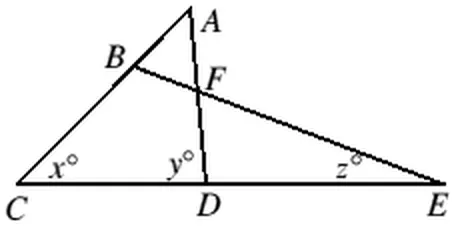
8. In the figure shown, \(AB = AF\) and \(ABC\),\(AFD\), \(BFE\) and \(CDE\) are all straight lines. Which of the following expressions gives \(z\) in terms of \(x\) and \(y\)?
A number is divisible by 9 if, and only if, the sum of its digits is divisible by 9. The given number is \(N + 2\), where \(N = 222\ldots220\) has 2007 2s. Since 2007 = 223 × 9, \(N\) is divisible by 9 and the required remainder is therefore 2.
10. Which one of the following rational numbers cannot be expressed as \(\dfrac{1}{m} + \dfrac{1}{n}\) where \(m\), \(n\) are different positive integers?
By inspection \[\frac{3}{4} = \frac{1}{2} + \frac{1}{4}; \qquad \frac{3}{5} = \frac{1}{2} + \frac{1}{10}; \qquad \frac{3}{6} = \frac{1}{3} + \frac{1}{6}; \qquad \frac{3}{8} = \frac{1}{4} + \frac{1}{8}.\] However \(\dfrac{3}{7} \neq \dfrac{1}{m} + \dfrac{1}{n}\). [To see why, suppose that \(\dfrac{3}{7} = \dfrac{1}{m} + \dfrac{1}{n}\) and note that \(\dfrac{1}{m} > \dfrac{1}{n}\) or vice versa. We will suppose the former. Then \(\dfrac{1}{m} \geqslant \dfrac{3}{14} > \dfrac{3}{15}\) and so \(\dfrac{1}{m} > \dfrac{1}{5}\) and \(m < 5\). Also \(\dfrac{1}{m} < \dfrac{3}{7}\) and so \(3m > 7\). Hence \(m \geqslant 3\). So \(m = 4\) or \(m = 3\). However \(\dfrac{3}{7} - \dfrac{1}{4} = \dfrac{5}{28}\) and \(\dfrac{3}{7} - \dfrac{1}{3} = \dfrac{2}{21}\) neither of which has the form \(\dfrac{1}{n}\).]
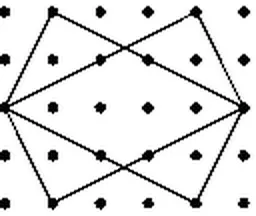
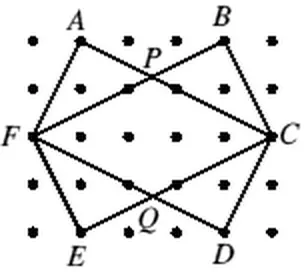
11. The distance between two neighbouring dots in the dot lattice is 1 unit. What, in square units, is the area of the region where the two rectangles overlap?
Let the six points where lines meet on the dot lattice be \(A\),\(B\),\(C\),\(D\),\(E\), \(F\) as shown and let the other two points of intersection be \(P\) ( where \(AC\) and \(BF\) meet ) and \(Q\) ( where \(CE\) and \(DF\) meet ). Triangles \(APB\) and \(CPF\) are similar with base lengths in the ratio 3:5. Hence triangle \(CPF\) has height \(\tfrac{5}{8} \times 2 = \tfrac{5}{4}\) units and base length 5 units so that its area is \(\tfrac{1}{2} \times \tfrac{5}{4} \times 5\) square units. Since the same is true of triangle \(CQF\), the required area is \(\tfrac{5}{4} \times 5 = 6\tfrac{1}{4}\) square units.
There are 365 days in a normal year and 366 in a leap year. Apart from certain exceptions (none of which occurs in this period) a leap year occurs every 4 years. Now 365 = 7 × 52 + 1 and 366 = 7 × 52 + 2. Hence each date moves on by 5 days every 4 years. So in 60 years, it moves on 75 days. Since 75 = 7 × 10 + 5, that means it moves on to a Thursday.
Since \(1280 = 2^8 \times 5 = 2^8(2^0 + 2^2) = 2^8 + 2^{10}\), we may take \(m\)=8 and \(n\) = 10 (or vice versa) to get \(m + n = 8 + 10 = 18\). It is easy to check that there are no other possibilities.
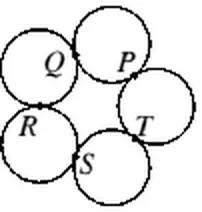
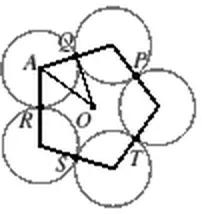
14. Five touching circles each have radius 1 and their centres are at the vertices of a regular pentagon. What is the radius of the circle through the points of contact \(P\),\(Q\),\(R\), \(S\) and \(T\)?
The internal angle of a regular pentagon is 108°. Let \(A\) be the centre of a touching circle, as shown. Since \(OA\) bisects \(\angle RAQ\),\(\angle OAQ = 54°\). Also, triangle \(OAQ\) is right-angled at \(Q\) (radius perpendicular to tangent). Since \(AQ = 1\),\(OQ = \tan 54°\).
15. A sequence of positive integers \(t_1, t_2, t_3, t_4, \ldots\) is defined by: \(t_1 = 13\); \(t_{n+1} = \tfrac{1}{2}t_n\) if \(t_n\) is even; \(t_{n+1} = 3t_n + 1\) if \(t_n\) is odd. What is the value of \(t_{2008}\)?
The sequence proceeds as follows: 13, 40, 20, 10, 5, 16, 8, 4, 2, 1, 4, 2, 1 … . The block 4, 2, 1 repeats ad infinitum starting after \(t_7\). But 2008 − 7 = 2001 and 2001 = 3 × 667. Hence \(t_{2008}\) is the third term in the 667th such block and is therefore 1.
16. The numbers \(x\), \(y\) and \(z\) satisfy the equations \[x + y + 2z = 850, \qquad x + 2y + z = 950, \qquad 2x + y + z = 1200.\] What is their mean?
17. Andy and his younger cousin Alice both have their birthdays today. Remarkably, Andy is now the same age as the sum of the digits of the year of his birth and the same is true of Alice. How many years older than Alice is Andy?
Let ‘\(X\)’ be a single digit. If \(2008 - 200X = 2 + 0 + 0 + X\) then \(8 - X = 2 + X\) so \(X = 3\). So Alice (being the younger) could have been born in 2003. Next if \(2008 - 199X = 1 + 9 + 9 + X\) then \(18 - X = 19 + X\), which is impossible. Similarly if \(2008 - 198X = 1 + 9 + 8 + X\) then \(28 - X = 18 + X\), so \(X = 5\). Thus Alice or Andy could have been born in 1985. Finally if \(2008 - 19YX = 1 + 9 + X + Y\) for some digit \(Y \leqslant 7\), then \(108 - YX = 10 + Y + X\). Hence \(98 = YX + Y + X\) which is impossible, since \(YX + Y + X\) is at most \(79 + 7 + 9 = 95\). Hence there are no more possible dates and so Andy was born in 1985 and Alice in 2003.
Since \(XY^2 = 18\), \(YZ^2 = 32\) and \(XZ^2 = 50\), we have \(XZ^2 = XY^2 + YZ^2\). Hence by the converse of Pythagoras' Theorem, \(\angle XYZ = 90°\). Since the angle in a semi-circle is 90° the segment \(XZ\) is the diameter of the specified circle. Hence the radius is \(\tfrac{1}{2}\sqrt{50}\) and the area of the circle is \(\dfrac{50\pi}{4} = \dfrac{25\pi}{2}\).
Let \(199p + 1 = X^2\). Then \(199p = X^2 - 1 = (X + 1)(X - 1)\). Note that 197 is prime. If \(p\) is also to be prime then either\(X + 1 = 199\), in which case \(X - 1 = 197\),or\(X - 1 = 199\), in which case \(X + 1 = 201\) (and 201 = 3 × 67 is not prime). Note that \(X - 1 = 1\), \(X + 1 = 199p\) is impossible. Hence \(p = 197\) is the only possibility.
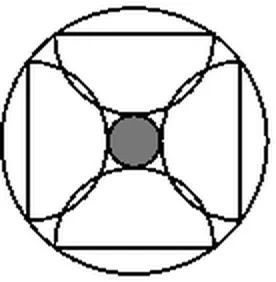
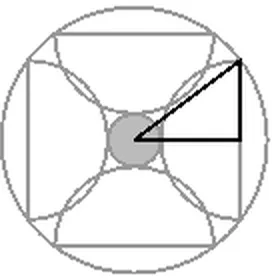
20. The diagram shows four semicircles symmetrically placed between two circles. The shaded circle has area 4 and each semicircle has area 18. What is the area of the outer circle?
Let \(r_1\), \(r_2\) and \(r_3\) be the radii of the shaded circle, semicircles and outer circle respectively. A right-angled triangle can be formed with sides \(r_3\), \((r_1 + r_2)\) and \(r_2\). Hence, by Pythagoras' Theorem, \(r_3^2 = (r_1 + r_2)^2 + r_2^2\). Now \(\pi r_1^2 = 4\), hence \(r_1 = 2\,/\sqrt{\pi}\). Likewise \(r_2 = 6\,/\sqrt{\pi}\). Hence \(r_2 = 3r_1\) so that \(r_3^2 = (r_1 + 3r_1)^2 + (3r_1)^2 = 25r_1^2\). Thus the required area is 25 × 4 = 100.
21. The fraction \(\dfrac{2008}{1998}\) may be written in the form \(a + \cfrac{1}{b + \cfrac{1}{c + \cfrac{1}{d}}}\) where \(a\),\(b\), \(c\) and \(d\) are positive integers. What is the value of \(d\)?
Since 2008/1998 lies between 1 and 2, \(a = 1\). Subtracting 1 and inverting gives \(b + 1/(c + 1/d) = 1998/10 = 199 + 4/5\) so that \(b = 199\). Then \(1/(c + 1/d) = 4/5\) so that \(c + 1\,/\,d = 5/4\) and this gives \(c = 1\) and \(d = 4\). {Note : This is an example of a continued fraction.}
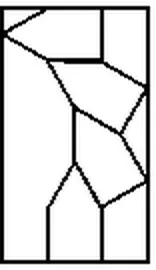
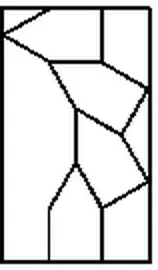
22. A pentagon is made by attaching an equilateral triangle to a square with the same edge length. Four such pentagons are placed inside a rectangle, as shown. What is the ratio of the length of the rectangle to its width?
Let \(r\) be the length of a side of the equilateral triangle. Hence the width of the rectangle is \(r\sin 60° + r + r\sin 60° =\) \(r(1 + 2\sin 60°) = r(1 + \sqrt{3})\) and its length is \(3r + 2r\sin 60° = r(3 + \sqrt{3})\). So the ratio of the length to the width is \[(3 + \sqrt{3}) : (1 + \sqrt{3}) = \sqrt{3}(1 + \sqrt{3}) : (1 + \sqrt{3}) = \sqrt{3} : 1.\]
Let \(X = x + 3\) and \(Y = y - 3\). Then the given equation becomes \((X + Y)^2 = XY\). So \(X^2 + XY + Y^2 = 0\). However \(X^2\), \(Y^2\) and \(XY\) (\(= (X + Y)^2\)) are non-negative. Hence \(X = Y = 0\); so \(x = -3\) and \(y = 3\) is the only solution.
24. The length of the hypotenuse of a particular right-angled triangle is given by \(\sqrt{1 + 3 + 5 + 7 + \;\ldots\; + 25}\). The lengths of the other two sides are given by \(\sqrt{1 + 3 + 5 + \;\ldots\; + x}\) and \(\sqrt{1 + 3 + 5 + \;\ldots\; + y}\) where \(x\) and \(y\) are positive integers. What is the value of \(x + y\)?
\(1 + 3 + 5 + 7 + \;\ldots\; + (2n + 1) = (n + 1)^2\). The \(n\) in the three cases given is 12, \(\tfrac{1}{2}(x - 1)\) and \(\tfrac{1}{2}(y - 1)\). So, the triangle has sides of length 12 + 1, \(\tfrac{1}{2}(x - 1) + 1\) and \(\tfrac{1}{2}(y - 1) + 1\). However the only right-angled triangle having sides of whole number length with hypotenuse 13 is the (5, 12, 13) triangle. So \(x = 9\) and \(y = 23\) (or vice versa). Hence \(x + y = 32\).
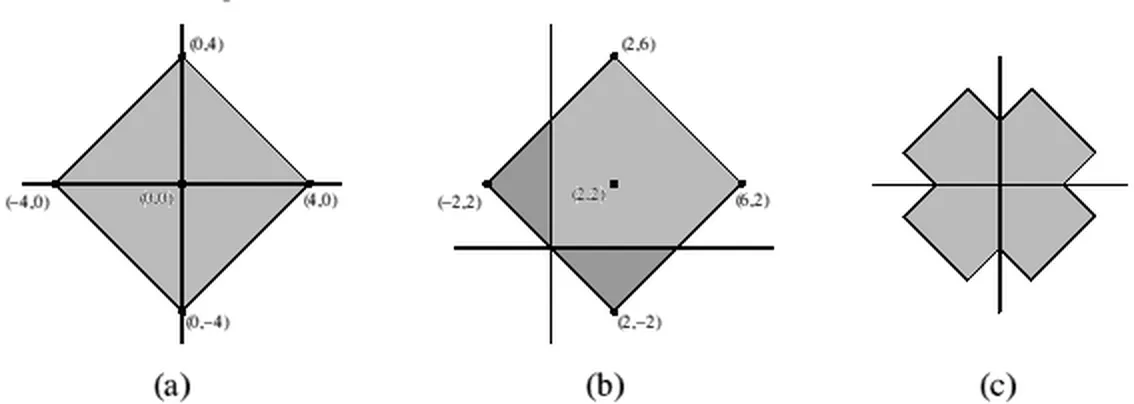
25. What is the area of the polygon formed by all points \((x,\ y)\) in the plane satisfying the inequality \(\big|\,|x| - 2\big| + \big|\,|y| - 2\big| \leqslant 4\) ?
To work out the area of \(\big||x| - 2\big| + \big||y| - 2\big| \leqslant 4\), we first consider the region \(|x| + |y| \leqslant 4\) which is shown in (a). This region is then translated to give \(|x - 2| + |y - 2| \leqslant 4\) as shown in (b). By properties of the modulus, if the point \((x,\ y)\) lies in the polygon, then so do \((x,\ -y)\), \((-x,\ y)\) and \((-x,\ -y)\). Thus \(\big||x| - 2\big| + \big||y| - 2\big| \leqslant 4\) can be obtained from (b) by reflecting in the axes and the origin, as shown in (c).
Hence the required area is 4 times the area in the first quadrant. From (b), the required area in the first quadrant is the area of a square of side \(4\sqrt{2}\) minus two triangles (cut off by the axes) which, combined, make up a square of side \(2\sqrt{2}\). So the area in the first quadrant is \((4\sqrt{2})^2 - (2\sqrt{2})^2 = 32 - 8 = 24\). Hence the area of the polygon is 4 × 24 = 96 square units.
We'd like to use Google Analytics cookies to count visits and see which pages help most. They're optional, and the site works exactly the same either way. Privacy policy