The whole Senior Mathematical Challenge 2019 paper, one question at a time in order (25 questions). Press Mark as done after each one: your marks add up below.
The expression \(n^2 + 2n\) factorises to \(n(n + 2)\). For \(n(n + 2)\) to be prime, one factor must equal 1 whilst the other must be equal to a prime. This happens when \(n = 1\), as \(n + 2 = 3\), but not when \(n + 2 = 1\) as \(n\) would be negative. There is therefore exactly one positive integer value of \(n\) which makes \(n^2 + 2n\) prime.
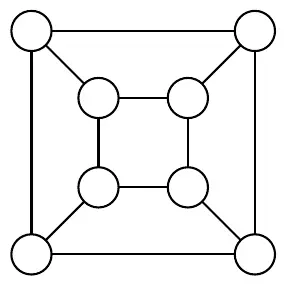
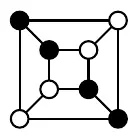
Each circle in the diagram is connected to three others, exactly one of which must be filled with the same colour. So, the number of colours required is greater than 1. One possible colouring with just two colours is shown here.
6. Each of the factors of 100 is to be placed in a 3 by 3 grid, one per cell, in such a way that the products of the three numbers in each row, column and diagonal are all equal. The positions of the numbers 1, 2, 50 and \(x\) are shown in the diagram.
The product of all the factors of 100 is \(1 \times 100 \times 2 \times 50 \times 4 \times 25 \times 5 \times 20 \times 10 =\) 1 000 000 000. As there are three rows, each of which has the same ’row product’, that row product is 1000. So, considering the top row, \(x \times 1 \times 50 = 1000\) and therefore \(x = 20\). The completed grid is as shown.
7. Lucy is asked to choose \(p\),\(q\), \(r\) and \(s\) to be the numbers 1, 2, 3 and 4, in some order, so as to make the value of \(\dfrac{p}{q} + \dfrac{r}{s}\) as small as possible.
What is the smallest value Lucy can achieve in this way?
In order to minimise the value of \(\frac{p}{q} + \frac{r}{s}\) we need to make \(p\) and \(r\) as small as possible and make \(q\) and \(s\) be as large as possible. Considering \(\frac{1}{3} + \frac{2}{4}\) and \(\frac{1}{4} + \frac{2}{3}\) and then removing both \(\frac{1}{3}\) and \(\frac{1}{4}\) from each sum leaves the first with value \(\frac{1}{4}\) and the second with value \(\frac{1}{3}\). As \(\frac{1}{4} < \frac{1}{3}\), the first sum has the smallest value, which is \(\frac{5}{6}\).
Considering some integer powers of 3, we have \(3^5 = 243\) and \(3^6 = 729\). As \(243 < 333 < 729\), \(3^5 < 3^{\left(3^x\right)} < 3^6\) implies that \(5 < 3^x < 6\). Rewriting once again to include powers of 3, gives \(3^1 < 5 < 3^x < 6 < 3^2\), so \(3^1 < 3^x < 3^2\) and finally, \(1 < x < 2\).
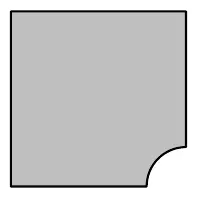
Folding the paper four times gives \(2^4\) layers. Removing a corner, 16 quarter-circles are formed. Of the given options, only D, with four whole circles could then be possible.
To provide a counterexample, we are looking for both the values of \(6n - 1\) and \(6n + 1\) to be composite for a particular \(n\) . When \(n = 20\), \(6n - 1 = 119 = 7 \times 17\) and \(6n + 1 = 121 = 11 \times 11\), which is our counter-example. In each of the other cases, at least one value is prime.
In order for \(\sqrt{200 - \sqrt{k}}\) to be an integer, \(200 - \sqrt{k}\) must be a square. As \(\sqrt{k} \geq 0\) , the smallest possible value of \(200 - \sqrt{k}\) which is square is 0, (when \(k = 200^2\)) and the largest is \(14^2 = 196\), (when \(k = 4^2\)). Counting the squares from \(0^2\) to \(14^2\) gives 15 values.
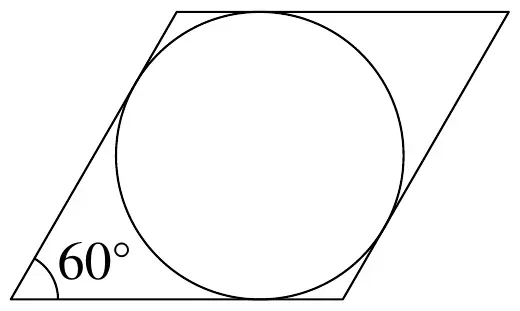
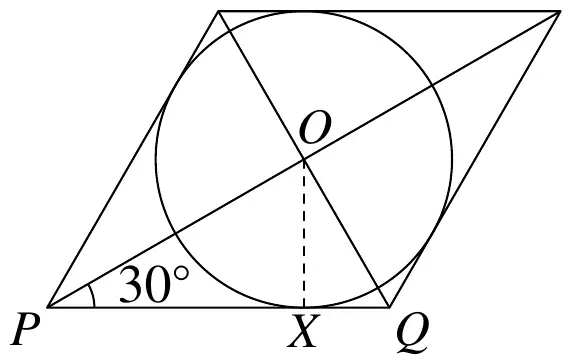
Let the centre of the rhombus and circle be \(O\). Let two of the vertices along an edge of the rhombus be \(P\) and \(Q\) and let \(X\) be the point on \(PQ\) where the rhombus is tangent to the circle. In order to relate the radius of the inscribed circle to a useful measurement on the rhombus, we can split the rhombus along its diagonals into four congruent triangles, one of which is \(POQ\). As \(PQ\) is tangent to the circle at \(X\), \(PQ\) and \(OX\) are perpendicular. Triangles \(OXP\) and \(OXQ\) are then similar 30°, 60°, 90° triangles with \(OX = 1\), \(XP = \sqrt{3}\) and \(XQ = \frac{1}{\sqrt{3}}\). The area of the rhombus is then \(4 \times \frac{1}{2} \times (\sqrt{3} + \frac{1}{\sqrt{3}}) \times 1 = 2 \times \frac{(3+1)}{\sqrt{3}} = \frac{8}{3}\sqrt{3}\).
13. Anish has a number of small congruent square tiles to use in a mosaic. When he forms the tiles into a square of side \(n\), he has 64 tiles left over. When he tries to form the tiles into a square of side \(n + 1\), he has 25 too few.
For a square to be a factor of \(10!\), the prime factors of the square must be present in \(10!\) an even number of times. Writing \(10!\) first as \(10 \times 9 \times 8 \times 7 \times 6 \times 5 \times 4 \times 3 \times 2 \times 1\) and then as \(2 \times 5 \times 3 \times 3 \times 2 \times 2 \times 2 \times 7 \times 2 \times 3 \times 5 \times 2 \times 2 \times 3 \times 2\) \(= 2^8 \times 3^4 \times 5^2 \times 7\) \(= (2^4 \times 3^2 \times 5)^2 \times 7\) we can see that the largest square is \(2^4 \times 3^2 \times 5\). Expanding \(2^4 \times 3^2 \times 5\) as \((2 \times 3) \times 5 \times (2 \times 2) \times 3 \times 2 \times 1\) shows that it is exactly \(6!\). So \((6!)^2\) is the largest square which is a factor of \(10!\).
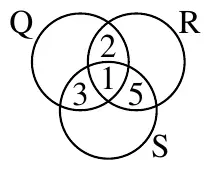
For \(Q + R + S\) to be as small as possible, we want the highest common factors of the pairs to be as small as possible, and prime. Therefore the highest common factors are 2, 3 and 5 in some order and then \(Q\), \(R\) and \(S\) are \(2 \times 3\), \(2 \times 5\) and \(3 \times 5\), i.e. 6, 10 and 15, in some order. This gives \(Q + R + S = 6 + 15 + 10 = 31\).
As \(9x + 3y - 5z = -4\) and \(5x + 2y - 2z = 13\), subtracting the first equation from twice the second gives \((10x + 4y - 4z) - (9x + 3y - 5z) = 2 \times 13 - (-4)\). The mean of \(x\), \(y\) and \(z\) which is \(\frac{(x+y+z)}{3}\) is therefore \(\frac{30}{3} = 10\).
The sum of the first 2019 positive integers is \(\frac{2019 \times 2020}{2}\) which is considerably larger than the required sum of 2019. In order for the sum of Jeroen’s 2019 integers to be only 2019, some of the integers must be positive and some must be negative. One of the integers will then be 0, so the product will also be 0. Jeroen’s list is \(-1008, \ldots - 2, -1, 0, 1, 2, \ldots, 1008, 1009, 1010\).
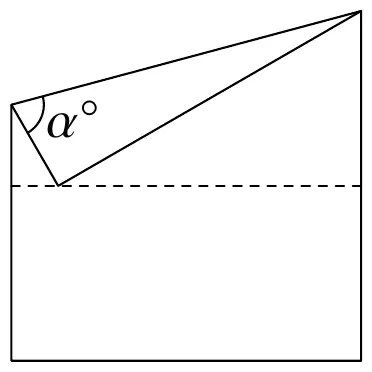
18. Alison folds a square piece of paper in half along the dashed line shown in the diagram. After opening the paper out again, she then folds one of the corners onto the dashed line.
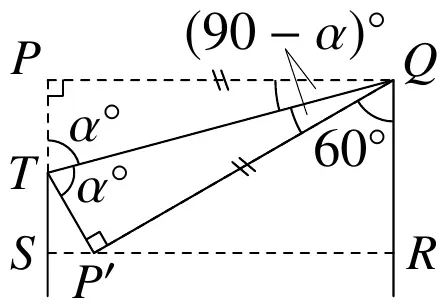
Let \(P\) and \(Q\) be the vertices on the top edge of the square. Let \(R\) and \(S\) be the points at the end of the first fold line. Let \(P'\) be the position of \(P\) on the first fold line after the second fold has been made. Let \(T\) be the point on \(PS\) which lies on the second fold line. Triangles \(PQT\) and \(P'QT\) are then congruent so \(\angle PQT = \angle P'QT = 90° - \alpha°\). As \(PQ = 2QR\) then \(P'Q = 2QR\) and so \(\angle P'QR = 60°\). Considering angles at \(Q\) gives \(2(90 - \alpha) + 60 = 90\), so \(150 = 2\alpha\) and \(\alpha = 75\).
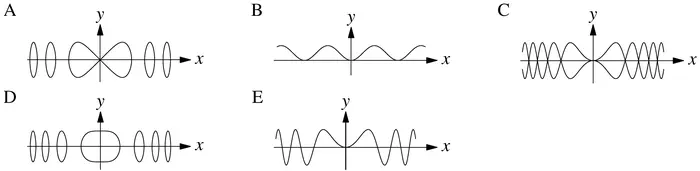
As \(\sin(0^2) = 0^2\) our graph must pass through the origin, so eliminating option D. As \(y^2 = \sin(x^2)\), \(y = \pm\sqrt{\sin(x^2)}\) and so the \(x\)-axis must be a line of symmetry, so eliminating options B and E. For some \(x\)-values, \(\sin(x^2)\) will be negative and so there will be no corresponding \(y\)-value, so eliminating option C, which has \(y\)-values for every \(x\)-value. The only possible remaining option is then A and it can be checked that the graph is indeed of this form.
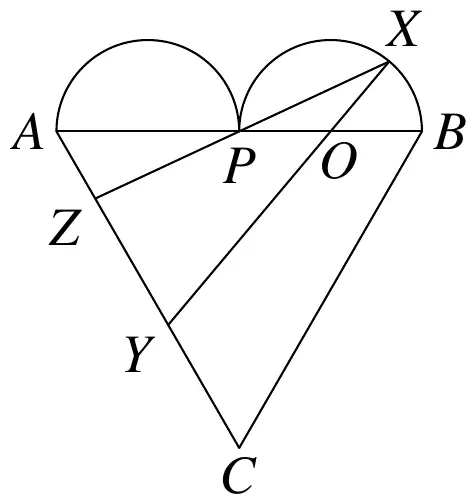
20. The "heart" shown in the diagram is formed from an equilateral triangle \(ABC\) and two congruent semicircles on \(AB\). The two semicircles meet at the point \(P\). The point \(O\) is the centre of one of the semicircles. On the semicircle with centre \(O\), lies a point \(X\). The lines \(XO\) and \(XP\) are extended to meet \(AC\) at \(Y\) and \(Z\) respectively. The lines \(XY\) and \(XZ\) are of equal length.
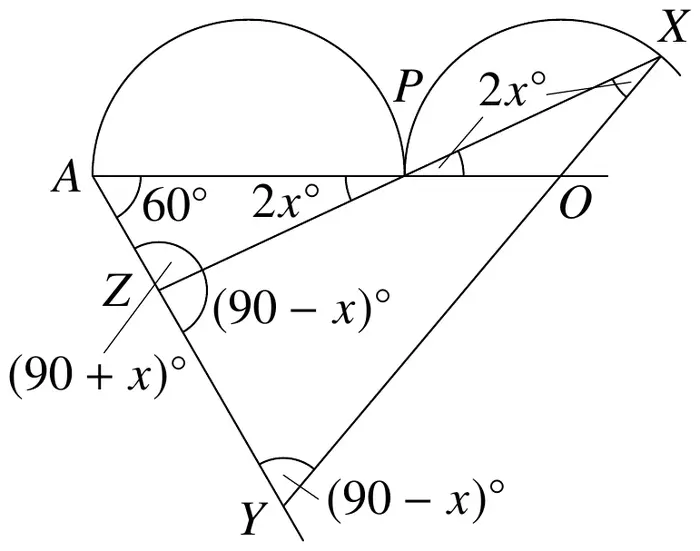
Let \(\angle ZXY = 2x°\), then the equal angles in isosceles triangle \(ZXY\), are each \(\frac{(180-2x)°}{2} = (90 - x)°\). We can then find each of the angles inside triangle \(AZP\) in terms of \(x\). Considering angles at \(Z\) gives \(\angle AZP = 180° - (90 - x)° = (90 + x)°\). Then, as triangle \(OXP\) is isosceles, \(\angle OPX = \angle OXP = 2x°\). As \(\angle ZPA\) is vertically opposite \(\angle OPX\) , \(\angle ZPA\) is also equal to \(2x°\). Finally, \(\angle OAY = 60°\) as triangle \(BAC\) is given to be equilateral. In triangle \(AZP\),\(60 + 90 + x + 2x = 180\), so \(x = 10\) and \(\angle ZXY = 2x° = 20°\).
21. In a square garden \(PQRT\) of side 10 m, a ladybird sets off from \(Q\) and moves along edge \(QR\) at 30 cm per minute. At the same time, a spider sets off from \(R\) and moves along edge \(RT\) at 40 cm per minute.
What will be the shortest distance between them, in metres?
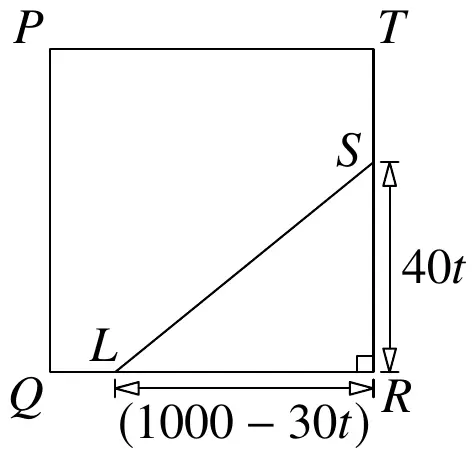
Let \(L\) be the position of the ladybird on \(QR\) and let \(S\) be the position of the spider on \(RT\) each after \(t\) minutes. The shortest distance between \(L\) and \(S\) is along the straight line which is the hypotenuse of the right-angled triangle \(LRS\). The distance \(QL\) is \(30t\) cm, so the distance \(LR\) is \((1000 - 30t)\) cm. Also, the distance \(RS\) is \(40t\) cm. So, \(LS^2 = (1000 - 30t)^2 + (40t)^2\) which expands and simplifies to \(2500(t^2 - 24t + 400) = 2500((t - 12)^2 + 256)\). The distance from \(L\) to \(S\) is shortest when \(t = 12\) and is \(\sqrt{2500 \times 256}\) cm = 800 cm = 8 m.
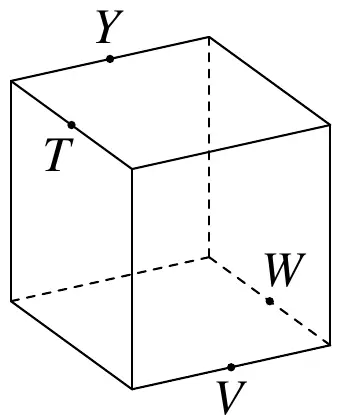
23. The edge-length of the solid cube shown is 2. A single plane cut goes through the points \(Y\),\(T\), \(V\) and \(W\) which are midpoints of the edges of the cube, as shown.
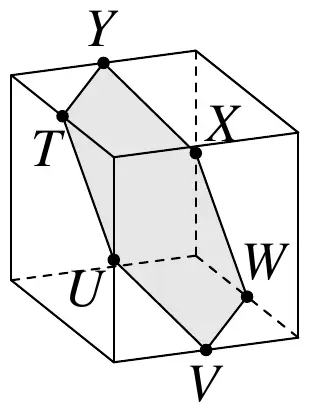
When the single plane cut is made through the cube, it passes through points \(Y\),\(T\), \(V\) and \(W\) and also points \(U\) and \(X\) which are midpoints of two of the remaining edges of the cube as shown. The cross-section is then a regular hexagon. As the side-length of the cube is 2, the distance between the midpoints of adjacent edges is \(\sqrt{2}\). This is the length of each edge of the hexagon.The hexagon can be split into six equilateral triangles and so the area of the hexagon is \(6 \times \frac{1}{2} \times \sqrt{2} \times \sqrt{2} \times \sin 60° = 6 \times \frac{\sqrt{3}}{2} = 3\sqrt{3}\).
Each of \(x\), \(y\) and \(z\) has the same form which is \(\sqrt{a - b} - \sqrt{a + b}\) for some \(a\) and \(b\). Squaring this expression gives \((a - b) - 2\sqrt{a + b} \times \sqrt{a - b} + (a + b) = 2a - 2\sqrt{(a^2 - b^2)}\). Applying this to \(x\) with \(a = 12\) and \(b = 3\sqrt{7}\) gives \(x^2 = 24 - 2\sqrt{81} = 6\). Similarly we can calculate that \(y^2 = 12\) and \(z^2 = 2\) . This gives us that \(x^2y^2z^2 = 6 \times 12 \times 2 = 144\). From the initial expressions \(x < 0\), \(y < 0\) and \(z > 0\), so \(xyz > 0\) and therefore \(xyz = 12\).
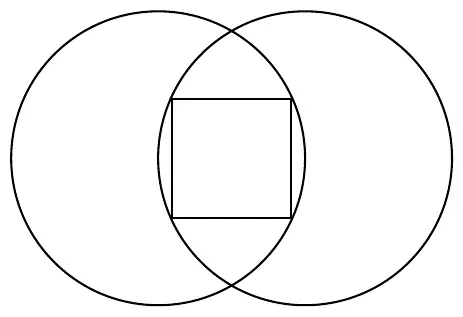
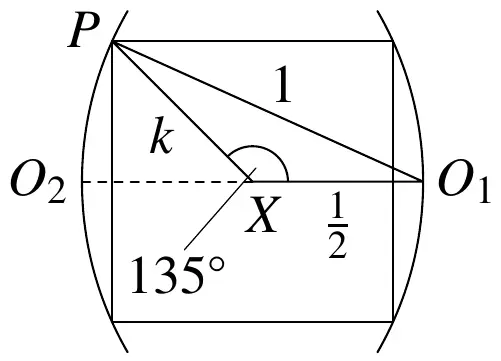
Let the centres of the circles and the square be \(O_1\), \(O_2\) and \(X\) respectively. Let \(P\) be the point on the circle with centre \(O_1\) which is a vertex of the square. Then \(O_1P = 1\) and \(O_1O_2 = 1\) so \(O_1X = \frac{1}{2}\). Let \(XP = k\), so the area of the square will be \(2k^2\). As \(O_1X\) is parallel to the top edge of the square and \(XP\) goes from the centre of the square to a vertex, angle \(O_1XP = 135°\). Using the cosine rule on triangle \(O_1XP\) gives \(1^2 = (\frac{1}{2})^2 + k^2 - 2 \times \frac{1}{2} \times k \times \cos 135°\). As \(\cos 135° = -\cos 45° = -\frac{1}{\sqrt{2}}\), this simplifies to \(4k^2 + 2\sqrt{2}k - 3 = 0\). Since we know \(k > 0\),\(k = \frac{-1+\sqrt{7}}{2\sqrt{2}}\). So \(\sqrt{2}k = \frac{-1+\sqrt{7}}{2}\) and the area of the square is \(2k^2 = 2 - \frac{\sqrt{7}}{2}\).
We'd like to use Google Analytics cookies to count visits and see which pages help most. They're optional, and the site works exactly the same either way. Privacy policy